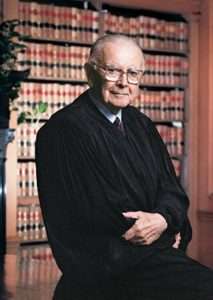
7/25/1965: Justice Arthur J. Goldberg resigns.
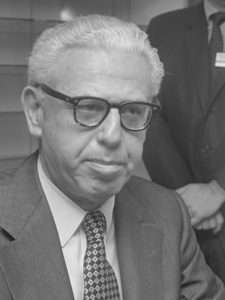

Mostly law professors | Sometimes contrarian | Often libertarian | Always independent | Est. 2002

7/25/1965: Justice Arthur J. Goldberg resigns.
From Nate Silver:
Here's the scandal. In March 2020, a group of scientists — in particular, Kristian G. Andersen the of The Scripps Research Institute, Andrew Rambaut of The University of Edinburgh, Edward C. Holmes of the University of Sydney, and Robert F. Garry of Tulane University — published a paper in Nature Medicine that seemingly contradicted their true beliefs about COVID's origins and which they knew to be misleading. The paper, "The proximal origin of SARS-CoV-2", has been cited more than 5,900 times and was enormously influential in shaping the debate about the origins of COVID-19.
We know this because of a series of leaked and FOIAed emails and Slack messages that have been reported on by Public, Racket News, The Intercept and The Nation along with other small, independent media outlets. You can find a detailed summary of the claims and a copy of the emails and messages here at Public. There's also good context around the messages here (very detailed) or here and here (more high-level).
The messages show that the authors were highly uncertain about COVID's origins — and if anything, they leaned more toward a lab leak than a spillover from an animal source. But none of that was expressed in the "Proximal Origin" paper, which instead said that "we do not believe that any type of laboratory-based scenario is plausible". Granted, there is a little bit of ass-covering — "More scientific data could swing the balance of evidence to favor one hypothesis over another," they also wrote in the paper. But the message — natural origin good, lab leak bad — was received clearly enough by mainstream news outlets. "No, the new coronavirus wasn't created in a lab, scientists say", reported the CBC in covering the paper. "COVID-19 coronavirus epidemic has a natural origin" was the headline at Science Daily….
What were the authors' motivations to mislead the public? … [Y]ou can find prominent virologists quoted on record as to why the lab leak theory was so problematic — even if it wasn't necessarily wrong. The problems fall into three buckets:
Jacob Mchangama (of Justitia, and now a Research Professor at Vanderbilt) has a detailed item about it; an excerpt:
In 1950, Eleanor Roosevelt, serving as the first Chairperson of the United Nations Commission on Human Rights, was involved in a bitter dispute about the limits of free speech. Stalin's Soviet Union fought tooth and nail to ensure that states should not only be permitted, but obliged to prohibit "hate speech" under international human rights law. Roosevelt issued a stark warning, as she found the Soviet proposal "extremely dangerous." It would "only encourage Governments to punish all criticisms in the name of protection against religious or national hostility," and she warned the commission "not to include… any provision likely to be exploited by totalitarian States for the purpose of rendering the other articles null and void."
Fast forward to July 12, 2023, and a majority of the United Nations Human Rights Council proved Roosevelt prophetic. It did so by adopting a resolution that drives a stake through Roosevelt's vision of an international human rights system that protects oppressed citizens against their oppressive governments.
The resolution calls on member states to, among other things, "address, prevent and prosecute acts and advocacy of religious hatred." The resolution is a response to the increasing number of Quran burnings in Denmark and Sweden by Danish far-right extremist Rasmus Paludan and a few copycats. No doubt Paludan is a bigot and revels in the attention and mayhem that his gratuitous provocations elicit. But however tempting it is to silence an extremist like Paludan, criminalizing the burning of "holy books" because it constitutes "advocacy of religious hatred," as the HRC resolution proposes, is short-sighted and dangerous.
If you adopt one of my books, I will, if invited, do a free presentation to the class.
It's July, and many academics are likely finalizing their syllabi for the upcoming academic year. For those who may be considering adopting one of my books, I have an offer: if you assign the book, or any substantial part of it, I will do a free virtual presentation to your class. It can be on Zoom or other similar platform. If you are located in the Washington DC area, I can come in person instead - also for free. Outside the DC area, I can potentially come in person, as well; but your institution will have to pay for transportation costs. I've given talks at dozens of universities and other institutions across the United States, and in twenty other countries. So I have experience speaking to a wide range of audiences, including law students, graduate students, undergraduates, and even high school students.
Yes, this is shameless self-promotion. But self-promotion is a time-honored academic tradition. It's a blogging tradition, too. What books do I have available? I'm glad you asked!
My most recent book is Free to Move: Foot Voting, Migration, and Political Freedom (Oxford University Press, revised and expanded edition, 2022). Free to Move makes the case for expanding opportunities for people to "vote with their feet" in the private sector, within federal systems, and through international migration. It explains why all three types of foot voting can do much to expand political freedom and human welfare, and addresses a wide range of possible objections. It's the first book to fit all three types of foot voting in a common framework. FTM is a good fit for courses on democratic theory, migration rights, constitutional structure (there's a whole chapter on the implications of foot voting for latter), international law (chapter on that, too) and general political theory. While the book is relatively new, it has already been used in courses at multiple universities in the US and Canada, including Georgetown and the University of Montreal. I have even heard of it being assigned to at least one high school class. Fifty percent of all royalties generated by FTM go to charities benefiting refugees.
Democracy and Political Ignorance: Why Smaller Government is Smarter (Stanford University Press, 2nd ed., 2016) is my mostly widely assigned book. It explains why widespread political ignorance is a major problem for democracy, critiques standard solutions and attempts to dismiss the problem, and outlines a new approach to addressing it. As with the subject of FTM, you might say that the Trump era and its aftermath has made the issues covered by this book great again. DPI has been assigned in various economics, political science, communications, and law courses at Harvard, NYU, Duke, Swarthmore, BYU, and elsewhere. Also various universities and seminars outside the US, including one as far afield as Ethiopia. It's even been assigned in several high school classes, as well as both undergrad and graduate courses. There are Japanese and Italian translations of the book, if you want to use it in courses in those languages.
The Grasping Hand: Kelo v. City of New London and the Limits of Eminent Domain (University of Chicago Press, 2015) assesses one of the Supreme Court's most important and controversial property rights decisions. It's useful for law, econ, or political science courses on property rights, law and economics, judicial review, and the interaction of law and popular movements. Suitable for undergrad as well as graduate and law classes. Don't take my word on the latter point. Take that of the American Political Science Association's Law and Politics Book Review, which made this very suggestion!
Eminent Domain: A Comparative Perspective (Cambridge University Press, 2017) is suitable for classes on property and comparative law, and has been used successfully in seminars for government officials in various Asian nations (I co-edited the book with two Korean law and economics scholars).
I've also authored or co-authored two other books: A Conspiracy Against Obamacare: The Volokh Conspiracy and the Health Care Case (Palgrave Macmillan, 2013) and Stillborn Crusade: The Tragic Failure of Western Intervention in the Russian Civil War, 1918-20. (Transaction Publishers, 1996, reprinted by Routledge). But the first four above are the ones I think most likely to be useful for classes.
In some cases, the publishers may offer a bulk discount to students in a class where the book is assigned. Reach out to me or to the publisher for additional information on that, if interested.
The new law is probably the least objectionable part of the right-wing government's attack on judicial review in Israel.

Today, Israel's parliament, the Knesset, enacted a law severely limiting judicial "reasonableness" review of government policy. The new law bars reasonableness review of policies enacted by the national cabinet and by individual ministers, but leaves it in place for policies adopted by lower-level government officials and municipal governments.
The new law is the least problematic element of the right-wing government's broader plan to essentially gut judicial review in Israel. Reasonableness review enables the Supreme Court to overturn a wide range of executive policies if it concludes they are "extremely unreasonable." For example, earlier this year, the Court blocked the government's plan to appoint Shas Party leader Aryeh Deri, to the positions of interior minister and health minister, because of a conviction for tax offenses arising from a plea bargain agreement in which he apparently promised to stay out of public office.
Critics of "reasonableness" review argue that it's an amorphous standard easily abused by judges. It goes well beyond practices in most other constitutional democracies. While there are some similarities to US "rational basis" review, the latter is far more deferential. The Israeli test is somewhat more akin to various types of heightened scrutiny that in US jurisprudence are usually reserved for government policies that threaten fundamental rights or discriminate on the basis of suspect classifications, such as race, gender, or religion.
Unlike the rest of the Israeli government's judicial reform plan, constraining reasonableness review probably poses only a minor danger to important individual rights. The latter are - for now - still protected by judicial enforcement of the various rights specifically guaranteed by Israel's Basic Laws.
I am not convinced that "reasonableness review" should be as sweeping as it was prior to today's reform. In some cases, it verges on dubious judicial policymaking. Consider, for example, this list of policy decisions the Supreme Court overturned as "extremely unreasonable," compiled by Israeli legal scholar Amichai Cohen (a supporter of reasonableness review):
The decision by the minister of defense not to install protection against rocket attacks in all classrooms in the city of Sderot, and instead to retain the system of common "protective spaces" despite the immediate danger to students (2007).[8]
The decision not to automatically recognize doctoral degrees issued by foreign universities, ignoring the fact that many students had relied on previous decisions by the Ministry of Education when they began their studies (2005).
The decision to suspend the decision of the minister of finance, according to which full-time Kollel (yeshiva) students would lose subsidies for daycare for their children, without giving Haredi families sufficient time to make alternative arrangements (2022).[9]
The decision not to construct a ritual bath (mikve) for women in the town of Kfar Vradim (2014).[10]
Several of these decisions seem right on policy or moral grounds. But I have serious doubts whether any of these issues are the kind well-suited to judicial resolution based on a very vague standard.
Given the highly centralized nature of Israeli government, which has very few checks and balances other than judicial review, I think some kind of more limited "reasonableness" review of executive policies may be justifiable. But, ideally, it would be less expansive than the system in place before today, and focus on specifically enumerated types of abuses of power.
If the right-wing government's judicial reform agenda were limited to the law enacted today, there would only be modest cause for concern. But it goes far beyond that, and would - if fully enacted - gut judicial review and gravely threaten individual rights, especially for Israel's many minority groups. Prime Minister Benjamin Netanyahu recently told US media that he plans to scrap the "override" clause enabling the Knesset to overturn judicial decisions with a simple majority vote. But various right-wing elements of his coalition are trying to force him to reverse himself on that issue. They may succeed, since Netanyahu can't stay in power without their support.
In previous posts, I outlined the reasons why I oppose the right-wing government's attack on judicial review, and how this is consistent with my opposition to left-wing proposals to undermine judicial review in the US. In the latter post, I also responded to various arguments for differentiating the two cases, such as claims that Israeli judicial review is illegitimate because Israel does not have a written constitution. Some commentators on both right and left have taken inconsistent stances on the Israeli and US cases. Here, as elsewhere, partisan and ideological commitments often trump long-term institutional principles.
Left-wing Americans who (justifiably) condemn Netanyahu's plan, but favor gutting judicial review in this county, should ask themselves whether they really want the next right-wing Republican president to be free of judicial constraints. They might also consider whether it would have been a good thing if Donald Trump had been able to successfully defy judicial rulings against his efforts to overturn the results of the 2020 election.
While I oppose the right-wing government's plans, I have also argued (as have many experts in both Israel and the US), that Israel would do well to develop stronger non-judicial checks on centralized government power, such as systems of federalism and separation of powers. It's dangerous to put too many eggs in the vulnerable judicial basket. Israel should also adopt a written constitution that clearly elevates fundamental rights and structural constraints on state power above ordinary legislation, and puts judicial review on a firm foundation.
There is in fact a long history of Israeli proposals for a written constitution, including a recent call to draft one by opposition leader and former prime minister Yair Lapid. But the idea seems unlikely to come to fruition anytime soon.
In the meantime, it is probable that severe conflict over judicial reform is going to continue in Israel. The government seems intent on pursuing at least some of the more radical elements of its agenda, and opponents have responded with massive protests- among the biggest in Israeli history, and various strikes and disruptions. I hope the government fails in its efforts, and that the conflict over its dangerous policies does not cause too much harm.
UPDATE: I should note that, in suggesting that Israel would do well to adopt a written constitution, federalism, and separation of powers, I do not mean to suggest that these structures should be the same as those in the US. While extreme centralization and concentration of government power is a bad idea for both countries, it doesn't follow that they should adopt identical (or very similar) approaches to limiting and decentralizing it.
Some ideas that might help you make better use of the opportunities available to you in law school.

Law students around the country will be starting classes over the next few weeks. Back in 2018, I wrote a post offering advice to entering students, which I updated in 2019 and last year. I tried to focus on points that I rarely, if ever, see made in other pieces of this type. I think all three of my original suggestions remain just as relevant today. So I reprint my advice from earlier posts largely unaltered, but with the addition of some modest editing and updating, and a new point:
1. Think carefully about what kind of law you want to practice.
Law is a profession with relatively high income and social status. Yet studies repeatedly show that many lawyers are deeply unhappy, a higher percentage than in most other professions. One reason for this is that many of them hate the work they do. It doesn't necessarily have to be that way. There are lots of different types of legal careers out there, and it's likely that one of them will be a good fit for you. A person who would be miserable working for a large "Biglaw" firm might be happy as a public interest lawyer or a family law practitioner, and so on. But to take advantage of this diversity, you need to start considering what type of legal career best fits your needs and interests.
There are many ways to find out about potential options. But one place to start is to talk to the career services office at your school, which should have information about a range of possibilities. Many also often have databases of alumni working in various types of legal careers. Talking to these people can give you a sense of what life as a practitioner in Field X is really like.
Regardless, don't just "go with the flow" in terms of choosing what kind of legal career you want to pursue. The jobs that many of your classmates want may be terrible for you (and vice versa). Keep in mind, also, that you likely have a wider range of options now than you will in five or ten years, when it may be much harder to switch to a very different field from the one you have been working in since graduation.
2. Get to know as many of your classmates and professors as you reasonably can.
Law is a "people" business. Connections are extremely important. No matter how brilliant a legal thinker you may be, it's hard to get ahead as a lawyer purely by working alone at your desk. Many of your law school classmates could turn out to be useful connections down the road. This is obviously true at big-name national schools whose alumni routinely become judges, powerful government officials, and partners at major firms. But it's also true at schools whose reputation is more regional or local in nature. If you plan to make a career in that area yourself, many of your classmates could turn out to be useful contacts. The same holds true for professors, many of whom have extensive connections in their respective fields. They are sometimes harder to get to know than students. But the effort is often worth it, anyway. And many of them are actually more than eager to talk about their work.
This is one front on which I didn't do very well when I was in law school, myself. Nonetheless, I still suggest you do as I say, not as I actually did. You will be better off if you learn from my mistakes than if you repeat them.
3. Think about whether what you plan to do is right and just.
Law presents more serious moral dilemmas than many other professions. What lawyers do can often cost innocent people their liberty, their property, or even their lives. It can also save all three. Lawyers have played key roles in almost every major advance for liberty and justice in American history, including the establishment of the Constitution, the antislavery movement, the civil rights movement and many others. But they have also been among the major perpetrators of most of the great injustices in our history, as well.
Robert Cover's classic book Justice Accused - a work that made a big impression on me when I was a law student - describes how some of the greatest judges and legal minds of antebellum America became complicit in the perpetuation of slavery. While we have made great progress since that time, the legal system is not as far removed from the days of the Fugitive Slave Acts as we might like to think. There are still grave injustices in the system, and lawyers whose work has the effect of perpetuating and exacerbating them. We even still have lawyers who do such things as come up with dubious rationales for deporting literal escaped slaves back to places where they are likely to face further oppression.
Law school is the right time to start working to ensure that the career you pursue is at least morally defensible. You don't necessarily have a moral obligation to devote your career to doing good. But you should at least avoid exacerbating evil. And it's easier to do that if you think carefully about the issues involved now (when you still have a wide range of options), than if you wait until you are already enmeshed in a job that involves perpetrating injustice. At that point, it may be too late - both for you and (more importantly) for the people harmed.
4. Legal knowledge isn't as different from other kinds of knowledge as you might think.
This is the new point for 2023. Students often ask me how best to study for law school classes. My answer is that there isn't one way that's best for everyone. You probably know what works for you far better than I do.
In law school, you are likely to be bombarded with all sorts of complex methods of studying and outlining cases. Advocates of each will often tell you theirs is the One True Path to law school success. Some students really do find these methods useful.
But I would urge you to consider the possibility that you can study for law school classes by using…. much the same methods as you used to study other subjects in the past. If you were successful in social science and humanities classes as an undergraduate, the methods that worked there are likely to carry over.
I know because that's largely what I did as a law student myself. I did the reading, identified key points, and didn't bother with complicated outlines or spend money on study guides. If I did badly in a class, it wasn't for lack of more complex study methods (usually, I either got lazy or just had a bad day on the final exam). And I've seen plenty of other people succeed with similar approaches. You can save a lot of time and aggravation (and some money) that way. And that time, energy, and money can be better devoted to other purposes - including advancing your studies and your career in other ways!
Ultimately, when reading a legal decision (or any assignment), you need to 1) identify the key issues, and 2) understand why they are important. With rare exceptions, the case was likely included in the reading because it highlights some rule, standard, or issue that has a broader significance. If you know what that is and why it matters, much of your work is done.
The experience of the Covid-19 pandemic has highlighted the importance of Point 2. The loss of much in-person contact was a serious problem, one we would do well to avoid repeating.
I don't think I need to dwell on how the events of the last few years have reinforced the significance of Point 3. Suffice to say there are many recent examples of lawyers facilitating both good and evil. Even if you don't maximize the former, you should at least avoid contributing to the latter.
Tomorrow I will argue that families who lost relatives in the crashes of two Boeing 737 MAX aircraft should be able to confer with prosecutors about prosecuting Boeing for lying to the FAA.
Previously I blogged about my petition to the Fifth Circuit under the Crime Victims' Rights Act (CVRA). My petition argues the families who lost relatives in the crashes of two Boeing 737 MAX crashes should have been afforded their CVRA rights to confer with prosecutors about prosecuting Boeing for its admitted crime of lying to the FAA about the safety of the MAX. The Fifth Circuit has set oral argument on the case, and tomorrow I will argue to the Circuit that it should grant the petition. In this post, I briefly set out the procedural history of the case and link to important briefs on both sides of the case (some citations omitted) for those who are interested.
The case arises out of "the deadliest corporate crime in our nation's history," as the district court described it. During the development of the Boeing 737 MAX, Boeing lied to the FAA about new safety features of the aircraft. As a result of that deception, the FAA did not require pilot training on those new features--ultimately causing the crashes of two of the aircraft and producing the deaths of 346 passengers and crew.
Ultimately, the Justice Department began an investigation into Boeing crimes. And late in 2020 and early 2021, the Department reached a deferred prosecution agreement (DPA) with Boeing. Under the DPA, Boeing admitted that it criminally conspired to deceive the FAA. But, under the DPA, Boeing will not be prosecuted for its crimes in exchange for various concessions.
On January 7, 2021, the DPA was filed in the U.S. District Court for the Northern District of Texas. The 346 families whose relatives were killed in the crashes were not informed about the deal--and never were given an opportunity to confer with prosecutors about it. Instead, they learned about the DPA through social media.
Eleven months later, after I agreed to represent some of the family members pro bono, the families filed a challenge to the DPA. The families argued that the DPA had been entered into in violation of their rights under CVRA, including their right to confer with prosecutors before any deal was finalized. After lengthy proceedings, on October 21, 2022, the district court found that the families represented "crime victims"--that is, their relatives who were killed as a result of Boeing's crimes. And the district court found that the families' CVRA rights, including the right to confer, had been violated. But several months later, on February 9, 2023, the district court concluded that it could not award any remedy to the families to enforce their rights. Read More
I received a long and thoughtful response to my post last month about the codified text of 42 U.S.C. 1983, from two lawyers at the Institute for Justice, Patrick Jaicomo and Daniel Nelson. I will reproduce it in full here (it continues after the break).
In a post last month, Professor William Baude joined a growing body of lawyers, judges, and commentators who have come upon a long-overlooked yet "game-changing" clause in the original text of 42 U.S.C. Section 1983, the federal statute which authorizes civil rights lawsuits against state officials. This clause, it turns out, shatters the foundation for one of today's rightfully most criticized legal doctrines: qualified immunity.
The original text of Section 1983 proclaimed, in unequivocal terms, that state officials who had violated someone's rights would be liable under federal law, "any such law, statute, ordinance, regulation, custom, or usage of the State to the contrary notwithstanding." In other words, this Notwithstanding Clause took all state-law defenses, including qualified immunity, completely off the table. But just three years after Section 1983 was passed, the Notwithstanding Clause was clipped for space, as compilers organized federal law into the Revised Statutes of 1874.
Because the language was dropped from Section 1983 when the statute was reworded, Baude wonders if the Notwithstanding Clause is relevant today. It absolutely is.
Policy analyst Justin Hayes summarizes the reasons why conservatives, progressives, and libertarians all have reason to support zoning reform.

Tennessee-based policy analyst Justin Hayes is writing a series of articles in which he "aim[s] to explore issues that could have broader appeal among the left, right, libertarians, and centrists on multiple fronts — from economic and philosophical perspectives to constitutional considerations and beyond." The first piece in the series focuses on the issue of exclusionary zoning:
As the U.S. grapples with a deepening affordable housing crisis, YIMBY (Yes-In-My-Backyard) Groups have sprouted around the country to advocate for major reforms to the exclusionary zoning practices prevalent in most major cities. These zoning policies often prioritize single-family homes and hinder the construction of more affordable housing options for low- and middle-income residents. A 2022 paper by Jonathan Levine describes the YIMBY movement as "a loose and shifting pro-housing alliance of renters, progressives, and libertarians who hold that exclusionary land-use policies in urban and suburban areas exacerbate housing unaffordability and racial segregation and increase long-distance commuting and greenhouse-gas emissions."
These coalitions primarily focus on zoning reform within local or metropolitan jurisdictions, where traditional party and ideological lines blur, and national culture wars have a limited reach, allowing people from diverse political backgrounds to unite in this cause. After all, the YIMBY movement's overarching goal—to create an affordable place for everyone to live — is challenging to argue against, regardless of one's ideological perspective.
However, despite the undeniable merits of ending exclusionary zoning, the path forward has not been so simple. Misconceptions about increasing housing density persist and surface at zoning hearings in nearly every city, voiced by concerned residents and NIMBY (Not-In-My-Backyard) groups. Their concerns range from traffic congestion to potential overcrowding in schools and the perceived threats of crime to "community character."
Hayes goes through a list of reasons why conservatives, libertarians, and progressives all have good reason to support the YIMBY cause. He also addresses a number of common objections.
I have made similar arguments myself (including some focusing on the cross-ideological nature of the issue), and Hayes cites some of my previous writings on this topic. So too have others, such as Richard Kahlenberg. But Hayes piece is nonetheless a very helpful summary of the case from the standpoint of each of these three major ideologies.
I would add a few points to his analysis. For libertarians, it's important to emphasize not only that zoning restricts property rights, but that it is the most widespread and severe restriction on property owners' rights in the United States today, preventing millions from using their land as they wish. For progressives, I would emphasize the long history of zoning as a tool of racial and ethnic exclusion - often deliberately used for that purpose. To this day, zoning restrictions disproportionately harm blacks and Hispanics.
Finally, for conservatives, I would emphasize that reducing exclusionary zoning would greatly help the working class, including the white working class whom the GOP claims to champion (and who are increasingly that party's biggest constituency). It would do so both by enabling more working-class people to "move to opportunity" and by stimulating a vast construction boom that would create many thousands of relatively well-paying working-class jobs. As I have long emphasized, zoning reform is a major underappreciated common interest of the mostly Republican white working class and its mostly Democratic minority counterpart.
For those particularly concerned - as many conservatives are - about expanding opportunities for working-class men, I would make the obvious point that construction workers are disproportionately male (almost 94%, according to the Construction Employers Association). But expanding job opportunities in this way would also help many working and lower-middle class women, albeit less directly. They, like men, benefit from being able to move to opportunity. Plus, increasing opportunity for male construction workers pretty obviously benefits their female wives and daughters, and improves the potential marriage market for single working-class women. If you care about family values, the latter is an important consideration in an age where working-class marriage rates have plummeted.
Much more can be said. And I have in fact said more in previous publications, and hope to write more in the future. In the meantime, Hayes' article is a very helpful introduction to the subject, covering a wide range of perspectives and issues. I also look forward to his analysis of the other issues he plans to cover in his series on cross-ideological common ground.
After a month-long hiatus, Dan Epps and I have posted a new, 2-hour-long podcast episode: My Despised World (Dan came up with the title.) Most of it discusses two of June's jurisdictional decisions -- Mallory v. Norfolk Southern Railway, and United States v. Texas -- with a shorter discussion of the affirmative action cases (see here for my earlier post on those).
But first we discuss this AP story about Justice Sotomayor's book business, and speculate fervently about whether Justice Sotomayor physically signs all of the "signed" copies of her books herself, and if so, how she found the time to sign 11,000 copies for a single appearance at Michigan State. Further speculation welcome!
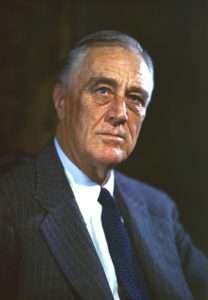
7/22/1937: The Senate voted down President Roosevelt's Court-Packing plan, 70-20.
From Wade v. Univ. of Michigan, decided yesterday by the Michigan Court of Appeals (Judges Mark Cavanagh and Deborah Servitto); the ban covered all university property, which I take it includes dorms and open spaces:
In Bruen, the Court stated that it was "settled" that arms carrying could be prohibited consistent with the Second Amendment in locations that are "sensitive places." The Court explained that, although the historical record showed relatively few 18th and 19th century "sensitive places," such as legislative assemblies, polling places, and courthouses, there was no dispute regarding the lawfulness of prohibitions on carrying firearms in sensitive places such as schools and government buildings. The Court's statements indicate that, even though 18th and 19th century "sensitive places" were limited to legislative assemblies, polling places, and courthouses, laws prohibiting firearms in schools and other government buildings are nonetheless consistent with the Second Amendment. Thus, if the University is a school or government building, then Article X does not violate the Second Amendment….
Samuel Johnson's dictionary from 1773 defines "school," in part, as: "A house of discipline and instruction[,]" and "[a] place of literary education; an university." It defines "university" as "[a] school, where all the arts and faculties are taught and studied." Thus, considering either time period, the term "school" included universities.
Notably, the reference to "schools" being sensitive places was first made by Justice Scalia in Heller. In discussing the "longstanding" tradition of laws forbidding firearms in sensitive places such as "schools and government buildings," Justice Scalia did not define the term "school," nor did he cite or rely on any authority. Given that the term "school" is not found in the Second Amendment, but was first used by Justice Scalia, it is not clear that either 1791 or 1868 are the correct time periods to determine the meaning of that term as used in Heller. Nonetheless, the plain meaning of "school" when Justice Scalia used the term in 2008 similarly includes universities….
Huge tracts of land, Dad does The RICO, and poor prosecutorial behavior
New on the Short Circuit Podcast: A big victory (in an IJ case) for economic liberty under state constitutions. We unlatch Georgia's now-former lactation consultant license. Read More
Taking this step would benefit both the migrants themselves and the American economy. It would also eliminate burdens on local governments.

The Chicago Tribune has an article describing how asylum-seeking migrants in the city are unable to support themselves, even as many employers in the city are desperate for workers. The article describes the sad situation of Venezuelans who fled socialism only to find themselves legally barred from working in the Land of the Free. There is a similar situation in New York City and elsewhere. The City struggles to accommodate asylum seekers who cannot support themselves, even as it also suffers from a major labor shortage.
Migrants seeking asylum can legally enter the US and then wait to have their claims adjudicated, which can take many months or even years. Meanwhile federal law prevents them from working for at least six months, and often even longer:
[Asylum] allows people to stay in the United States instead of being deported to a country where they fear persecution or harm. But those people must apply for asylum. If the government grants them that status, they get protection and the legal right to stay in the United States.
One challenge they face, however, is that the federal government requires applicants to wait 180 days or roughly six months before they are legally allowed to work, and they must apply for that permission to work, which is called "work authorization." Furthermore, that 180-day clock doesn't start until the government receives the first application.
The United States Custom and Immigration Services often takes much longer than 180 days to approve these applications. The government website noted that 80 percent of applications are processed in 12 months.
In addition, the USCIS is struggling to process the initial asylum applications. US Customs and Immigration Services is supposed to process the asylum application within 30 days, but it often takes much longer.
During this lengthy period when they are ineligible to work legally, asylum seekers have little choice but to rely on some combination of public assistance, charity, and precarious illegal employment. Ironically, this state of affairs allows immigration restrictionists to depict these migrants as a burden and crow over how liberal jurisdictions like NYC have trouble accommodating them. But the migrants are only a burden because they are legally barred from working to support themselves. You too would likely be a burden to society if the federal government forbade employers from hiring you!
There is an obvious solution to this problem: Let asylum seekers work legally immediately upon entering the United States. Doing so would be good for the migrants, enabling them to support themselves and their families. It would also benefit the US economy, particularly areas with major labor shortages. And it would alleviate burdens on local governments. Indeed, the latter would actually benefit from the extra tax revenue and economic growth generated by additional workers.
Maine GOP Senator Susan Collins and independents Angus King and Kyrsten Sinema have drafted the Asylum Work Authorization Act, a bill that would cut the work authorization time to 30 days. Sadly, I am not optimistic it will pass.
In May, the Biden Administration introduced a harsh new policy that makes it harder to for asylum-seekers to enter the US to begin with. But the new policy has been challenged in court, and may well be struck down, as was a similar Trump-era rule. Even if it remains in force, substantial numbers of asylum seekers will still enter the US by various pathways permitted under the policy, and work eligibility will continue to be a problem.
The work-authorization issue is just the tip of a much larger iceberg of flaws in the US asylum system. Among other things, we should expand the ridiculously and unjustly narrow criteria for eligibility, which exclude many people fleeing horrific violence and oppression. We should also take more steps to make legal migration easier. The Biden Administration has made some important progress on the latter front, but much more needs to be done.
In the meantime, however, expanding work eligibility for asylum seekers should be a relative no-brainer. It should not be hard to see that it's better if these people who entered the US legally can also support themselves legally, while they are here.
Prof. Howard Friedman (Religion Clause) reports (some punctuation revised):
In State of Missouri ex rel. Dr. Anna Fitz-James v. Bailey (MO Sup. Ct., July 20, 2023), the Missouri Supreme Court affirmed a trial court's issuance of a writ of mandamus requiring the state Attorney General to approve the State Auditor's fiscal note summaries to eleven Reproductive Rights initiative petitions. That approval is necessary so that the Secretary of State can certify the ballot language and proponents can begin to circulate the petitions for signatures. (Full text of petitions [scroll to No. 2024-77 through 2024-87]). AP reports on the case.
State Attorney General Andrew Bailey—a gubernatorial appointee in Missouri— contended that the Auditor's conclusion that the proposed constitutional amendments would have no fiscal impact were inaccurate. Bailey, an abortion opponent, contended that, if approved by voters, the state could lose $12.5 billion in Medicaid funds and $51 billion in future tax revenues because of fewer births. This earlier report by the Missouri Independent has additional background.
From the opinion:
This case is not about the substance of Fitz-James's proposed initiatives petitions, nor is it about the fiscal impact of those proposals. Rather, this case is about which state official is authorized to estimate and summarize that fiscal impact. Section 116.175 unequivocally answers this question. It is the Auditor, and not the Attorney General, who bears this responsibility. The Attorney General's narrow authority to approve the "legal content and form" of the fiscal note summaries cannot be used as a means of usurping the Auditor's broader authority to assess the fiscal impact of the proposals and report that impact in a fiscal note and fiscal note summary….
Celebrate your independence with a subscription to Reason magazine, your most trusted source of honest, insightful news and analysis.