The Volokh Conspiracy

Mostly law professors | Sometimes contrarian | Often libertarian | Always independent | Est. 2002

The Volokh Conspiracy

Second Amendment Roundup: A miscellany of errors in Justice Department's Rahimi reply

The Government’s reply brief contains a host of mistakes, some quite elementary.

|

In two previous posts (here and here) I've pointed out some erroneous arguments by Merrick Garland's Justice Department in its reply brief filed in United States v. Rahimi. That's the case in which the Fifth Circuit recently struck down a federal statute imposing additional penalties, including a ban on the possession of firearms, on individuals subject to state domestic violence restraining orders (DVROs). The Supreme Court will hear argument in the case on November 7.

Here are several more, ranging from basic errors to nonsensical arguments. Each begins with a quote from the reply brief in italics, followed by a rebuttal.

"Rahimi next objects to the government's reliance on 19th-century surety statutes, under which potentially irresponsible persons could be required to post bond in order to carry firearms. But those laws illustrate the principle that legislatures may keep firearms away from those who are apt to misuse them."

Not so.  The person would simply post the bond or obtain sureties and keep on carrying. Even if the person violated the conditions imposed on them, the remedy was forfeiture to the government of the sum pledged, not loss of the right to arms. See the note at the end of this post regarding the research of Angus McClellan, Ph.D., that shows how surety laws were used to prevent spousal abuse.

"In criticizing those historical laws, however, Rahimi ignores that past lawmakers' failure to enact firearms laws can likewise reflect prejudice.  For example, past generations' failure to disarm domestic abusers may have reflected greater tolerance of domestic abuse, the belief that state intervention would undermine marital harmony, or women's inability to vote before the Nineteenth Amendment."

So the absence of any analogue even though the same societal problems existed somehow becomes an analogue because today we're better than the Founders? In identifying historical analogues, the burden is on the government to point to real laws that were actually passed and enforced, not to make excuses regarding why imaginary laws were not passed.  And, by the way, domestic abuse was widely condemned at the time of the Founding, and measures were enforced to prevent or punish it. Again, see the note at the end of this post.

"Rahimi cites no historical sources or judicial decisions—literally nothing—suggesting that legislatures lack authority to disarm dangerous individuals." Read More
Donald Trump

Video of University of Minnesota Conference on Potential Disqualification of Donald Trump Under Section 3 of the 14th Amendment

The conference includes a variety of legal scholars and other experts on different sides of the issue, including VC bloggers Josh Blackman and myself.

|

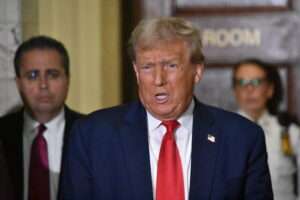
Donald Trump speaking
Donald Trump. ( Kyle Mazza/SOPA Images/Sipa USA/Newscom)


This Monday, the University of Minnesota Law School held a conference on the potential disqualification of Donald Trump from the 2024 presidential election under Section 3 of the Fourteenth Amendment. Participants included a variety of legal scholars and other experts, including Michael Stokes Paulsen (coauthor of a widely discussed article arguing Trump should be disqualified), Kurt Lash (author of an article cutting more the other way), VC blogger Josh Blackman (coauthor of an article defending Trump's eligibility), and myself.

A list of the participants and panels at the conference is available here. I have embedded the Youtube video of the entire event below. I spoke on the last panel of the day, which addressed pragmatic and political implicatoins of Trump's possible disqualification. It begins at around 4:35:00.

The other participants in our panel were Georgia State University law Professor Eric Segall and political scientist Julia Azari (Marquette University). Political scientist Larry Jacobs (University of Minnesota) moderated.

This is a rare instance where I got to outflank Eric Segall on the left! I am far more supportive of disqualification than he is, even though he is generally far more left-wing than I am.

The Lawfare website has posted an audio/podcast version of our panel here.

I developed some of the points I made at the panel in greater detail in this article. I have written about other aspects of the Section 3 debate here and here.


Democracy

Are Right-Wingers More Prone to Believe Conspiracy Theories than Left-Wingers?

An extensive new study finds that the answer is "no." Belief in conspiracy theories is about equally common on different sides of the political spectrum.

|

NA

There is a common perception that right-wingers are more likely to believe conspiracy theories than people on the left. But a large-scale new study authored by political scientists Adam Enders, Christina Farhart, Joanne Miller, Joseph Uscinski, Kyle Saunders, and Hugo Drochon finds otherwise. Uscinski is a leading expert on public belief in political conspiracy theories. Here is the abstract of their article, published in Political Behavior:

A sizable literature tracing back to Richard Hofstadter's The Paranoid Style (1964) argues that Republicans and conservatives are more likely to believe conspiracy theories than Democrats and liberals. However, the evidence for this proposition is mixed. Since conspiracy theory beliefs are associated with dangerous orientations and behaviors, it is imperative that social scientists better understand the connection between conspiracy theories and political orientations. Employing 20 surveys of Americans from 2012 to 2021 (total n = 37,776), as well as surveys of 20 additional countries spanning six continents (total n = 26,416), we undertake an expansive investigation of the asymmetry thesis. First, we examine the relationship between beliefs in 52 conspiracy theories and both partisanship and ideology in the U.S.; this analysis is buttressed by an examination of beliefs in 11 conspiracy theories across 20 more countries. In our second test, we hold constant the content of the conspiracy theories investigated—manipulating only the partisanship of the theorized villains—to decipher whether those on the left or right are more likely to accuse political out-groups of conspiring. Finally, we inspect correlations between political orientations and the general predisposition to believe in conspiracy theories over the span of a decade. In no instance do we observe systematic evidence of a political asymmetry. Instead, the strength and direction of the relationship between political orientations and conspiricism is dependent on the characteristics of the specific conspiracy beliefs employed by researchers and the socio-political context in which those ideas are considered.

The authors find that conservatives and Republicans are more likely to believe conspiracy theories that fit their predispositions and biases. For example, they are far more likely than liberals and Democrats to believe that the 2020 election was stolen from Donald Trump. But, by the same token, left-wingers are more likely to believe conspiracy theories that fit their biases, such as 9/11 "trutherism" (claims that George W. Bush knew about the 9/11 attacks in advance and deliberately allowed them to happen). The authors also find that "[t]here are also many conspiracy theories finding equal support among the left and right, including theories involving "chem-trails", the moon landing, fluoridated water, Freemasons, lizard people, and television mind control, to name a few." When a conspiracy theory doesn't have a strong political valence, left and right are usually about equally prone to believe it.

Sometimes conspiracy theories shift valence over time. For example, belief in anti-vaxxer conspiracy theories was about equally common before Covid, but has acquired a right-wing orientation since then. The career of Robert F. Kennedy, Jr. - who used to peddle anti-vaccine conspiracy theories primarily to the left, but now caters more to the right - is a an example of the shift.

This is far from the first study of the distribution of beliefs in conspiracy theories. But it is notable for its extensive scope. It adds to the already extensive evidence that political ignorance and misinformation are serious problems across the political spectrum, not just on the right.

While right-wing susceptibility to conspiracy theories may not be generally greater than that of the left, it can nonetheless be a more severe danger at any given point in time. Right now, widespread conservative/Republican endorsement of Donald Trump's "big lie" about the 2020 election is a greater menace than any currently prevalent left-wing conspiracy theory, because it incentivizes potential future GOP efforts to reverse election results they don't like, and could lead to more violence like that which occurred on January 6, 2021.

But we can recognize the urgency of that issue without falling into the trap of thinking that ignorance,  misinformation, and conspiracy-mongering are only significant problems on one side of the political spectrum. Sadly, that just isn't true.

Acknowledging the bipartisan, cross-ideological nature problem is not enough to solve it. But it's at least a good start. I assess a variety of potential ways to mitigate political ignorance and misinformation in this recent article and in my book Democracy and Political Ignorance.

Free Speech

English Police Apparently Arrest Man for Criticizing Immigration of Supporters of Palestinians

|

From the Express (UK) (Max Parry) (expurgation, of course, in the news story):

The arrest, made at 9.55pm on Tuesday, October 31 in east London, comes after a video was posted on Facebook where the person behind the camera appears to condemn the number of Palestinian flags on Bethnal Green Road.

The person filming appears to say: "Look at this cr*p here," while zooming in on a number of flags attached to lamp posts and road signs.

"You let them into the country and this the s**** they come up with," the person then adds.

Read More

Free Speech

Court Reverses Personal Protective Order Issued Against "Distasteful and Provocative" Critic of Inkster City Attorney

Hustler Magazine v Falwell comes to small town politics.

|

From DWJ v. CLB, decided today by the Michigan Court of Appeals, in a nonprecedential opinion by Judges Anica Leticia, Christopher Murray & Sima Patel (as the public record below reveals, the plaintiff is Inkster City Attorney David W. Jones, and the defendant is Charles Blackwell):

Petitioner, the city attorney for the city of Inkster, obtained an ex parte personal protection order [PPO] against respondent, who moved to have it terminated on the ground that all the complained of conduct was constitutionally protected speech. The trial court denied the motion, holding that respondent's repeated conduct of showering petitioner with offensive commentary, while sometimes displaying critical caricatures of petitioner, both in-person and electronically, constituted stalking. The court also held that respondent's communications were not constitutionally protected expression because they violated petitioner's "right to be left alone." … We reverse….

Respondent is a private citizen who has often engaged petitioner, a city attorney, through e-mail and at public meetings, to express his opinion of petitioner's job performance through insulting utterances and displays of petitioner's face in unflattering and embarrassing settings. Petitioner testified that respondent first contacted him by e-mail at his work address in January 2020 after petitioner denied one of respondent's Freedom of Information Act (FOIA) requests. Thereafter, respondent filed many additional FOIA requests and lawsuits. According to respondent, petitioner "began a pattern of appearing at the public meetings and ridiculing myself, ridiculingmyclients, depictingme, alongwith elected officials in defamatoryand pornographic" ways.

Petitioner sought the protective order after respondent appeared at a city council meeting with a poster depicting petitioner's wife disparaging him to the mayor, while their heads were resting on pillows. Petitioner alleged that respondent then called him a "chump" when petitioner walked near him, and that he thought that respondent was armed because he had informed officials that he would exercise his permit to carry a concealed weapon during public meetings and then appeared with a small tote bag on his body….

We conclude, as a matter of law, that, in light of the obvious focus of the speech at issue on matters of public interest relating to local politics, and of petitioner's statutorily recognized status as a public officer, petitioner was a public figure for present purposes.

Read More

More On Both-Sidesism

|

On the theme of both-sidesism, let me draw an analogy. During the Great Awokening, there was a common call-and-response: the left would would say "Black Lives Matter," and the right would respond "All Lives Matter." The purpose of this response was obvious: to draw attention to the fact that there are many types of oppression in this world, and it is a mistake to only focus on one race. The response to the response was that "All Lives Matter" was actually racist (what isn't?) and was designed to minimize the oppression faced by black people, in particular. And don't even get started on "Blue Lives Matter." Even thinking about the lives of police officers is enough to get hate-grouped by the SPLC.

In the wake of October 7, we see a similar refrain: "we oppose Anti-Semitism, Islamophobia, and all forms of hate." It wasn't possible to focus on the most horrific act of Anti-Semitism since the Holocaust. Rather the message had to immediately be diluted to include all other types of hate. As we speak, the rate of Anti-Semitic attacks around the world is at record highs. But attention cannot be paid to Anti-Semitism, by itself.

Jew Lives Matter, All Lives Matter.

Free Speech

A Rare Order Calling for Defendant-Side Pseudonymity,

and a much more common rejection of plaintiff-side pseudonymity.

|

From today's order by Judge Philip P. Simon (N.D. Ind.) in Bartole v. Doe:

Marcus T. Bartole, a prisoner without a lawyer, filed a complaint but didn't pay the filing fee or file an in forma pauperis motion…. As required by 28 U.S.C. § 1915A, I must screen the complaint and dismiss it if it is frivolous or malicious, fails to state a claim upon which relief may be granted, or seeks monetary relief against a defendant who is immune from such relief….

In a nutshell, Bartole's complaint alleges two private individuals, whom I will refer to for the time being as Jane Doe #1 and Jane Doe #2, conspired to violate his civil rights under 42 U.S.C. §§ 1985(3), 1986 & 28 U.S.C. 1343. {He also claims these individuals subjected him to intentional infliction of emotional distress, invaded his privacy, defamed, and slandered him.} Bartole starts by telling me he is part of a "suspect class" as a registered "sexually violent offender" and perhaps generally as a male. He alleges the two Jane Does began using social media and other electronic means to track his location and activities, and in June of 2021, they began broadcasting their "class based animus belief of [Bartole] that as a 'man' and as a 'sexually violent predator' (as [he] is labeled via his registration)," Bartole was dangerous, evil, and a "women hater and rapist."They allegedly did this because they didn't believe he should have been released into the community. He claims they continued to conspire throughout October and November of 2021, and eventually made up "false allegations of criminal and sexual misconduct" against him.

Without repeating Bartole's very detailed account of the events that allegedly transpired, here is a summary: on November 11, 2021, Jane Doe # 1 engaged him in conversation, invited herself to his house for a drink, and essentially seduced him—all part of their conspiracy against him. After having consensual sex in the shower with Bartole, Jane Doe #1 became sick and wasn't able to perform the next part of the conspiracy which would have involved hitting herself to make it look like she had been beaten by Bartole. Instead, Bartole escorted her to the bus station and sent her home.

Read More

Supreme Court Roundup: Not all History is Created Equal

Bruen directs the proper approach to historical analogue laws in Rahimi.

|

In a previous post, I wrote about the attempt by Merrick Garland's Justice Department in United States v. Rahimi, set to be argued before the Supreme Court on November 7, to sidestep the controlling "text and history" interpretative methodology described in District of Columbia v. Heller and in New York State Rifle & Pistol Ass'n v. Bruen. Rahimi is the case challenging the facial constitutionality of 18 U.S.C § 922(g)(8), a federal statute that disarms any individual subject to a state domestic violence restraining order (DVRO). In that post, I explained how the Government is contending, contrary to Bruen, that the established rule is that "Congress may disarm persons who are not 'law-abiding, responsible citizens.'" That statement is not just incorrect, but a serious distortion of what Heller actually said.

As it turns out, the Government's recently filed reply brief contains several other important errors about the fundamental principles to be applied when assessing historical analogue laws, which are central to Bruen's methodology.  Let's start with an easy one.  The Government takes Rahimi to task for allegedly asserting that Bruen limits courts to historical evidence from "near the time of ratification." Here's what Rahimi's brief actually said, after discussing attempts by some courts to boost some dicta in Heller to the level of substantive constitutional law:

[T]he original meaning of the Second Amendment must be determined exclusively using the text and the historical tradition of firearm regulations adopted near the time of ratification—not with assumptions or dicta. 

That statement by Rahimi was contrasting the use of actual historical traditions to determine the meaning of the Second Amendment, as opposed to twenty-first century dicta, or assumptions by lower courts regarding what those dicta meant. It was not an attempt to fine tune the period of time with precision.

Yet Rahimi is correct that the time around the adoption of the Bill of Rights must be the principal period to determine the original public meaning of its provisions.  Bruen quoted Heller to the effect that "Constitutional rights are enshrined with the scope they were understood to have when the people adopted them," before noting that "The Second Amendment was adopted in 1791…."

Read More

Free Speech

"The Massacre in Israel and the War in Gaza Have Led to a Misguided Clampdown on Free Expression"

|

Prof. Jacob Mchangama (Vanderbilt) has an excellent article on the subject; an excerpt:

The bans against pro-Palestinian demonstrations in Germany and France are particularly problematic. A blanket prohibition on the right to assembly targeted specifically against supporters of one side of a conflict dividing world opinion sets a dangerous precedent, allowing democratic governments to discriminate against particular viewpoints. Such a ban also fails to distinguish between protesters critical of Israel's response to Hamas' attack—a perfectly legitimate point of view—and those who call for the death and destruction of Jews and Israel. Moreover, cracking down on protests may act as a pressure cooker that can lead to explosions of pent-up anger. Illegal demonstrations in Germany have already led to riots when police sought to break them up. Free speech, on the other hand, can act as a safety valve that permits grievances to be aired and channeled towards political rather than violent ends.

Bigoted opinions may be of little social value, but knowing that someone is a bigot can be of great practical value. However disturbing to Jews around the world, the groundswell of outright antisemitism in open democracies has revealed the depth of Jew hatred still persisting in the 21st century. This phenomenon cannot be effectively countered if hidden from view and lurking in the dark. Those who support silencing "dangerous" opinions coercively have failed to answer the question: Are we really safer when we know less about what motivates our neighbors?

The bans against pro-Palestinian demonstrations also undermine efforts to resist the increasingly vocal demands for prohibitions against "islamophobia" and the expansion of "hate speech" laws to cover blasphemy. This is an agenda advanced by Muslim minorities in Europe and Muslim-majority states at the United Nations.

Read More

A Little Too Much Sex on Plaintiff's Mind?

|

From Kamdem-Ouaffo, PhD v. Colgate Palmolive Co., filed yesterday by Judge Claire C. Cecchi (D.N.J.); the lawsuit is a spinoff of an underlying lawsuit over "alleged misappropriation of Plaintiff's proprietary pet food flavoring information":

Defendants also note that, throughout his filings and in correspondence with the parties, Plaintiff has made a number of inappropriate assertions. For example, in a January 2023 email to certain of the Morgan Lewis and Naturasource Defendants, Plaintiff asserted that Defendants engaged in "abysmal sexual intercourse depravity," and stated, "[w]e do not hesitate about denouncing improper sexual intercourse fornicators like you, and when the form of government permits we will identify improper sexual inter[co]urse fornicators like you to [ ] the government to be prosecuted and punished, including death sentence if the Jihad/Sharia law so determines." ECF No. 40-2.

In the Colgate Action, Plaintiff made similar accusations against the Court, claiming that its prior orders have "been about SEX and MONEY, and nothing else about the laws of the United States." Kamdem-Ouaffo v. Colgate Palmolive Co., No. 15-7902, 2023 WL 4287611, at *2 n.1 (D.N.J. June 30, 2023). In that case, Plaintiff also asserted that the Third Circuit Court of Appeals only credited his "argument to the extent that it does not conflict with the Circuit Judges' personal financial, improper sexual intercourse, and political interests." Id. As has been previously stated, this Court is in no way influenced by these comments and continues to liberally construe Plaintiff's pro se pleadings and examine the relevant arguments made therein.

On a more positive note, here's another passage from the email the judge quoted:

Read More

Free Speech

Government Blocking of "Tornado Cash" Cryptocurrency-Related Service Was Legal, Didn't Violate First Amendment

|

From Monday's opinion by Judge T. Kent Wetherell, II (N.D. Fla.) in Coin Center v. Yellen (for a similar decision, see this August post about Van Loon v. Dep't of Treasury):

Plaintiffs argue that [the government's restriction on the use of] Tornado Cash [a mechanism for further anonymizing cryptocurrency transactions] violated the First Amendment because it chilled Plaintiffs' protected rights of association by blocking a financial privacy tool they relied on to make donations to organizations and causes and it was not narrowly tailored to achieve its aims. Defendants responds that the First Amendment was not implicated by OFAC's designation of Tornado Cash and, and even if it was, the designation satisfies the requisite level of scrutiny.

Plaintiffs do not cite any authority supporting the existence of a First Amendment right to use a particular service or type of currency to make donations for charitable or other purposes. The freedom of association cases cited by Plaintiffs are distinguishable because those cases involve government action that compelled private associations to disclose their major donors or members. See Americans for Prosperity Found. v. Bonta (2021); Gibson v. Florida Legislative Investigation Comm. (1963). Here, the designation of Tornado Cash did not compel private associations to disclose anything about their donors or members.

Read More

Politics

The Southeastern Legal Foundation Is Hiring

"SLF is hiring Litigation Attorneys who are committed to putting their courtroom, legal strategy, and communication skills towards advancing our public interest mission."

|

The Southeastern Legal Foundation is hiring Litigation Attorneys:

Who you are: SLF is hiring Litigation Attorneys who are committed to putting their courtroom, legal strategy, and communication skills towards advancing our public interest mission. Are you an attorney who believes in our constitutional system and is willing to fight hard to protect it? Do you have experience with constitutional law, individual rights, property rights law, separation of powers issues, and a love of American values? Do you want to make a more direct impact in holding government and other state actors accountable for crossing constitutional lines? Do you love to litigate, but are eager to be passionate about your cause? Do you believe that principles and action both matter when it comes to the law? Are you interested in working with a committed group of like-minded attorneys who put excellence and principles before everything else? If so, we want to speak with you!

What our Litigation Attorneys will do:

  • Report to the Director of Litigation, work with our litigation team and General Counsel to execute with excellence the organization's strategies
  • Serve as lead counsel for SLF and as co-counsel with partner organizations in select cases under the guidance of the Director of Litigation and organizational leadership
  • Identify and represent pro-bono clients in court and through other legal processes
  • Identify creative legal strategies to help advance SLF's litigation priorities
  • Represent the organization publicly in various fora, including with allied organizations and the public
  • Support the work of other attorneys on the litigation team as needed
  • Support branding, communications, and marketing of the organization
  • Support key functions and organizational growth (development, communications, outreach, litigation)
  • Coordinate operations and strategies with like-minded organizations
  • Jump in, as the rest of the team does, when something needs doing!

What we're looking for:

  • 2+ years of litigation experience preferred (Senior Attorneys 7+ years encouraged to apply also)
  • Demonstrated interest in the public interest approach to legal practice
  • Knowledge of the law in the areas of SLF's focus, with relevant policy knowledge being a plus
  • Willingness to take on issue areas or unpopular causes
  • Dedication to serving clients with the highest ethical standards
  • Commitment to the SLF mission
  • Ability to work difficult collaboratively but also manage responsibilities independently
  • Demonstrated ability to draft detailed memoranda on complicated issue of unsettled law
  • Experience in complex discovery
  • Strong verbal and interpersonal skills, media experience preferred
  • Admitted to one or more state bars
  • A sense of humor
  • Ability to travel occasionally
  • An affinity with SLF's mission and for public interest litigation

You can apply here.

Free Speech

No Pseudonymity in Disability Discrimination / Forced Labor Claim by Terrorism Expert Against Middlebury College

|

[UPDATE 12/6/23: The court denied the motion to reconsider the decision, and plaintiff has refiled an Amended Complaint under her own name, Jade Parker.]

From D.C. Superior Court Judge Todd Edelman's decision two weeks ago in Doe v. President & Fellows of Middlebury College:

Plaintiff brought this lawsuit against numerous defendants [including American University, George Washington University, and Middlebury College -EV] alleging inter alia employment discrimination, harassment, forced labor, trafficking in labor or commercial sex acts, and bias-related crime. Plaintiff contends that she has been working in the "accelerationism" subfield of terrorism studies since 2015, and that from 2018 to 2021 she "was driving a series of ground-breaking advancements" in the field when the Defendants coerced her to provide her labor and services to them against her will.

According to Plaintiff, the "intellectual core" of Middlebury College's Accelerationism Research Consortium ("ARC") is "derived exclusively from the [P]laintiff's labor," yet she was excluded from the venture because of her disabilities. Plaintiff asserts that Defendants carried out a campaign of harassment and emotional abuse that denied her credibility, equal treatment, benefits, and opportunities. She further states that Defendants' actions have driven her out of her field of study such that she "will never be able to return to the workplace or higher education because of injuries resulting from the [D]efendants' actions." [UPDATE: Here's the original pro se Complaint, for those curious about the factual allegations. -EV]

Plaintiff alleges Counts I-IV pursuant to the District of Columbia Human Rights Act. She alleges that (i) Defendants "maintain[ed] a discriminatory employment scheme, plan, or pattern that systematically and intentionally result[ed] in the disparate treatment of the [P]laintiff … because of or arising from her protected medical condition"; (ii) Defendants engaged in "unlawful harassment or fostered a hostile work environment for the [P]laintiff on the basis of disability discrimination"; (iii) Defendants retaliated against her for protected activity that included "[P]laintiff's public or private opposition to the [D]efendants' patterns or practices of discrimination and harassment on the basis of disability," and later filing of a claim with the Equal Employment Opportunity Commission ("EEOC"); and (iv) Defendants aided and abetted acts of discrimination, harassment, or retaliation by furthering and seeking to make the discrimination and harassment of other Defendants succeed.

Plaintiff brings Counts V-VIII pursuant to the Prohibition Against Human Trafficking Amendment Act. These counts allege that (v) Defendants "knowingly used prohibited means to cause the [P]laintiff to provide labor or services" by "manipulat[ing] her pre-existing belief that her failure to work would result in serious physical harm to members of the public"; (vi) Defendants "enter[ed] into an agreement, explicitly or tacitly, intended to deprive the [P]laintiff of her skilled labor and contractual autonomy," and some Defendants used means of coercion to secure Plaintiff's labor while others "recruited, enticed, provided, obtained, or maintained the [P]laintiff's provision of labor or services knowing that it was caused by means of coercion"; (vii) Defendants "knowingly benefitted financially from the trafficking offenses" because the Defendants all had at least constructive knowledge of, and participated in, a venture that allowed some Defendants to use Plaintiff's work as the labor basis for the ARC; and (viii) Defendants engaged in labor exploitation based on Plaintiff's actual or perceived disabilities evidenced by the alleged statements from some Defendants that Plaintiff's disabilities were their motivation for the acts described in the Amended Complaint and via the doctrine of respondeat superior for other Defendants….

Read More

Politics

"There Will Be No Rambo Tactics, Acerbic Shrillness, or Other Forms of Elementary School Behavior"

|

From Judge Fred Biery's Court Advisory, this one from Nine Line Apparel, Inc. v. Sergio, but apparently normal for his cases:

As this case begins, the Court wishes to apprise counsel and the parties of the Court's expectations concerning the conduct of discovery and other matters:

  1. Subject to matters of privilege, the Court expects the parties to engage in full and open discovery, laying all cards on the table with the goal being the early and less expensive resolution of this dispute for the benefit of the parties. See generally FED. R. CIV. P. 26(b)(1) and W. DIST. LOC. R. CV-16 and CV-26 through CV-37.
  2. There will be no Rambo tactics, acerbic shrillness, or other forms of elementary school behavior. Simply put: Do not play games.
  3. Make time for earspace, i.e. talking and listening as opposed to texting and emailing.

Read More

Politics

Racial Classification in Higher Education Admissions Before and After SFFA

|

This is my new article, forthcoming in the SMU Law Review. Larry Solum's legal blog says its "highly recommended," and you can download it here.

Meanwhile, here is the abstract:

Hundreds of law review articles have discussed the legality of affirmative action programs. Virtually all of them begin with the implicit assumption that the racial classifications used in these programs are legitimate and uncontroversial (an assumption I challenge in my 2022 book, Classified: The Untold Story of Racial Classifications In America). That assumption has been undermined by Students for Fair Admissions, Inc. v. President and Fellows of Harvard College ("SFFA").

Chief Justice Roberts, writing for a 6-3 majority, asserted that the underlying classifications are "imprecise in many ways" and "opaque." He quoted Justice Gorsuch's concurring opinion, which criticized the classifications for relying on "incoherent" and "irrational" stereotypes. Using these classifications in admissions decisions, Roberts concluded, is inherently illegal because they are so arbitrary that using them could not be a narrowly tailored means to serve the universities' asserted compelling interest in educational diversity.

This Article focuses on the evolution of, and judicial reaction to, racial classifications in cases involving university affirmative action programs. The classifications themselves initially included preferences African Americans plus an idiosyncratic collection of other groups. For example, in the DeFunis case, preferences were given to Mexican Americans and Filipinos, but not to other Hispanic or Asian Americans. By the early 2000s, however, all universities were using the racial and ethnic classifications established by the federal government in Statistical Directive No. 15.

Meanwhile, while lower courts sometimes raised important issues with regard to the scope and definition of the classifications used by universities, this issue played only a tangential role in relevant Supreme Court decisions until SFFA. Following SFFA, institutions seeking to classify people by race and ethnicity are going to need to show a much closer match between the classifications and the "compelling" interests they are pursuing than they needed to before SFFA, and will not be able to rely on broad classifications as "Asian American" or "Hispanic" combine people of wildly varied physiognomies, national origins, and cultural backgrounds.

Politics

Today in Supreme Court History: November 1, 1961

|

11/1/1961: Planned Parenthood League of Connecticut opens center in New Haven, CT.

"Specific guarantees in the Bill of Rights have penumbras, formed by emanations from those guarantees that help give them life and substance." An ''emanation'' refers to a ray of light. During a lunar eclipse, the ''umbra'' refers to the darkest part of the shadow formed when the Earth orbits between the sun and the moon. The ''penumbra'' refers to the lighter part of the shadow, where some of the ''emanations'' from the sun are visible.

"Cornell Student Arrested for Making Online Threats to Jewish Students on Campus"

|

Federal prosecutors have announced an arrest in the Cornell threats case (see Sunday's post):

Patrick Dai, age 21, a junior at Cornell University who is originally from Pittsford, New York, was arrested today on a federal criminal complaint charging him with posting threats to kill or injure another using interstate communications….

The complaint alleges that Dai posted threatening messages to the Cornell section of an online discussion site, including posts calling for the deaths of Jewish people and a post that said "gonna shoot up 104 west." According to information provided by Cornell University Police and other public information, 104 West is a Cornell University dining hall that caters predominantly to Kosher diets and is located next to the Cornell Jewish Center, which provides residences for Cornell students.

In another post, Dai allegedly threatened to "stab" and "slit the throat" of any Jewish males he sees on campus, to rape and throw off a cliff any Jewish females, and to behead any Jewish babies. In that same post, Dai threatened to "bring an assault rifle to campus and shoot all you pig jews."

Read More

More