From State v. Richards, decided yesterday by the Washington Court of Appeals (Chief Judge Rebecca Glasgow, joined by Judges Bradley Maxa & Erik Price):
Jennifer Richards' dog, Thor, twice bit another dog unprovoked. As a result, Wahkiakum County determined that Thor was a dangerous dog under chapter 16.08 of the Revised Code of Wahkiakum County (RCWC). One evening, Richards left Thor alone and unsecured on her property.
{[A] deputy sheriff responded to a report of a dangerous dog "running loose." The deputy saw Thor unsecured on Richards' property while Richards was away getting medication her daughter urgently needed that evening. The deputy called Richards, and she asked if the deputy "could attempt to secure Thor in her residence." The deputy tried unsuccessfully to calm Thor, who had been barking continuously. Thor then lunged at the deputy's waist, "mouth open" and "snapping his jaws." After Thor ran behind Richards' home, the deputy called for backup and watched Thor from afar until Richards returned. The deputy did not impound Thor, instead leaving him in Richards' care as authorized under the county code.}
The county charged Richards with violating RCWC 16.08.050(F), an ordinance that makes it unlawful for a dangerous dog to be outside a proper enclosure unless the dog is muzzled and restrained by a substantial leash or physically restrained by a responsible person. Neither state statute nor the county code authorizes destruction of the dog without an opportunity to cure a violation like this one.
After a bench trial on stipulated facts, the district court found Richards guilty and imposed the maximum jail time of 364 days. However, the district court told Richards that it would suspend the sentence if Richards were to turn Thor over to animal control the next day. {Although the district court did not explicitly say Thor would be destroyed upon surrender, it appears that the judge, attorneys, and Richards all understood that Thor would be destroyed.}
Richards appealed her conviction and sentence to the superior court, and the superior court affirmed. The superior court granted a stay pending appeal.
The court affirmed the conviction, but "reverse[d] the sentence and remand[ed] for resentencing":
A very interesting article by Prof. Steve Sanders (Indiana), who is also an Associate Dean for Academic Affairs and a scholar of sexual orientation and the law; it's in the Chronicle of Higher Education, but also available without the need for registration here. An excerpt:
During the Red Scare of the 1950s, college faculty members were lauded by Supreme Court Justice Felix Frankfurter as being among the "priests of our democracy." As campuses were roiled by political controversies in 1967, the Court invalidated a New York loyalty oath and underscored that "[t]he essentiality of freedom in the community of American universities is almost self-evident." More recently, in Grutter v. Bollinger, a 2003 case upholding some forms of affirmative action, the Court said "universities occupy a special niche in our constitutional tradition" and thus were owed "a constitutional dimension … of educational autonomy."
A much different attitude prevails on the Court today. When Harvard and the University of North Carolina argued that their affirmative action practices were entitled to the same deference the Court had shown in Grutter, Chief Justice John Roberts's response was sarcastic, even mocking. In his opinion last June in Studentsfor Fair Admissions v. President and Fellows of Harvard College, Roberts, writing for six justices, laid out a series of objections to the universities' admissions practices, then twisted the knife: "The universities' main response to these criticisms is, essentially, 'trust us.'"
The Court's message was clear: universities, we don't trust you….
Unfortunately, universities are giving courts more reasons to question whether their policies are based on favoritism or politics rather than neutral and objective criteria. In the post-George Floyd era, they are embracing political projects under banners like "social justice" and "anti-racism." By remaking themselves into institutions devoted to progressive politics, universities weaken their moral and legal claims to judicial deference.
The Cato Institute (where I am the Simon Chair in Constitutional Studies, in addition to my position at George Mason University) has issued a call for papers for its upcoming April 2024 symposium on constitutional economic liberties.The deadline for proposal submissions has been extended to Nov. 22.
Here is an excerpt from the description (full version available at the Cato website):
Most people would be hard‐pressed to define the "American Dream" without some reference to economic freedom. From Benjamin Franklin's dozens of inventions (bifocals! A flexible catheter!), to self‐made man Frederick Douglass, to serial inventor Joy Mangano's miracle mop, Americans believe that with a good idea and enough hard work, anyone can enjoy economic success—no matter the circumstances of their birth.
They'd be surprised, then, to learn that courts do very little to protect the right to earn a living. By all accounts, that precious right was intended to be a centerpiece of the Fourteenth Amendment. Yet Federal courts have all but written it out of the Constitution…
If we want the judiciary to protect economic freedom, it's time to try something new.
Are there constitutional theories besides due process and equal protection that could provide more effective protection for economic liberty? The Cato Institute's Robert A. Levy Center for Constitutional Studies is calling for legal scholarship on legal theories that would protect the freedom to contract, to innovate, to earn a living, and to freely engage in mutually beneficial economic transactions. The Center seeks a mix of papers that are both theoretical and practical; that both suggest new litigation strategies and identify specific policies that seem ripe for legal challenge. The papers will be compiled in a special journal edition produced by the Cato Institute, which can serve as a blueprint for scholars, researchers, and litigants who seek to restore the Constitution's promise of opportunity through economic freedom.
Examples include:
Evidence of the original meaning of the Contracts Clause and ways it might be reinvigorated through litigation
Potential theories under the Citizenship Clause
State constitutional anti‐monopoly and anti‐gift provisions and other causes of action unique to state law or state constitutions
The Ninth Amendment….
What's left of the dormant Commerce Clause after National Pork Producers v. Ross?…
Surveys of laws that are particularly ripe for challenge
Lessons learned from the past 20 years of economic liberty litigation
Submission Details: Please submit a brief research proposal that describes a new or underexplored constitutional protection for economic liberty. Proposals should be submitted by November 22, 2023, to Anastasia Boden at aboden@cato.org. All proposals will be reviewed on a rolling basis and approvals will allow authors to begin work early.
Honorarium and Other Support: Authors of accepted papers will receive a $2,000 honorarium. Authors will be offered expert feedback on their research, along with peer‐review and copyediting assistance. Papers will be published as a special journal volume through the Cato Institute. If requested during the initial proposal period or soon thereafter, we also will try to connect potential coauthors with different legal and empirical expertise.
Symposium: Completed drafts are due by March 1, 2024, but need not be in polished or publishable form. Each author will be expected to formally comment on others' papers. Authors will present their papers at a symposium at the Cato Institute in April of 2024. Cato will cover the cost of hotel accommodation and reasonable travel expenses to the symposium.
In a law-packed Cyberlaw Podcast episode, Chris Conte walks us through the long, detailed, and justifiably controversial SEC enforcement action against SolarWinds and its top infosec officer, Tim Brown. It sounds as though the SEC's explanation for its action will (1) force companies to examine and update all of their public security documents, (2) transmit a lot more of their security engineers' concerns to top management, and (3) quite possibly lead to disclosures beyond those required by the SEC's new cyber disclosure rules, at the risk of alerting network attackers to what security officials know about them in something close to real time.
Jim Dempsey does a deep dive into the administration's executive order on AI, adding details not available last week when we went live. It's surprisingly regulatory, while still trying to milk jawboning and public-private partnership for all they're worth. The order more or less guarantees a flood of detailed regulatory and quasiregulatory initiatives for the rest of the President's first term. Jim resists our efforts to mock the even-more-in-the-weeds OMB guidance, saying it will drive federal AI contracting in significant ways. He's a little more willing, though, to diss the Bletchley Park announcement on AI principles that was released by a large group of countries. It doesn't say all that much, and what it does say isn't binding. So if you missed it, you didn't really miss much.
David Kris covers the Supreme Court's foray into cyberlaw this week – oral argument in two cases that ask when politicians can block people from their social media sites. This started as a Trump issue, David reminds us, but it has lost its predictable partisan valence, so now it's just a surprisingly hard constitutional controversy that, as Justice Elena Kagan almost said, left the Supreme Court building littered with first amendment rights.
Finally, I drop in on Europe to see how that Brussels Effect is doing. Turns out that, after years of huffing and puffing, the privacy bureaucrats are finally dropping the hammer on Facebook's personal-data-fueled advertising model. In a move that raises doubts about how far from Brussels the Brussels Effect will reach, Facebook is changing its business model, but just for Europe, where kids won't get ads and grownups will have the dubious option of paying about ten bucks a month for Facebook and Insta. Another straw in the wind: Ordered by the French government to drop Russian government news channels, YouTube competitor Rumble has decided to drop France instead.
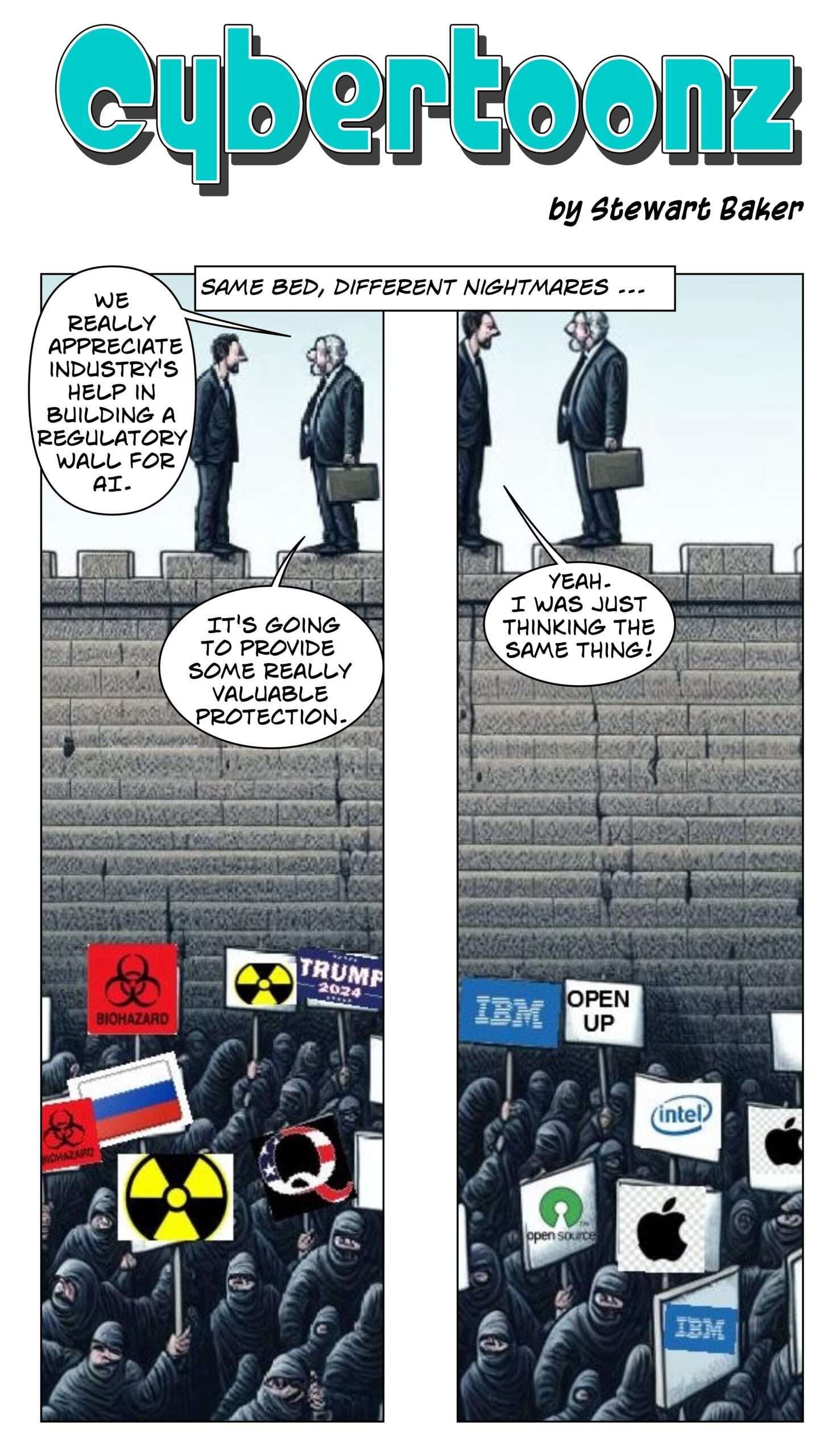
And in recognition of the week's focus on international AI regulation, Cybertoonz explains what's really going on in Bletchley Park:
You can subscribe to The Cyberlaw Podcast using iTunes, Google Play, Spotify, Pocket Casts, or our RSS feed. As always, The Cyberlaw Podcast is open to feedback. Be sure to engage with @stewartbaker on Twitter. Send your questions, comments, and suggestions for topics or interviewees to CyberlawPodcast@gmail.com. Remember: If your suggested guest appears on the show, we will send you a highly coveted Cyberlaw Podcast mug! The views expressed in this podcast are those of the speakers and do not reflect the opinions of their institutions, clients, friends, families, or pets
I have long advocated using May 1 for this purpose. But November 7 is a worthy alternative candidate, which I am happy to adopt if it can attract a broad consensus.
Since 2007, I have advocated designating May 1 as an international Victims of Communism Day. The May 1 date was not my original idea. But I have probably devoted more time and effort to it than any other commentator. In my view, May 1 is the best possible date for this purpose because it is the day that communists themselves used to celebrate their ideology, and because it is associated with communism as a global phenomenon, not with any particular communist regime. However, I have also long recognized that it might make sense to adapt another date for Victims of Communism Day, if it turns out that some other date can attract a broader consensus behind it. The best should not be the enemy of the good.
As detailed in my May 1 post from 2019, November 7 is probably the best such alternative, and in recent years it has begun to attract considerable support. Unlike May 1, this choice is unlikely to be contested by trade unionists and other devotees of the pre-Communist May 1 holiday. While I remain unpersuaded by their objections on substantive grounds, pragmatic considerations suggest that an alternative date is worth considering, if it can sidestep objections and thereby attract broader support.
The November 7 option is not without its own downsides. From an American standpoint, one obvious one is that it will sometimes fall close to election day. On such occasions, a November 7 Victims of Communism Day might not attract as much attention as it deserves, because many will - understandably - be focused on electoral politics instead. Nonetheless, November 7 remains the best available alternative to May 1; or at least the best I have seen so far.
For that reason, I am - once again - doing a Victims of Communism Day post on November 7, in addition to the one I do on May 1. If November 7 continues to attract more support, I may eventually switch to that date exclusively. But, for now, I reserve the options of returning to an exclusive focus on May 1, doing annual posts on both days, or switching to some third option should a good one arise.
In addition to its growing popularity, November 7 is a worthy alternative because it is the anniversary of the day that the very first communist regime was established in Russia. All subsequent communist regimes were at least in large part inspired by it, and based many of their institutions and policies on the Soviet model.
Having explained why November 7 is worthy of consideration as an alternative date, it only remains to remind readers of the more general case for having a Victims of Communism Day. The following is adopted from this year's May 1 Victims of Communism Day post, and some of its predecessors:
The Black Book of Communism estimates the total number of victims of communist regimes at 80 to 100 million dead, greater than that caused by all other twentieth century tyrannies combined. We appropriately have a Holocaust Memorial Day. It is equally appropriate to commemorate the victims of the twentieth century's other great totalitarian tyranny.
Our comparative neglect of communist crimes has serious costs. Victims of Communism Day can serve the dual purpose of appropriately commemorating the millions of victims, and diminishing the likelihood that such atrocities will recur. Just as Holocaust Memorial Day and other similar events promote awareness of the dangers of racism, anti-Semitism, and radical nationalism, so Victims of Communism Day can increase awareness of the dangers of left-wing forms of totalitarianism, and government domination of the economy and civil society.
While communism is most closely associated with Russia, where the first communist regime was established, it had equally horrendous effects in other nations around the world. The highest death toll for a communist regime was not in Russia, but in China. Mao Zedong's Great Leap Forward was likely the biggest episode of mass murder in the entire history of the world.
November 7, 2017 was the 100th anniversary of the Bolshevik seizure of power in Russia, which led to the establishment of the first-ever communist regime. On that day, I put up a post outlining some of the lessons to be learned from a century of experience with communism. The post explains why most of the horrors perpetrated by communist regimes were intrinsic elements of the system. For the most part, they cannot be ascribed to circumstantial factors, such as flawed individual leaders, peculiarities of Russian and Chinese culture, or the absence of democracy. The latter probably did make the situation worse than it might have been otherwise. But, for reasons I explained in the same post, some form of dictatorship or oligarchy is probably inevitable in a socialist economic system in which the government controls all or nearly all of the economy.
While the influence of communist ideology has declined greatly since its mid-twentieth century peak, it is far from dead. Largely unreformed communist regimes remain in power in Cuba and North Korea. In Venezuela, the Marxist government's socialist policies have resulted in political repression, the starvation of children, and a massive refugee crisis—the biggest in the history of the Western hemisphere.
In Russia, the authoritarian regime of former KGB Colonel Vladimir Putin has embarked on a wholesale whitewashing of communism's historical record. Putin's brutal war on Ukraine is primarily based on Russian nationalist ideology, rather than that of the Soviet Union. Nonetheless, the failure of post-Soviet Russia to fully reckon with its oppressive Soviet past is likely one of the reasons why Putin's regime came to power, and engaged in its own atrocities.
In China, the Communist Party remains in power (albeit after having abandoned many of its previous socialist economic policies), and has become less and less tolerant of criticism of the mass murders of the Mao era (part of a more general turn towards greater repression). The government's brutal repression of the Uighur minority, and escalating suppression of dissent, even among Han Chinese, are just two aspects in which it seems bent on repeating some of its previous atrocities. Under the rule of Xi Jinping, the government has also increasingly reinstated socialist state control of the economy.
Here in the West, some socialists and others have attempted to whitewash the history of communism, and a few even attribute major accomplishments to the Soviet regime. Cathy Young has an excellent critique of such Soviet "nostalgia" in a 2021 Reason article.
In sum, we need Victims of Communism Day because we have never given sufficient recognition to the victims of the modern world's most murderous ideology or come close to fully appreciating the lessons of this awful era in world history. In addition, that ideology, and variants thereof, still have a substantial number of adherents in many parts of the world, and still retains considerable intellectual respectability even among many who do not actually endorse it. Just as Holocaust Memorial Day serves as a bulwark against the reemergence of fascism, so this day of observance can help guard against the return to favor of the only ideology with an even greater number of victims.
When they arrived, Ruba Almaghtheh, 34, told officers she had been watching the news and "couldn't breathe anymore," and referenced the Palestinian people.
Police said she had passed the Israelite School of Universal and Practical Knowledge several times, calling it the "Israel school," and told officers, "Yes, I did it on purpose." …
However, the building Almaghtheh crashed into is not, in fact, a Jewish school. The Anti-Defamation League says the Israelite School of Universal and Practical Knowledge is in fact an extremist organization that is anti-Israel and antisemitic.
Thankfully, no-one in the school was injured. Almaghtheh has apparently been arrested "for criminal recklessness."
We know what "green card" means when it comes to immigration law (and employment law). But I just ran across a reference to "green card" in a court docket that had a completely different meaning; searching for it revealed that this is actually a commonly used term. What does it refer to?
The hiring process for a University of Washington psychology professor position titled "Diversity in Development" initially ranked a white person No. 1 out of 84 applicants, the university says in a report released this week.
But psychology department faculty members then pressured one another until the third-ranked finalist, who was Black, was given this tenure-track assistant professor job, above the white and Asian finalists, the document states. It adds that it's unclear how candidates' racial identities were assigned. The assistant professor accepted the job in April of this year.
The investigation, which the university posted online Tuesday, concludes that "race was used as a substantial factor in the selection of the final candidate and the hiring process," violating a university executive order that bans considering race in hiring. Though the report itself doesn't conclude state law was violated, university spokesman Victor Balta noted in an email to Inside Higher Ed Thursday that Washington citizens, in 1998, passed a referendum banning affirmative action in public colleges and universities.
The university announced on its website that the psychology department is now "barred from conducting searches for tenured and tenure-track faculty positions" for at least two years, "subject to review by the Provost's Office." It also said the department will "undergo a comprehensive review and revision of its hiring processes," and all department members "will receive training on how to conduct searches consistent with law and policy."
My new co-authored article reviews 168 victim impact statements from the Larry Nassar sentencing hearing and concludes that these statements show a victim voice at sentencing can improve justice.
In brief, we examine the 168 victim impact statements (VISs) presented at the sentencing of Larry Nassar for sex abuse. The article culls insights about what crime victims include in their VISs through quantitative and qualitative analysis of the statements presented. We conclude that content analysis of the 168 statements provides strong support for the use of VIS in criminal cases.
Here's the introduction:
Over the past several decades, crime victims' rights advocates have sought to amplify the victim's voice in the criminal justice process. A key part of that effort has been giving crime victims the right to deliver a victim impact statement (a "VIS") at sentencing before a sentence is imposed. Today, the federal system and virtually all states allow VISs in the United States.
While VISs are now firmly entrenched in the American criminal justice landscape, the wisdom of allowing such statements is sometimes disputed. Yet many arguments for and against VISs rest not on empirical data but rather on theoretical speculation about what those statements might look like, what victims' motives are in delivering them, or what effects the statements produce at sentencing. This reliance on speculation stems from the fact that surprisingly little is known about VISs. To be sure, anecdotal examples of particular statements have been cited by scholars, including by us. And various scholars have theorized about what VISs might usually contain. But, relatively little empirical work exists regarding VISs, either quantitative or qualitative.
This dearth of empirical research is partially explained by the difficulty in studying a "typical" VIS. Different crimes perpetrated by different offenders in different ways cause different forms of victimization. And even when the victimization stems from the same legally defined crime, the crime may take varying forms or be perpetrated in different social contexts, with different offender-victim relationships producing variable harms. Because each crime—and each victim—is unique, it is hard to determine whether victims' assertions in their VISs result from their unique circumstances. And that difficulty has left scholars wondering what factors might drive victim impact statements and their content generally.
Recently, a unique data set of VISs developed. In January 2018, Michigan Judge Rosemarie Aquilina allowed 168 direct and indirect victims of former USA Gymnastics team doctor Larry Nassar (or the victims' representatives) to all deliver VIS. The nation was riveted as Nassar's victims explained how Nassar had sexually abused them. The resulting set of VISs is rich in details about what kinds of assertions victims make in them. Nassar committed similar crimes against each of his victims, allowing a robust research approach to answer questions about the content, motivations for, and benefits to victims of submitting VISs. Specifically, it is possible to explore the question of whether (roughly) the same crimes produce (roughly) the same VISs. This data set also has the advantage of the absence of significant utilitarian motives for submitting the VISs, such as the desire to affect the sentence. When the victims prepared and delivered their VISs, they already knew that Nassar would spend essentially the rest of his life in prison. Thus, the opportunity to present the VIS itself drove victim participation. Further, the victims essentially had complete freedom in what they discussed and to whom they addressed their statements; their statements were completed without any "guidelines or control" from criminal justice personnel, as has been the case in some other sentencing hearings.
To explore issues surrounding the content of VISs, this article relies on a thematic content analysis of the VISs presented at Nassar's sentencing. The analysis generates both quantitative and qualitative information, focusing on such questions as why a victim chose to present a VIS, which audiences the victim was addressing, the types of harms the victim suffered, and the meaning of the opportunity to present a VIS. With those findings in hand, this article returns to the core question about VISs: Do they promote justice? Read More
Harvard concludes that it is, but I’m skeptical that this is right—just as I’d be skeptical that an employer’s restricting pro-Hamas speech constitutes such discrimination or harassment.
As I've written in a separate post, three Israeli students in Harvard Kennedy School Prof. Marshall Ganz's "Organizing: People, Power, Change" course complained that Ganz had rejected their class project proposal's description of Israel as a "Jewish democracy":
When the Parties met on February 27, 2023, Professor Ganz told the Students they could not describe Israel as a "liberal-Jewish democracy" because Israel is not democratic.
In a March 2, 2023 email, Professor Ganz wrote that the Students' statement of purpose was "not acceptable going forward," and he instructed them to revise it. In a later email that night, Professor Ganz wrote, "I cannot permit [a debate of the question of 'Jewish democracy'] to claim the very limited time and space in a class in which 116 students are enrolled to learn to practice organizing. Please find a way to describe your organizing project in terms that are respectful of others in the class." {There is no evidence that the Students intended to debate whether Israel is a democracy in the Jewish homeland. According to Professor Ganz, certain teaching fellows sought to debate this issue, which Professor Ganz rightfully stopped.}
When the Students told Professor Ganz that they would not change their purpose, he told them they would be responsible for the "consequences" of their decision, and later clarified that by consequences, he meant "fulfillment of course requirements."
A report commissioned and accepted by the Kennedy School concluded that this violated the students' free speech rights; I discuss that in a separate post. But the report also concluded this violated Kennedy School rules forbidding "discrimination and harassment" based on national origin, ethnicity, and ancestry, which the report treated as embodying federal rules developed under Title VI of the Civil Rights Act of 1964:
[Title VI] extends to those who experience discrimination, including harassment, based on their actual or perceived: (i) shared ancestry or ethnic characteristics; or (ii) citizenship or residency in a country with a dominant religion or distinct religious identity. Likewise, the Act protects individuals from discrimination based on the country, world region, or place where a person or their ancestors come from, including membership in a religion that may be perceived to exhibit such characteristics, such as Jewish individuals…. [To violate Title VI,] "the conduct must … be considered sufficiently serious to deny or limit a student's ability to participate in or benefit from the educational program." Conduct can be harassing even if the offender does not intend harm, and even if the conduct is not directed at a specific target.
The report concluded that Ganz's actions "treated the Students differently on the basis of their Israeli national origin and Jewish ethnicity and ancestry," by "instruct[ing] the Students not to use as a purpose anything that describes Israel as a 'Jewish democracy,' which he did only after complaints by Muslim and Arab students." Ganz had replied that he was focused solely on the topic, regardless of the ethnicity of the students, and would have likewise rejected a proposal from non-Jews who wanted to describe Israel as a "Jewish democracy." But the report disagreed:
That was the Kennedy School's conclusion, in endorsing a report by an outside employment and education law firm (Kurker Paget LLP). Three Israeli students in Prof. Marshall Ganz's "Organizing: People, Power, Change" course complained that Ganz had rejected their class project proposal's description of Israel as a "Jewish democracy." (The story seems to have been broken by the Jewish Insider [Haley Cohen] on Oct. 30.) From the report:
It is undisputed that:
When the Parties met on February 27, 2023, Professor Ganz told the Students they could not describe Israel as a "liberal-Jewish democracy" because Israel is not democratic.
In a March 2, 2023 email, Professor Ganz wrote that the Students' statement of purpose was "not acceptable going forward," and he instructed them to revise it. In a later email that night, Professor Ganz wrote, "I cannot permit [a debate of the question of 'Jewish democracy'] to claim the very limited time and space in a class in which 116 students are enrolled to learn to practice organizing. Please find a way to describe your organizing project in terms that are respectful of others in the class." {There is no evidence that the Students intended to debate whether Israel is a democracy in the Jewish homeland. According to Professor Ganz, certain teaching fellows sought to debate this issue, which Professor Ganz rightfully stopped.}
When the Students told Professor Ganz that they would not change their purpose, he told them they would be responsible for the "consequences" of their decision, and later clarified that by consequences, he meant "fulfillment of course requirements."
The report concluded that this violated the Kennedy School's rules related to student free speech:
Every August and December, thousands of practicing lawyers ready themselves for the fall or spring (or in the quarter system, winter) classes they will be teaching at any one of the 197 ABA-approved law schools around the country…. [These a]djuncts are in most circles unquestionably perceived as a relevant part of legal academia. But amazingly, scholars and other commentators have written or said comparatively little about them.
Speaking plainly, the law school stakeholders accept the adjuncts' presence on campus as a given without much consideration being paid to: (i) what motivates them to take on these positions with little to no remuneration, (ii) the exceptional economic benefit this team of short-term instructors provides for their institutions, (iii) what makes for a positive adjunct experience, or (iv) how institutions and their students can fully integrate adjuncts into the law school community with the attendant benefits to both from doing so….
[In this article,] we will take a closer, though necessarily summary, look at the mix of incentives motivating both adjuncts and the institutions that employ them. From these observations, we develop a list of best practices calibrated to ensure that adjuncts, their law schools, and the all-important students (who are the ultimate consumers adjunct and law schools cater to) get the most out of this important relationship.
From a Justice Department press release [UPDATE: link fixed] dated Oct. 24, but just posted on Westlaw a few days ago:
A Diamond Bar man pled guilty today to a federal criminal civil rights charge for disrupting a "Stop Asian Hate" rally in March 2021 by running a red light and driving through a crowded crosswalk of peaceful demonstrators while shouting racial slurs and epithets.
On the third day of trial, Steve Lee Dominguez, 57, pleaded guilty to one felony count of bias-motivated interference with federally protected activities….
From a Justice Department press release dated Oct. 24, but just posted on Westlaw a few days ago:
An Ohio man pleaded guilty yesterday to violating the Church Arson Prevention Act and to using fire and explosives to commit a felony, all in connection with his attempt to burn down a church because of the church's support for the LGBTQI+ community.
According to court documents, on March 25, Aimenn D. Penny, 20, of Alliance, made Molotov cocktails and drove to the Community Church of Chesterland (CCC), in Chesterland, Ohio.
Angered by the church's plan to host two drag events the following weekend, Penny threw two Molotov cocktails at the church, hoping to burn it to the ground. Through Penny's guilty plea, he admitted to using force through fire and explosives, intending to obstruct CCC congregants in their enjoyment and expression of their religious beliefs….