The Volokh Conspiracy

Mostly law professors | Sometimes contrarian | Often libertarian | Always independent | Est. 2002

The Volokh Conspiracy

Probation Condition Banning "Hostile Contact" with Police Is Unconstitutionally Vague

|

From today's decision in State v. Shreve, written by Judge Erik Price and joined by Chief Judge Rebecca Glasgow and Judge Bernard Veljacic:

In March 2022, Shreve attended a party at a hotel. Around 4:00 a.m., he got into a physical altercation with another individual at the hotel. A hotel security guard intervened. When approached by the security guard, Shreve drew a knife and lunged toward him. The security guard blocked the attack and disarmed Shreve. The security guard confiscated the knife and brought Shreve to the lobby.

Police were dispatched. Upon arrival, Officer Hannity saw Shreve seated in the lobby while the security guard stood nearby. Shreve appeared to be intoxicated and angry. Although Officer Hannity and the security guard initially decided to allow Shreve to leave the hotel without his knife, Shreve escalated the situation by suddenly and aggressively moving toward the security guard. As the security guard and the other police officers at the scene told Shreve to leave the hotel premises, Shreve attempted to elbow two nearby officers. The officers forced Shreve to the ground and attempted to handcuff him. Ultimately, Officer Hannity was forced to use his taser to subdue Shreve.

Shreve was initially charged with second degree assault with a deadly weapon enhancement and resisting arrest. But on June 30, 2022, Shreve pleaded guilty to a single count of second degree burglary as part of a Barr plea. {In re Pers. Restraint of Barr (Wash. 1984) (holding that a trial court may accept a guilty plea to an amended charge lacking factual support if the facts support the original charge).} … As a first-time offender, Shreve was sentenced to one day of confinement and twelve months of community custody. The sentencing court imposed several community custody conditions, including:

No hostile contact w[ith] law enforcement/first responders….

Read More

A Reversal in Rahimi Will Be Tougher to Write Than Critics Admit

Courts are "not insensitive to domestic violence" but are "sensitive to the constitutional rights of the accused."

|

The conventional wisdom is that the Supreme Court will certainly reverse the Fifth Circuit in Rahimi. Indeed I've voiced that position myself several times, especially in light of a potential grant in Range. (The New York Times picked up Justice Barrett's question). But let me challenge that conventional wisdom: an opinion reversing Rahimi will be tougher to write than most critics will admit.

Let's start with a premise: Rahimi was a faithful application of Bruen. Efforts to "clarify" Bruen are really an attempt to rewrite the precedent. I don't think anyone seriously doubts this premise. Now the reason why the Court may "clarify" Bruen is because certain members of the Court don't like the results that it yields: namely, that a dangerous person like Rahimi can possess a firearm. Again, the correctness of the Bruen precedent should be able to stand without regard to how it may be applied in future cases. But that's where we are. Some members of the Court who profess to be originalists are still motivated by consequentialism. And these concerns came out loud and clear during oral argument.

Still, there is a long time between November and June. A majority opinion has to be written. And that opinion will have to navigate an issue that didn't get much attention during oral argument: what other constitutional rights should dangerous people lose? Certainly this case can't just be about guns.

One of my first published articles, The Constitutionality of Social Cost, was published in the Harvard Journal of Law & Public Policy in 2011. I had started thinking about the topic in 2009, before McDonald v. Chicago was decided. The basic premise of my article was that there are many dangerous rights, and the Second Amendment was not an outlier. Here is a snippet from the introduction:

Read More

Defenestration at OpenAI

Episode 482 of the Cyberlaw Podcast

|

In this episode, Paul Rosenzweig brings us up to date on the debate over renewing section 702, highlighting the introduction of the first credible "renew and reform" measure by the House Intelligence Committee. I'm hopeful that a similarly responsible bill will come soon from Senate Intelligence and that some version of the two will be adopted. Paul is less sanguine. And we all recognize that the wild card will be House Judiciary, which is drafting a bill that could change the renewal debate dramatically.

Jordan Schneider reviews the results of the XI-Biden meeting in San Francisco and speculates on China's diplomatic strategy in the global debate over AI regulation. No one disagrees that it makes sense for the U.S. and China to talk about the risks of letting AI run nuclear command and control; perhaps more interesting (and puzzling) is China's interest in talking about AI and military drones.

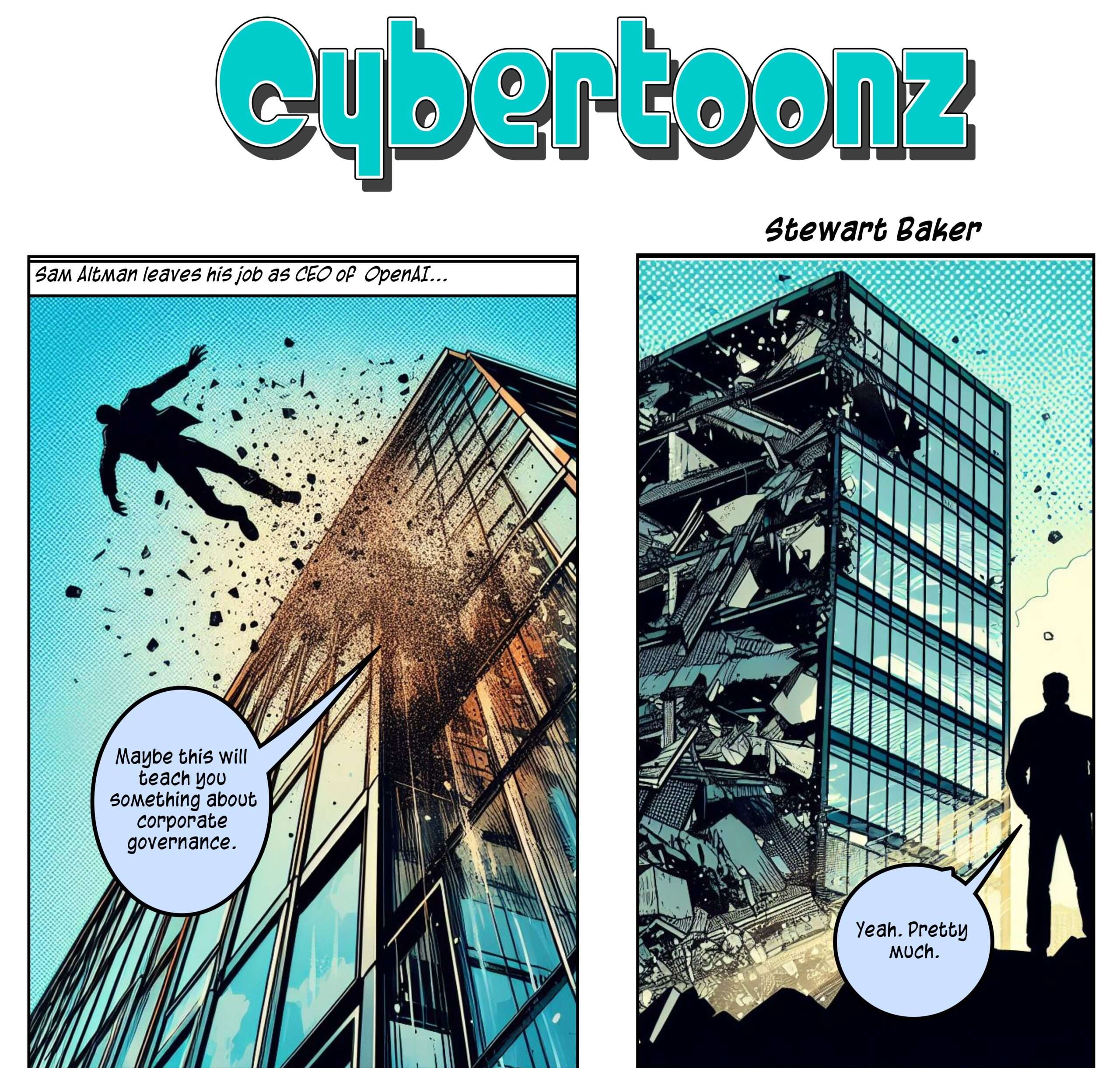
Speaking of AI, Paul reports on Sam Altman's defenestration from OpenAI and soft landing at Microsoft. Appropriately, Bing Image Creator provides the artwork for the latest Cybertoonz commentary.

Nick Weaver covers Meta's not-so-new policy on political ads claiming that past elections were rigged.

I cover the flap over TikTok videos promoting Osama Bin Laden's letter justifying the 9/11 attack.

Jordan and I discuss reports that Applied Materials is facing a criminal probe over shipments to China's SMIC.

Nick reports on the most creative ransomware tactic to date: compromising a corporate network and then filing an SEC complaint when the victim doesn't disclose it within four days. This particular gang may have jumped the gun, he reports, but we'll see more such reports in the future, and the SEC will have to decide whether it wants to foster this business model.

I cover the effort to disclose a bitcoin wallet security flaw without helping criminals exploit it.

And Paul recommends the week's long read: The Mirai Confession – a detailed and engaging story of the kids who invented Mirai, foisted it on the world, and then worked for the FBI for years, eventually avoiding jail, probably thanks to an FBI agent with a paternal streak.

Download 482nd Episode (mp3)

You can subscribe to The Cyberlaw Podcast using iTunes, Google Play, Spotify, Pocket Casts, or our RSS feed. As always, The Cyberlaw Podcast is open to feedback. Be sure to engage with @stewartbaker on Twitter. Send your questions, comments, and suggestions for topics or interviewees to CyberlawPodcast@gmail.com. Remember: If your suggested guest appears on the show, we will send you a highly coveted Cyberlaw Podcast mug! The views expressed in this podcast are those of the speakers and do not reflect the opinions of their institutions, clients, friends, families, or pets.

Free Speech

Settlement and Apology as to Restriction on Holding "God Bless the Homeless Vets" Sign by City Hall

|

From the Foundation for Individual Rights and Expression (FIRE):

A Georgia city apologized and paid up to settle a lawsuit about its officer's arrest of a veteran for holding a sign that said "God Bless the Homeless Vets" outside of its city hall.

Following a First Amendment lawsuit from the Foundation for Individual Rights and Expression and the University of Georgia Law School's First Amendment Clinic, the City of Port Wentworth, Georgia, agreed to a settlement with Jeff Gray. As part of the settlement, the city agreed to donate a symbolic $1,791 to the National Coalition for Homeless Veterans — a nod to the First Amendment's ratification in 1791 — and will give $1,791 each to Gray and FIRE. Port Wentworth will also maintain the public space in front of city hall as an open public forum and train its officers on citizens' First Amendment rights….

On Jan. 31, FIRE filed two lawsuits on Gray's behalf to protect Americans' right to speak outside government buildings: the first, against Alpharetta, Georgia, and two of its police officers; and the second, against the police chief of Blackshear, Georgia. On July 17, FIRE filed a third lawsuit against Port Wentworth.

On July 19, 2021, Gray was arrested in Port Wentworth by then-Sergeant Robert Hemminger. In conversations caught on the officer's body camera, Hemminger acknowledged to city employees — and Gray, repeatedly — that Gray wasn't doing anything unlawful. But the employees adamantly insisted they didn't want Gray there, saying, "He can't stand in front of our city hall talking about 'support the homeless vets.' We can't have that."

Read More

Free Speech

Limits on Sealing in Trade Secret Cases

|

From Judge Beth Phillips' opinion in Kyndryl, Inc. v. Cannady (W.D. Mo.):

In this suit, Plaintiff asserts Defendant misappropriated trade secrets, breached a contract, and converted Plaintiff's property.  The Court granted Plaintiff's Motion for a Temporary Restraining Order, ("TRO"), which bars Defendant from disclosing certain information he obtained from Plaintiff, and the TRO remains in effect.

When it filed the suit, Plaintiff also filed a Motion to Seal Documents…. [While the motion has been pending,] Plaintiff had begun unilaterally filing [all] documents under seal….

Material filed with the Court is presumptively public, although that presumption can be overcome based on a specific need to protect specific information…. The Court agrees that any actual trade secrets should be kept from public view—but this is not what Plaintiff requests. Indeed, it does not contend any trade secrets have been filed. Instead, Plaintiff argues practically all documents in this case should be sealed because (1) they describe the nature of the trade secrets at issue, (2) they discuss (as required to establish the basis for Plaintiff's lawsuit) that Defendant misappropriated the trade secrets and has threatened to disclose them, and (3) Plaintiff will suffer reputational harm if it is revealed that its trade secrets were misappropriated.

The Court does not agree that Plaintiff's interests overcome the common law right to access. Descriptions of trade secrets are not themselves trade secrets; the fact that trade secrets exist also are not trade secrets. To hold otherwise, or to permit sealing of these facts, would justify sealing practically everything in any case where misappropriation of trade secrets is alleged. Moreover, the nature of the trade secrets at issue here is such that it will be no surprise to anyone that they exist. But to reiterate—while the Court would approve the sealing or redaction of trade secrets, that is not what Plaintiff requests.

Read More

Law & Government

Arthur D. Hellman on The Supreme Court's Shrunken "Discuss List"

|

Professor Arthur Hellman of the University of Pittsburgh is one of the great academic experts on the Supreme Court's case selection process. He recently wrote to me with a very interesting insight about the Supreme Court's "discuss list," which I asked him to elaborate on for readers of the blog.

His thoughts are below:

The Supreme Court's Shrunken "Discuss List"

Arthur D. Hellman

Buried in the commentary to the Supreme Court's new Code of Conduct is some never-before-disclosed information about how the Court selects its cases for plenary consideration. It's only two sentences, but there's a lot to be mined from it. Here is the passage (on p. 11):

The Court receives approximately 5,000 to 6,000 petitions for writs of certiorari each year. Roughly 97 percent of this number may be and are denied at a preliminary stage, without joint discussion among the Justices, as lacking any reasonable prospect of certiorari review.

Preliminarily, the Court's reference to "approximately 5,000 to 6,000 petitions for writs of certiorari [received] each year" does not tell the whole story. A decade ago, according to the Court's official statistics sheets, the number was above 7,000 (7,509 in the 2012 Term). But the number has trended downward since then, and in the most recent term (2022) the total number of new filings was under 4,200 – about 1,250 paid cases and about 2,900 in forma pauperis (IFP). (The statistics sheet is page 2 of each PDF.)

We can assume that the commentary to the Court's new code was written with some care. What do the Justices mean when they say that about 97 percent of the petitions "are denied at a preliminary stage, without joint discussion among the Justices?" In all likelihood, this is a reference to the "discuss list." (If someone has another idea, I'd like to hear about it.) Chief Justice Rehnquist explained the process in his book The Supreme Court, published in 2001 (pp. 234-35):

Shortly before each [conference of the Justices], the Chief Justice sends out a list of the petitions he wishes to have discussed. After the Chief's "discuss list" has come around, each of the Associate Justices may ask to have additional cases put on this list. … The petitions … that are not discussed at conference are denied without any recorded vote. … [The] great majority of petitions … are never even discussed at conference and are simply denied without being taken up by the justices as a group.

So when the Court says that 97 percent of the petitions "are denied … without joint discussion," it is probably telling us that 97 percent of the cases do not make it to the discuss list – and that only 3 percent do.

Four points about the discuss list deserve attention. First, the discuss list today represents a considerable dropoff from two or three decades ago. In his 2001 book (and in the first edition published in 1987), Chief Justice Rehnquist said that "[i]f at a particular conference there are one hundred petitions for certiorari on the conference list, the number discussed at conference will range from fifteen to thirty." Even the lower number is five times the percentage given (implicitly) in the Court's commentary on the code.

Second, we need to translate the current percentage to numbers. For the 2022 Term, that would be about 125 cases. To put that number in perspective, the number of cases granted in the 2022 Term was 60. Thus, the Court could have granted cert in every case on the discuss list, and the plenary docket would still be smaller than it was during most of the Burger Court years (about 150 cases).

Third, the percentage of cases on the discuss list that are granted is higher today (perhaps much higher) than it was under Chief Justice Rehnquist. This could be because the individual Justices have all internalized pretty much the same criteria for grants. Or perhaps there are fewer idiosyncratic requests from a single Justice to add cases to the list that will never get the four votes required for a grant.

Finally, we would like to know what the cases are that make it to the discuss list but not to the plenary docket. (We know some of these – the cases in which one or more Justices issue a statement or publish a notation about the denial of certiorari. But in the 2022 Term, those accounted for only about half the number suggested by the Court's statement.) The discuss list is not made public, but a close approximation may be available – the relists, which are tracked by veteran Supreme Court advocate John Elwood at Scotusblog.

As Elwood explains, "[w]hen a case is relisted, the justices do not grant or deny review, but instead will reconsider the case at their next conference." So the relists must be a subset of the discuss list. No case would be relisted if it had not been first placed on the discuss list, but some of the discuss list cases may be denied at the first conference for which they are listed. We just don't know how frequently that happens. Still, the relists would give us as good a picture as we can get of the cases that make it to the discuss list but not to the plenary docket.

It would be a useful project to analyze the relisted-but-denied cases from the last few terms and see what patterns emerge. For example, to what extent do the cases have ideological valence? How often do the respondents point to apparently serious "vehicle" problems?

A larger project would also ask about cases with amicus briefs at the certiorari stage that were denied without relisting.

A quarter of a century ago, I published an article seeking to explain "the shrunken docket of the Rehnquist Court." The time is ripe for someone to explore the shrunken discuss list of the Roberts Court.

(Thanks to John Elwood and Matt Hellman for comments on an earlier draft of this post.)

Politics

Moving The Section 3 Officer Argument From "Off The Wall" to "On The Wall"

Debates about Section 3 remind me of debates over the Affordable Care Act’s individual mandate

|

Think back to 2010. The Affordable Care Act was signed into law. Challenges were filed across the country. Each case presented a central question: could Congress mandate that people purchase health insurance? A vigorous debate formed. Some legal scholars, including my colleague Randy Barnett, argued that the federal mandate was beyond Congress's powers. It was unprecedented, they said. Other scholars argued that the mandate was squarely in Congress's powers, or alternatively, there was no mandate at all. Needless to say, the position that Barnett and others advanced was ridiculed at every step. His position was called crazy, stupid, frivolous, and worse. 

But then something changed. A federal district court judge in Florida agreed with Barnett's argument. He wrote a careful decision laying out both sides, and ultimately concluding that the mandate was beyond Congress's powers. Around the same time, prominent conservatives adopted the rallying cry that the federal government can't make you buy health insurance, or for that matter, broccoli. To use Jack Balkin's framing, an argument that was "off the wall" became "on the wall." How it happened is complex. I discuss the history at length in my 2012 book, fittingly titled Unprecedented. I won't rehash all of the developments here.

Today, I feel a sense of deja vu. Or maybe it's nostalgia. Debates over Section 3 bring me back to the heady days of 2010. I, along with my colleague Seth Barrett Tillman, contend that the President is not an "Officer of the United States" for purposes of Section 3. And, as could be expected, critics call our position crazy, stupid, frivolous, and worse. President Trump's counsel adopted our position. And wouldn't you know it, a trial judge in Denver accepted our position! Her opinion closely tracked how we've presented our argument for years. The judge wrote a careful decision laying out both sides, and she ultimately concluded that the better argument is that Trump is not covered by Section 3's "Officer of the United States"-language. Unsurprisingly, critics still call our position crazy, stupid, frivolous, or worse. Well, they don't mention us by name. Like with the Foreign Emoluments Clause cases, Seth and I get the Voldemort treatment—we shall not be named, unless our position is rejected.

There is, of course, a big difference between the arguments in the ACA litigation and the arguments in the Section 3 cases. The challenge to Obamacare was premised on a line-drawing exercise: the ACA went further than any statute went before. In many regards, the argument in that case was limited to the facts of that case. Before 2009, very few scholars even considered whether Congress could regulate inactivity. But here, the officer-issue predates January 6. It predates Trump. Tillman has been repeatedly writing on these issues since 2008. He persuaded me circa 2012. And collectively, we have written hundreds of pages in articles, briefs, and blog posts on the scope of the Constitution's "office"- and "officer"-language. (More than a few of our most extreme critics have written zero pages on this issue before January 6, and some have yet to publish anything on this issue.) Indeed, if we want to go back further, debates over the scope of the Constitution's "office"- and "officer"-language were first raised during the ratification of the Constitution. (If you don't get the reference, check out our writings on this topic.) Unlike the ACA issue, the office issue is no way tethered to Trump, January 6, and insurrection. The question is a purely legal one. Hence, either the President is an "officer of the United States" or he is not. 

Is the Blackman/Tillman "office" position still "off the wall" or is it "on the wall"? Is that position part of the mainstream, even if a minority position? Has the conservative legal movement found merit in this position? Will these forces once again align? I'll let others decide. What I would say is that efforts to ridicule our argument as "stupid" or "frivolous" won't work. There are valid arguments on both sides of the issue, and hyperbole is frequently a mask for weakness. The Colorado court's ruling establishes at least that much. And past predictions that no court, including the Supreme Court, would or will ever adopt our position, have not aged well.

Politics

The Pleasantly Shaded Docket

|

From Daniel M. Gonen, Judging in Chambers: The Powers of a Single Justice of the Supreme Court, 76 U. Cin. L. Rev. 1159 (2008):

On a late-summer day in 1970, three men wearing business suits and carrying briefcases hiked six miles into the wilderness of central Washington State. As their appearance might have suggested, these were not ordinary hikers. The trio consisted of two civil-rights lawyers from Portland, Oregon, and their law clerk. They had set out into the woods that day to find Justice William O. Douglas and to apply to him for a temporary restraining order on behalf of their clients.

The Supreme Court had ended its term months earlier, and Justice Douglas was in Washington on a ten-day camping trip near his summer home in Goose Prairie, more than ten miles from the nearest telephone. With assistance from U.S. Forest Rangers, who had spotted Justice Douglas's campsite by plane, the lawyers were able to track down Justice Douglas and his party. They presented their case to the Justice in a fifteen-minute oral argument, and left a 1.5-inch [thick] petition for him to review.

Justice Douglas indicated a particular tree stump and told the lawyers that they would find his decision there the next day. Only one of the original three was physically able to make the hike back the next day, but sure enough, a single sheet of paper was waiting for him on the designated stump. In a one-paragraph opinion, Justice Douglas denied the application.

{This story is drawn from Phil Cogswell, Lawyers Hike 6 Miles in Woods to Find Justice Douglas, Oregonian, Sept. 1, 1970, at 6. Cynthia Rapp, one of the foremost experts on the in-chambers opinions of Supreme Court Justices, deserves credit for rescuing this story from historical obscurity. See Cynthia Rapp, Introduction to 1 A Collection of In Chambers Opinions by the Justices of the Supreme Court of the United States, at vii (Cynthia Rapp ed., 2004).}

Free Speech

Journal of Free Speech Law: "Carriage and Removal Requirements for Internet Platforms: What Taamneh Tells Us," by Daphne Keller

|

This just-published article is here; the Abstract:

The Supreme Court's 2023 Twitter v. Taamneh ruling arrived at a moment of potentially great change in the laws governing Internet platforms. The ruling, including Justice Thomas's factually dubious descriptions of platforms as passive and agnostic toward user content, will have major influence in two categories of future cases.

  • Most obviously, Taamneh will affect cases in which plaintiffs seek to hold platforms liable for unlawful material posted by users.
  • Less obviously, Taamneh is sure to affect "must-carry" claims or mandates for platforms to carry content against their will—including major cases on the Supreme Court's 2023–24 docket about laws in Texas and Florida.

This piece explains how Taamneh may be invoked in both kinds of cases, and explores the strengths and limitations of parties' likely arguments—in particular, arguments based on platforms' putative passivity. It also examines import­ant intersections between must-carry claims and claims seeking to hold plat­forms liable for unlawful user content. It argues that ignoring those connections may cause cases in one area of law to distort outcomes in the other. Taamneh itself may already have done just that.

And an excerpt from the Introduction:

Read More

Constitutional Interpretation

Life After Erie:

What happens on the day after Erie is overturned?

|

Erie Railroad Co. v. Tompkins is a foundational case for American lawyers, and it's one of the Supreme Court's greatest mistakes. Rather than rejecting "federal common law," Erie and its progeny actually created the category, discarding along the way a crucial concept of "general law" foundational to our constitutional structure. I've argued at length that this was an intellectual and practical mistake, particularly in my paper on "Finding Law," and I've tried to identify its consequences for statutory interpretation, personal jurisdiction, individual rights, originalism, and constitutional argument generally.

On November 1, I was privileged to give a "chair lecture" to mark my appointment as the inaugural Antonin Scalia Professor of Law. (It's a nice Harvard tradition, combining a celebration of a career with attention to scholarship.) So I chose as my topic "Life After Erie," describing what might happen when Erie is finally overturned (speedily, in our days). Here's the introduction:

For those who might be mystified by the title, Erie Railroad Co. v. Tompkins is the most important case that no one who isn't a lawyer has ever heard of. Viewed narrowly, it holds that a federal court, when deciding issues subject to state law, has to defer to the opinions of state courts.

As we will see, that proposition is often false. But the problem with Erie isn't this narrow result; the problem is its reasoning. As the Supreme Court would later put it, Erie overruled, not just a past line of cases, but "a particular way of looking at law." Erie rejected a category of law—sometimes called general common law, or just "general law"—that was fundamental to our federal system.

Read More

Politics

AI and Politics (Though Just Hypothetical for Now)

|

Prof. Donald Tobin (Maryland) posted this to a discussion list I'm on, and kindly agreed to let me publish it.

I am writing practice exam questions for my students in election law. I asked Chat GPT to write a campaign commercial for a fictional character, Ray Sunshine, that didn't expressly advocate for his election. It made me chuckle, so I thought I would share it.

[* * *]

[Opening scene: A bright, sunny morning in a bustling town. The camera pans over a picturesque landscape filled with smiling people going about their daily lives. A cheerful, uplifting music track begins.]

Narrator (Voiceover): "In a world that often feels divided and uncertain, we all yearn for a ray of hope."

[Cut to Ray Sunshine, a charismatic and warm-hearted individual, standing amidst a diverse group of people, shaking hands and exchanging warm greetings. He's wearing casual attire, exuding approachability.]

Narrator (Voiceover): "Meet Ray Sunshine, a person who brings warmth, positivity, and kindness wherever he goes."

Read More

Free Speech

Tiger King + Libel: Video Log and Web Site Post Aren't Covered by Florida's Defamation Retraction Statute

|

From McQueen v. Baskin, decided by the Florida Court of Appeal (Judge Matthew Lucas, joined by Judges Darryl Casanueva and Susan Rothstein-Youakim):

A sanctuary for lions and tigers, the unexplained disappearance of one of its owners, and competing allegations of embezzlement, double-dealing, and betrayal have spawned a defamation lawsuit….

In the 1990s Carole Baskin and her then-husband "Don" Lewis operated Wildlife on EasyStreet, a big cat sanctuary, an enterprise which would later become known as Big Cat Rescue. Anne McQueen was employed as Mr. Lewis' personal assistant.

In August 1997, Mr. Lewis disappeared. His whereabouts, or whether he is still alive, remains unknown to this day.

Not long after Mr. Lewis' disappearance, one of his daughters filed a conservatorship petition in the Hillsborough County Circuit Court. In that petition Mr. Lewis' daughter sought to appoint Ms. McQueen as a conservator of Mr. Lewis' property. Disputes arose during the course of the conservatorship proceedings. Ms. Baskin alleged that Ms. McQueen "improperly transferred real property, mortgages, and tax certificates." For her part, Ms. McQueen filed a petition for an injunction.

Read More

Free Speech

Missouri "Stealth Statute Requires Redaction of All Witness and Victim Names" in Court Records

|

Missouri media lawyer Mark Sableman has this article in St. Louis Lawyer, identifying what strikes me as a very serious problem; an excerpt:

As lawyers read new Missouri judicial opinions, they will find that something is missing. There are no names, except for defendants. In court opinions, Missouri has become the State of Unnamed Persons.

The names of witnesses in Missouri court cases have become a state secret. This is so even for the names of public officials, like prosecutors, and other people who expect to be in the public eye, like trial lawyers. Some recent court opinions mention scores of witnesses—but none of them, except the parties, are named.

The same is true of the names of victims. They are secret, and do not appear in court decisions. Yes, this applies even to murder victims, who are deceased and under the common law have no right of privacy, since that right is confined to the living.

This is not a joke or a fantasy. It is really happening. You can see it in Missouri appellate decisions issued in September and October 2023, which (with only a very few exceptions in my research) refer to non-parties variously using status words (e.g., "Victim"), relationships (e.g., "Victim's sister"; "Girlfriend"; "Uncle"), initials (e.g., "D.V. and E.C"), profession (e.g., "Nurse"), and office (e.g., "[State Attorney]"and "[Trial Counsel]").

And that's not all. The same law that appellate courts began following in September would put a veil of secrecy over all witness and victim names in all court pleadings. Yes, under this law, you as a Missouri lawyer, in both civil and criminal cases, must redact from your pleadings all names of witnesses and victims. You must also redact all witness names from exhibits attached to your pleadings….

Read More

Politics

Justices Kavanaugh And Barrett's Shadow Docket Concurrence In The Hamburger Mary's Case

The good, the bad, and the ugly.

|

Florida enacted a law that prohibits restaurants and bars from showing "adult live performances" to children. A restaurant in Orlando named Hamburger Mary's challenged the law on First Amendment grounds. The District Court agreed, and enjoined the state from enforcing the law against Hamburger Mary's, and any other entity. In other words, the court granted relief to non-parties. This was a universal injunction. (See Howard Wasserman's post from July.) The Eleventh Circuit denied a stay pending appeal. Florida sought partial relief from the Supreme Court. Specifically, the state asked the Supreme Court to limit the relief to Hamburger Mary's.

The Supreme Court denied Florida's application. Justices Thomas, Alito, and Gorsuch would have granted the application, though they did not provide any reasoning. Justice Kavanaugh wrote a three-page concurrence, which Justice Barrett joined, with the exception of a footnote--more on that footnote later.

There is some good, some bad, and some ugly.

At the outset, I will provide some praise of the concurrence. (I always try to give credit where it's due). Justice Kavanaugh acknowledges that in the abstract, Florida's request has merit:

No federal statute expressly grants district courts the power to enter injunctions prohibiting government enforcement against non-parties in the circumstances presented in this case. The question of whether a district court, after holding that a law violates the Constitution, may nonetheless enjoin the government from enforcing that law against non-parties to the litigation is an important question that could warrant our review in the future. [FN1]

Justice Kavanaugh is exactly right here. Lost in the debates about nationwide injunctions and "set aside" under the APA is the more fundamental question teed up by Jonathan Mitchell's canonical article: what aspect of the judicial power allows judges to grant relief to non-parties? And don't say equity. This is an issue on which most judges would rather not address. The Florida district did not certify a class of all similarly-situated businesses. Rather, it purported to grant relief to non-parties based on the overbreadth doctrine. (The overbreadth doctrine is already on a death watch.) Jonathan Mitchell has proven that courts cannot "strike" down statutes, as if they had a writ of erasure. Whole Woman's Health v. Jackson is proof of the genius's work. So what gives courts the power to grant relief to non-parties? Justice Kavanaugh and Barrett tell us the answer is open. And this issue could warrant review in the future. Amen! This issue is far more important than arcane debates about nationwide injunctions against the federal government.

Next, we get to Footnote 1, which Justice Barrett did not join. It is long, so I'll break it up into three sections.

First, Justice Kavanaugh takes a side in the longstanding debate over APA Section 706 and "set aside." Specifically, he concurs with Mila Sohoni, and in the process, disagrees with Sam Bray. Justice Barrett, a former colleague of Bray, disagrees with Kavanaugh on this point.

1 Importantly, that issue is distinct from the issue of a court's setting aside a federal agency's rule under the Administrative Procedure Act. The APA expressly authorizes a court to "hold unlawful and set aside agency action" that violates the Act. 5 U. S. C. §706(2); see M. Sohoni, The Power To Vacate a Rule, 88 Geo. Wash. L. Rev. 1121, 1173 (2020)("The term 'set aside' means invalidation—and an invalid rule may not be applied to anyone" (footnote omitted)).

Second, Justice Kavanaugh, an alum of the D.C. Circuit which sets aside ten rules before brunch, maintains that the APA does give courts something like a writ of erasure:

As a leading article explained: "Judicial review of agency action presents a different situation because the Administrative Procedure Act instructs a reviewing court to 'hold unlawful and set aside' agency rules and orders that it deems unlawful or unconstitutional." J. Mitchell, The Writ-of-Erasure Fallacy, 104 Va. L. Rev. 933, 1012 (2018). Therefore, "[u]nlike judicial review of statutes, in which courts enter judgments and decrees only against litigants, the APA . . . go[es] further by empowering the judiciary to act directly against the challenged agency action. This statutory power to 'set aside' agency action is more than a mere non-enforcement remedy. . . . In these situations, the courts do hold the power to 'strike down' an agency's work, and the disapproved agency action is treated as though it had never happened." Id., at 1012–1013 (footnote omitted).

If Sam Bray is right, and the APA merely granted courts the sort of power they already had at common law, then the APA does not give courts the writ of erasure for agency actions. I don't know that Mitchell has addressed Bray's scholarship. Kavanaugh and Barrett are now clearly on both sides of this debate.

Read More

Free Speech

No Liability for Supposed Medical Journal Article Misrepresentation About How to Treat Lyme Disease

|

From the Fifth Circuit's decision Thursday in Torrey v. Infectious Diseases Soc'y of Am., written by Judge Kyle Duncan, joined by Judges Carl Stewart and Edith Jones; seems quite right to me:

A professional society specializing in the study and treatment of infectious diseases published guidelines in a peer-reviewed medical journal for treating Lyme disease. Individuals who claim to suffer from persistent Lyme disease symptoms sued the society, alleging the guidelines harmed them by casting doubt on how chronic Lyme disease should be treated and even whether the condition exists.

The district court dismissed the claims because it concluded that the statements at issue were non-actionable medical opinions, not factual assertions that could support a claim for fraudulent or negligent misrepresentation….

Plaintiffs are people who claim to suffer from chronic Lyme disease…. Many patients respond to short-term antibiotics, but some do not. This latter group is said by some to experience "post-Lyme disease syndrome," "posttreatment chronic Lyme disease," or "chronic Lyme disease."

Read More

More