The Society for the Rule of Law (formerly known as Checks and Balances) has posted the video of today's webinar on "Impeachment of the Rule of Law," where I appeared along with fellow VC blogger Keith Whittington. Here is the video:
We covered a number of topics, including the history and purpose of impeachments, how the utility of this institution has been undermined by partisanship and polarization, the recent impeachment of DHS Secretary Alejandro Mayorkas, and ongoing efforts to impeach Biden.
Keith is one of the nation's leading experts on impeachment, and I look forward to reading his forthcoming book on the subject.
Please enjoy the latest edition of Short Circuit, a weekly feature written by a bunch of people at the Institute for Justice.
Last month, the Fifth Circuit granted qualified immunity to a Waxahachie, Tex. SWAT officer who directed his team to smashbangraid the wrong house. It was obviously the wrong house because it had the wrong house number, the wrong amount of wheelchair ramps leading to the front door (1), the wrong number of chain-linked fences around the perimeter (0), and various other readily identifiable indicators of wrongness. Click here for IJ's petition urging review en banc.
The Fifth Circuit leaves room for possible retroactive pseudonymization of the case, however, though it doesn't decide for certain whether such retroactive pseudonymization is proper.
From the Fifth Circuit's decision yesterday in Sealed Appellant v. Sealed Appellee, a per curiam signed by Chief Judge Priscilla Richman and Judges Edith Jones and James Ho:
Plaintiff sued Defendant for allegedly posting explicit pictures of Plaintiff online and otherwise harassing Plaintiff and her family. Plaintiff and Defendant have since settled, but we must still address whether the district court abused its discretion by unsealing the case. Because the district court applied an incorrect standard for determining when judicial records may be sealed, we vacate and remand….
Plaintiff and Defendant engaged in an affair for approximately a year. Plaintiff ultimately ended the affair. She alleges, however, that Defendant retaliated by harassing Plaintiff and her family, including by posting sexually explicit images of Plaintiff online. Plaintiff sued Defendant for public disclosure of private facts and intrusion on seclusion, later amending her complaint to also include claims against the adult websites Defendant allegedly used to post explicit images. Plaintiff requested and received both a temporary restraining order and a temporary injunction against Defendant.
After she filed her original complaint and the district court granted the TRO, Plaintiff moved to seal the case, citing the "nature and content of documents on file," the "anticipated filing" of exhibits "depicting pornographic images" and "sexually-related texts and messages," and "reference[s] … in pleadings or materials on file" to Plaintiff's family, including her daughter. The district court granted the motion, ordering that all pleadings and documents on file in the case—including all future filings—be sealed.
Nonetheless, some case documents were published online on legal websites and databases. When Plaintiff discovered this, she asked the district court to issue an order preventing the websites from publishing the information. Defendant opposed the motion and moved to unseal the case. The district court denied Plaintiff's motion to prevent publication, but it also denied Defendant's motion to unseal, noting that the case would remain sealed with attorney-only electronic access. Defendant later moved again to unseal. The district court largely denied this request, granting only in part to allow parties and attorneys electronic access to certain documents but continuing to completely restrict public access.
Professor Eugene Volokh then moved to intervene. Volokh is a law professor who specializes in the First Amendment and desires to write about this case. He explained that this case came to his attention after one of the district court's orders turned up in a scheduled daily Westlaw search for cases mentioning sealing and the First Amendment. Volokh sought permission to intervene so he could move to unseal.
The United States is in the process of rolling out a sweeping regulation for personal data transfers. But the rulemaking is getting limited attention, perhaps because it targets transfers to our rivals in the new Cold War – China, Russia, and their allies. Adam Hickey whose old office is drafting the rules, explains the history of the initiative, which stems from endless CFIUS efforts to impose such controls on a company-by-company basis.
Now, with an executive order as the foundation, DOJ has published an advance notice of proposed rulemaking that promises what could be years of slow-motion regulation. Faced with a similar issue – the national security risk posed by connected vehicles, particularly those sourced in China – the Commerce Department has issued a laconic notice whose telegraphic style contrasts sharply with the highly detailed Justice draft.
I take a stab at the riskiest of ventures – predicting the results in two Supreme Court cases about social media regulations adopted by Florida and Texas. Four hours of strong appellate advocacy and a highly engaged Court make predictions risky, but here goes. I divide the Court into two camps – on one hand the Justices (Thomas, Alito, probably Gorsuch) who think that the censorship we should worry about comes from powerful speech-monopolizing platforms and on the other hand the Justices (Kavanagh, the Chief) who see the cases through a lens that values corporate free speech. Many of the remainder (Kagan, Sotomayor, Jackson) see social media content moderation as understandable, consistent with their own biases, and justified, but they're uneasy about the power of large platforms and reluctant to grant a sweeping immunity from regulation to those companies. To my mind, this foretells a decision striking down the laws insofar as they restrict content moderation, but one that won't resolve all the issues raised by the two laws and won't overturn them entirely on the current record. There are too many provisions in those laws that some of the Justices considered reasonable for Netchoice to win a sweeping victory. So I look for an opinion that rejects regulation aimed at "private censorship" but expressly leaves open or even approves other, narrower measures disciplining platform power, leaving the lower courts to deal with them on remand.
Kurt Sanger and I dig into the SEC's amended complaint against Tim Brown and SolarWinds, alleging material misrepresentation with respect to company cybersecurity. The amended complaint tries to bolster the case against the company and its CISO, but at the end of the day it's less than fully persuasive. SolarWinds didn't have the best security, and it was slow to recognize how much harm its compromised software was causing its customers. But the SEC's case for disclosure feels like 20-20 hindsight. Unfortunately, CISOs will now have to spend the next five years trying to guess which intrusions will look material in hindsight.
I cover the National Institute of Standards and Technology's (NIST) release of version 2.0 of the Cybersecurity Framework, particularly its new governance and supply chain features.
Adam reviews the latest update on section 702 of FISA, which likely means the program will stumble zombie-style into 2025, thanks to a certification expected in April. We agree that Silicon Valley is likely to seize on the opportunity to engage in virtue-signaling litigation over the final certification.
Kurt explains the remarkable power of adtech data for intelligence purposes, and Senator Ron Wyden's (D-OR) effort to make sure such data is denied to U.S. agencies but not to China, Russia, and the rest of the world. He also pulls Adam and me into the debate over whether we need a federal backup for cyber insurance. Bruce Schneier thinks we do, but none of us is persuaded.
Finally, Adam and I consider the divide between CISA and GOP election officials. We agree that it has its roots in CISA's imprudent flirtation with election security mission creep, as it moved from assessing the cybersecurity of voting machines to trying to combat "malinformation," otherwise known as true facts that the administration found inconvenient. We wish CISA well in the vital job of protecting voting machines and processes and hope that it will manage in this cycle to stick to its cyber knitting.
You can subscribe to The Cyberlaw Podcast using iTunes, Google Play, Spotify, Pocket Casts, or our RSS feed. As always, The Cyberlaw Podcast is open to feedback. Be sure to engage with @stewartbaker on Twitter. Send your questions, comments, and suggestions for topics or interviewees to CyberlawPodcast@gmail.com. Remember: If your suggested guest appears on the show, we will send you a highly coveted Cyberlaw Podcast mug! The views expressed in this podcast are those of the speakers and do not reflect the opinions of their institutions, clients, friends, families, or pets.
Part of the facts in an interesting recent case, dealing with plaintiff's claims that the police retaliated against her for exercising her First Amendment rights to report crime.
From Judge William Alsup's Tentative Order filed Tuesday in Doe v. City of Hayward (N.D. Cal.) (I also plan on posting in the next few days about the pseudonymity issue in the case):
Plaintiff, a [self-represented] professor in the Bay Area, describes herself as "a victim of serial crime." Between July 2010 and June 2016, plaintiff submitted seven criminal complaints, while members of her household submitted five more. Although specific dates and details are not reported in the pleadings, those complaints concerned, among other crimes: "heavy metal poisoning; a dog attack; tampering with [redacted] car; attempted carjacking/robbery; [and] attempted kidnapping of [redacted] son." Many, if not all, of these criminal complaints were submitted to the Hayward Police Department .
Plaintiff has appended two reports to her opposition. The first, from Bardwell Consulting, concludes that "[plaintiff] and her household has [sic] been subjected to a level of crime that cannot be explained by chance." The second, attributed to Phyllis Gerstenfeld, concludes that "[plaintiff] was targeted due to her gender," and that the "the technology [used by the perpetrators] implies a sophistication more often seen in organized political schemes than in personal vendettas." Gerstenfeld concludes that "[plaintiff] has been the victim of hate crimes" and that "domestic terrorism charges could be successfully levied against the person who victimized [plaintiff] and her family." A third report, referenced but not on record, is attributed to a Dr. Liu and is said to analyze the origins of the technology used by those victimizing plaintiff.
At issue here is plaintiff's most recent criminal complaint to HPD. On May 27, 2022, plaintiff traveled to a HPD station to file a police report regarding an alleged sexual assault, battery, and hate crime. Plaintiff reported that "a foreign object had been removed from her intimate parts; that she had not consented to this penetration; that her husband was a witness to its location and removal; that an engineering lab had identified the foreign object as an electronic device/semiconductor; that a PhD in electrical engineering … Dr. Liu had identified the lab that designed and manufactured this device."
Plaintiff now claims that police defendants harassed her while she gave her report on May 27, and subsequently retaliated against her for making that report. These allegations fall into three categories: actions taken on May 27, inaccuracies in the resulting report, and subsequent inaction despite plaintiff's repeated follow-up requests.
A striking characteristic of last month's oral arguments in the content-moderation cases was the uncertainty about facts. In Moody v. NetChoice and NetChoice v. Paxton, it was really unclear what the effect of the laws would be in practice. Which businesses and business models would be affected, and how—all of this was unclear, or at least it seemed so in the oral argument. (I will confess to not having followed the briefs in the cases.) And that lack of clarity affects the substantive questions, but also the questions about whether this should be considered a so-called "facial challenge."
There was debate at the oral argument about how much this was due to litigation decisions by the states. But it's also due to changes in how suits and remedies are conceptualized. There are so many pressures toward abstraction—preenforcement suits, broad injunctions, and major constitutional questions decided on appeals from preliminary injunctions. And there are other pressures toward abstraction that apply in other cases, such as state standing after Massachusetts v. EPA (on that, see Proper Parties, Proper Relief). Putting all this together means that major constitutional questions are increasingly decided in an essentially fact-free posture, which is a significant change from the way First Amendment cases used to be decided primarily when there was some kind of actual enforcement of the challenged statute. That's not good.
It's not good for the decisionmaking of the Court, if we really believe that cases make good law. And it's also not good as a democratic matter, because it prevents experimentation by elected legislatures. And these two problems intersect: if states could experiment, and their laws actually went into effect, then we could see what the results are. The parade of horribles might not have that many floats--or it might have more than could have been imagined. But either way the courts will be in a better position to assess what happened after a law goes into a effect and there has been a trial, instead of after preenforcement preliminary injunctions block the law from going into effect (I speak colloquially--a court can do no such thing). Without any actual enforcement of a law, the constitutional analysis rests on the hopes and fears about what enforcement would be. "If hopes were dupes, fears may be liars."
This trend toward abstract, fact-free constitutional decisionmaking was on clear display in the content-moderation cases.
One good corrective would be to have more occasions where the Supreme Court or a court of appeals dissolves a preliminary injunction and remands the case for further proceedings, including trial once there has been some experience with the enforcement of the challenged statute or rule.
Speaking of facial challenges, I can't help but pass along this great passage from Justice Scalia's dissent in Morales, in case any readers do not know it:
In Monday's Lazor v. Souders(opinion by Judge Michael Powell, joined by Judges Stephen Powell & Matthew Byrne), the Ohio Court of Appeals upheld a stalking protection order against Souders, based on his deceptively trying to contact a woman he met online, and who had said she didn't want him to contact her:
On or about May 18, 2023, appellant and Lazor began talking on the online dating app "Hinge." As their communications progressed in a positive manner, appellant asked that they move their conversation to Facebook. In response, Lazor asked for appellant's last name so she could conduct a Google search on him. Appellant told Lazor that his last name was Sowders. After a Google search yielded no results, Lazor agreed to communicate with appellant on Facebook.
After interacting for a while on Facebook, appellant asked Lazor for a date. Prior to responding, Lazor decided to investigate appellant further to make sure she was safe going on a date with him. Consequently, Lazor posted appellant's photograph on a "private Facebook community for women." The Facebook group was created for women to post photographs of men and for other women in the group to provide any information, including "red flags," they may have on the individual depicted.
Lazor posted appellant's photograph on May 20, 2023. Several women in the private Facebook group reported negative interactions with appellant, and some indicated he was hostile and dangerous. Upon receiving this information, Lazor blocked appellant on Hinge and Facebook. Appellant then found Lazor on Instagram on May or May 22, 2023, even though Lazor had never provided appellant her Instagram name or handle. Upon finding Lazor on Instagram, appellant messaged her and called her out for blocking him on Hinge and Facebook. Lazor did not respond to appellant's message and instead instantly blocked him on Instagram.
On June 7, 2023, Lazor received a message on Facebook from Tatiana Koblinski. It is undisputed that the Tatiana Koblinski Facebook account was a fake Facebook account appellant had created and which he used to message Lazor. Using that Facebook account, appellant messaged Lazor, claiming that the information she had received from the private Facebook group was not true. Appellant also used the fake Facebook account to "text yell" at Lazor for blocking him on other social media platforms.
At 7:10 P.M. on Saturday, September 29, 2018, members of the Cambridge police and fire departments arrived at the plaintiff's business for an enforcement matter regarding its use of candles. After observing five to ten lighted votive candles in glass on the bar and tables, the officials spoke with Courtney and Dietrich [then-owners of Coffeeshop, a wine bar], who each recorded most of the interaction.
The officials instructed Courtney and Dietrich to extinguish the candles. Courtney refused and demanded that the men show her the text of the laws that the plaintiff's use of candles violated. The officials attempted to read aloud a law purportedly governing the use of the candles; Courtney interrupted them and said that the law in question was inapplicable, which as discussed below is correct.
As the conversation continued, the group moved outside. One of the officials then called a supervisor, who arrived at the premises at 7:35 P.M. While Courtney spoke to two of the officials, the other officials returned inside the premises to shut down the establishment. Once an official asked an employee to turn the music off, Courtney relented and extinguished the candles "under protest." After she extinguished the candles, Courtney asked the officials for their business cards or identification. As they were leaving, at approximately 7:53 P.M., Courtney stated "you will live to regret this."
Generally, Federalist Society events are scheduled months in advance. When these debates focus on pending cases, there is no way to know whether the event will happen before or after the case is decided. And so it goes.
Last week, I spoke about the then-pending Section 3 case at the University of Texas, Austin Law School.
Today, I spoke about the now-decided Section 3 case at Texas A&M Law School.
You can see these as a before and after series. Before--what could have been. After--what we got.
The Supreme Court's ruling in Trump v. Anderson is in part rooted in fears of divergent state decisions on election issues. But a patchwork of divergent state rulings isn't necessarily bad.
A major consideration underlying the Supreme Court's recent ruling in Trump v. Anderson was fear of a "patchwork" of conflicting state determinations on the application of Section 3 of the Fourteenth Amendment to Trump (and, potentially, other candidates for federal office). This concern united all nine justices, even as they disagreed on a number of other key points. The majority per curiam opinion worries that "state-by-state resolution of the question whether Section 3 bars a particular candidate for President from serving would be quite unlikely to yield a uniform answer." Similarly, the concurring opinion written by the three liberal justices invokes the specter of "a chaotic state-by-state patchwork, at odds with our Nation's federalism principles."
In previous writings, I have argued this issue is overblown because federal courts can review state decisions on federal legal issues. And, to the extent the concern is valid, it is a natural consequence of the Constitution's assignment of power over election administration to state governments, as opposed to a federal agency with authority to impose uniform nationwide rules. See also Michael Rappaport's and Chris Green's originalist critques of the Court's reasoning. They argue that state diversity on election policy is a part of the Framers' original design. As Green puts it, "lack of uniformity in the Electoral College is a feature, not a bug."
In this post, I argue that some divergence between states on Section 3 issues isn't necessarily bad. An election law "patchwork" has its flaws. But it may often be better than uniform wrongness. I do not claim that decentralization of election law is clearly superior to uniformity, merely that the issue is a much closer call than often assumed. If so, there is even less justification than there would be otherwise for the Supreme Court to base its decision in part on anti-"patchwork" policy considerations.
Imagine, for the sake of argument, that Trump or some other presidential candidate really is an insurrectionist who deserves to be disqualified under Section 3. Would it not be better if he is disqualified from running in at least some states, than if he is allowed on the ballot everywhere because the federal government takes no action or makes a mistaken decision that binds the entire country? In the former scenario, disqualification in some states might prevent the insurrectionist from winning the election, thereby saving the nation from having a constitutionally ineligible president who poses a grave menace to liberal democracy. Disqualification in some states might also incentivize the insurrectionist candidate's party to choose someone else instead, even if only to increase the chances of winning the general election.
In this scenario, a federalist patchwork seems clearly superior to a uniform-but-wrong decision imposed by the federal government. As David French puts it in a New York Times column on the Supreme Court's ruling, "[c]haotic enforcement of the Constitution may be suboptimal. But it's far better than not enforcing the Constitution at all."
The same logic applies to disqualifications for other federal offices. It's far better that insurrectionist candidates for the House and Senate be disqualified in only some states than that they be permitted to run and take office everywhere.
And the same goes for enforcement of other constitutional qualifications for the presidency and other federal offices, such as the Twenty-Second Amendment, the requirement that the president be at least 35 years old, and so on. Better to enforce them effectively in only some states than not at all.
The above assumes that enforcement of constitutional constraints on office-holding is generally good. I admit I think this is not true in the case of the Natural Born Citizen Clause, which I have argued is indefensible and unjust. But the other restrictions generally make good sense, including Section 3. Liberal democracies have good reason to bar some types of people from holding high office, especially those whose track record indicates they are incipient authoritarians. And even the Natural Born Citizen Clause is still binding law, unless and until revoked by a constitutional amendment.
The federal government might over-enforce constitutional constraints, as well as under-enforce them. Imagine a candidate who is unjustly accused of being an insurrectionist. Here, it's better if some states allow him or her on the ballot than if the federal government bars the candidate nationwide. The same goes for false accusations of violating other constitutional constraints on office-holding.
The above arguments might not move you if you think uniform federal resolution of these issues is highly likely to reach correct results. But if you believe federal officials are likely to err or simply under-enforce through inaction, then the case for a federalist patchwork approach becomes much stronger.
Under-enforcement through inaction is especially likely in the case of Section 3 disqualification. Particularly in our highly polarized age, it is highly unlikely that Congress will enact meaningful enforcement legislation of the kind the Supreme Court majority held is necessary. Thus, if such legislation is required, there will be no meaningful enforcement of Section 3 against candidates for federal office for a long time to come.
There is a tradeoff here: the risk of flawed decisions by some states must be balanced against the risk of uniformly wrong federal ones - and situations where the federal government simply lets constitutional provisions atrophy through inaction. From a pragmatic or consequentialist point of view, which is better depends on how likely the federal government's uniform determinations are to be wrong - and how likely the feds are to simply fall down on the job through inaction.
On balance, I think letting states take the lead, subject to the important constraint of judicial review by federal courts, is better than relying on the federal government exclusively. The latter can, of course, still enact enforcement legislation under Section 5 of the Fourteenth Amendment (for Section 3). But such legislation should not be a mandatory prerequisite to enforcement by states. Admittedly this is a tentative judgment, and people with greater confidence in the federal government's judgment may have good reason to doubt it.
On a variety of issues, I support decentralization because it empowers people to vote with their feet, thereby leading to better decision-making than is usually feasible under ballot-box voting. But it's unlikely many people will vote with their feet for states with better procedures for addressing candidate-disqualification issues.
Thus, the case for decentralization here is weaker than for decisions on many other issues. But, depending on how often the federal government is likely to err, it might still be strong enough to outweigh the case for total federally-mandated uniformity. A uniformly wrong decision is even worse than a patchwork.
Once we take account of the dangers of uniformly wrong federal decisions, it is far from obvious that a "patchwork" approach to issues like Section 3 disqualification is necessarily a bad thing. In my view, the tradeoff between the costs and benefits of uniformity is a policy issue that was determined by the framers and ratifiers of the Constitution, not a matter for the Supreme Court to decide.
But if the justices insist on basing their ruling on this policy question, they should at least have considered both sides of it. Instead, they overrated the risks of divergent state judgments, while completely ignoring those of misguided uniformity.
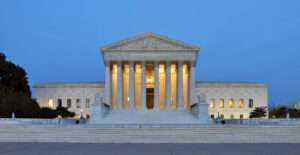
The Supreme Court. (Joe Ravi/Wikimedia/CC-BY-SA 3.0)
Michael Rappaport is one of the nation's most prominent originalist legal scholars, and author of such important works as Originalism and the Good Constitution (coauthored with John McGinnis). For those who care, he's also considerably to the right of me politically. In a recent post at the Originalism Blog, he skewers the Supreme Court's recent ruling in Trump v. Anderson, the Section 3 disqualification case:
The Supreme Court has decided by a 9-0 vote that former President Donald Trump cannot be kept off the ballot. In my view, the reasoning in the opinion is a disaster…. While I agree with the Court that Trump cannot be disqualified, it is not because of the nonoriginalist, made-up argument in the majority and concurring opinions. It is because section 3 applies to those who engage in an insurrection, not those who aid and assist a riot.
In my view, section 3 is self-enforcing. This follows pretty clearly from the constitutional text. Section 3 prohibits an oath-breaking insurrectionist from serving in certain offices. State officials are required by oath to respect this constitutional provision. That Congress is specifically given the authority to eliminate the bar by a two-thirds vote makes this even clearer. The section simply cannot be read as saying that only Congress or the federal government can enforce it.
The opinion relies upon spurious, non-textual reasoning. It says that the 14th Amendment restricts state autonomy and therefore it is unlikely that the state was allowed to enforce it against federal candidates. But the 14th Amendment restricts state autonomy only as to the rules it sets. For example, it prohibits states from violating the equal protection of the laws. But it does not prohibit the state from enforcing the equal protection clause. On the contrary, the state can pass a law that enforces the equal protection clause…..
The Supreme Court opinion says that nothing in the Constitution delegates to the states the power to disqualify federal candidates. But this is obviously mistaken under the original meaning. The Constitution says that "each State shall appoint, in such Manner as the Legislature thereof may direct, a Number of Electors, equal to the whole Number of Senators and Representatives to which the State may be entitled in the Congress." This provision allocates to the states the power how to run their presidential elections. State legislatures could decide not to hold elections at all but could assign their electoral votes to the candidate of their choosing. States have broad authority to structure their presidential elections. While this authority might be subject to other constitutional limitations, the Court does not point to any such limitation here.
Some might question whether the Constitution could really have allowed individual states to disqualify people for insurrections, given how difficult it might be to define this term. But the Constitution did not leave this issue unaddressed. Congress has the power, under section 5 of the 14th Amendment, to preempt state disqualification by creating a federal procedure for such disqualifications. Even without such federal legislation, the Supreme Court has the authority to hear challenges to the state determinations, as it did in this case (although it is possible that such challenges might not lead to complete national uniformity as to section 3 questions….).
It is true that presidential elections have come to be viewed as national elections. This view has led many people to view the electoral college as inconsistent with such national elections and to argue for a national popular vote method instead. But that is not the system that the Constitution establishes. Instead, the Constitution grants significant authority to states over presidential elections. That is the original meaning.
I think Mike is right here on virtually all counts. I offered some similar criticisms of the Court's ruling here.
As Mike suggests, even if the Court had ruled against Trump on the self-execution issue, he could have potentially avoided disqualification on one of several other grounds, one of which is the argument that the January 6 attack was not an "insurrection," but merely some other kind of violence.
In my view, the the January 6 attack on the Capitol was pretty obviously an insurrection (see also here and here). The argument on the other side is so weak that Trump's lawyer Jonathan Mitchell chose not to advance it in his brief before the Supreme Court.
Mitchell did make the much stronger argument that Trump's involvement in the attack wasn't great enough to qualify as "engaging" in insurrection. I think that was the best argument on Trump's side of the case, though I also think the Colorado Supreme Court offered compelling reasons to reject it.
Be that as it may, Michael Rappaport is right about the federal Supreme Court's reliance on the claim that Section 3 isn't self-executing with respect to candidates for federal office. It is, as he puts it, "an unprincipled, pragmatic resolution" of the case, one that cannot be justified on originalist grounds.
I am less convinced he is right to suggest this outcome occurred because the Court's "self-interest was severely implicated." Perhaps the justices were driven by genuine, even if overblown, fears that letting states adjudicate Section 3 issues with respect to candidates for federal offices would lead to a chaotic "patchwork" of conflicting rulings. But if so, that's still a triumph of consequentialist "living constitution" reasoning over originalism.
Today a unanimous panel of the U.S. Court of Appeals for the D.C. Circuit affirmed the dismissal of a lawsuit filed by former cobalt miners against several tech companies for acquiring cobalt that may have been mined using forced labor. Judge Neomi Rao wrote for the panel, joined by Judges Pillard and Srinivasan.
Cobalt is an essential metal for producing the lithium-ion batteries that power modern electronics. Nearly two-thirds of the world's cobalt comes from the Democratic Republic of the Congo ("DRC"), where some of the metal can be traced to informal mining by Congolese nationals digging with primitive tools in unsafe conditions. Many of these informal miners are children, pressured into work by extreme poverty.
This lawsuit seeks to impose liability on five American technology companies for "forced labor" used for informal cobalt mining in the DRC. The plaintiffs, former cobalt miners injured in mining accidents and their representatives, sued the companies under the Trafficking Victims Protection Reauthorization Act of 2008 ("TVPRA"). That statute makes it unlawful to "participat[e] in a venture" that engages in forced labor. The plaintiffs allege the technology companies participated in a venture with their cobalt suppliers by purchasing the metal through the global supply chain. The district court dismissed the suit for a variety of reasons, including lack of Article III standing and failure to state a claim.
Although we conclude that the plaintiffs have standing to pursue their damages claims, they have failed to state a claim for relief. Purchasing an unspecified amount of cobalt through the global supply chain is not "participation in a venture" within the meaning of the TVPRA. We therefore affirm the district court's dismissal of the complaint under Rule 12(b)(6).
Back in January, Politico reported that some Democrats, including in the White House, were hoping Justice Sonia Sotomayor would retire this year.
Some Democrats close to the Biden administration and high-profile lawyers with past White House experience spoke to West Wing Playbook on condition of anonymity about their support for Sotomayor's retirement. But none would go on the record about it.
They worried that publicly calling for the first Latina justice to step down would appear gauche or insensitive. Privately, they say Sotomayor has provided an important liberal voice on the court, even as they concede that it would be smart for the party if she stepped down before the 2024 election. There is a firm belief that a Senate controlled by Republicans will simply not confirm a Biden-picked Court nominee should he run and win reelection. Should a vacancy occur under a Republican run Senate with a Republican in the White House, it could expand the current 6-3 conservative majority into an even more powerful 7-2 split.
But getting party leaders to speak more openly about those realities has been difficult.
Party leaders may be unwilling to broach the topic, but Josh Barro isn't. He writes:
Sonia Sotomayor will turn 70 this June. If she retires this year, Biden will nominate a young1 and reliably liberal judge to replace her. Republicans do not control the Senate floor and cannot force the seat to be held open like they did when Scaliadied. Confirmation of the new justice will be a slam dunk, and liberals will have successfully shored up one of their seats on the court — playing the kind of defense that is smart and prudentwhen your only hope of controlling the court again relies on both the timing of the deaths or retirements of conservative judges, plus not losing your grip on the three seats you already hold.
But if Sotomayor does not retire this year, we don't know when she will next be able to retire with a likely liberal replacement. It's possible that Democrats will retain the presidency and the Senate at this year's elections, in which case the insurance created by a Sotomayor retirement won't have been necessary. But if Democrats lose the presidency or the Senate this fall (or both) she'll need to stay on the court until the party once again controls both. That could be just a few years, or it could be a while — for example, Democrats have previously had to wait 14 years from 1995 to 2009, and 12 years from 1981 to 1993.2 In other words, if Sotomayor doesn't retire this year, she'll be making a bet that she will remain fit to serve through age 82 or 84 — and she'll be taking the whole Democratic Party coalition along with her in making that high-stakes bet.
If Democrats lose the bet, the court's 6-3 conservative majority will turn into a 7-2 majority at some point within the next decade. If they win the bet, what do they win? They win the opportunity to read dissents written by Sotomayor instead of some other liberal justice. This is obviously an insane trade. Democrats talk a lot about the importance of the Court and the damage that has been done since the court has swung in a more conservative direction, most obviously including the end of constitutional protections for abortion rights. So why aren't Democrats demanding Sotomayor's retirement?
Some may worry that Senate Republicans would seek to block the confirmation of a replacement. I doubt this is a serious threat. For one thing, Senate Republicans under Mitch McConnell demonstrated that a committed majority can get a nominee through. For another, were Sotomayor to announce plans to retire, she could make it contingent upon the confirmation of a replacement, and rescind her retirement should a replacement not get confirmed in time.
All this said, I doubt Justice Sotomayor will retire this year (not that I would be one to know). If she were to make such a decision, it would likely be communicated to the White House this spring, and announced at the end of the Supreme Court's term.
Utah Senator Orrin Hatch, 1977 to 2019, was a stalwart supporter of originalist, rule of law judges through many a slugfest Senate confirmation fight. Senator Hatch fought for traditional American values, and, like Donald Trump, he always wanted to Make America Great Again. Sadly, when Hatch retired due to old age, the feckless RINO Mitt Romney, was elected to replace him. Romney voted twice to impeach President Donald Trump, and he was a longtime loser. Romney lost a winnable U.S. Senate race to Ted Kennedy in 1994 in Massachusetts by promising to be more pro-gay rights than Kennedy, and by being unable to defend his outsourcing of American jobs to China when he was a businessman. And, he lost the U.S. Presidency to Barack Obama, in 2012, again because of his outsourcing of American jobs to China as a businessman and because he implausibly claimed to be the leading social conservative in the race never bothering to explain his change of mind from 1994. Mitt Romney always was, and always will be remembered as a big time loser. Now is the perfect time to consider the candidacy of Senator Hatch's oldest and most conservative son, Brent Hatch.
Brent is a first rate lawyer who graduated from Columbia Law School and who was my co-clerk for Judge Robert H. Bork in 1984-1985 on the United States Court of Appeals for the D.C. Circuit. After clerking we both had the great privilege of working as political appointees in senior jobs in Ed Meese's Justice Department under President Ronald Reagan. Brent went on to serve as an associate White House Counsel under the senior President Bush. He became one of my closest friends and was a groomsman at my wedding in 1995.
Brent loves to hunt and has many proud trophies including of a huge stuffed Wild Boar that he shot himself. He is as ardent as it gets when it comes to Second Amendment rights. Brent is also a former Bishop in the Church of Jesus Christ of Latter Day Saints, and he is as socially conservative as was Judge Bork. Brent is a brilliant trial lawyer who started his own law firm and who built up a fortune in the process of doing so. He has lived in Utah continuously for the last thirty years in a hill top mansion that overlooks Salt Lake City. But, what Brent really loves doing is driving his motorcycles, all terrain vehicles, and working in his yard. When my daughter went out to visit him a few years ago, he signed her up for an axe-throwing contest where you got a prize if you hit the bullseye. With Brent's coaching, my daughter hit the bullseye and won the prize. She also had a blast practicing law with Brent at his firm.
Brent has served for three decades as a member of the 12 person Board of Directors of the Federalist Society -- a hot shot legal conservative organization. Brent has been an invaluable member of the Board of Directors, especially when financial matters arise. He is a great and good friend.
Like his Dad, Brent wants to see more lawyers like Judge Robert H. Bork and Justices Antonin Scalia and Clarence Thomas on the Supreme Court. Brent is a staunch and committed originalist. If he is elected, Senate Republicans should give him back his father's seat on the Senate Judiciary Committee. Like his father, Brent is a real fighter, but unlike his father Brent cracks jokes all the time and can talk with everyday Americans. Brent was the first person who told me that he thought Donald Trump was going to win the presidency in 2016. Brent is actually much more conservative than his father, and he is a real populist to boot. The people of Utah have a chance this year to send the best possible Republican Senator to Washington, D.C. I certainly hope they take advantage of this opportunity to reward talent and conservative principles by electing a man I have known very well and have admired for almost forty years.