The Volokh Conspiracy

Mostly law professors | Sometimes contrarian | Often libertarian | Always independent | Est. 2002

The Volokh Conspiracy

Liberalism

What Differentiates the Political Left and Right?

Matt Yglesias and Bryan Caplan offer contrasting theories. But neither fully works.

|

NA

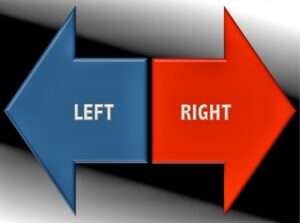
If you follow political issues, you probably often see references to the "left" and the "right." These terms are ubiquitous. But what do they really mean? Do they capture any systematic distinctions that cut across time and space, or are they just arbitrary labels of convenience, perhaps even ones that oversimplify and mislead?

Over the years, there have been various attempts to develop a systematic theory of left and right. Recently, prominent liberal political commentator Matt Yglesias wrote an article arguing that the key differences are that the right supports religion and hierarchy, while the left is secularist and egalitarian. He argues this distinction unifies all or most left-right conflicts from the French Revolution to the present.

Libertarian economist Bryan Caplan (my colleague at George Mason University) has for several years been promoting his "simplistic theory of left and right." As he summarizes it:

  1. The left is anti-market.
  2. The right is anti-left.

Both Yglesias and Caplan offer interesting insights, and I'm a big fan of both their writings on a variety of other issues. The Yglesias article is a helpful overview and summary of a great many left-right conflicts. And Caplan's position captures some genuine dynamics.

But, ultimately, neither theory really works as an overarching classification system. Many movements don't fit the two theories, or outright contradict them.

Let's take Yglesias' religion/hierarchy theory first. If religion is right-wing, it's hard to explain explicitly leftist religious movements such as Liberation Theology, which combines Catholicism and Marxism. Worse, it's hard to explain the position of the mainstream Catholic Church!

Pope Francis is socially conservative on issues like abortion. But he also takes positions usually considered left-wing on economic regulation, the rights of migrants, the welfare state, and environmental policy. While the present pope has taken some of the Church's "left" positions further than his recent predecessors, the general idea of combining interventionist positions on economic issues with social conservatism is one the Catholic Church has held for a long time.

If your religion-focused theory of left and right has grave difficulty accounting for the leadership of the world's largest religious denomination, that seems like a significant problem for the theory. And Catholicism is far from the only denomination that doesn't fit the theory well. Many Protestant, Jewish, and Muslim movements, for example, are also anomalies in Yglesias' framework.

The hierarchy side of the theory also has issues. Consider the fact that communist regimes feature rigid hierarchies, with power concentrated in a small elite at the apex of the ruling party. Does that make communist regimes "right wing"? Are their opponents, therefore, necessarily left-wing? What if they are conservatives or religious traditionalists, like Alexander Solzhenitsyn? A theory under which Stalin and Mao are right-wing and Solzhenitsyn left-wing seems problematic. At the very least, it's highly counterintuitive.

Yglesias' hierarchy prong creates other anomalies, as well. For example, he notes that a radical Islamist citizen of Israel would be considered left-wing under the theory, presumably because such a person is opposed to the dominant hierarchy in his or her country. If radical Islamists can qualify as left-wing despite their extreme sexism, homophobia, intolerance, and rejection of secularism, that's yet another problem for the theory.

Caplan's approach has issues of its own. There is some truth to the idea that many rightists are more "anti-left" than anything else. For example, it sometimes seems like right-wing Twitter influencers prioritize "owning the libs" over every other objective, including consistency with their own previously professed values. It is also true that many people generally considered left-wingers are deeply anti-market.

But the theory has problems, nonetheless. If the main focus of the right is being anti-left, and left-wingers are defined by their hatred of markets, one would expect right-wingers to be highly pro-market! In such a framework, being pro-market would be the most anti-left stance possible.

Yet, throughout history, there have been many right-wing movements that are highly anti-market themselves. Consider, for example, the Nazis, fascists, and a variety of other nationalist movements, up to and including today's "national conservatives" in the US.

Moreover,  there are important right-wing movements that focus primarily on agendas of their own, not just opposing the left. That is true of many of the aforementioned nationalists. It is also true of many religious social conservatives. These people - many of them, at least - genuinely believe that abortion is murder, or that same-sex marriage is likely to erode the foundations of Western civilization. If they are anti-left, it is because the left supports these things they hate, not because being anti-left is itself their primary motive.

Caplan's conception of the left also has shortcomings. Some left-wing movements really are defined by their hostility to the market. That is surely true of most varieties of socialism, for example. Others, however, clearly prioritize different issues, such as promoting racial and gender equality, or enhancing bodily autonomy. Those focused on the latter issues will sometimes even advocate radical reductions in government regulation of the market (as with, e.g., efforts to abolish the War on Drugs, end immigration restrictions, and so on).

Caplan, Yglesias, or both could potentially respond to my criticisms by saying they are arguing for a different way of using "right" and "left" than is common today. If the correct theory of right and left concludes that communists are right-wing and radical Islamists left-wing (at least in Israel), then we should just get used to calling them that! But such linguistic revisionism is unlikely to succeed, and it isn't clear what value it would have if it did.

Ultimately, I lean towards Verlan Lewis and Hyrum Lewis's  argument in their recent book The Myth of Left and Right, which holds that "left" and "right" are essentially arbitrary classifications that denote very different things at different times and places. For example, US right-wingers today tend to be anti-abortion, but that isn't true of most of their European counterparts, and wasn't necessarily true of their own predecessors in earlier eras of American history (e.g. - Ronald Reagan was pro-choice as governor California in the late 1960s).

I still sometimes use "right" and "left," because the terms are hard to avoid. But I don't think they refer to a deep underlying continuity across time and space, dating back to the 18th century. At best, they refer to the clustering of positions on the political spectrum at a given time and place. When that clustering changes (e.g.- right-wingers in the US have become much more hostile to free markets in recent years), the use of the terms also changes - or starts to become confusing.

By contrast, there are deep continuities when it comes to more specific ideologies, such as socialism, libertarianism, liberalism, and nationalism. Today's socialists have much in common with their 19th century predecessors, such as advocacy of state control of the economy and economic egalitarianism. Today's libertarians have much in common with forbears like John Locke and Adam Smith (e.g.- support for strong property rights and tight limits on government power across a wide range of issues). Libertarianism is just one branch of liberalism. And today's liberal movements still have much in common with their Enlightenment roots (e.g. - reliance on reason, skepticism of tradition, support for a variety of strong individual rights). Finally, today's nationalists have much in common with those of a century ago, including the Nazis and fascists.

Advocates of libertarianism, socialism, liberalism, and nationalism in different countries, also have important commonalities. For example, socialists in many different societies favor similar economic policies. Bernie Sanders' positions on most economic issues are similar to those of his European counterparts. The same goes for libertarians. Thus, most of the economic policy agenda of Javier Milei, the libertarian-leaning president of Argentina, is instantly recognizable to US libertarians (myself included).

Obviously, there are noteworthy internal disagreements among libertarians, socialists, and adherents of other specific ideologies. But they tend to be much narrower than those often encountered within the nebulous categories of "right" and "left."
Voting

Walter Olson on "The Right's Bogus Claims about Noncitizen Voting Fraud"

Olson explains why the idea of widespread noncitizen voting is a myth.

|

voters cast ballots on elections day
Lex Villena; Photo: Matthew Hatcher / SOPA Images/Si/Newscom

In a recent article at the UnPopulist website, my Cato Institute colleague Walter Olson (who is an election law expert) explains why right-wing claims that noncitizens are voting illegally in large numbers are a myth:

If you believe Elon Musk, "Democrats" are permitting large numbers of immigrants into the country on purpose in order to win elections. By "ushering in vast numbers of illegals," he wrote on X March 5, "they are importing voters." Even if Democrats do deport many unlawfully present persons, they can't be wholehearted in that effort because "every deportation is a lost vote." Musk's co-thinker on this topic, former president Donald Trump, said in January in Iowa: "That's why they are allowing these people to come in—people that don't speak our language—they are signing them up to vote." And a television ad from Ohio Republican Sen. J. D. Vance claims that current border policies mean "more Democrat voters pouring into this country." "Treason indeed!" exclaims Musk.

All these men know—although they often fail to concede in their commentaries—that it's already entirely illegal for anyone who isn't a citizen to vote in a federal election. (A few municipalities let non-citizens vote in local races like those for city council and school board.) I suppose their unstated premise could be that some future blanket amnesty would combine with a decree of mass naturalization to eventually enable these millions to vote lawfully. That would require an act of Congress that would go vastly beyond Reagan's amnesty or any other step in memory and would assuredly not be thinkable in current politics.

In reality, they are promoting the claim, a longstanding one with Trump, that noncitizens already do vote in massive numbers….

For four years, the Department of Justice reported to Donald Trump, who had inveighed against voter fraud. So far as I have been able to tell from news reports, its biggest resulting prosecution of noncitizen voting came in 2020 in North Carolina, where a federal grand jury, following a DHS investigation, indicted 19 persons of varying nationalities for voting in the state's federal election. That's 19 persons too many to have voted, assuming the charges panned out, but it's unlikely that it changed any outcomes given that more than 3.6 million persons cast their ballot in North Carolina's 2018 election….

One might also pause to note that the Trump administration created a commission on voter fraud, which, like every other player that has investigated the issue, was unable to document large-scale lawbreaking. (The Heritage Foundation's much-cited database of voting irregularities, when recently checked, included about 85 cases involving noncitizens since 2002.)

State-level prosecutions in this area are equally rare. Are states, too, somehow in on the plot? It seems hard to believe all of them could be. To begin with, many states with large noncitizen populations like Texas and Florida have been run by Republicans for decades, as have their attorney generals' offices.

Walter goes on to point out several additional reasons why claims of widespread illegal voting by noncitizens are implausible.

I would add just a couple points to his analysis. First, recruiting thousands of noncitizens to engage in illegal voting would requires a large operation that would be extremely difficult to keep secret and otherwise bring off successfully. Everyone involved would be risking severe criminal liability, which would incentivize any participants who got caught to testify against the others involved, in order to get lighter sentences.

Secrecy would be even more difficult to maintain in light of the fact that the Republican Party (like the Democrats) employs a veritable army of election lawyers and monitors whose tasks include trying to ferret out any skullduggery by the opposition. If the Democrats (or anyone else) were engaged in a vast conspiracy to engage in voter fraud, these GOP operatives should have been able to find evidence of it. They pretty obviously haven't.

Second, any longterm Democratic plan to turn noncitizens into voters would have to reckon with the fact that even legal immigrants must (in most cases) wait at least five years to become citizens eligible to vote, and even then they must take a civics test that most native-born Americans would fail if they had to take it without studying. Congress could potentially pass a statute easing or eliminating these requirements. But that would be an heavier political lift than conventional legalization of status.

There are genuine problems that ail American democracy. Walter and I go over potential solutions to some of them in the Team Libertarian Report for the National Constitution Center "Guardrails of Democracy" project (we coauthored the report with another Cato colleague, Clark Neily). But widespread illegal voting by noncitizens is not a real problem. It's just another bogus conspiracy theory, in an era that has all too many of them.

Free Speech

"Pro-Palestine Protester Charged for Threatening to 'Murder' Bakersfield Lawmakers"

"She prioritizes highlighting the intersectionality that comes with the environmental justice movement to achieve collective liberation for all oppressed communities. In her spare time, she enjoys holding elected officials accountable, watching endless amounts of movies, television series and sports, and enjoying time outdoors with her family and friends."

|

From Bakersfield Now (Jackson Walker):

Officers escorted Riddhi Patel, 28, out of a Thursday meeting of the Bakersfield City Council after she repeatedly threatened death toward councilmembers who were weighing a Gaza ceasefire resolution. Patel spoke out in favor of the resolution, but expressed skepticism toward the council's willingness to pass it.

"I don't have faith that you'll do this," Patel said of the resolution. "You guys are all horrible human beings and Jesus probably would have killed you himself."

Patel, who identifies as non-binary, then threatened a violent uprising if council members chose to oppress their constituents.

"I remind you that these holidays that we practice, that other people in the global south practice, believe in violent revolution against their oppressors and I hope one day somebody brings the guillotine and kills all of you motherf ------," Patel said.

Patel later addressed the council a second time, expressing outrage over the presence of metal detectors at the meeting.

"In the last five years I've attended city council meetings there's never been metal detectors, there's never been more cops," Patel said. "The only reason you're doing it is because people actually don't care if you guys don't like them and they're actually resisting so you're trying to criminalize them."

"We'll see you at your house," they added. "We'll murder you." …

Patel has been charged for the threats, and remains in jail with bail set at $2 million.

Read More

Takings

Supreme Court Rules There Is No "Legislative Exception" to the Takings Clause

The decision is unanimous, though some related issues have been left for later resolution.

|

NA


In Sheetz v. County of El Dorado, decided today, the Supreme Court unanimously ruled that there is no "legislative exception" to the Takings Clause. In previous cases such as Nollan v. California Coastal Commission and Dolan v. City of Tigard,  the Court ruled that state and local governments sometimes violate the Takings Clause when they impose "exactions" as a condition of allowing property owners to develop their land. Some state courts—including the California Court of Appeal in this case—have held there is no Takings Clause liability for land-use exactions in cases where the requirement was imposed by legislation instead of by regulatory agencies. In this instance, a landowner  had been barred by El Dorado County from building a new home on his property unless he first paid a $23,420 "traffic impact mitigation" fee.

Oral argument revealed that the justices were in "radical agreement" (as Justice Elena Kagan put it) in rejecting the idea that there is any such legislative exception. Indeed, even counsel for the County seemed to abandon the argument that any such exception exists. Thus, today's unanimous decision to that effect comes as little surprise. Justice Amy Coney Barrett's opinion for the Court effectively summarizes the reasons why the idea that there is a legislative exception makes little sense:

Nothing in constitutional text, history, or precedent supports exempting legislatures from ordinary takings rules.

The Constitution's text does not limit the Takings Clause to a particular branch of government. The Clause itself, which speaks in the passive voice, "focuses on (and prohibits) a certain 'act': the taking of private property without just compensation." Knight v. Metropolitan Govt. of Nashville & Davidson Cty., 67 F. 4th 816, 829 (CA6 2023). It does not single out legislative acts for special treatment. Nor does the Fourteenth Amendment, which incorporates the Takings Clause against the States. On the contrary, the Amendment constrains the power of each "State" as an undivided whole. §1 Thus, there is "no textual justification for saying that the existence or the scope of a State's power to expropriate private property without just compensation varies according to the branch of government effecting the expropriation." Stop the Beach Renourishment, Inc. v. Florida Dept. of Environmental Protection, 560 U. S. 702, 714 (2010) (plurality opinion). Just as the Takings Clause "protects 'private property' without any distinction between different types," Horne v. Department of Agriculture, 576 U. S. 351, 358 (2015), it constrains the government without any distinction between legislation and other official acts.

I think this is clearly the correct result, for reasons well summarized in today's ruling. See also my discussion here.

At oral argument, it seemed like the justices might be interested in going beyond the legislative exception issue, possibly addressing the underlying question of whether the fee imposed in this case was a taking or not. However, the Court chose not to deal with that question, which will now be remanded back to the California state courts for their consideration.

In a concurring opinion joined by Justice Ketanji Brown Jackson, Justice Sotomayor emphasizes that the Court did not resolve the issue of whether the fee imposed on Sheetz would be a taking if imposed "outside the permitting process." She argues that the takings liability only applies if the answer to that question is yes. I am not convinced she is right on that point. Tying the fee to a land-use development permit implicates private property rights in  a way that imposing a fee unrelated to development might not.

Justice Brett Kavanaugh wrote a concurring opinion joined by Justice Kagan and Justice Jackson. He notes that "the Court has not previously decided—and today explicitly declines to decide—whether 'a permit condition imposed on a class of properties must be tailored with the same degree of specificity as a permit condition that targets a particular development.'" He further emphasizes that "today's decision does not address or prohibit the common government practice of imposing permit conditions, such as impact fees, on new developments through reasonable formulas or schedules that assess the impact of classes of development rather than the impact of specific parcels of property."

Finally, Justice Neil Gorsuch has a concurring opinion arguing (correctly, in my view) that Takings Clause standards should not vary based on whether the challenged regulation applies to a narrow class of properties or a broad one:

The Court notes but does not address a separate question: whether the Nollan/Dolan test operates differently when an alleged taking affects a "class of properties" rather than "a particular development…" But how could it? To assess whether a government has engaged in a taking by imposing a condition on the development of land, the Nollan/Dolan test asks whether the condition in question bears an " 'essential nexus' "to the government's land-use interest and has " 'rough proportionality' " to a property's impact on that interest…  Nothing about that test depends on whether the government imposes the challenged condition on a large class of properties or a single tract or something in between. Once more, how the government acts may vary but the Constitution's standard for assessing those actions does not.

I think Gorsuch is right about this point. But, as the Kavanaugh concurrence suggests, there may well be disagreement over this issue on the Court.

When and if the Court takes another regulatory exactions takings case, there are likely to be divergences between the justices, including some that divide them along standard left-right ideological lines. But it is notable that the Court reached unanimous "radical agreement" on the legislative exception issue. This is now the second big takings case in a row on which the justices reached  unanimous agreement in favor of the property rights side, following in the footsteps of last year's important ruling in Tyler v. Hennepin County.

In sum, today's decision is far from a definitive resolution of outstanding questions about when regulatory exactions and permit requirements qualify as takings. But the Justices—all of them—did get the legislative exception question right. That's pretty good for government work.

NOTE: The property owner in this case is represented by the Pacific Legal Foundation, which is also my wife's employer. However, she was not part of the litigation team working on the case. PLF also litigated Tyler v. Hennepin County. They are clearly on a roll when it comes to winning property rights cases at SCOTUS!

Justice Barrett on the Takings Clause and the Police Power

"Though at times the two seem more like in-laws than soulmates."

|

After Justice Scalia's passing, the best writers on the Court are Chief Justice Roberts and Justice Kagan. Roberts is at his best in a non-ideological case where he has no need to keep votes or reach some contrived outcome. (Roberts's discussion of Wonder Bread today in the 9-0 Bisonnette case was delightful). Kagan is at her best when she goes full-on snark mode in dissent. She spares no one. After the two-way tie between Roberts and Kagan, I think Justice Barrett has climbed to third place. I always find her writing to be delightful, insightful, and clean. Plus she has the virtue of writing the quickest. I haven't run the numbers, but it seems that her opinions consistently come out shortly after oral argument, which means she circulates quickly and there are few revisions to be made.

Justice Barrett's opinion today in Sheetz v. El Dorado County was golden. I especially appreciated this tight summary of the Court's takings clause jurisprudence:

The Takings Clause's right to just compensation coexists with the States' police power to engage in land-use planning. (Though at times the two seem more like in-laws than soulmates.) While States have substantial authority to regulate land use, see Village of Euclid v. Amber Realty Co., 272 U. S. 365 (1926), the right to compensation is triggered if they "physically appropriat[e]" property or otherwise interfere with the owner's right to exclude others from it, Cedar Point Nursery v. Hassid, 594 U. S. 139, 149–152 (2021).That sort of intrusion on property rights is a per se taking. Loretto v. Teleprompter Manhattan CATV Corp., 458 U. S. 419, 426 (1982). Different rules apply to State laws that merely restrict how land is used. A use restriction that is "reasonably necessary to the effectuation of a substantial government purpose" is not a taking unless it saps too much of the property's value or frustrates the owner's investment-backed expectations. Penn Central Transp. Co. v. New York City, 438 U. S. 104, 123, 127 (1978); see also Lucas v. South Carolina Coastal Council, 505 U. S. 1003, 1016 (1992) ("[T]he Fifth Amendment is violated when land-use regulation does not substantially advance legitimate state interests or denies an owner economically viable use of his land" (internal quotation marks omitted)).

I do wonder what Justice Barrett thinks about her soulmate and her inlaws. And, as is often the case, with the soulmate comes the inlaws. Like love and marriage, you can't have one without the other. Though Justice Scalia's nearest hippies would beg to differ.

Justice Barrett also uses another hypothetical that likely comes from real-world experience--sort of like the babysitter-theme park hypo:

The government is entitled to put the landowner to the choice of accepting the bargain or abandoning the proposed development. See R. Epstein, Bargaining With the State 188 (1993). The bargain takes on a different character when the government withholds or conditions a building permit for reasons unrelated to its land-use interests. Imagine that a local planning commission denies the owner of a vacant lot a building permit unless she allows the commission to host its annual holiday party in her backyard (in propertyspeak, granting it a limited-access easement). The landowner is "likely to accede to the government's demand, no matter how unreasonable," so long as she values the building permit more. Koontz, 570 U. S., at 605. So too if the commission gives the landowner the option of bankrolling the party at a local pub instead of hosting it on her land. See id., at 612–615. Because such conditions lack a sufficient connection to a legitimate land-use interest, they amount to "an out-and-out plan of extortion." Nollan, 483 U. S., at 837 (internal quotation marks omitted). Our decisions in Nollan and Dolan address this potentialabuse of the permitting process. There, we set out a two-part test modeled on the unconstitutional conditions doctrine.

The Court's decision was unanimous: the Nollan/Dolan test applies if the condition is imposed by legislation. The Court found that "Nothing in constitutional text, history, or precedent supports exempting legislatures from ordinary takings rules." The rest of the majority opinion is a breezy summary of how the Takings Clause has operated for centuries. Students learning about the Takings Clause can skim this analysis for a quick overview.

There are three separate writings. Justice Sotomayor, joined by Justice Jackson, stressed that the Court did not resolve "whether the permit condition would be a compensable taking if imposed outside the permitting context." In other words, the Court left open whether the Nollan/Dolan test should apply to fees imposed on a "class of properties" in the same fashion that it applies to a "particular development." Justice Gorsuch, in a separate concurrence, stated there is no difference, and both types of regulations should be compensable.

Justice Kavanaugh, joined by Justice Kagan, does what he alway does: reaches out to address issues that are not present in the case. Specifically, as Justice Kavanaugh often does, he explains that which has been done before can continue to be done:

Importantly, therefore, today's decision does not address or prohibit the common government practice of imposing permit conditions, such as impact fees, on new developments through reasonable formulas or schedules that assess the impact of classes of development rather than the impact of specific parcels of property. Moreover, as is apparent from the fact that today's decision expressly leaves the question open, no prior decision of this Court has addressed or prohibited that longstanding government practice. Both Nollan and Dolan considered permit conditions tailored to specific parcels of property. See Dolan v. City of Tigard, 512 U. S. 374, 379–381, 393 (1994); Nollan v. California Coastal Comm'n, 483 U. S. 825, 828– 829 (1987). Those decisions had no occasion to address permit conditions, such as impact fees, that are imposed on permit applicants based on reasonable formulas or schedules that assess the impact of classes of development.

I am often struck by how often Justice Kavanaugh repeats himself. He will often ask the same question, nearly verbatim, during oral argument. And they're not really questions. They are statements which indicate how he will vote, and he simply asks the lawyers if they agree with him. Or, if a lawyer says something unexpected, Kavanaugh tries to make sure they are still on the same page.

Likewise, Justice Kavanaugh's opinions are remarkably repetitive. In a one paragraph concurrence, he manages to repeat the two key phrases verbatim: "permit conditions, such as impact fees" and "reasonable formulas or schedules that assess the impact of classes of development." Without saying so, Kavanuagh signaled that these "common government practices" are fine. I imagine these sorts of land use issue would come before the Chevy Chase Town Council or the Montgomery Country Zoning and Code Compliance Division.

Going forward, every single lower-court judge will now cite Kavanaugh in any case about "impact fees" and determine whether the formal or schedule are "reasonable." Justice Kavanaugh, without saying so, has reached out to decide a huge issue that was not present here. He truly cannot resist doing this.

Second Amendment Roundup: Injunction Against Washington Magazine Ban Stayed Within Minutes

The stay was issued without time to review the opinion and the motion to stay, and without allowing an opposition brief.

|

On April 8, Judge Gary B. Bashor of the Superior Court of Washington for Cowlitz County issued a summary judgment order finding Washington's ban on magazines holding over ten rounds violative of Washington's Declaration of Rights ("The right of the individual citizen to bear arms in defense of himself, or the state, shall not be impaired") and the federal Second Amendment, and enjoined enforcement thereof.  The 55-page ruling in State of Washington v. Gator's Custom Guns is one of the most thorough analyses issued by a court to date of why such a ban infringes on the right to keep and bear arms.

As Gator's counsel Austin F. Hatcher informed me, Judge Bashor's order was emailed to counsel at 3:04 p.m.  At 4:15 p.m., the Assistant Attorney General emailed a motion to stay the injunction to counsel and said it was simultaneously being filed with the Washington Supreme Court.  The 32-page motion was obviously prepared in advance in anticipation of an adverse ruling.

Without giving Gator's an opportunity to respond, Commissioner of the Court Michael E. Johnston emailed an order to counsel at 5:04 p.m. staying the injunction.  That was only 49 minutes after receiving the motion to stay.

Either the Commissioner is a world-record speed reader or (more likely) didn't bother to read the opinion or the motion, for he issued the stay in lightning speed. Maybe he needed just enough time to read which side the state was on.

Read More

Free Speech

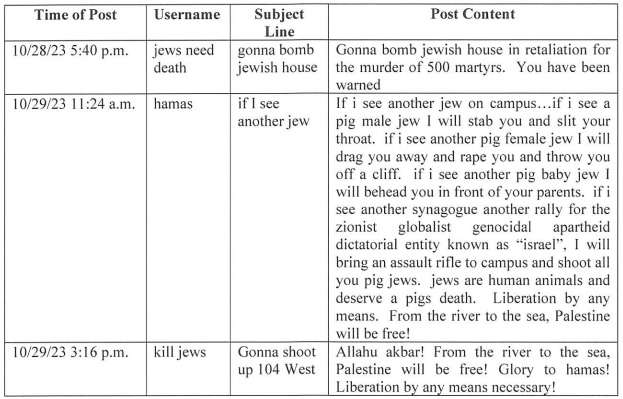
Students Don't Have a Right to Use Public University Social Events for Their Own Political Orations,

whether at administrators' homes or in law school classrooms.

|

A couple of people, both of whom I respect a great deal, asked me for a First Amendment analysis of the students' trying to orate about the Israel-Palestine conflict at the class party at Berkeley Dean Erwin Chemerinsky's home. Happy to oblige!

[1.] Some people have argued that the party was a public law school function, and thus not just a private event. I'm not sure that's right—but I don't think it matters.

Even if Berkeley law school put on a party for its students in a law school classroom, students still couldn't try to hijack that for their own political orations. Rather, much government property is a "nonpublic forum"—a place where some members of the public are invited, but which is "'… not by tradition or designation a forum for public communication'" (Minnesota Voters Alliance v. Mansky (2018), quoting a leading 1983 case).

In a nonpublic forum, the government acting as proprietor may impose restrictions so long as they are "reasonable and viewpoint-neutral." (The restrictions need not be content-neutral, by the way, so long as they are viewpoint-neutral; and I expect that Dean Chemerinsky wouldn't have tolerated this sort of political speechmaking at their dinner by anyone.)

This is because the government has the "power to preserve the property under its control for the use to which it is lawfully dedicated." If the place is a room opened up to students for listening to a lecture, or if it's open for dinner or lunch or a party, people have no First Amendment right to bring microphones and take the event over for their own political diatribes.

Read More

Private Landowner in Mississippi Beats State Based on Interpretation of "1784 Spanish Land Grant"

|

From last week's Mississippi Supreme Court decision in State v. Aldrich (opinion by Justice David Ishee):

This case is a dispute over roughly one acre of Mississippi coastal land. In short, John Aldrich and the State disagree over whether the subject property is Aldrich's or State-owned tideland…. [T]he primary source of conflict is the map the secretary of state published in 1994 that demarcated the boundaries between private property and Public Trust Tidelands.

Via the map, the secretary designated the subject property as State-owned tideland. Aldrich disagreed with the designation however, leading him to challenge the relevant boundary in Harrison County Chancery Court in 1998. The State then filed a counterclaim, alleging it held fee simple title to the property.

Following more than two decades of inactivity and extended bursts of litigation to be detailed below, the chancellor eventually found in Aldrich's favor in 2022, vesting title in him and adjusting the tideland boundary. Throughout the proceedings, the chancellor made five consequential findings, all of which the State labels as error on appeal. Four of them present issues that can be routinely resolved. The outlier, however, poses a unique issue.

Specifically, the chancellor found that a 1784 Spanish land grant, which is the root of Aldrich's deraignment of title, negated the State's claim to fee simple title. This finding carries considerable weight, as it calls into question which lands passed from the federal government to Mississippi upon statehood. This case therefore requires careful historical analysis that balances the interests of private landowners with those of the State. Upon review, however, we find no error and affirm the chancery court's decision….

The 1783 Treaty of Paris, the 1795 Treaty of San Lorenzo, the 1800 Treaty of St. Ildefonso, and the 1803 Treaty of Paris also come up, as does "[t]he deposition of oyster shells and dredge spoils."

Who's the bigger cybersecurity risk – Microsoft or open source?

Episode 500 of the Cyberlaw Podcast

|

There's a whiff of Auld Lang Syne about episode 500 of the Cyberlaw Podcast, since after this the podcast will be going on hiatus for some time and maybe forever. (Okay, there will be an interview with Dmitri Alperovich about his forthcoming book, but the news commentary is done for now.) Perhaps it's appropriate, then, for our two lead stories to revive a theme from the 90s – who's better, Microsoft or Linux? Sadly for both, the current debate is over who's worse, at least for cybersecurity.

Microsoft's sins against cybersecurity are laid bare in a report of the Cyber Security Review Board, Paul Rosenzweig reports. The Board digs into the compromise of a Microsoft signing key that gave China access to U.S. government email. The language of the report is sober, and all the more devastating because of its restraint. Microsoft seems to have entirely lost the security focus it so famously pivoted to twenty years ago. Getting it back will require that it renew the focus on security -- at a time when the company feels compelled to put all its effort into building AI into its offerings. The only people who come out of the report looking good are the State Department security team, whose mad cyber skillz deserve to be celebrated – not least because they've been questioned by the rest of government for decades.

With Microsoft down, you might think open source would be up. Think again, Nick Weaver tells us. The strategic vulnerability of open source, as well as its appeal, is that anybody can contribute code to a project they like. And in the case of the XZ backdoor, anybody did just that. A well-organized, well-financed, and knowledgeable group of hackers cajoled and bullied their way into a contributing role on an open source project that enabled various compression algorithms. Once in, they contributed a backdoored feature that used public key encryption to ensure access for the authors of the feature. It was weeks from  being in every Linux distro when a Microsoft employee discovered the implant. But the people who almost pulled this off were well-practiced and well-resourced. They've likely done this before, and will likely do it again, making them and others like them open source's long-term strategic vulnerability.

It wouldn't be the Cyberlaw Podcast without at least one Baker rant about political correctness. The much-touted bipartisan privacy bill threatening to sweep to enactment in this Congress turns out to be a disaster for anyone who opposes identity politics. To get liberals on board with a modest amount of privacy preemption, I charge, the bill would effectively overturn the Supreme Court's Harvard admissions decision and impose race, gender, and other quotas on a host of other activities that have avoided them so far. Adam Hickey and I debate the language of the bill. Why, you might ask, would the Republicans who control the House go along with this bill? I offer two reasons: first, business lobbyists want both preemption and a way to avoid lawsuits over discrimination, even if it means relying on quotas; second, maybe former Wyoming Senator Alan Simpson (R) was right, and the Republican Party really is the Stupid Party.

Nick and I turn to a difficult AI story, about how Israel is using algorithms to identify and kill even low-level Hamas operatives in their homes. Far more than killer robots, this use of AI in war is likely to sweep the world. Nick is critical of Israel's approach; I am less so. But there's no doubt that the story forces a sober assessment of just how personal and how ugly war will soon be.

Paul takes the next story, in which Microsoft serves up leftover "AI gonna steal yer election" tales that are not much different than all the others we've heard since 2016. The bottom line: China is using AI to advance its interests in American social media and to probe U.S. weaknesses, but so far the effort doesn't seem to be having much effect.

Nick answers the question, "Will AI companies run out of training data?"He thinks they already have. He invokes the Hapsburgs to explain what's going wrong. We also touch on the likelihood that demand for training data will lead to copyright liability, or that hallucinations will lead to defamation liability. Color me skeptical about both legal risks.

Paul comments on two U.S. quasi-agreements, with the UK and the EU, on AI cooperation.

Adam breaks down the FCC's burst of initiatives, which are a belated celebration of the long-awaited arrival of a Democratic majority on the Commission -- for the first time since President Biden's inauguration. The commission is now ready to move out on net neutrality, on regulating cars as oddly shaped phones with benefits, and on SS7 security.

Adam covers the security researcher who responded to a North Korean hacking attack by taking down that country's internet, Adam acknowledges that maybe my advocacy of hacking back wasn't quite as crazy as he thought when he was in government.

In Cyberlaw Podcast alumni news, I note that Paul Rosenzweig has been appointed an advocate at the Data Protection Review Court, where he'll be expected to channel Max Schrems.

And Paul closes with a tribute to what has made the last 500 episodes so much fun for me, our guests, and our audience. Thanks to you all for the gift of your time and your tolerance!

Direct Download is here.

You can subscribe to The Cyberlaw Podcast using iTunes, Spotify, Pocket Casts, or our RSS feed. As always, The Cyberlaw Podcast is open to feedback. Be sure to engage with @stewartbaker on Twitter. Send your questions, comments, and suggestions for topics or interviewees to CyberlawPodcast@gmail.com. Remember: If your suggested guest appears on the show, we will send you a highly coveted Cyberlaw Podcast mug! The views expressed in this podcast are those of the speakers and do not reflect the opinions of their institutions, clients, friends, families, or pets.

Free Speech

"A Tale Of Two Protests: UVA v. Berkeley Law"

"What's the most effective way for law students to fight injustice?"

|

David Lat's latest item in his Original Jurisdiction newsletter; I thought it was very well done, as usual. The opening paragraphs:

Last week, when I went down to speak at UVA Law, I arrived in time to attend a speech about textualism by Justice Jay Mitchell of the Alabama Supreme Court. I got to know Justice Mitchell last fall, when we participated in a debate about whether the U.S. Supreme Court should adopt an ethics code—I argued in favor, he argued against—and even though we disagreed, I appreciated his thoughtful perspective. So I was eager to attend his UVA talk.

But Justice Mitchell is now a controversial figure, ever since he wrote the Alabama Supreme Court's opinion in LePage v. Center for Reproductive Medicine, P.C.—the big IVF case, in which the court held that the destruction of frozen embryos can give rise to a wrongful-death cause of action. Some UVA students decided to protest him.

As I approached the room where he would be speaking, I saw several protesters standing outside and holding signs. I wondered if they would yell at me or other people going into the talk, à la the Stanford law students who shouted "shame, shame" at attendees of Judge Kyle Duncan's March 2023 talk—and who screamed at Judge Duncan things like, "We hope your daughters get raped!"

But these were the most polite protesters I've ever seen.

Read More

Free Speech

Journal of Free Speech Law: "'Falsely Shouting Fire,'" by Profs. Genevieve Lakier & Evelyn Douek

|

The article is here; the Introduction:

Over one hundred years ago, in Schenck v. United States, Justice Oliver Wendell Holmes created a meme.

Holmes wanted to illustrate why freedom of speech was not—and could never be—absolute. "The most stringent protection of free speech," Holmes wrote, "would not protect a man in falsely shouting fire in a theatre and causing a panic." This was because, Holmes explained, "[t]he question in every case is whether the words used are used in such circumstances and are of such a nature as to create a clear and present danger that they will bring about the substantive evils that Congress has a right to prevent." A false cry of fire in a theater, he implied, surely posed this kind of clear and present danger.

It might have surprised Holmes to know that more than a century later, his claim about the constitutionality of false cries of fire in theaters has become one of the most famous hypotheticals in American constitutional law. And it has acquired a remarkable significance in debates about speech regulation. On a near-daily basis, the fire meme is invoked to support restricting a wide variety of speech, from health misinformation, to former presidents' social media posts, to Tucker Carlson's television show.

In response to these near-constant invocations of the hypothetical, many have suggested that the meme should be struck from our lexicon in conversations about free speech. These arguments typically come in three forms.

Read More

More