The Volokh Conspiracy

Mostly law professors | Sometimes contrarian | Often libertarian | Always independent | Est. 2002

The Volokh Conspiracy

About Justice Jackson's "Recusal" From Loper Bright

Justice Jackson's "participation" in Relentless and SFFA further demonstrates why the usual recusal rules will not work for the Supreme Court.

|

Last term, the Supreme Court decided two affirmative action cases brought by Students for Fair Admission. Justice Jackson was recused from the Harvard case, since she served on the Harvard Board of Overseers. But Jackson participated in the University of North Carolina case. Ultimately, the Court only issued a single decision. Everyone can reasonably assume that Justice Jackson reviewed portions of the draft that concerned the Harvard case, even if she signaled that she didn't actually participate in that case.

Richard Re criticized Jackson. I defended Jackson. I contended that the "duty to sit" on the Supreme Court is significant, and should not be discarded lightly--even where some people may see a potential conflict of interest. Moreover, I surmised that Jackson consulted with her colleagues on how to proceed. Indeed, every Justice signed off on how Jackson characterized her role in the case, and presumably agreed with her decision.

Another term, another "recusal." (Will Baude flagged it here.) The Supreme Court originally granted cert in Loper Bright. Justice Jackson heard oral argument in that case during her ever-so-brief tenure on the D.C. Circuit, but did not issue an opinion in that case. (Justice Thomas jokes that he was on that court for a short period, but at least he made it past the one-year mark.) Despite her limited involvement in the case, Jackson recused from Loper Bright. Later, the Court granted cert in Relentless, a similar case from the First Circuit. The thinking was that this would give Justice Jackson a chance to participate. But unlike the two SFFA cases, where the UNC case had the Fourteenth Amendment issue, the questions presented in Loper Bright and Relentless were identical. This cert grant was designed solely to let KBJ ask questions during oral argument. That's it. The Court heard separate oral argument in each case. And participate Jackson did--according to Empirical SCOTUS she spoke for more than 13 minutes, whereas Justice Sotomayor spoke for about 6 minutes. Here is the breakdown for the whole term:
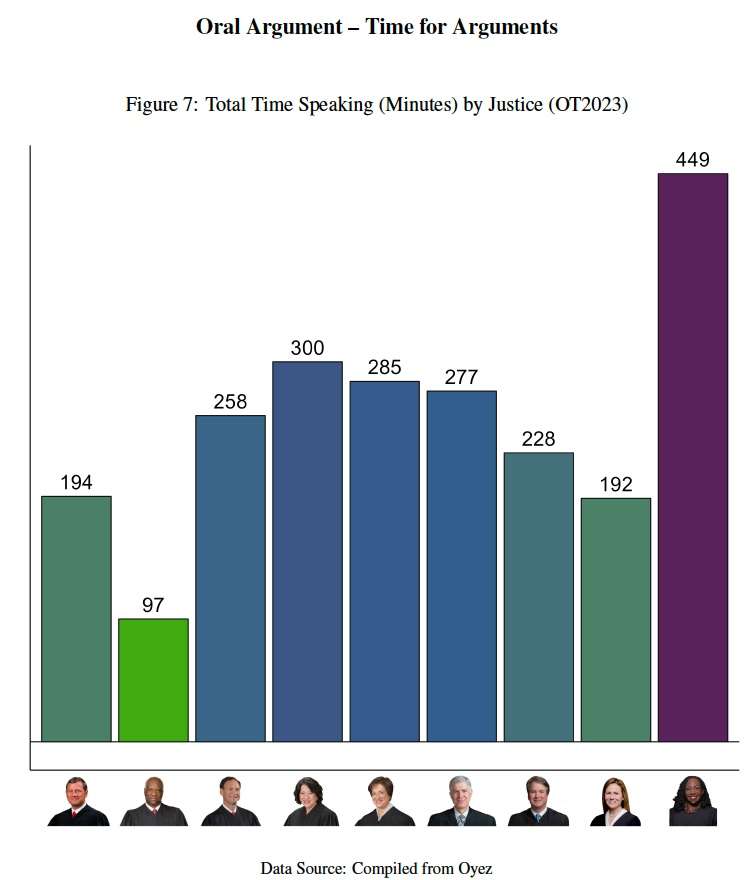
Fast-forward to the decision. Justice Kagan's dissent includes this footnote:

JUSTICE JACKSON did not participate in the consideration or decision of the case in No. 22–451 and joins this opinion only as it applies to the case in No. 22–1219.

What does that even mean? Both cases were jointly considered. It is a fiction that they could be separated. But I'll defend Jackson again. This is a case of the utmost importance, and the mere fact that she participated in the lower-court opinion really does not require her recusal. I've never fully understood this rule about recusal based on past participation. The Justice does not have to recuse if they had previously ruled on a legal issue in a different case; only in the same case. In 2018 Justice Kennedy was forced to recuse in a case because he participated in an earlier proceeding from 1985 on the Ninth Circuit. In what world does that rule even make sense? Kennedy had forgotten about the case, yet he somehow has some sort of latent bias?

Back in the good old days, Justices who heard a case while riding circuit could would hear the case again when it was appealed to the Supreme Court. My understanding is that Justice Bradley participated in Cruikshank before the District of Louisiana, and there is no indication he recused on that case when it was certified to the Supreme Court.  I hope I don't trigger anyone with a discussion of Section 3, but had Jefferson Davis not been pardoned, Chief Justice Chase would have heard his criminal appeal before the Supreme Court, after presiding over the criminal trial. (I'm sure some moderns will find yet another ethical violation based on ethical rules that did not exist at the time.)

Justice Jackson did nothing wrong. What difference does it make that she heard oral argument? We are often told that questions at oral argument should not be taken as an indication of which way a judge is going to vote. Moreover, hearing Loper Bright as a circuit judge focused on the best reading of the Magnuson-Stevens Fishery Act. But before the Supreme Court, the only issue was whether Chevron should be overruled--a question that a circuit judge could not even think about. Where is the conflict? I think that these sorts of recusals are largely performative, and not about addressing actual conflicts. As I said last year, there should be fewer Supreme Court recusals, and not more.
On The Loper Bright Side For Immigration Lawyers

How will the Board of Immigration Appeals operate in a world without Chevron?

|

Several months ago, a reporter from a national outlet called to talk about Chevron deference in immigration. Apparently, immigration lawyers were (quietly) thrilled that Chevron deference was on the chopping block. That decision requires the Board of Immigration Appeals to defer to the executive branch when interpreting an "ambiguous" provision of the immigration laws. Most immigration lawyers are left of center, and they did not dare file an amicus brief on this issue in Loper Bright, but I've heard they were eagerly looking forward to the Court's decision. And such has come to pass.

Indeed, Justice Gorsuch cites immigration law as a justification to overrule Chevron.

In another case, one which I heard as a court of appeals judge, De Niz Robles v. Lynch, 803 F. 3d 1165 (CA10 2015), the Board of Immigration Appeals invoked Chevron to overrule a judicial precedent on which many immigrants had relied, see In re Briones, 24 I. & N. Dec. 355, 370 (BIA 2007) (purporting to overrule Padilla–Caldera v. Gonzales, 426 F. 3d 1294 (CA10 2005)). The agency then sought to apply its new interpretation retroactively to punish those immigrants—including Alfonzo De Niz Robles, who had relied on that judicial precedent as authority to remain in this country with his U. S. wife and four children. See 803 F. 3d, at 1168–1169. Our court ruled that this retrospective application of the BIA's new interpretation of the law violated Mr. De Niz Robles's due process rights. Id., at 1172. But as a lower court, we could treat only the symptom, not the disease. So Chevron permitted the agency going forward to overrule a judicial decision about the best reading of the law with its own different "reasonable" one and in that way deny relief to countless future immigrants.

Justice Kagan also alluded to immigration in her dissent. She suggests that--contra Justice Gorsuch--the Court would still allow deference doctrines in immigration cases that involve "mixed questions" of fact and law:

It first appears to distinguish between "pure legal question[s]" and the so-called mixed questions in Gray and Hearst, involving the application of a legal standard to a set of facts. Ante, at 11. If in drawing that distinction, the majority intends to confine its holding to the pure type of legal issue—thus enabling courts to defer when law and facts are entwined—I'd be glad. But I suspect the majority has no such intent, because that approach would preserve Chevron in a substantial part of its current domain. Cf. Wilkinson v. Garland, 601 U. S. 209, 230 (2024) (ALITO, J., dissenting) (noting, in the immigration context, that the universe of mixed questions swamps that of pure legal ones).

For further reading, see this article on immigration law after Relentless in the NYU Law Review Online.

Update: Reason, which graciously hosts the Volokh Conspiracy, has a piece today titled Why the End of Chevron Could Be a Win for Immigrants. Here is a snippet:

Read More

What Exactly Do Justices Thomas and Gorsuch Disagree About In Loper Bright

Justice Thomas agrees with the "lion's share" of Justice Gorsuch's concurrence.

|

Back to Loper Bright. Both Justices Thomas and Gorsuch wrote concurrences. Justice Thomas explained why Chevron violated the separation of powers. Justice Gorsuch argued that stare decisis, as he conceives it, demands that Chevron must be overruled. Both of these concurrences were solo. Why did Thomas not join Gorsuch? Why did Gorsuch not join Thomas?

Justice Thomas include this somewhat cryptic star footnote:

*There is much to be commended in JUSTICE GORSUCH's careful consideration from first principles of the weight we should afford to our precedent. I agree with the lion's share of his concurrence. See generally Gamble v. United States, 587 U. S. 678, 710 (2019) (THOMAS, J., concurring).

Gamble declined to overrule the dual sovereignty doctrine. Here is the relevant passage from Justice Thomas's Gamble concurrence:

Insofar as the expansion of the reach of federal criminal law has been questioned on constitutional rather than policy grounds, the argument has focused on whether Congress has overstepped its legislative powers under the Constitution. See, e.g., Gonzales v. Raich, 545 U.S. 1, 57–74, 125 S.Ct. 2195, 162 L.Ed.2d 1 (2005) (THOMAS, J., dissenting). Eliminating the dual-sovereignty rule would do little to trim the reach of federal criminal law, and it would not even prevent many successive state and federal prosecutions for the same criminal conduct unless we also overruled the long-settled rule that an "offence" for double jeopardy purposes is defined by statutory elements, not by what might be described in a looser sense as a unit of criminal conduct. See Blockburger v. United States, 284 U.S. 299, 52 S.Ct. 180, 76 L.Ed. 306 (1932). Perhaps believing that two revolutionary assaults in the same case would be too much, Gamble has not asked us to overrule Blockburger along with the dual-sovereignty rule.

Gamble v. United States, 587 U.S. 678, 710, 139 S. Ct. 1960, 1980, 204 L. Ed. 2d 322 (2019)

What exactly is the delta between Justices Thomas and Gorsuch here? I do not know. I wish Thomas would have explained himself a bit more fulsomely.

This is probably an academic question, since Chevron is dead and gone--unless, Congress purports to re-enact something like Chevron by statute. In that case, the courts would then have to decide if deference itself runs afoul of the separation of powers, along the lines that Justice Thomas suggests.

A few other points from Justice Gorsuch's Loper Bright concurrence:

First, Justice Gorsuch accurately describes how Abraham Lincoln responded to Dred Scott:

Read More

Attention SCOTUS Shoppers: Clean up on Article III and there is a Blue-Light Special on the Second Amendment.

SCOTUS GVR's Range, sends Second Amendment to inferior court purgatory.

|

Today, the Supreme Court issued the "clean-up" order list. The Court GVR'd eight cases in light of Rahimi. One of them was Garland v. Range. Here, the en banc Third Circuit held that a person who committed a non-violent felony (food stamp fraud) could not be subject to a complete ban on owning a firearm. Justice Barrett brought the case up during the Rahimi oral argument. I suspected that the Court was holding Range pending Rahimi. After Rahimi was decided, the SG urged the Court to grant Range. Counsel for Range urged the Court to grant the writ. I thought the Court might sit on the issue for the summer, and figure out what to do at the long conference. No such luck. The Court, without any noted dissent, GVR'd Range.

Now, Range, other cases, and the Second Amendment, return to inferior court purgatory. And I should note that since Range was decided, the composition of the Third Circuit has changed. President Biden will have "flipped" two seats, changing the balance of the en banc court. We'll see if there are four votes for cert when this case comes back.

Bruen had a good two-year run! Alas, Rahimi placed a blue light special on the Second Amendment.

Update: I wrote that the SG recommended a GVR in Range. In fact, the government recommended a grant. I've updated the post.

Which Circuit Had The Highest Reversal Rate?

It was not the Fifth Circuit.

|

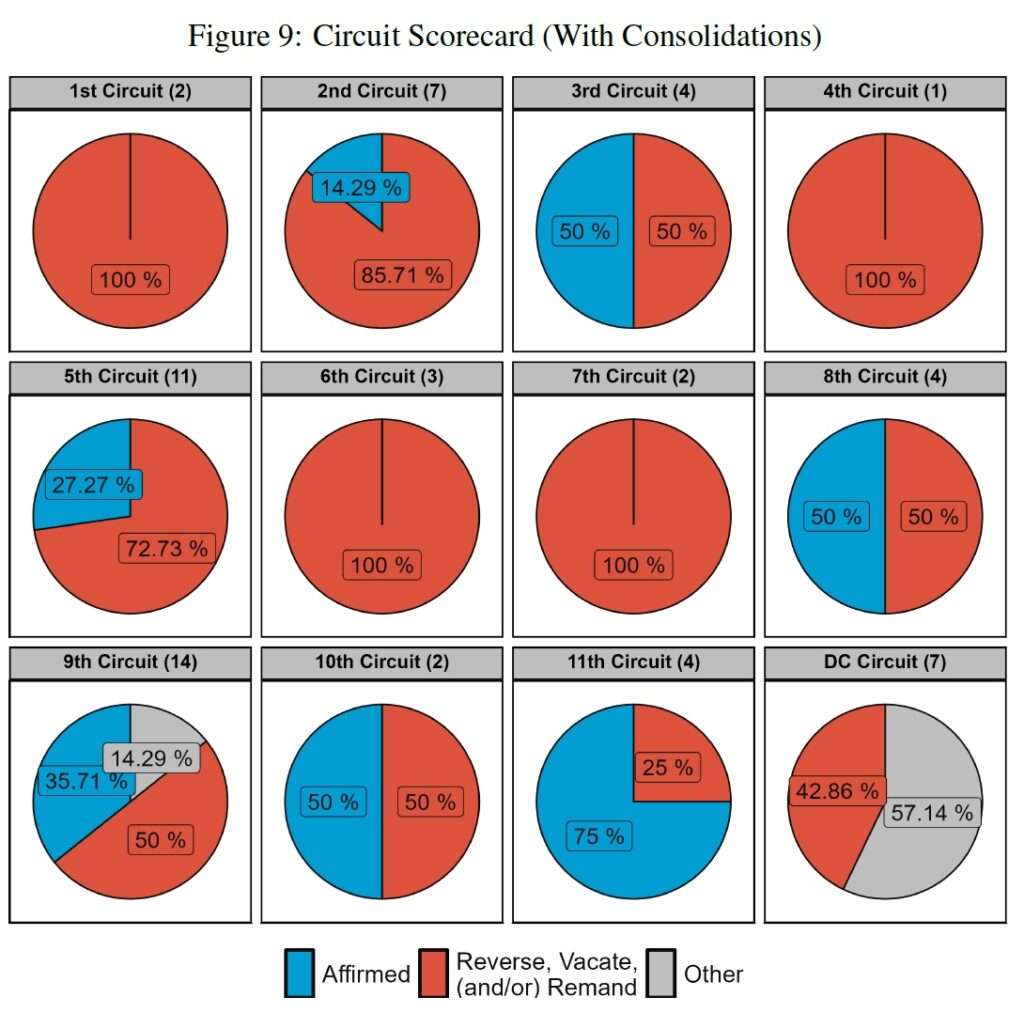
Last term, SCOTUSBlog ceased to publish its reliable StatPack. I am pleased that Adam Feldman and Jake Truscott have published a Stat Review of OT 2023. You should read through the rich 68-page report in detail. Here, I'd like to tease out one datapoint.

Which Circuit had the highest reversal rate? Surely it must be the Fifth Circuit, right? No. It was the Second Circuit. The Second Circuit's reversal rate was 85.71%. And for those keeping track at home, all but one were unanimous, 9-0 reversals: Murray v. UBS, Macquarie, Bissonette, Cantero, and NRA v. Vullo.

For the Fifth Circuit, if we include consolidated cases (such as AHM, and NetChoice), the  reversal rate was 72.73%. The most prominent unanimous reversal was in AHM. Another unanimous reversal came in Devillier, though that holding was on completely different grounds than the Fifth Circuit ruled, and in some regards, was actually a victory for Texas. (No, I won't get into that mess again.) NetChoice was sort-of-unanimous, but it was a very strange reversal. For what it's worth, the Eleventh Circuit was also reversed (It seems the SEC East has a much higher affirmance rate than the SEC West.) The other reversals of the Fifth Circuit split 8-1 (Rahimi and Trevino), 7-2 (CFPB), and 6-3 (Murthy).

By my rough count, it seems the Second Circuit may have had a worse term this year than the Fifth Circuit. But that doesn't fit the narrative.

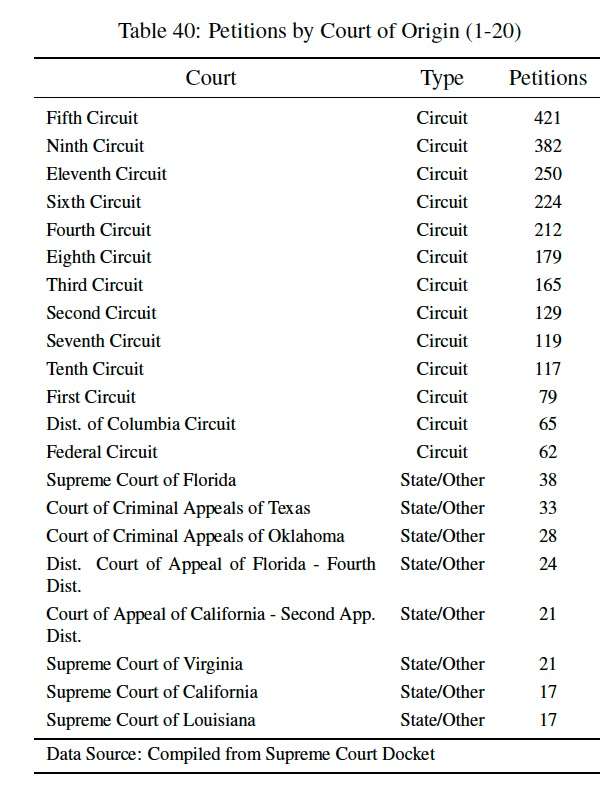
Another interesting data point. There were 421 cert petitions from the Fifth Circuit. (At least 420 of those were from the Solicitor General's Office--I'm kidding, I'm kidding). The Ninth Circuit, which is far larger, had only 382 cert petitions. And the Second Circuit, which had a higher reversal rate, yielded only 129 cert petitions.

I realize it is en vogue to dump on the Fifth Circuit, and fault lawyers in that circuit for shoddy advocacy. I was quoted today in one such piece about the reversal rate by the Texas Tribune, titled "Again and again, U.S. Supreme Court slaps down 5th Circuit." But I think that criticism misses the mark. I told the Trib:

…

The bigger problem is when the Court shifts doctrine on the fly. It makes it much harder for lower-court judges to do their jobs. I think this is especially true in Rahimi (Second Amendment and facial challenges) and Murthy (standing), two of the higher-profile reversals.

Update: An IP Professor reminded me that in fact the Circuit Court with the highest reversal rate was the Federal Circuit--it went 0-2.

"What Should a Court Do When Faced with a 40-Year-Old Conviction Resting on Science That Has Now Been Wholly Discredited?"

|

A longish and interesting opinion by Justice Sotomayor, regarding the Court's decision not to review the matter for now (McCrory v. Alabama). According to Justice Sotomayor:

Petitioner Charles M. McCrory was convicted of murder in 1985 based on forensic bitemark testimony that has now been roundly condemned by the scientific community and retracted by the expert who introduced it at his trial.

For more, read the whole opinion.

Prosecutors

Justice Sotomayor on Prosecutorial Immunity

|

From Justice Sotomayor's statement today respecting the denial of review in Price v. Montgomery County:

Nickie Miller was charged with murder based on the false confession of a witness. The witness later recanted her coerced confession, including in jailhouse letters she sent to her husband. Upon learning about the letters, a court ordered the witness to retrieve and turn them over to Miller's defense team. The lead prosecutor on Miller's case, Keith Craycraft, instead allegedly encouraged the witness to destroy the letters in response to the court order. The witness destroyed the letters instead of turning them over.

Miller spent two years in prison before the State dropped the charges against him. Miller then sued Craycraft and others under 42 U. S. C. §1983 for malicious prosecution, fabrication and destruction of evidence, due process violations, and conspiracy. The District Court dismissed the claims against Craycraft, concluding that he had absolute immunity as a prosecutor. The Sixth Circuit agreed, but noted that Craycraft's "successful pressuring of [the witness] to destroy her jailhouse correspondence" was "difficult to justify and seemingly unbecoming of an official entrusted with enforcing the criminal law." Miller now asks this Court to decide whether absolute immunity is available under §1983 when, as here, a prosecutor knowingly destroys exculpatory evidence and defies a court order.

The Court's denial of certiorari should not signal tolerance of the prosecutor's conduct. {The Court may deny certiorari for many reasons, including that the facts presented by a petition do not clearly or cleanly implicate a division of authority among the lower courts.}

Read More

Guns

Justice Thomas Argues the Court Should at Some Point Consider Whether "Assault Weapons" Bans Violate Second Amendment

Justice Alito takes a similar view, but, at least in this case, this view didn't get the four votes necessary to grant review.

|

From today's statement by Justice Thomas in Harrel v. Raoul:

The State of Illinois enacted a law that makes it a felony to possess what Illinois branded "assault weapons," a term defined to include AR–15s. "The AR–15 is the most popular semi-automatic rifle" in America and is therefore undeniably "in common use today." Petitioners sought a preliminary injunction against the enforcement of the law, arguing that the law violates their Second Amendment right to "keep and bear Arms." The Court of Appeals for the Seventh Circuit rejected petitioners' request for a preliminary injunction, concluding "that the AR–15 … is not protected by the Second Amendment." According to the Seventh Circuit, the rifle selected by millions of Americans for self-defense and other lawful purposes does not even fall within the scope of the Arms referred to by the Second Amendment.

This Court is rightly wary of taking cases in an interlocutory posture. But, I hope we will consider the important issues presented by these petitions after the cases reach final judgment.

We have never squarely addressed what types of weapons are "Arms" protected by the Second Amendment. To be sure, we explained in District of Columbia v. Heller (2008), that the Second Amendment's protection "extends, prima facie, to all instruments that constitute bearable arms, even those that were not in existence at the time of the founding." And, we noted that "the Second Amendment does not protect those weapons not typically possessed by law-abiding citizens for lawful purposes," recognizing "the historical tradition of prohibiting the carrying of dangerous and unusual weapons." But, this minimal guidance is far from a comprehensive framework for evaluating restrictions on types of weapons, and it leaves open essential questions such as what makes a weapon "bearable," "dangerous," or "unusual."

Read More

Free Speech

Justices Thomas and Gorsuch Argue Court Should Review Scope of 47 U.S.C. § 230 Immunity

But, at least in this case, this view didn't get the four votes necessary to grant review.

|

From today's opinion by Justice Thomas, joined by Justice Gorsuch, dissenting from the denial of review in Doe v. Snapchat, L.L.C.:

When petitioner John Doe was 15 years old, his science teacher groomed him for a sexual relationship. The abuse was exposed after Doe overdosed on prescription drugs provided by the teacher. The teacher initially seduced Doe by sending him explicit content on Snapchat, a social-media platform built around the feature of ephemeral, self-deleting messages. Snapchat is popular among teenagers. And, because messages sent on the platform are self-deleting, it is popular among sexual predators as well.

Doe sued Snapchat for, among other things, negligent design under Texas law. He alleged that the platform's design encourages minors to lie about their age to access the platform, and enables adults to prey upon them through the self-deleting message feature. The courts below concluded that §230 of the Communications Decency Act of 1996 bars Doe's claims. The Court of Appeals denied rehearing en banc over the dissent of Judge Elrod, joined by six other judges..

The Court declines to grant Doe's petition for certiorari. In doing so, the Court chooses not to address whether social-media platforms—some of the largest and most powerful companies in the world—can be held responsible for their own misconduct. Section 230 of the Communications Decency Act states that "[n]o provider or user of an interactive computer service shall be treated as the publisher or speaker of any information provided by another information content provider." In other words, a social-media platform is not legally responsible as a publisher or speaker for its users' content.

Notwithstanding the statute's narrow focus, lower courts have interpreted §230 to "confer sweeping immunity" for a platform's own actions. Malwarebytes, Inc. v. Enigma Software Group USA (2020) (statement of Thomas, J., respecting denial of certiorari). Courts have "extended §230 to protect companies from a broad array of traditional product-defect claims." Even when platforms have allegedly engaged in egregious, intentional acts—such as "deliberately structur[ing]" a website "to facilitate illegal human trafficking"—platforms have successfully wielded §230 as a shield against suit. See Doe v. Facebook (2022) (statement of Thomas, J., respecting denial of certiorari).

Read More

Free Speech

S. Ct. Will Decide: May States Require Age Verification to Access Porn Sites?

|

The Court just agreed to hear this case, Free Speech Coalition v. Paxton. You can read the majority and dissenting opinions in the Fifth Circuit here, and the petition, response, and reply here. Here's the issue in a nutshell:

1. Ginsberg v. N.Y.(1968) held (in a majority opinion by Justice Brennan) that states may ban sales to minors of pornographic material that's "obscene as to minors" (even if it's fully protected for adults). This meant that stores and theaters that wanted to sell or exhibit such material would have to make "a reasonable bona fide attempt to ascertain the true age of" young-seeming patrons, even though that would of course in some measure affect the rights of adults (who might, for instance, be required to show identification cards, and thus lose part of their privacy). In the process, the majority applied the highly deferential "rational basis" test, though only after it essentially concluded that the law fell within a recognized First Amendment exception.

2. Ashcroft v. ACLU (II)(2004) upheld (in a majority opinion by Justice Kennedy) a preliminary injunction against enforcement of a federal law that required credit card or age verification for commercial online distribution of such "obscene as to minors" material. The majority concluded that the law burdened the rights of adults, and that the government hadn't shown that other alternatives (such as filtering) would be inadequate for protecting children. In the process, the majority applied the highly undeferential "strict scrutiny" test, and didn't discuss Ginsberg.

The core question is which approach is right for these kinds of restrictions aimed at shielding minors from pornographic material. (There's a lot more to the question, of course, which you can learn about from the opinions below.)

By the way, here's some more background detail on the "obscene-as-to-minors" category (also known as the "harmful-to-minors" category) and how it fits within First Amendment law more generally:

Read More

Plucking Beauty out of Dangerous Cracks and Crevices

|

Herbert Butterfield, the historian often remembered for coining or at least popularizing the phrase "Whig history," published in 1950:

It is not open to any of us to say that we will postpone what philosophers call 'the good life'—postpone any of the higher purposes of mankind—until the world is more happily placed or the environment becomes more congenial. Some people have become accustomed to arguing, for example, that we must not pretend to have any art to-day—for how can a man write poetry when society is still so disjointed? I have even heard it said that we must put aside all thought of the arts until the world has been made safe for democracy. If men had taken that attitude in the past there never would have been a civilisation or a civilised ideal for us to inherit; and I do not know that Providence has ever promised to men either the Arcadian bliss or the reign of justice which this argument seems to have in view. All the time it has been a case of plucking beauty out of dangerous crags and crevices, and making sure that there should be music somewhere though apparently the world was generally near the edge of the abyss. And we must have our Elizabethan literature even though the Spanish Armada may be coming, because it is always part of the game that the good life must be attained now, no matter at what date in history you place the 'now.'

Politics

Plutarch on Open Courts

|

From Plutarch's Sayings of Kings and Commanders (Frank Cole Babbitt trans.); Antigonus was one of Alexander the Great's successors:

When Marsyas his brother had a lawsuit, and claimed the right to have the trial held at his house, Antigonus said, 'It shall be in the Forum and with everybody listening to see whether we do any injustice.'

(Spotted as a result of a conversation with my father, Vladimir.)

Free Speech

Ohio S. Ct. Vacates Order Sealing Documents at Defendant's Behest in Alleged Child Rape Case

The defendant had alleged that he, his family, and his lawyer had been threatened by the public, but the Ohio Supreme Court concluded that the trial court wasn't given adequate evidence to justify sealing.

|

From the Ohio Supreme Court's decision Friday in State ex rel. Shubert v. Breaux:

In February 2024, Jeremiah Stoehr was indicted in the Summit County Court of Common Pleas on one count of rape, two counts of kidnapping, one count of gross sexual imposition, and one count of disseminating matter harmful to juveniles. The record contains some ambiguity regarding how many alleged victims there were, but at least one alleged victim was under the age of ten. Stoehr was a high school student when the complaint in this action was filed, and the criminal case against him has received media attention. Judge [Alison] Breaux is presiding over Stoehr's pending criminal case….

On May 9, Stoehr filed a motion in the trial court to seal the docket and remove public access to case filings during the pendency of Stoehr's case. Stoehr's motion to seal states that after media began reporting on his case, Stoehr was assaulted and threatened, his parents were followed, and his address was published online. The motion was not supported by any affidavits. The same day the motion was filed, Judge Breaux issued an order granting it.

On May 16, Judge Breaux sua sponte issued an amended sealing order. The amended order states that before Stoehr filed his motion to seal, the trial court held a meeting in chambers with the prosecution and defense counsel. During the meeting, "it was brought to the attention of the Court" that Stoehr, his family, and his counsel had been threatened, intimidated, and confronted. The prosecution also expressed a concern about the minor victim being identified. The trial court "weigh[ed] the risk of injury to persons, public safety and fairness of the adjudicatory process against the presumption of allowing public access to the docket and [found], by clear and convincing evidence, that the restricting [of] access to information in this case is warranted to protect the parties and counsel."

The amended order directs the Summit County Clerk of Courts to remove any online public access to the docket or images in Stoehr's case and to remove any public access to the docket or images "regarding subpoenas, summons returns, search warrants, service returns, any court filing containing information protected under Marsy's Law, and any court filing containing private information of the Defendant or other records as provided by state, federal, or common law." …

"[Craig] Shubert, a former journalist and a member of the public interested in" the case sought review of the sealing order, and the Ohio Supreme Court agreed that the order had been improperly issued:

Read More

Did Justice Alito Lose The Majority Opinions In Trevino and NetChoice?

Alito had only four majority opinions this term, while Roberts, Thomas, Sotomayor, and Kagan all had seven.

|

Generally, the Court tries to evenly distribute majority opinions. This term, four members of the Court had seven majority opinions: Roberts, Thomas, Sotomayor, and Kagan. Three members had six majority opinions: Gorsuch, Kavanaugh, and Barrett. Justice Jackson had five. And Justice Alito had four.

It would be unusual for the third-most-senior Justice to have so few majority opinions. My speculation is that Alito lost two majority opinions.

First, a few weeks ago, I wrote that Justice Alito may have lost the majority opinion in Gonzales v. Trevino. That case was argued in the March sitting. Alito did not have any majority opinions from that sitting. Every other Justices from that sitting had at least one opinion--Sotomayor and Thomas each had two! But Trevino was released as a per curiam opinion, with an Alito concurrence. I observed:

Why is this a per curiam opinion? It is possible that Justice Alito was assigned the majority opinion, but lost it, and the Chief came in to salvage the majority with a narrow per curiam. At present, Alito does not have any assignments from the March sitting.

Second, Justice Alito also may have lost the majority opinion in the two NetChoice cases. Those cases were argued in the February sitting. Alito did not have any majority opinions from that sitting. Every other Justice had at least one assignment--Sotomayor had two. Here is the vote breakdown in NetChoice:

KAGAN, J., delivered the opinion of the Court, in which ROBERTS, C. J., and SOTOMAYOR, KAVANAUGH, and BARRETT, JJ., joined in full, and in which JACKSON, J., joined as to Parts I, II and III–A. BARRETT, J., filed a concurring opinion. JACKSON, J., filed an opinion concurring in part and concurring in the judgment. THOMAS, J., filed an opinion concurring in the judgment. ALITO, J., filed an opinion concurring in the judgment, in which THOMAS and GORSUCH, JJ., joined.

My guess is that Justice Thomas assigned the majority opinion to Justice Alito. At conference, Justices Barrett and Jackson were with the majority. But Alito's opinion that tried to do too much. Justice Barrett became uneasy with the Alito opinion, and Justice Kagan accommodated her join. Then, Justice Jackson was able to join enough of the Kagan opinion to make it a solid, six-member majority. At that point, Justices Alito, Thomas, and Gorsuch were left concurring in judgment. And that 30-page concurrence sure looks a lot like a majority opinion.

All of this, of course, is speculation. But it would explain how Justice Alito had only four majority opinions. The story of this term has been Justice Barrett's moving away from the Court's conservatives and towards the welcoming arms of Justice Kagan. This movement probably happens more than we are aware--this is one spot where we can guess what happened. The other story of this term is that the Justices have absolutely no idea what to do with facial challenges--see Rahimi, Trump, and NetChoice. More on that later.

Firearms Law

Call for Papers: National Firearms Act Symposium

|

Date: Friday, October 18, 2024
Location: Laramie, Wyoming
Abstracts Due: July 29, 2024

Manuscripts Due: August 29, 2024

The Wyoming Law Review and the University of Wyoming Firearms Research Center announce a call for papers for a Symposium this fall on the National Firearms Act (NFA). Papers may address any aspect of the NFA, including but not limited to:

  • the implications for the NFA of recent and upcoming U.S. Supreme Court decisions (New York State Rifle & Piston Association v. Bruen, Garland v. Cargill, and others);
  • the NFA's role in the U.S. today;
  • conflict or cooperation between states; the NFA's history;
  • empirical study; and
  • implications relating to the use of suppressors ("silencers"), including in wildlife conservation and hearing loss prevention.

The Symposium will take place in the new facilities at the University of Wyoming College of Law in Laramie, Wyoming. Accepted final papers will be published in a symposium issue of the Wyoming Law Review. Speakers at the Symposium will be selected based on the abstracts authors submit in July. The articles published in the law review will be selected based on a review of the final drafts.

Submission Details:

  • Paper titles and abstracts should be submitted electronically to frc@uwyo.edu by July 29, 2024. Abstracts should be no longer than one page and should be submitted as a PDF file saved under the file name "[last name, first name] – [paper title]." Please use the subject line "NFA Submission" in your email.
  • Symposium speakers will be selected based on the abstracts submitted in July.
  • Authors are expected to submit a law review quality manuscript between 20 and 50 pages by August 29, 2024. The full manuscript will be subject to board review and vote, followed by a formal invitation to publish.
  • Publication is anticipated in January 2025.

Extra note by Kopel: The Wyoming Law Review was recently cited in Chief Justice Roberts' opinion for the Court in United States v. Rahimi, slip op. at 9, regarding English legal history: J. Greenlee, The Historical Justification for Prohibiting Dangerous Persons From Possessing Arms, 20 Wyo. L. Rev. 249, 259 (2020).

Edited Version of Trump v. United States

Download the edited version from the 2024 Barnett/Blackman supplement.

|

I've now finished reading and editing the Court's 119 page decision in Trump v. United States. Even though the Court is deciding fewer and fewer cases, I feel like I am reading more and more, but learning less and less. This one was a tough slog.

I distilled the case down to about 33 pages for the 2024 Barnett/Blackman supplement. You can download it here. I imagine this case will appear in the next edition of the casebook, replacing Clinton v. Jones and Trump v. Vance. More likely than not, we will just include Chief Justice Roberts's majority and parts of Justice Sotomayor's dissent. Justice Thomas's concurrence has important implications for the Appointments Clause (which I will write about later), but it doesn't have much bearing on the presidential immunity issue. Were Justice Barrett the fifth vote, her concurrence would be quite significant, but as the sixth vote, it probably will not have much lasting impact. ConLaw students will probably not have much interest in the evidentiary issue that she thought important. Sometimes, less is more. I thought Justice Jackson's dissent had some insights into the framework behind punishment, though it was largely duplicative of what Justice Sotomayor wrote.

I feel like a bit of a slacker. The term is over, and I still haven't finished reading Jarksey (98 pages), Grants Pass (74 pages), NetChoice (96 pages), and Corner Post (70 pages). That totals more than 300 pages. I wrote several posts on Chief Justice Roberts's majority opinion in Loper Bright, but I haven't had time to write about the concurrences and dissents. Those will come soon.

Stay tuned.

More