The Volokh Conspiracy

Mostly law professors | Sometimes contrarian | Often libertarian | Always independent | Est. 2002

The Volokh Conspiracy

Politics

Dean Kagan Would Rather Forget About Rumsfeld v. FAIR

But she did smuggle in a dictum that echoes Harvard's 2005 amicus brief about expressive activity in the classroom.

|

What a difference two decades make. In 2003, Elena Kagan was the Dean of Harvard Law School. At the time, many law schools had banned JAG officers from recruiting on campus, citing the "Don't Ask, Don't Tell" policy. Dean Kagan did not ban JAG recruiters, but voiced support for the ban. She articulated this position in an email to the community:

"I abhor the military's discriminatory recruitment policy. The importance of the military to our society -- and the extraordinary service that members of the military provide to all the rest of us -- makes this discrimination more, not less, repugnant. The military's policy deprives many men and women of courage and character from having the opportunity to serve their country in the greatest way possible. This is a profound wrong -- a moral injustice of the first order. And it is a wrong that tears at the fabric of our own community, because some of our members cannot, while others can, devote their professional careers to their country."

Still, Kagan permitted the recruiters to use the Office of Career Services.

But there was also the Solomon Amendment. Under this federal law, colleges would be denied funding if they denied military recruiters access to campus. An association of law schools, known as the Forum for Academic and Institutional Rights challenged the constitutionality of the Solomon Amendment.

In 2004, Kagan joined an amicus brief before the Third Circuit, arguing that the Solomon Amendment violated Harvard's freedom of expression--in this case, excluding military recruiters as a way to protest "Don't Ask, Don't Tell." After the Third Circuit ruled for FAIR, Dean Kagan imposed the ban on military recruiters. But the Pentagon then threatened to withhold funding, and Kagan relented. (SCOTUSBlog links to many of the primary sources.)

The case was then appealed to the Supreme Court, with Kagan joining another amicus brief. The Court, per Chief Justice Roberts, ruled against FAIR by an 8-0 vote. (The case was argued in December 2005, before Justice Alito joined the bench.) The Court held that the Solomon Amendment regulated conduct, and not speech, and was constitutional. As I recall, the Dean of the George Mason University School of Law was the only Dean to file a brief in support of the Solomon Amendment. (Mason was a very special place in 2006--several months before I matriculated.)

I suspect Dean Kagan would rather forget about Rumsfeld v. FAIR. And, perhaps fittingly, in NetChoice, Justice Kagan downplayed the case. She only mentioned it briefly at the top of page 17 of the slip opinion, and in a curious footnote on page 18:

4 Of course, an entity engaged in expressive activity when performing one function may not be when carrying out another. That is one lesson of FAIR. The Court ruled as it did because the law schools' recruiting services were not engaged in expression. See 547 U. S. 47, 64 (2006). The case could not have been resolved on that ground if the regulation had affected what happened in law school classes instead.

I pulled the Harvard amicus brief in FAIR, and it included a very similar point:

Or, by the government's reasoning, Congress might use the hook of federal funding to require private universities to begin each class during hiring season by informing students of when and where military recruiters will be available for interviews. Because these conditions would not target "dangerous ideas," in the government's view they would present no constitutional problem. Plainly, however, such conditions would undermine both the principle of academic freedom and the First Amendment values that principle serves.

Dean Kagan never forgets an argument. Glad she smuggled that dicta into a majority opinion. It will be cited in contexts near and far. And, as nothing changes, Seth Waxman represented Harvard here, as he did in SFFA.

Justice Alito's NetChoice dissent points out how Justice Kagan glossed over FAIR, as well as Pruneyard.

Two precedents that the majority tries to downplay, if not forget, are illustrative. The first is PruneYard, which I have already discussed. . . .The decision in FAIR rested on similar reasoning.

Yes, Justice Kagan would rather forget about FAIR.

Of course, Justice Alito may have had some thoughts on this issue. Alito did not participate in the Third Circuit's panel opinion in FAIR. But he did serve in ROTC at Princeton. And he was affiliated with Concerned Alumni of Princeton, which was founded to bring ROTC back to Princeton, though he later disavowed that group.
Politics

Mission to Israel Part III: What I Learned About The Israeli Separation of Powers

Ambition does not check ambition. Erudition checks opposition.

|

[This is the third post in my series on my mission to Israel. You can read Parts I and II.]

As a general matter, I am skeptical of comparative constitutional law. I think it is exceptionally difficult to master one legal system. I don't even pretend I've figured out own own laws. I barely have enough time to read all of the Supreme Court's decision. (I still need to finish Jarkesy, Corner Post, and NetChoice.) I doubt a professor could purport to be an expert of both Louisiana Civil Law and Texas Common Law, even though the states border each other! How can one person possibly become an expert in multiple legal systems from different corners of the globe, and purport to compare and contrast them? I have no clue. Maybe comparativists are simply smarter than us simple-minded schlubs who are mired in a single, provincial system of laws.

With that caveat in mind, I will describe my admittedly crude crash course into the Israeli separation of powers.

Israel has no written Constitution. Yet, it has a robust separation of powers: elite lawyers separate the power from the people. Ambition does not check ambition. Erudition checks opposition.

Let me provide a brief sketch.

Israel has a parliamentary government. A coalition that obtains a majority of the seats in the parliament can select a prime minister. The prime minister, in turn, can appoint various cabinet ministers. (I think technically the cabinet makes the appointment, but that doesn't make a difference for present purposes.) One of those ministers is the Attorney General. The Attorney General serves a fixed, six-year term. The Attorney General is entirely independent--there is no removal power. Indeed, the Attorney General can take positions that are adverse to the prime minister. And those positions are binding on the government. The prime minister has to go to court to reject the Attorney General's argument. And Israel has no standing rules, so the Attorney General, as well as outside groups, can challenge virtually any policy in court. Everything goes to the courts.

Due to the fluctuations in Israeli politics, an Attorney General appointed by a left-wing government can serve during a right-wing government. Can you imagine if Attorney General Holder served under President Trump? AG Sessions under President Biden? And, in candor, even an Attorney General appointed by a conservative government will still be the byproduct of the elite legal education system in Israeli. Conservative lawyers in Israel are a discrete and insular minority.

Here is another example. The Military Advocate General (MAG) is the equivalent of the American Judge Advocate General (JAG). The MAG is appointed by the incumbent government for a fixed term. (The duration, I was told is about five years, but the lawyers seemed a bit unsure.) The MAG is entirely independent. The Prime Minister has no at-will removal power over the chief legal advisor. Moreover, the MAG is completely outside the command structure of the military. As a result, military legal advisors officers are in no way accountable to the generals on the battle field. They answer directly to another independent official who cannot be removed, or even directed by the Prime Minister. If the government wants to take a military action, and the MAG says no,that is basically the final answer. I was told that the Prime Minister could, in theory, appeal a decision of the MAG to (wait for it), the independent Attorney General, and to the independent Supreme Court. My mouth was wide open. Again, the popularly-elected government will always be subordinate to the views of elite lawyers.

Read More

Donald Trump

GOP VP Nominee J. D. Vance is an Enemy of Free Markets

The Ohio Senator is one of the Party's leading advocates of protectionism, economic planning, and immigration restrictions.

|

J.D. Vance
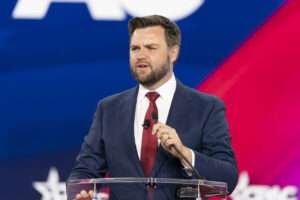
J.D. Vance in 2022. (Lev Radin/ZUMAPRESS/Newscom)


Ohio Senator J.D. Vance just became Donald Trump's running mate. If you care about free markets and liberty generally, he's just about the worst person the Republicans could have chosen, among those who got serious consideration.

Since being elected to the Senate in 2022, Vance has become one of the GOP's leading champions of protectionism, economic regulation and planning through "industrial policy," restrictions on foreign investment, and - of course - immigration restrictions. As Alex Nowrasteh and I explained in our article "The Case Against Nationalism," these right-wing forms of central planning have most of the same weaknesses as their socialist counterparts. These policies create terrible incentives, and predictably make the nation poorer and less innovative.

Vance also shares right-wing nationalists' penchant for conspiracy theories. For example, has endorsed bogus claims the 2020 election was rigged against Trump, and said he would have connived in Trump's scheme to overturn the 2020 election had he been in the place of then-vice president Mike Pence (who, to his credit, refused to do so).

Vance is also one of the GOP's leading opponents of US aid to Ukraine in resisting Vladimir Putin's brutal war of aggression.  He tried hard to block the deal on aid to Ukraine, Israel, and Taiwan reached by the White House and GOP Speaker Mike Johnson in April. There is a strong case for aiding Ukraine on both moral and strategic grounds. Letting Vladimir Putin have his way won't "make America great again." It will just make us look simultaneously weak and unprincipled. These problems would be accentuated by Vance's support for the massive trade war Trump wants to start with our allies - arising from their joint commitment to large-scale protectionism.

If you wanted Trump to select a VP with at least some commitment to relatively free market policies and some tendency to restrict Trump's own worst impulses, Vance is one of the last people you would want to see chosen.

Vance wasn't always like this. I am a fan of his 2016 book, Hillbilly Elegy, a memoir of his upbringing in a poor Appalachian family. His 2016 warning that Trump is an "opioid of the masses" was in many ways valid; he rightly predicted that Trump could not solve the problems of declining communities by policies like building border walls, and escalating the War on Drugs.

In 2017, Vance and I had an exchange about his argument that talented people living in poor and declining communities should stay where they are, rather than move to places where there is greater opportunity. I emphasized that empowering people to "vote with their feet" is one of the best ways to increase opportunity for them, and make our society more innovative and productive. I also noted that Vance's own life is an example of that dynamic:

If you read his moving book, it's hard to avoid the conclusion that his life was transformed by [mobility]: leaving home to join the Marine Corps, get a college degree at Ohio State University, and eventually going to Yale, opened up opportunities that he probably would never have had if he had not left home. As a result, he is now a far more productive member of society than he likely would have been otherwise.

Although Vance has returned to his home state, he did not move back to the depressed community where he grew up, but to Columbus, a thriving city whose economy has done very well in recent years. He likely concluded that he and his family would be happier, more productive, and better able to serve society there than in a less successful part of the state.

We continued the exchange on Twitter. But I cannot find that part now.

In my later book Free to Move, I pointed out that Vance's story of success through domestic foot voting  is also similar to that of people who transformed their lives through international migration. Almost all the standard arguments against allowing the latter also apply to the former.

Over the last several years, Vance has undergone a kind of ideological transformation, becoming a prominent advocate of the MAGA populism he previously opposed. Sadly, the policies Vance now advocates would destroy opportunities for immigrants and natives alike, and in the process make America weaker and poorer.

Report from Israel: Israelis Aren't Out for Vengeance, But For Safety and Security

|

One constant refrain I have seen in the media since Hamas' Oct. 7 massacre is that Israel is seeking "revenge" in Gaza, or "retaliating" for Oct. 7. Israel, by contrast, asserts two primary motivations--return of its hostages, and the defeat of Hamas to restore Israeli security.

Having just returned from Israel, on the same lawprof trip that Josh Blackman went on, I saw firsthand that Israel's account of things is the one widely embraced by the Israeli public. As soon as you step off the airplane in Israel, posters with photos of the hostages are everywhere. In talking to Israelis, it's obvious how deeply the hostage situation cuts. Israelis don't just know that there are 120 hostages, they know their individual names and stories by heart.

As for security, people underestimate how much of a shock 10/7 was to Israelis. There were the multiple failures of the intelligence services and the army. There was the depraved brutality of Hamas. But most of all, there was the uncertainty and a loss of a sense of personal security. That morning, the country was in chaos. No one knew how bad the attack was, or what it would lead to. Would Hamas break through to the southern cities of Ashdod, Ashkelon, and Be'er Sheva? Would there be a simultaneous attack from the West Bank, threatening not just border towns but Israelis in the "center," including Tel Aviv and Jerusalem? Would Hezbollah join the attack, and launch thousands of precision missiles at Israeli cities? Iran? No one knew, and it was clear that the IDF was woefully unprepared for any such scenarios, given that it clearly was caught with its pants down in the South.

So Israelis desperately want the hostages returned, and for their sense of security to be returned. Residents of the South and North who had to evacuate after 10/7 especially want to to be able to safely return to their homes.

What Israelis, in general, are not after is vengeance. Considering that Israel was in month nine of a war with support both wide and deep among the Jewish public, there was little if any of the rabble-rousing nationalism and militarism one might expect in such circumstances. Every Israeli we spoke to volunteered that Hamas must be defeated, but that thereafter, "we have to find a way to live with" neighboring Palestinians. While I'm sure there is a minority who have more aggressive views, even "support the troops" or "we will succeed together"-type signs were vastly outnumbered by hostage posters. Israelis are resigned and determined, but not bloodthirsty.

It's also true that I saw very little over concern about Palestinian civilian casualties, even among the people we met who are on the left, even far-left, politically, who would normally be vocal about such things. This, it seems to me, is a product of several factors.

First, Israelis see the war as one of survival. Israel can't survive if the South and North are uninhabitable, nor if the public in the rest of the country lives in permanent dread of sudden, brutal, terrorist attacks. When your survival is at stake, you tend to be less concerned with the fate of others.

Second, Israelis' sympathy for the civilian population of Gaza is strained by the behavior of civilians there. During the Hamas invasion, mobs of Palestinian civilians entered into southern Israeli towns, looting, murdering, and raping. In some cases, Hamas had to protect its hostages from civilians who sought to murder them on the spot. When the hostages were brought into Israel, including sick, elderly people and small children, civilian crowds cheered. And when Hamas had to figure out how to hide the hostages, it paid civilians to do so, who, according to released hostages, participated eagerly. One civilian was even murdered by a doctor in Sheba hospital. Meanwhile, while many thousands of Palestinians had some clue as to where the hostages were being held, it seems that Israel has received precious little assistance or tips from them, even, again, about children and aged hostages.

Third, as Josh pointed out earlier today, while many of us think international law standards are in practice weaponized bullshit, Israeli lawyers, especially IDF lawyers, really believe in it, and really do their best to comply. Every unit has a lawyer attached to it, and any significant operation must be discussed with and approved by those lawyers. Many operations are modified to meet the lawyers' objections. (Aside: The biggest issue is "proportionality," ie, an operation's military value must be "proportional" to the risk to civilian welfare. This strikes me outside of extreme situations as an entirely subjective and thus absurd legal standard, but all indications are that the IDF's lawyers really do try to adhere to it as best they can.) If Israel is fighting a war for survival and is doing its best to comply with international law, resulting civilian deaths are on Hamas's, not Israel's, conscience.

Fourth and finally, Israel has a people's army. Most of the soldiers fighting in Gaza are reservists who come from all over the country, and have the entire spectrum of political and ideological views. Gaza is only 1.5 hours or so from Tel Aviv and Jerusalem, and the reservists are often home on leave or go home when their tour ends. There's a lot of chatter in anti-Israel circles about Israel being indiscriminately violent and Gaza and so on. But what Israelis are hearing from their friends and family in the IDF, left, right, and center, is that the IDF is doing everything it can reasonably do to avoid unnecessary civilian casualties. Indeed, they are hearing that soldiers are being wounded and even killed because of the precautions they took to avoid harming civilians.

Of course, I'm not on the ground to confirm this narrative. But when an Israeli's left-wing kibbutnik brother-in-law and his right-wing Likudnik nephew both tell him that the IDF is going out of its way to reduce civilian casaulties, at the expense of IDF casualties, that Israeli will be inclined to believe it--even if the kibbutznik is praising these actions, and the Likudnik is decrying them as unfair to the soldiers who get killed or injured.

Politics

Making Sense of the Moody Opinions In NetChoice

I think it is clear that Justice Alito lost the majority, but the resulting schizophrenic opinions still do not cohere.

|

Shortly after NetChoice was decided, I speculated that Justice Alito lost a majority opinion. Now, having had some time to stew on the case, I think my speculation is right, but the precise contours of the deliberations are complex.

Let's start with the easy part. All nine members of the Court agreed that both the Fifth and Eleventh Circuits failed to apply the proper standard for a facial challenge.

With the benefit of hindsight, this holding may seem obvious, but a lot of really smart people seemed to have missed the issue below. NetChoice was represented by Clement Murphy and Lehotsky Keller Cohn. This firm has some of the most gifted attorneys around. The panel opinions included Judges Andy Oldham and Kevin Newsom, two of the most brilliant lower court judges, who are total FedCourts nerds. Yet, despite all of this intellectual firepower, everyone apparently missed the boat.

If there was so much agreement on the Court, why did Justices Thomas, Alito, and Gorsuch not join the portions of Justice Kagan's majority opinion that concerned the facial challenge? The troika only concurred in the judgment.

Part II of Justice Kagan's majority opinion is very short. It stretches only three pages, and there are no subparts. The first three paragraphs lay out the usual standard for a facial challenge (Salerno), the somewhat-easier challenge for a facial challenge in the Free Speech context (AFP and Hansen), and explains that the lower courts did not heed these standards. Justice Kagan concluded:

On their way to opposing conclusions, [the Fifth and Eleventh Circuits] concentrated on the same issue: whether a state law can regulate the content-moderation practices used in Facebook's News Feed (or near equivalents). They did not address the full range of activities the laws cover, and measure the constitutional against the unconstitutional applications. In short, they treated these cases more like as-applied claims than like facial ones.

So far, so good. I think Justice Alito could have joined this analysis in its entirety. Justice Alito's concurrence described the holding of the case in such limited terms:

The holding in these cases is narrow: NetChoice failed to prove that the Florida and Texas laws they challenged are facially unconstitutional.

The case could have ended here, and I think there would have been a unanimous reversal.

However, the next three paragraphs of Part II take an unexpected turn.

In the fourth paragraph, Justice Kagan previews the "first step in the proper facial analysis." She walks through a range of potential applications, such as Gmail, Etsy, and Venmo. None of this analysis was necessary to the holding, but at least it signaled how the facial analysis should proceed.

The fifth paragraph begins, "The next order of business is to decide which of the laws' applications violate the First Amendment, and to measure them against the rest." Here, Justice Kagan explains that "even on a preliminary record," the analysis would differ for the Facebook News Feed and direct messages. Again, I'm not sure this analysis was necessary, but it at least was in the ballpark.

The sixth paragraph cites Cutter v. Wilkinson, the Court's favorite precedent to cite when it doesn't want to address an issue in the first instance:

The problem for this Court is that it cannot undertake the needed inquiries. "[W]e are a court of review, not of first view." Cutter v. Wilkinson, 544 U. S. 709, 718, n. 7 (2005). Neither the Eleventh Circuit nor the Fifth Circuit performed the facial analysis in the way just described. And even were we to ignore the value of other courts going first, we could not proceed very far. The parties have not briefed the critical issues here, and the record is underdeveloped.

The opinion also could have ended here. And I think it would probably been unanimous. But Justice Kagan proceeds with Part III of her opinion. It stretches seventeen pages. And it explains virtually all facets of the First Amendment analysis. Why did it undertake that analysis? To prevent the Fifth Circuit from running afoul of the majority's understanding of the merits:

Read More

Politics

Mission to Israel Part II: What I Learned About International Law From Israeli Lawyers

The primary effect, if not purpose, of international law, is to use lawfare to punish Israel, and by extension, the United States.

|

[This is the second post in my series on my mission to Israel. Part 1 is here.]

I'll put my cards on the table. I've long had a cynical perspective of international law. I was completely unmoved by the notion that foreign tribunals, with systems of government completely alien to our own, could establish "norms" and "customary" international law. I always saw international law as a ruse for progressive lawyers to give their policy preferences the patina of some sort of quasi-binding law. My mission to Israel has reinforced that perspective in ways I could not have even fathomed.

The World Jewish Congress, to its credit, did an admirable job in lining up a series of legal experts from across the spectrum. We met with, among others, a former Attorney General, a Dean of an Israeli law faculty, two Israeli military lawyers (known as Military Advocate General, or MAG), a lawyer at an NGO working on returning the hostages, a lawyer who participates in proceedings before the International Court of Justice and the International Criminal Court, and more. All of these jurists provided a thorough overview of how international law operates with regard to Israel. They also entertained all of my questions, even some that were a bit hostile. I was thankful for this opportunity. My conclusion: the primary effect, if not purpose, of international law, is to use lawfare to punish Israel, and by extension, the United States. If you're bothered by that statement, please stop reading.

Read More

Donald Trump

Thoughts on the Assassination Attempt Against Trump

The attack deserves condemnation. But it should not obscure the evil of Trump himself, including his role in promoting political violence.

|

Former President Donald Trump stands amid four Secret Service agents, with blood showing on his ear.
Former President Donald Trump stands amid four Secret Service agents helping him off the stage, in the wake of the assassination attempt. (Hu Yousong / Xinhua News Agency/Newscom)


A few thoughts on yesterday's assassination attempt against Trump:

1. It should go without saying. But I condemn the attack. Violence is not the way to solve our political problems. It's worth remembering that Trump was not the only victim. A participant in the rally was killed, and two others wounded. The slain spectator, former firefighter Corey Comperatore, died bravely trying to shield his family. The shooting of these three people is even more reprehensible than that of Trump. No one deserves to die merely for attending a political rally. As for Trump, his wrongdoing should be dealt with through the legal and political system, not random violence.

It is nowhere near the same thing as actually getting shot at. But I have my own experiences with politically motivated death threats, including one from the man who later turned out to be "pipe bomber" Cesar Sayoc, a right-wing nativist. I do not want such things to continue spreading.

Can political assassination ever be justified? Maybe so. I think Fanny Kaplan was right to try to kill Lenin, and von Stauffenberg and others right to try to assassinate Hitler. But unlike Lenin and Hitler's subjects, we don't face an evil on the same scale, and - even more importantly - we still have available peaceful means of combating it.

2. Despite gaslighting to the contrary, there is no contradiction between condemning the attack and saying that Trump is an authoritarian, an enemy of fundamental liberal values, and a menace to democracy. The man tried to use force and fraud to stay in power after losing an election (promoting an insurrection in the process), threatens to use the power of government to punish political opponents, brutalized thousands of innocent children with his illegal family separation policy, and more. Pointing this out was and is entirely justified.  Nothing that happened yesterday mitigates Trump's evil. He is no Hitler. But being a run-of-the-mill wannabe dictator is bad enough. Certainly enough to justify severe condemnation and harsh rhetoric.

3. It's worth noting that nearly all prominent Democrats, from President Biden on down, condemned yesterday's attack without reservation. By contrast, Trump and many of his allies defend and praise the January 6 attackers,  and make light of other political violence by their supporters (e.g. - the attack on Nancy Pelosi's husband). For those keeping score, prominent Democrats - including Biden and Barack Obama also condemned the post-George Floyd riots (as did I at the time). There's plenty of awful people and politicians who abuse power in both major parties (e.g.- I have condemned Biden's repeated attempts to raid the treasury for his student loan forgiveness program).  But when it comes to promoting and excusing political violence by their supporters, the two parties are not morally equivalent.

4. We now know the shooter was a registered Republican and also once donated $15 through Act Blue (a left-wing political fundraising group). This combination is less surprising than it might seem. Many people have unusual political views that don't neatly fit the left-right political spectrum. That's true of many perpetrators of political assassinations, as well. This guy may have had weird political motives that only make sense to him. Alternatively, he could have had a nonpolitical motive that was even weirder. Recall that John Hinckley (the man who almost killed Reagan), did it because he thought it would impress movie star Jodie Foster and persuade her to go out with him. We may learn more about the current shooter's motives in coming days. Until then, we should avoid unsupported claims about them.

5. I fear Trump will get a sympathy boost from this event. It may be only a couple percentage points in the upcoming election. But that could be decisive in a close contest. If so, it is even more imperative than before that the Democrats replace Biden with a stronger candidate.

6. Those who claim the Democrats and Biden were trying to get Trump killed in order to stay in power should recall that, if Trump were assassinated, the GOP could replace him with a more popular candidate, who would also get a sympathy boost from the assassination, while being free of much of Trump's negative baggage. That would actually increase the Republicans' odds of winning the election relative to a world where the attack never happened. Biden's narrow self-interest was better served by keeping Trump as his opponent. There are other problems with the conspiracy theory, as well. But this is a big one I have not seen mentioned elsewhere.

Politics

Mission to Israel Part I: Should I Stay Or Should I Go?

The first in a multi-part series about my recent mission to Israel.

|

Though I have a lot of family in Israel, I had only visited once. After I took the bar exam in 2009, I took a trip known as Birthright--a program that provides young Jews a free trip to Israel. For much of the past fifteen years, I kept telling myself I should visit Israel again, but the logistics never worked out. Indeed, during the summer of 2023, several of my cousins visited New York. I wanted to take my family to see them, but we had already committed to other travels and couldn't make it work. I told my kids that we would go to Israel the following year. 

Little did I know what would happen on October 7. In the immediate aftermath of that horrific date, I could not have fathomed when it would be safe to return to Israel. I was in close contact with many of my cousins, and feared for their safety. Still, a trip to Israel seemed out of reach.

In March 2023, the World Jewish Congress sponsored a delegation of American judges to visit Israel. The mission made some headlines. Since then, WJC has sponsored other similar delegations. In April, I received an invitation to attend a mission with other law professors. The timing was inauspicious. Only a few days later, Iran sent a massive barrage of drones and missiles to Israel. Thankfully, American and other allies helped Israel shoot down virtually all of the projectiles, and the damage was minimal. Still, a potential war with Iran loomed in the horizon. Moreover, United and other airlines cancelled all flights to Israel through June.

I thought about the issue for some time, and ultimately decided to accept the invitation. In future posts, I will explore my thinking of why I chose to go. Here, I want to make a more basic point for others: with proper precautions, the country is safe for tourism. Indeed, as I traveled throughout Israel, I heard a constant refrain: the best way for Americans to show solidarity with Israel is to buy a plane ticket and see what happened with your own eyes. Reading stories and listening to podcasts does not cut it.

Moreover, this is a once-in-a-lifetime opportunity to visit Israel without crowds. Tourism has declined in recent months--and reasonably so. Landmarks like the Church of the Holy Sepulcher usually have lines that stretch for hours. But now it can be entered in a few minutes, without people jostling for space. I was able to have a private moment at the Western Wall (the Kotel) without anyone crowding near me. (And, in the Jewish small world department, I met two Rabbis who were friends with my Rabbis back home in Houston.) 

A brief note on security. Israel is a small country, roughly the size from New Jersey. From top to bottom, it is about a five-hour drive. At the widest point, from east to the west (or from the river to the sea, if you will), it is about a three hour drive. The most unpredictable threat are missiles from Lebanon in the north and from the Gaza Strip in the South. (The other sides do not provide pamphlets or text messages indicating where and when a missile will be sent.) Throughout the country, Israel has developed a series of sophisticated missile defense systems, as well as warning sirens. There is also an app to alert your phone. Every structure is required to have a "safe room" that provides at least some protection from blast. Each floor of a hotel has a special space. Depending on your distance from the border, the warning time varies. In Tel Aviv, you have about 90 seconds from a siren to get into a shelter. In Jerusalem, you have about 1 minute. In Ashkelon, you have about 30 seconds. If you are near the Gaza Strip, you have about 10 seconds--just enough to lay down on the floor. During my trip, I thankfully did not hear any sirens, but was well prepared to comply with the safety protocols. The WJC had a designated security official who kept us very safe. As he told with a classic Israeli accent, "If you do whatever I say, you will be safe, no worries." It is a miracle how people are able to go about their daily lives in the middle of war zone.

One final note. I realize that my posts on most topics tend to trigger and infuriate people. If so, I encourage you to stop reading. My perspectives here will not be popular, and will likely cause some controversy. But those most likely to take offense truly can't help it, and they will read, only to express faux outrage. It's a vicious cycle. Remember, these reactions are largely performative. Everyone plays their role.

Bauer: "[T]here's little point left to [the Special Counsel] regulations, at least insofar as they purport to authorize investigations of presidents."

Good riddance to special counsel investigations of the President.

|

Earlier this week, I revisited the Mueller investigation in light of Trump v. United States. My conclusion: the entire basis of the investigation would have been void in light of the Court's decision. Virtually everything that triggered Mueller's appointment was a "core" presidential power. Moreover, nearly the entirety of the investigation probed Trump to determine whether he had "corrupt" motives--an inquiry that Chief Justice Roberts's decision foreclosed. In hindsight, this investigation should have never happened. I think we would have been all better off without that colossal waste of time.

Going forward, do the special counsel regulations have any vestigial role with regard to investigations of the President? I think the answer has to be no. And agreeing with me is Bob Bauer.

At Lawfare, Bauer explains that his thinking on this issue has changed since Trump v. United States--a decision he vigorously disagrees with on many levels:

Jack Goldsmith, my co-author of "After Trump: Reconstructing the Presidency," and I have written about and proposed reforms to the special counsel regulations pursuant to which the department may conduct criminal investigations of the president. Goldsmith has since argued that the regulations have proved to be a failure, attempts at reform will fail, and the rules ought to be withdrawn. He made his case by appeal to experience. I did not agree. I have had second thoughts and now conclude that, after the Supreme Court immunity decision, there's little point left to these regulations, at least insofar as they purport to authorize investigations of presidents. Perhaps they could remain in place for cases involving other senior administration officials, but it is not obvious why, once on the chopping block, any piece of them survives.

The Archibald Coxes, the Leon Jaworskis, the Robert Muellers, the Jack Smiths: We may never see the likes of them again.

Bauer is nostalgic for Mueller and Smith. I say good riddance. The concept that prosecution can be divorced from politics was always a fantasy. Justice Scalia's dissent in Morrison has gone unanswered for nearly three decades. He was right.

It is true that the special counsel regulations remain on the books for lower-ranking officials. And I agree with Zach Price that it will be very hard for the President to do much mischief without the help of subordinates who lack immunity. But we should not pretend that some "independent" prosecutor can perform any meaningful function.

Clarifying the Uncertainty over Direct and Indirect Taxes in Moore v. United States

A guest post from Professor Rob Natelson

|

[I am pleased to pass along this guest post from Professor Rob Natelson, a leading originalist scholar whose work is frequently cited in Supreme Court opinions.]

The Supreme Court's June 20 decision in Moore v. United States continues the long-standing controversy over the Constitution's distinction between "direct" and "indirect" taxes. Writing for the Court, Justice Brett Kavanagh stated that "Generally speaking, direct taxes are those taxes imposed on persons or property" while indirect levies are "imposed on activities and transactions." Apparently based on that standard, he concluded that income taxes are indirect.

In her concurring opinion, Justice Ketanji Brown Jackson wrote, "[I]t appears the category [of direct taxes] was originally intended to encompass only land and head taxes."

From an originalist standpoint, these statements are wrong. A full review of the historical record leaves little doubt that the direct/indirect distinction was both clear to the Founders and quite different from either description in Moore.

Although the difference between direct and indirect taxes probably did not affect the result in Moore, it continues to be consequential. It governed the result in National Federation of Independent Business v. Sebelius, the 2012 case that upheld the penalty in the Affordable Care Act (ACA) for not purchasing health insurance. The Court held that (1) the penalty, although intended primarily to affect behavior and not raise revenue, was a tax, and (2) that it was an indirect tax.

For reasons set forth below, both holdings were erroneous—the product, I believe, of the fact that parties and amici both under-briefed the tax issue. The Founding-era record shows that the ACA penalty was not a tax. And that if it were a tax, it would be a capitation, and therefore direct.

More recently, some commentators have argued that a federal wealth tax should be considered "indirect." Some maintain that the decision in Pollock v. Farmers Loan and Trust, holding that the income tax is direct, was erroneous. Then there are those who think the direct-tax apportionment rule was a product of slavery.

The Founding-era record does not support any of these contentions.

Direct Tax Statutes

During the 18th century, direct tax laws were omnibus statutes imposing specific rates on an identified base—sometimes called the "ratable estate." The content of the base occasionally was amended, but mostly remained stable from year to year. However, the elements in the base were subject to periodic assessment. Hence variations on the word "assessment" were associated closely with direct tax statutes.

Such statutes commonly apportioned tax revenue among counties, towns, or other subdivisions.

Apportionment aside, direct tax statutes were somewhat similar in structure to modern real property tax laws. And early (pre-1700) statutes of this kind, particularly in Britain, focused mostly on land and improvements to land.

By the Founding-era, although land continued to be the most valuable part of the base, the statutes had been expanded to include many other items. By way of example, consider a British direct tax law adopted in the reign of Queen Anne (1713)—linked here. Note that it is elaborately apportioned among political subdivisions. Note also that the base includes not only land but wealth and income: "ready Money" (cash), debts receivable, other personal property, and income from a range of employments.

The income tax rate imposed in this statute was ten percent—that is, "Two Shillings for every Twenty Shillings which he she or they do receive in One Year by virtue of" such income.

Now let's go stateside. Here is a link to a 1780 Massachusetts direct tax statute. It also is apportioned by geographic location. It levies on "male polls above the age of sixteen years," personal estates, "including money at interest . . . monies of all kinds in hand, and also the amount of the just value of all goods, wares, and merchandize, stock in trade, vessels of all sorts . . . plate, horses, oxen and cattle . . . sheep, swine and grain of all sorts, and all kind of produce of the land, and all other property whatsoever . . . [unimproved land and certain general exceptions follow]." Thus, this direct tax statute levied on almost all kinds of wealth and property.

Read More

Supreme Court

NYT Round Table on the Supreme Court Term

|

Over at the New York Times opinion page, I participated in a fun roundtable conversation with Professors Kate Shaw and Stephen Vladeck about the recent Supreme Court term. We discussed the Trump immunity case, my recent op-ed, the state of the Supreme Court's shadow docket, and more.

Here's one exchange:

Shaw: Will, I want to ask a couple of questions about your recent Times piece reflecting on the term. As I read you, you think the court went (badly?) astray in its two cases directly involving Trump, on immunity and on Colorado's efforts to disqualify Trump under Section 3 of the 14th Amendment. Your paper with Michael Stokes Paulsen played a critical role in the Section 3 debates.

Yet you also write that elsewhere this term, the court was faithful to originalism, a method of interpretation you favor. But is this any kind of originalist court if it's willing to jettison the method in the term's two biggest constitutional cases? One way to view the court after this term is originalist for Republican results, pragmatic for anything else.

Baude: There are plenty of examples of the court adhering to its principles even in ruling against right-wing claims — the Consumer Financial Protection Bureau appropriations case, Rahimi (the Second Amendment case), the standing cases that reversed the Fifth Circuit on both mifepristone and social media jawboning.

But I agree with your basic point. The law professor Gerald Gunther once criticized the law professor Alexander Bickel for wanting the Supreme Court to maintain "100 percent insistence on principle, 20 percent of the time." Maybe now we're getting closer to 80 percent of the time, but that remaining percentage is killer.

Shaw: Your piece ends on a tantalizing note: "When dealing with Mr. Trump in particular, the court is so sure that our other institutions cannot be trusted that it fails to look in the mirror." If it looked in the mirror, what do you think it would see?

Baude: See, that line worked so well when I could end with an ambiguity.

Shaw: I know!

Baude: It's no secret that the Supreme Court trusts no institution in America as much as it trusts the Supreme Court. That's not something unique to the Roberts court — we've been living in an age of judicial supremacy for more than 50 years. But I think the court should recognize that all of the flaws and biases it sees in other institutions are potentially true of itself, too. The justices are only human, even if they are really doing their best.

You can read the whole thing here.

More