The Volokh Conspiracy

Mostly law professors | Sometimes contrarian | Often libertarian | Always independent | Est. 2002

The Volokh Conspiracy

Reconsidering United States v. Nixon

Maybe the Roberts Court was right and the Burger Court was wrong.

|

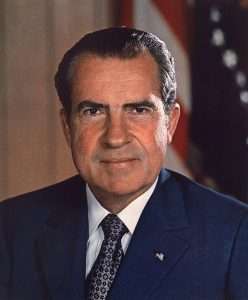
Fifty years ago today, President Richard Nixon resigned. His resignation came shortly after the Supreme Court unanimously decided United States v. Nixon. This decision is often held up as an exemplar of Supreme Court jurisprudence at its best. Justice Kavanaugh, for example, often stresses that Nixon was joined by three Nixon appointees. (Justice Rehnquist recused because former Attorney General John Mitchell, one of the defendants, had been Rehnquist's boss.)

But I'm not sure Nixon has stood the test of time. The argument that the Court had jurisdiction to resolve what was, in effect, a dispute within the executive branch, never persuaded me. This theory led inexorably to the concept of the independent counsel, an anathema to the separation of powers. Moreover, to the extent that Nixon said anything at all about the Appointments Clause, that analysis has been overcome by Buckley v. Valeo, Bowsher v. Synar, and other cases. (Seth Barrett Tillman and I explain why the holding of Nixon, whatever it is, was limited to some "unique" facts—which is precisely what the decision repeatedly stated.) I've long seen Nixon v. Fitzgerald as a something of a correction to Nixon. Fitzgerald was decided nearly a decade after Nixon during a more sober time.

There's more. Today's Wall Street Journal includes an Op-Ed by Kenneth L. Khachigian, who served as an aide to President Nixon. He argues, provocatively, that Nixon should not have resigned, and that he could have survived an impeachment vote--or at least that he should have taken a principled stand and forced Congress to impeach him. But more relevant for my purposes are behind-the-scene machinations. Khachigian speaks to some of the questionable legal issues lurking in the background:

I hope new generations are open to some different thinking—or at least a balanced treatment that goes beyond the story of bungling burglars and political damage control. It must include how the "Watergate affair" was also the culmination of Nixon's political opponents' long-yearned-for goal of destroying him. Nixon had a political target on his back from his congressional days of vanquishing the communist Alger Hiss, a favorite of Washington's intellectual left. Through his entire presidency, Congress was controlled by opposition Democrats, with confrontation aggravated further by Nixon's determination to end the Vietnam War he had inherited from the Kennedy and Johnson administration planners at the State and Defense departments.

Sen. Edward Kennedy set up the Senate Watergate Committee. Three months later John F. Kennedy's 1960 campaign director of opposition research against Nixon, Archibald Cox, was hired as Watergate special prosecutor with a staff seeded from the ranks of Robert F. Kennedy's Justice Department. The subsequent special prosecutor, Leon Jaworski, expressed concern in an internal memorandum that his chief deputy reflected "an attitude I discussed with you before—the subjective conviction that the president must be reached at all cost."

Watergate scholar Geoff Shepard has unearthed further damning evidence that the special prosecutors had several unethical private meetings with Judge John Sirica in the absence of attorneys for Nixon and Watergate defendants—each violating the most basic legal protections. Nixon's adversaries weren't looking only for the truth. They were looking for a scalp.

I didn't know these things. Did you?

There is also the entire fever pitch of the time. Every element of government was focused on getting Nixon out of office. And from what I've researched, we still have no idea what the burglars were looking for in the Watergate Hotel. Nixon had no role in, or even knowledge of, the break-in before it happened. But he later became aware of the break-in. My sense is that Nixon did the sorts of things that  many of his predecessors had done, and gotten away with, but Nixon was recorded. I was not alive at the time, but I have to imagine that Watergate felt something like the resistance to the Trump Presidency.

After half a century, perhaps the members of the Trump v. United States majority have come to second-guess the Nixon majority. The immunity case, I've written, culminated from years of lawfare against Trump. James Piereson makes this point at City Journal:

Pushback against the Watergate legacy is evident in efforts to curtail independent prosecutors and partisan "lawfare," conservative attacks on the politics of the nation's capital, and Trump's current presidential campaign, supported in great part by voters who believe that they have been shut out of influence in Washington and (inferentially) that Watergate promoted political rules that reward insiders. The Supreme Court recently broke new ground in ruling that a president is immune from criminal prosecution for acts undertaken while carrying out the core powers of the presidential office. That opinion may partly reflect a recognition of the lawfare that a Democratic administration is waging against its Republican opponent. It is, in addition, an opinion that works against Watergate sensibilities in regard to presidential conduct and accountability. It's a worthy question whether the current justices would have ruled as their predecessors did in 1974's United States v. Nixon regarding the White House tapes. Today's Court might have permitted Nixon to keep those tapes, in the belief that Watergate represented a form of lawfare against an elected president.

Maybe the Roberts Court was right and the Burger Court was wrong.

Sports

"XY Athletes in Women's Olympic Boxing: The Paris 2024 Controversy Explained"

"The historical, political, and medical context of the Imane Khelif and Lin Yu-ting cases."

|

An interesting and informative Quillette article by Duke Law School Prof. Doriane Coleman, who has guest-blogged here on gender and sports. An excerpt from the introduction and the conclusion:

With the return of the Olympics, it's time for another predictable global uproar about XY athletes competing in the female category. This is now a century-old problem in elite sport that we've somehow not yet managed to solve in a uniform way. The Paris 2024 iteration of this debate is arguably the most explosive ever due to a confluence of at least three factors:

  • This time around, the athletes are boxers not runners, which means they're going to be punching their competitors. Physical safety and gender norms, not just competitive fairness, are front-and-centre in people's minds.
  • After the debates about Lia Thomas and Caster Semenya (which I discussed in an essay for Quillette in 2019), the public knows a lot more—though still not enough—about the two categories of XY athletes who might be included in female competition: transwomen like Thomas and people like Semenya with disorders or differences of sex development (DSD). DSD are also sometimes called intersex conditions or sex variations by those who prefer non-medical terms.
  • The domestic culture wars around sex and gender have since heated up significantly to become a global battle, with LGBTQI-rights organisations and their allies in the international human-rights community arguing that sex isn't real or doesn't matter—either at all or as much as gender identity. Authoritarian regimes led by the Kremlin, meanwhile, describe gender diversity as a harbinger of the end of Western civilisation.

…

I will close by reiterating the three basic points that I and other experts in girls' and women's sport have been making for a long time.

First, the female category in elite sport has no raison d'être apart from the biological sex differences that lead to sex differences in performance and the gap between the top male and female athletes. The suggestion that we could choose to rationalise the category differently—for instance, on the basis of self-declared gender identity—or that we could make increasingly numerous exceptions in the interests of inclusion (as the IOC seems to have done to allow Khelif and Lin to compete in Paris) has no legs outside of certain progressive enclaves.

Second, any eligibility standard—like the IOC's framework—that denies or disregards sex-linked biology is necessarily category-defeating.

Finally, federations that are committed to the female category and to one-for-one equality for their female athletes must step up and do two things. They must craft evidence-based rules and then stick to them consistently. And they must seriously embrace other opportunities to welcome gender diversity within their sports.

Judge Ezra's Worrying Behavior in the Buoy Case

Judge Ezra boasted about knowing the judges on the Fifth Circuit, being sworn into the Texas Bar by the Chief Judge's husband, and threatened to have the Deputy Solicitor General's lawyer removed from the courtroom.

|

On Tuesday, July 30, the en banc Fifth Circuit vacated the preliminary injunction that Judge David Ezra had entered in the buoy case. (Ilya wrote about the case here.) To date, the Fifth Circuit has not yet issued the mandate in that case, which remains before the court of appeals. What has happened over the past eight days is weird--so strange that I worry about Judge Ezra. I will lay out the chronology as best as I can, and offer some commentary along the way. I apologize for the length of this post, but there is much ground to cover.

Read More

Animals

Scooby Dooby Doo, Whose Are You?

|

In Roger v. Keller, decided earlier this month by Waterbury, Connecticut trial court judge Robert D'Andrea, plaintiffs had a pit bull named Scooby; they kept him with defendants (who were apparently, to oversimplify, plaintiffs' family members) for three years, despite defendants' insistence that plaintiffs take them back. Eventually, defendants gave him away (the opinion is unclear on to whom), and plaintiffs sued, claiming this violated plaintiffs' property rights:

Plaintiff Roger filed an affidavit attesting that on or about November 9, 2019, he found the pit bull abandoned in Waterbury and took possession of it that day. However, the plaintiffs, rather than taking the pit bull to their own apartment, brought the pit bull to 25 Linden Street, Oakville, Connecticut, the home of defendants Deborah Roger and Phil Roger (collectively "Rogers"). The plaintiffs asked the Rogers to take care of the pit bull for a few weeks, then for a few months, then for a few more months, and so on. The plaintiffs did not live at 25 Linden Street, but the plaintiffs rented in the Waterbury/Watertown/Oakville area property which prohibited animals. The pit bull resided with the defendants in Oakville from approximately November 9, 2019 through June 28, 2022, or about two years and eight months.

From the start, and for the entirety of the nearly three years Scooby lived with them, the Rogers claim that they repeatedly asked the plaintiffs to take back possession of Scooby citing physical and financial circumstances; and although the plaintiffs had numerous opportunities to do so, they repeatedly failed to take action. Following a major back surgery, defendant Deborah Roger asserts that she demanded that the plaintiffs take possession of Scooby or else it would be rehomed. Defendant Deborah Roger further warned the plaintiff Roger that Scooby would be rehomed should the plaintiff Roger be arrested or incarcerated. Once again, the defendants assert that the plaintiffs had numerous opportunities to take possession but repeatedly failed to do so.

The defendants Rogers and their family, with the exception of the plaintiffs, were the sole providers for the pit bull during the nearly three-year period it lived with them in Oakville. The defendants Roger, not the plaintiffs, provided Scooby food, water, shelter, entertainment, and exercise. The defendant Rogers, not the plaintiffs, let Scooby outside and cleaned up after it. The defendants Roger, not the plaintiffs, incurred the cost associated with its care. The plaintiffs occasionally took Scooby for an overnight stay at their rental properties but otherwise left it with the Rogers in Oakville and bought several bags of food over the nearly three-year period. At no point did the plaintiffs take possession of Scooby, provide for it, or offer compensation to the defendants Roger for the cost they incurred. The plaintiffs simply expected the defendants Roger to take care of Scooby indefinitely.

Read More

Supreme Court

Supreme Court Rejects Missouri's Attempt to Sue New York Over Trump Prosecution

Insofar as the justices split, it was due to long-standing disagreement over the nature of the Court's original jurisdiction.

|

This morning, as expected, the Supreme Court rejected the state of Missouri's attempt to sue the state of New York over the prosecution of Donald Trump and the imposition of a gag order during the pendency of appeals. Missouri had filed a motion for leave to file a bill of complaint against New York in the Court's original jurisdiction. To call the underyling legal theory aggressive would be an understatement (something about how the state law prosecution of a presidential candidate unconstitutionally inhibits the ability of Missouri voters and electors to support the candidate of their choice). Missouri invoked the Court's original jurisdiction by styling this as a dispute between one state and another, and thus sought to bring this suit, in the first instance, in the Supreme Court.

The justices are not having it. The order reads in full:

Missouri's motion for leave to file a bill of complaint is denied, and its motion for preliminary relief or a stay is dismissed as moot. Justice Thomas and Justice Alito would grant the motion for leave to file the bill of complaint but would not grant other relief.

This means the Court split 7-2 over whether Missouri should be allowed to file its bill of complaint, but was unanimous in rejecting Missouri's request for relief in this case. (In other words, Justices Alito and Thomas would let Missouri make their case, but would not grant any of Missouri's requested relief, which included enjoining the gag order imposed on Trump by New York courts.)

No doubt some commentators will read this order as an indication that Justices Alito and Thomas believe that Missouri's filing had merit. Those that do so will show they know very little about the Supreme Court's original jurisdiction and the long-standing debate over whether the Court has jurisdiction to reject bills of complaint filed by states against other states.

The reason that Justices Thomas and Alito dissented form the denial of Missouri's motion for leave to file the bill of complaint is because they believe that when a state seeks to invoke the Court's original and exclusive jurisdiction, the Court is obligated to hear the case. This is also not a new view. See, for instance, this dissent by Justice Thomas, joined by Justice Alito, in Arizona v. California. It reads in relevant part:

The Constitution establishes our original jurisdiction in mandatory terms. Article III states that, "[i]n all Cases . . . in which a State shall be [a] Party, the supreme Court shall have original Jurisdiction." §2, cl. 2 (emphasis added). In this circumstance, "[w]e have no more right to decline the exercise of jurisdiction which is given, than to usurp that which is not given." Cohens v. Virginia, 6 Wheat. 264, 404 (1821) (Marshall, C. J., for the Court).

Our original jurisdiction in suits between two States is also "exclusive." §1251(a). As I have previously explained, "[i]f this Court does not exercise jurisdiction over a controversy between two States, then the complaining State has no judicial forum in which to seek relief." Nebraska v. Colorado, 577 U. S. ___, ___ (2016) (opinion  dissenting from denial of motion for leave to file complaint) (slip op., at 2). Denying leave to file in a case between two or more States is thus not only textually suspect, but also inequitable.

The Court has provided scant justification for reading "shall" to mean "may." It has invoked its "increasing duties with the appellate docket," Arizona v. New Mexico, 425 U. S. 794, 797 (1976) (per curiam) (internal quotation marks omitted), and its "structur[e] . . . as an appellate tribunal," Ohio v. Wyandotte Chemicals Corp., 401 U. S. 493, 498 (1971). But the Court has failed to provide any analysis of the Constitution's text to justify our discretionary approach.

Justice Thomas raised this concern when Nebraska and Oklahoma sought to file a bill of complaint against Colorado over marijuana legalization too.

As I have noted before, Justice Thomas is making a serious argument, and one which I suspect may be correct. Note that this would not mean that the Court has to actually hear oral argument. Rather it would mean that the Court has to accept the bill of complaint and resolve it on the merits -- something that would be quite easy to do in a case like this, but might be more difficult in other contexts (e.g. the dormant commerce clause). I suspect the justices do not want to open this door lest they invite other filings in the sorts of cases they prefer to see percolate up through the lower courts, but it is not clear to me the Constitution gives the Court that choice.

Politics

United States v. Abbott and State War Powers

A guest post from Professor Rob Natelson.

|

Last week, the en banc Fifth Circuit resolved the buoy case. I am happy to pass on this guest post from Professor Robert Natelson, who co-authored an article on the war powers of the states.

--

On July 30, the U.S. Court of Appeals for the Fifth Circuit ruled that the district court should not have granted the United States a preliminary injunction ordering Texas to remove a barrier lying in the Rio Grande River. The case was United States v. Abbott, and it was decided on the issue of navigability. However, the case also has implications for states' power to wage defensive war—and particularly defensive war against illegal immigration.

Andrew T. Hyman and I recently published an examination of those issues in the British Journal of American Legal Studies. We focused mostly on Founding-era evidence of the kind probative of the Constitution's original meaning. Our article played a role in the case—but, as described below, a rather unusual one.

The Parties' Contentions

The State of Texas had placed a 1000-foot floating barrier in the Rio Grande near Eagle Pass, Texas, a busy border-crossing area. The state justified the barrier by invoking state war powers to stem an "invasion."

The U.S. government claimed that Texas's power to respond to the alleged "invasion" had expired. The government also maintained that the state right of self-defense had been qualified by the congressional Rivers and Harbors Appropriation Act of 1899, which forbids obstructing navigable waterways without federal consent. (The Constitution grants Congress jurisdiction over navigable waterways as a component of the Commerce Power.)

Texas countered that under traditional navigability tests, the Rio Grande was not, and never had been, navigable above the city of Roma, Texas—far downstream from the Eagle Pass floating barrier.

State War Powers

The Constitution granted federal officers and entities, as well as the government itself, certain enumerated powers. As confirmed by the Tenth Amendment, it reserved the remainder to the states and the people. Moreover, where the Constitution did not specify that federal authority was exclusive, the states retained concurrent, although subordinate, jurisdiction.

Among the concurrent powers reserved to the states was the prerogative of making war. However, Article I, Section 10, Clause 3 limited that prerogative considerably:

No State shall, without the Consent of Congress . . . keep Troops, or Ships of War in time of Peace . . . or engage in War, unless actually invaded, or in such imminent Danger as will not admit of delay.

In international law terms, Congress could authorize state participation in offensive war. But states retained unconditional power to wage defensive war.

As our study pointed out, this clause retained a balance between federal and state war-making that was approximately the same as that prevailing under the Articles of Confederation.

But only approximately. The Constitution added one further constriction and four expansions of state war powers. Specifically, the Constitution (1) denied state power to issue letters of marque and reprisal—an additional restriction on offensive war but (2) discarded the former limitations on states' ability to wage defensive conflicts.

The Constitution also granted the federal government supreme power to regulate immigration (Article I, Section 8, Clause 10). However, states also retained subordinate concurrent power over that subject. This was recognized in the portion of Article I, Section 9, Clause 1 that referred to free migration as opposed to the importation of slaves: "The Migration . . . of such Persons as any of the States now existing shall think proper to admit . . . .".

Mr. Hyman and I investigated the Founding-era meaning of "invasion" and "invaded" to determine if, as three U.S. appeals courts have opined, those terms were limited to formal attacks by foreign military forces. We found they certainly were not. Both 18th century dictionaries and contemporaneous usage supported definitions broad enough to encompass peaceful but unauthorized cross-border incursions that resulted in damage. For example, in the years before the Constitution was written, both Benjamin Franklin and Pennsylvania officials referred to a peaceful but unauthorized wave of immigration into their state as an "invasion."

We also learned that during the Founding era, migrants entering a country illegally were considered, or treated as, "alien enemies." They were not accorded the same rights as "alien friends." It made no difference whether an illegal migrants' country of origin was friendly or hostile.

Finally, we examined Founding-era international law to determine the sorts of tools a sovereign may use to fight a defensive war. Not surprisingly, these included barriers to thwart invaders.

So based on our findings, it appeared that Texas was on sound constitutional ground when invoking its defensive war powers to justify building a barrier—at least until one considers the Rivers and Harbors Appropriation Act.

The Court's Decision

Under that law, if the Rio Grande is "navigable" at the point where Texas constructed its barrier, then a conflict arises between congressional exercise of the Commerce Power and state exercise of defensive war powers.

In United States v. Abbott, the court avoided that conflict. In an opinion written by Judge Don R. Willett, the court concluded that the Rio Grande was not navigable in the area of the barrier, because the river above the city of Roma had never been a "highway of commerce." Although there was some evidence that a ferry had crossed the river near Eagle Pass, Judge Willett held that ferries crossing rivers merely cover gaps in land routes. A ferry may indicate that a lake is navigable, but "Lakes are obviously not rivers."

Read More

Free Speech

Lawsuit Over Alleged Discriminatory Refusal to Let Church Lease School Property on Weekends Can Go Forward

|

From Pines Church v. Hermon School Dep't, decided last week by Chief Judge Lance Walker (D. Me.):

Plaintiffs The Pines Church and its lead pastor, Matt Gioia, looking for a new space to accommodate their growing congregation, requested a twelve-month lease to hold Sunday services at Hermon High School. The Defendant Hermon School Department's School Committee, after meeting and discussing the challenges associated with such a relationship, did not make a motion to vote on the requested twelve-month lease. Furthermore, the Committee members refused to second a motion to vote on a six-month lease. Ultimately, the Committee voted to offer Plaintiffs a month-to-month lease.

Plaintiffs filed this civil action, alleging that the School Committee's refusal to extend a long-term lease was motivated by animus against their sincerely held religious views …. The School Department offers a competing characterization of events, maintaining that the School Committee's decision was influenced by concerns about entering into a long-term lease agreement.

Before the Court are the parties' competing motions for summary judgment. Plaintiffs rely on the relatively blatant bias and the inferences that arise from the interrogatories posed by one Committee member who demanded to know from Pastor Gioia the Church's "position" on a spate of religious, political, and cultural flashpoints before evaluating whether to extend a lease on behalf of a publicly funded school.

Plaintiffs also rely on a somewhat more tepid bias, sanitized through fear-of-association comments by others, along the lines that association with the Church may not fit with the Committee's "goals" and may therefore create a "negative image" by not comporting with the School Department's "mission" and evidently its own beliefs. This evidence certainly is probative of Plaintiffs' position that the School Committee's refusal to offer Plaintiffs a lease was motivated by unconstitutional considerations, such as animus toward the Church's orthodox religious beliefs.

For its part, the School Department counters that the School Committee's decision, save for the one Committee member's bill of particulars put to the Pastor, simply resulted from humdrum, benign space and cost concerns, although that narrative is far from conclusive based on the summary judgment record. These competing characterizations of the Committee's motivations form the most conspicuous reason I deny summary judgment to the parties in favor of a jury trial.

More on the facts of the case:

Read More

Free Speech

D.C. Circuit Strikes Down Automated Filtering of Supposedly "Off-Topic" Comments on NIH Site

|

In last week's People for Ethical Treatment of Animals v. Tabak, the D.C. Circuit (in an opinion by Judge Bradley Garcia, joined by Judges Karen LeCraft Henderson and Patricia Millett), held that NIH's automated filtering of comments on Facebook and Instagram pages was unconstitutional. The filtering was supposedly aimed at blocking "off-topic" posts, but it did so by filtering out words "such as … 'animal,' 'testing,' and 'cruel.'" This was unconstitutional, the court held because a government-agency-run comment section was a "limited public forum," where restrictions on public speech had to be "reasonable in light of the purpose served by the forum" and "viewpoint neutral," requirements that weren't satisfied here:

Reasonableness is to be assessed in light of the purpose of the forum, which here is to "communicate and interact with citizens," and to "encourage respectful and constructive dialogue" through the public's comments. Reasonableness in this context is thus necessarily a more demanding test than in forums that have a primary purpose that is less compatible with expressive activity, like [speech by attendees at a] football stadium …. In service of those purposes, NIH's off-topic restriction furthers the "permissible objective[s]," of creating comment threads dedicated to each post's topic and allowing the public to engage on that topic, instead of being distracted or overwhelmed by off-topic comments.

But NIH must "draw a reasonable line,"  informed by "objective, workable standards," between what is considered on-topic and what is considered off-topic. "Although there is no requirement of narrow tailoring," the government "must be able to articulate some sensible basis for distinguishing what may come in from what must stay out." This NIH has not done.

In the context of NIH's posts—which often feature research conducted using animal experiments or researchers who have conducted such experiments—to consider words related to animal testing categorically "off-topic" does not "ring[ ] of common-sense." For example, consider NIH's July 20, 2021 Instagram post, which featured a photo of the eye of a zebrafish. The caption read, in part: "This picture of an anesthetized adult zebrafish was taken with a powerful microscope that uses lasers to illuminate the fish." It is unreasonable to think that comments related to animal testing are off-topic for such a post. Yet a comment like "animal testing on zebrafish is cruel" would have been filtered out because "animal," "testing," and "cruel" are all blocked by NIH's keyword filters.

Read More

Supreme Court

Biden-Harris on Supreme Court Term Limits

An attack on the independence of the federal judiciary.

|

President Biden launched an attack on the independence of the federal judiciary on July 29th when he endorsed the packing of the U.S. Supreme Court. He did this in an op-ed in the Washington Post and then in a partisan speech that same day commemorating the 60th anniversary of the passage of the Civil Rights Act of 1964. His Vice President, Kamala Harris, endorsed Biden's comments and indicated that she would be more aggressive on this issue than Biden has been. Packing the Supreme Court is thus a key issue in the 2024 presidential and senatorial elections, as GOP Senate candidates running in red or purple states like Montana, Ohio, Pennsylvania, Wisconsin, Michigan, Nevada, and Arizona should make clear.

Technically, Biden and Harris are probably calling for a statute that would unconstitutionally limit the voting rights of Supreme Court justices to 18-year terms in violation of Article III of the Constitution. I base this inference on my knowledge of the proceedings of President Biden's Supreme Court Reform Commission, since Biden's July 29th op-ed and speech provided no specifics. The Biden-Harris proposal of July 29th reflects the fact that a solid majority of voters oppose court packing, but voters like the idea of Supreme Court term limits by a large margin. Term limits on Supreme Court justices could be legally imposed by constitutional amendment, which would require a bipartisan consensus, and, if the term limit were long enough, it might be somewhat reconcilable with judicial independence. In reality, the Biden-Harris proposal is both a disguised court packing plan, which voters rightly oppose, and it is also unconstitutional and the greatest threat to judicial independence since President Franklin D. Roosevelt tried unsuccessfully, in 1937, to increase the size of the Supreme Court from 9 to 15 justices.

Biden tipped his hand that he is asking for a statute imposing an 18-year term limit on the voting rights of Supreme Court justices in cases or controversies before the Supreme Court because, in his July 29th proposal, he called for a constitutional amendment to overturn a recent Supreme Court case that he disagreed with, but he pointedly did not call for a constitutional amendment to enact an 18-year term limit on Supreme Court justices' voting rights on cases before the Supreme Court. Biden also did not specify whether such a package would apply retroactively to the nine current Supreme Court justices or prospectively, as some members of his Presidential Commission on Supreme Court reform have suggested it should. President Biden, and some members of his Commission, seem to think that the mere passage of a statute and not a constitutional amendment is all that is needed to eliminate the voting rights of Supreme Court justices once they have served for 18 years. I am not aware of any Republican member of Biden's Commission or of any right of center legal scholar or lawyer who currently thinks that what Biden-Harris are contemplating is constitutional.

Read More

Justice Gorsuch Explains What Collegiality Means

Does it mean going to the opera together, or a willingness to be persuaded?

|

It seems that Justice Gorsuch is going through the media circuit in advance of his book launch. Yesterday I wrote about this interview with the Wall Street Journal. Today, David French of the New York Times published a transcript of his NMG sit down. To go back to one of my hobby horses, when a publisher gives a book deal to a Justice, with a large advance, the publisher knowns that the media will gladly sit down for interviews in Supreme Court chambers. This is free press that cannot be purchased--well it can be purchased with a substantial advance. All the more reason to place a cap on royalties for Justices. I digress.

French and Gorsuch had an extended discussion of what was learned from the COVID cases. In truth, we need to reflect a lot more on that period than we have. So many of us (present company included) made some terrible decisions. Our faith in the power of government and self-professed "experts" was largely misplaced. And nothing that has happened since the pandemic has restored my faith. Chief Justice Roberts's "super-precedent" in South Bay has not aged well. I have to imagine that distrust was lurking in the background of Loper Bright.

I found the most enlightening exchange to turn on collegiality. I think that is a term that many people use to mean different things. It was well known that Justices Scalia and Ginsburg were dear friends, and often socialized together. They were collegial. But did RBG ever persuade Scalia to change his mind, at least on a big case? Probably not. Does that mean they were not collegial?

Of late, Justice Kagan has been pushing the latter conception of collegiality--that it entails having an open mind, and a willingness to be persuaded. I have to imagine this push is part of her effort to corral Justice Barrett's votes at every opportunity. If there is any common thread with Joan Biskupic's reporting, is that Justice Kagan flipped Justice Barrett in several cases. I've yet to see any indication that a conservative Justice has flipped a liberal member of the court to reach a conservative outcome. Flipping is not ambidextrous--it only works on the left.

I for one, reject the notion that collegiality entails a willingness to reconsider your views. It is always a judge's role to find the truth, and determine the best answer to a particular legal dispute by his or her best lights. And that process primarily entails weighing the arguments advanced by counsel, and deciding which side should prevail. To be sure, judges on a multi-member court will lobby one another for this position or that position. And to maintain relations, it is important to be willing to listen. But I do not think collegiality requires anything more than listening. Indeed, there are problems with this sort of ex-post lobbying that happens after the briefs are submitted and arguments conclude. Perhaps the parties have obvious rejoinders to some post-hoc position raised, but there is no chance to discuss it. The vote at conference reflects an assessment of the actual case, as it is presented. But when votes change after conference, invariably, it will be because of some newly-determined facet of the case that the parties did not have the chance to address. The Court could always order re-briefing and re-argument, but alas, the pattern has been to simply decide cases on grounds that would be entirely foreign to the lower courts. NetChoice and Moyle comes to mind.

David French poses this question to Justice Gorsuch, which he sort-of-answers, indirectly.

French: Justice Kagan gave some remarks to the Ninth Circuit recently where she talked about this issue of collegiality within the court. There's been some friendships, for example, most famously of Justice Ruth Bader Ginsburg and Justice Antonin Scalia. Also recently, Justice Sonia Sotomayor gave a speech in which she said some really kind things about Justice Clarence Thomas and the way that he interacts with court personnel.

But Justice Elena Kagan said something interesting. She said the collegiality that America should be looking for — and I'm paraphrasing — is not "Do we go to the opera together?" but "Are we open to each other?" Are we collegial enough to where we are open to each other? What is your temperature check on the collegiality of the court?

Gorsuch: Well, you're not going to drag me to an opera, David.

French: I wasn't expecting to.

Gorsuch: There's a lot in that question.

French: Yeah.

Gorsuch: I don't know whether you want me to talk first about the court.

French: Let's go first with the court and then with the culture.

Gorsuch: Sure. So with the court, I think it is important that we're friends and that we enjoy each other's company. We have a nice dining room upstairs. Lovely dining room, but it is the government, and we bring our own lunch. And oftentimes you'll see the chief justice with a brown bag and a peanut butter and jelly sandwich. OK. Those moments are important. They're human. But I also take the point that collegiality in a work environment means being able to work together well. And can I share just some numbers with you that I think tell the story on that?

Gorsuch goes on to explain that the Court decides many cases unanimously, and that he often votes for the "liberal" side of the case. And he says those unexpected coalitions are evidence of "collegiality."

Gorsuch: We decide the 60, 70 hardest cases in the country every year where lower courts have disagreed. That's the only point to get a case to the Supreme Court. We just want federal law — largely our job is to make sure it's uniform throughout the country, and if the circuit courts are in agreement, there's very little reason for us to take a case, unless it's of extraordinary importance.

So most of the work we do is when lower court judges disagree about the law. Magically, I think in this country there are only about 60 or 70 cases. You could argue a little bit more, a little bit less, but there aren't thousands of them. They're very few in number.

There are nine of us who've been appointed by five different presidents over the course of 30 years. We have very different views about how to approach questions of statutory interpretation, constitutional interpretation about political disagreements or interpretive methodological disagreements. Yet we're able to reach a unanimous verdict on the cases that come before us about 40 percent of the time, I think it might have been even higher this last term. I don't think that happens automatically.

I think that's the product of a lot of hard work. I think that's proof of collegiality. OK? That is what we do and we do well. Now people often say, "Well, what about the 6-3s?" Fair enough. Fair enough. But that's about a third of our docket. And it turns out they aren't always what you think they are. About half the 6-3s this last term are not the 6-3s you're thinking about.

Okay, Gorsuch does not actually answer the second part of Kagan's question. The fact that the Justices vote in unusual ways reflects the fact that all of the Justices are, to various extents, heterodox. They are not--contrary to what you might read--ideologues. Trust me, if we had an actual MAGA Court, things would look very different. But Gorsuch does not even hint that collegiality requires a willingness to be persuaded. It is the facts of a case, and the arguments advanced by counsel, that determine the unusual lineups.

I would like this same question posed to Justice Barrett. I think she might see things differently.

French also asked about Justice Kagan's ethics proposal. Gorsuch explains that the facts changed since Kagan's speech. Namely, President Biden wrote a pointless op-ed and Senator Schumer introduced a nuclear bill.

French: We're running out of time, so I do want to get to a couple of other questions. One, Justice Kagan also raised this interesting idea regarding ethics. And she talked about that the Supreme Court has a code of ethics that she appreciates, but she also talked about the possibility of enforcement through — and I'll read the quote here, one moment — "If the chief justice appointed some sort of committee of highly respected judges with a great deal of experience, with a reputation for fairness, you know, that seems like a good solution to me."

And a reason for that, the creation of sort of an outside judicial panel would, part of it would be to protect the court, to provide an outside voice that could not only adjudicate potentially valid claims but also debunk invalid accusations. And she made it clear she was speaking only for herself. What's your reaction to that concept?

Gorsuch: Well, David, since that talk, there's been some developments in the world, and this is now a subject that's being intensely discussed by the political branches, and I just don't think it would be very useful for me to comment on that at the moment.

In hindsight, would Kagan still have given her remarks, knowing what would come the following week? Or perhaps Kagan knew what was coming, and gave her remarks to shift the Overton Window? We are working with a crafty, plugged-in operator here, so be skeptical. How does that work for collegiality?

Some Highlights From Justice Gorsuch's WSJ Interview

Justice Gorsuch likes the new oral argument format and he writes his own opinions.

|

Justice Gorsuch gave a wide-ranging interview with Kyle Peterson in the Wall Street Journal. The focus is his new book, which will be released on Tuesday. There are also some insights into how the Court functions post-COVID, and how his chambers operate.

First, Gorsuch strongly intimates that the Dobbs leak did not come from his chambers. I doubt any NMG clerks lawyered up, or refused to turn over their devices:

Did the Covid pandemic and the 2022 leak of the Dobbs abortion ruling change how the high court operates? Not much, apparently. "Unsurprisingly, the court has taken more security precautions with respect to its internal drafts," Justice Gorsuch says. He declines to detail what he told his clerks about the leak. "I can tell you," he says, in a low steely voice, "that it was very important to me that anybody who works for me was totally cooperative with the investigation. And they were."

Second, Gorsuch seems to appreciate the interminable round-robin format:

Oral arguments, influenced by pandemic teleconferences, have become "a little more leisurely." Lawyers now get two minutes to speak and settle in before the interrogating begins, which Justice Gorsuch says he loves: "They're all overcaffeinated and underslept, and they have a point they want to make." At the end, each justice is given a turn for final queries. "You don't have to elbow your way in," he says. "You never leave oral argument thinking, gosh, there's a question I wanted to ask."

I am not a fan. Then again, I'm not the one trying to ask questions.

Third, Gorsuch does not like his own writing:

Then comes the work of drafting rulings, where Justice Gorsuch says his colleagues shine. "I think we have an unusually large number of very gifted writers on the court right now," he says. "I'm not patting myself on the back. I put myself kind of in the middle of the pack, frankly." Asked if he has a favorite of his opinions, he answers without pausing to think: "Nope. I hate 'em all. Do you like reading your old writing?" Sometimes the job requires it. "Inevitably I think, ah, I wish I'd said this differently, ah, I didn't explore that enough."

I agree, and would put Gorsuch around the middle of the Court with writing prowess. My current top three are Roberts, Kagan, and Barrett. But Gorsuch writes in his own distinct tone, which works for him. On that point…

Fourth, Gorsuch states that he writes his own opinions. This is not surprising, since his tone is so distinctive, term-after-term:

What is his drafting process? "I like to have a law clerk do something," Justice Gorsuch says, even if he ultimately follows the practice of his old boss, Justice Byron White: "He'd say, write me something. And he'd read it. And then he'd throw it away. And then he'd write his own thing." This isn't to say the clerks are wasting time: "It's informative to see how another mind might approach the problem."

But then Justice Gorsuch sits down to write a complete draft himself. "It's a pretty intense, lock-yourself-in-a-room-with-the-materials process," he says. "At the end of the end of the end of the day," he says, repeating himself for emphasis, "I'm the one who took the oath, right? And I have to satisfy myself, that I've gone down every rabbit hole, and I understand the case thoroughly, and I'm doing my very best job to get it right."

I appreciate that Justice Gorsuch is now writing books at a regular clip. It is unfortunate that Gorsuch's royalties pale in comparison to his colleagues'. But that shouldn't matter. Gorsuch is writing about important legal topics, in much the same way that Justices Scalia and Breyer did. Gorsuch is trying to affect the long-term legal conversation. The other Justices are trying to… well, write about themselves.

For what it's worth, Gorsuch seems to identify as a libertarian-but-not-a-nut:

Whatever the cause, he worries that the U.S., with its accumulated statutory commands and regulatory crimes, is on the far side of what one might call the legal Laffer curve. "Too little law poses problems," he says. "I love my libertarian friends, but I am not with them on anarchy, OK? Law is essential." And yet: "Too much law actually winds up making people fear law rather than respect law, fear their institutions rather than love their institutions."

I can relate.

More