[1.] Eugene Volokh (Volokh), an emeritus law professor, who writes a legal blog hosted by Reason Magazine, has moved to intervene in this case and to unseal two exhibits of the recently filed complaint….
According to the complaint, Mastriano is a retired U.S. Army colonel, a recipient in 2013 of a Ph.D. in military history from the University of New Brunswick, Canada (UNB), a former Army War College professor, a published author of books on Sergeant Alvin York and the World War I conflict in France, and a public speaker on military history. He alleges that he is also a current State Senator for the Commonwealth of Pennsylvania's 33rd District. He was the 2022 Republican nominee for Pennsylvania governor and, by his account, at least, was considered the frontrunner for the 2024 United States Senate seat for Pennsylvania.
In his complaint, Mastriano alleges, among other things, claims of civil racketeering, anti-trust violations, fraud, and defamation against the University of New Brunswick (UNB), UNB's president, vice-president, dean of graduate studies, and several history professors, faculty or instructors, the National Research Council of Canada and its research officer, members of an investigatory commission tasked with looking into Mastriano's Ph.D. work, and a graduate student and Ph.D. candidate at the University of Oklahoma.
Mastriano specifically alleges that the graduate student, James Gregory III, made fraudulent statements to the press about Mastriano's books and Ph.D. thesis and filed fraudulent complaints with UNB seeking to debunk his Ph.D. thesis, to cancel his books and to cancel his historical authority in the field of World War I history. Mastriano also specifically alleges that the UNB professors, faculty or instructors signed and publicly issued a letter defaming Mastriano, depriving him of his intangible property interest in his Ph.D., books and speaking engagements and interfering with his elected position and candidacies.
Exhibit no. 2 to Mastriano's complaint is a redacted Insider Higher Ed article written by Katherine Knott in 2022. It concerns criticism of Mastriano, who was then running for Pennsylvania governor. The exhibit is referenced with respect to the allegations of fraudulent statements made by Gregory to the press. Exhibit no. 4 to the complaint is the letter signed and publicly issued by UNB professors, faculty or instructors which Mastriano claims defamed him. It is specifically referenced in paragraphs 17, 24, 34, and 125 of the complaint. Upon request of Mastriano, exhibit no. 4 was filed under seal.
After Anna Netrebko, an acclaimed opera singer, refused to repudiate Russian President Vladimir Putin in the wake of Russia's 2022 invasion of Ukraine, the Metropolitan Opera fired her….
Netrebko first alleges that the Met's February 27 Policy, in which it announced it would cut ties with artists and institutions that support or are supported by Putin, is "facially discriminatory" because it "singles out Russian artists." The Met argues that the Policy was "a political statement" and demonstrates that Netrebko's termination "ha[d] nothing to do with Netrebko being Russian" and everything to do with the Met's support for Ukraine and Netrebko's support for Putin….
The February 27 Policy is not facially discriminatory as it does not explicitly implicate a protected class. On its face, non-Russians can run afoul of the Met's policy. Moreover, a policy that targets "a generalized political affiliation, [and] not a specific national origin," cannot form the basis of a claim for national origin discrimination. That there exist Russian expatriates in the United States who support Putin does not compel a finding that the February 27 Policy facially discriminates against them.
Next, Netrebko alleges that the Met's discriminatory motivation is evidenced by (1) the "pretextual nature" of its stated reason for her firing (Netrebko's support of Putin), and (2) the fact that she was replaced by non-Russian performers. The Court disagrees.
Magistrate Judge Bristow Marchant's decision earlier this month in Doe v. Weston & Sampson Engineers, Inc.(D.S.C.) arose in a case where plaintiff sued alleging that a coworker had sexually assaulted her, including by "threatening her with a gun." Many (though not all) courts allow plaintiffs alleging sexual assault to sue pseudonymously in order to protect their privacy as to "matters of a sensitive and personal" nature (see pp. 1430-37 of this article). And the magistrate generally endorsed that position—but concluded that in this instance pseudonymity was unavailable:
[W]here a Plaintiff has not herself acted in a manner to preserve her privacy as to her allegations of sexual assault, this interest [in plaintiff's privacy] may be negated…. [Defendant] Roberts argues that other factors weigh against Plaintiff's request for anonymity here, as Plaintiff herself "has not acted to preserve her privacy" because she used her own name and photograph on social media in claiming that Roberts sexually assaulted her, thus unmasking her identity in a public forum. Roberts argues that "[b]ecause Plaintiff's reasons for anonymity (to preserve her privacy) are belied by her [own] actions, this factor weighs against anonymity." The Court is constrained to agree….
Based on a review of the parties' submissions regarding Plaintiff's Facebook posts, the Court concludes as follows. "Are We Dating the Same Guy?" ("AWDTSG") is a network of approximately 200 female-only Facebook groups that are location-specific. Within these groups, women can post screenshots of men's dating profiles to their specific location's group, asking other members of the group for "red flags" or "tea" (apparently referring to gossip or information) about the identified men…. To join a group, a member must be vetted and only individuals (presumably female) who have been admitted to the group are able to see the content posted by other members and to post content themselves. The rules applicable to these groups prohibit taking screen shots of content and sharing the information outside of the group.
The parties have identified two AWDTSG groups in which Plaintiff was a member and posted information about the issues involved in this case. First, there is a regional group for Greenville and Anderson Counties, which has approximately 16,700 members …. Second, there is a regional group for the Charleston and Columbia areas … with over 40,000 members….
In June or July 2023, a member of one of the two groups posted a request seeking information about Roberts. Plaintiff, using her full name and profile picture, responded to this post as follows:
To everyone, he SA me. I didn't know he had a criminal history. I'm putting this out there to protect anyone I can from him. He is DANGEROUS.
Although members of AWDTSG have the option to post anonymously, Plaintiff posted this comment using her real name along with a photograph. Moreover, Plaintiff's post was linked to her personal Facebook profile, which contained additional pictures and personal information.
Thursday's decision by Judge Alvin Thompson (D. Conn.) in Knights of Columbus Council 2616 v. Town of Fairfield involved a challenge to the Town's refusal to allow the Knights to move their Christmas Vigil from one park where it had been held since 1983 (Town Hall Green) to another, apparently more prominent, park (Sherman Green):
The Christmas Vigil begins on December 23rd and ends on Christmas morning, December 25th. During the Christmas Vigil, "one or more members of the Knights is present with the Nativity scene at all times." The Nativity scene is composed of a "3-sided box, with small figurines of the Holy Family, angels, the magi (three kings), shepherds and livestock." "In addition to the Nativity scene, the Knights post a 4′ × 8′ sign with 6- inch letters stating that the Nativity scene is not endorsed by the Town of Fairfield and is sponsored by the Knights of Columbus."
The Knights allege that their 2020 request for the move was rejected, ostensibly on COVID grounds, but another group's menorah-lighting event was allowed. They also allege that, as to both the 2020 and 2021 requests, officials were really motivated by the content of the display and its potentially controversial nature; allegedly,
In the early days of the COVID-19 pandemic, Governor Roy Cooper declared a state of emergency and issued an executive order affecting outdoor venues such as stadiums, concert arenas, and racetracks. The executive order permitted these venues to stay open but limited attendance to only twenty-five people, regardless of the venue's size.
Robert Turner, who operated a racetrack in Alamance County known as Ace Speedway, spoke out against these restrictions and told the public that his racetrack would remain open for all attendees. This led to the series of events at issue in this lawsuit….
[T]he claims at issue allege that Governor Cooper took a series of "unusual steps" to single out and shut down Ace Speedway—first by pressuring the local sheriff to arrest Turner and, when the sheriff refused, ordering public health officials to shut down Ace Speedway as a health hazard. The claims also allege that Governor Cooper took these actions not because there was an actual health hazard at the racetrack, but to punish Turner for speaking out, and that health officials did not take similar actions against other large outdoor venues whose owners did not openly criticize the Governor.
We emphasize that these allegations remain unproven. After all, the case has barely begun. Still, as explained below, these allegations assert colorable claims under the North Carolina Constitution for which there is no alternative remedy. As a result, at this stage of the case, the trial court properly denied the State's motion to dismiss….
We begin with Ace Speedway's claim that the State deprived the speedway and its owners of their inalienable right to earn a living guaranteed by the provision of Article I, Section 1 of the North Carolina Constitution known as the "Fruits of Their Labor Clause."
Article I, Section 1 provides as follows: "We hold it to be self-evident that all persons are created equal; that they are endowed by their Creator with certain inalienable rights; that among these are life, liberty, the enjoyment of the fruits of their own labor, and the pursuit of happiness."
There are two staples of every 1L curriculum. First, in Constitutional Law, Employment Division v. Smith drew a distinction between belief and actions. The Constitution squarely protects all religious beliefs, but those protections do not necessarily extend to actions. To use United States v. Reynolds as an example, a person can believe that polygamy is a religious mandate, but that belief does not override a law barring multiple spouses. Smith more-or-less followed this rule, holding that one could believe that peyote is part of a religious ritual, but that belief does not mandate an exemption from controlled substance laws. The second chestnut is Pierson v. Post. This case applied the rule of capture to a fox hunt. The first person to actually lay hands on a fox gains possession. It does not matter that a hunter accompanied by hounds was engaged in a lengthy, regal pursuit. That decision, from 1803, also reflected the rejection of the aristocratic fox hunt by the young-scrappy-and-hungry country.
What do these two cases have in common? Before today, I would have said the answer was nothing. But the doctrines merge!
The United Kingdom banned fox hunts. Now, fox hunters are asserting that their practice is a (religious) belief. I put religious in parentheses, because under English law, there is no requirement that a belief be religious to obtain protected status. But I think this question is in the same ballpark as religious belief.
The New York Timesoffers a useful summary of the conflict.
Ed Swales, the activist, founded Hunting Kind, a lobby group that aims to protect hunting with dogs and other forms of hunting, in early 2022. He wants to use Britain's Equality Act — which protects people from discrimination because of their age, race, sexuality or religion, among other things — to classify a pro-hunting stance as a protected belief.
"If he's 'anti-hunt,' well, you can be 'hunt,'" Mr. Swales said. "It's just the same law."
Mr. Swales, 55, said he was preparing to bring a series of anti-discrimination lawsuits in the hope of setting a legal precedent that could, eventually, help reverse the fox-hunting ban.
"We've been doing this for millennia," he said. Hunting is "literally part of our cultural heritage."
You may think this argument is frivolous, but UK law defines a belief quite broadly.
Several lawyers and academics who study discrimination said Mr. Swales's argument might have some success, but the bar would be high. Under Britain's 2010 Equality Act, a protected characteristic must "be a belief and not an opinion or viewpoint" and it must "not conflict with the fundamental rights of others."
"The test requires that the belief be genuinely held and that it be sufficiently cogent and weighty and coherent," said Colm O'Cinneide, a professor of constitutional and human rights law at University College London. A mere political opinion would not pass muster, he said: "There needs to be some sort of belief structure or framework."
The UK Law has an express requirement that one's belief does not conflict with other "fundamental" rights. This is more-or-less Justice Ginsburg's Hobby Lobby dissent, and one possible reading of Cutter v. Wilkinson. The Supreme Court has not gone down that road, and has more-or-less rejected the third-party harms doctrine. (Do we even care about Justice Kennedy's Hobby Lobby concurrence after Roman Catholic Diocese?)
This definition also relates to difficult questions under American law that I have written about (and enraged people with). What is a religion? And is a religion sincerely held? I do not know how these questions shake out under UK Law, but I am skeptical this Church of Fox Hunting would be considered a religious belief in the United States. And this entire scheme seems like a cynical ploy to let people hunt foxes. It does not strike me as particularly sincere.
At a recent rally, former-President Trump talked about the Supreme Court:
And by the way, how courageous were our justices of the United States Supreme Court?
What they did — they're saving our country. They're actually saving our country. What they've done is — I mean, they've passed things that were so important, and they did it for the right, not for the wrong. They did it for — they did the right thing. They did the right thing.
Here, Trump was likely talking about Dobbs. He understands, intrinsically, that it took an act of judicial courage for those five Justices to cast that vote. I'll give Roberts some courage points for NFIB, but not for his lonely, failed saving construction in Dobbs.
In this regard, Trump is on the same page with Kamala Harris who favored the "bold" Ketanji Brown Jackson over the "cautious" Leondra Kruger.
Make no mistake, both of the leading presidential candidates understand what makes a successful Supreme Court pick: judicial courage.
Trump, in his unique way, demonstrates a keen grasp of how the courts work. He analogized "working the refs" in sports to "working the Justices":
And I just have such respect for the job they've done against — and, you know, the radical left plays the ref. You know the great Bobby Knight? He supported me. He used to fight with the referees all the time. Scream at him, "Bobby, Bobby, please, don't do that." It's not going to work. He said, "You're right. It's not going to work now."
It's going to work for the next one. And the next call, there'd be a flagrant foul, and they wouldn't call it. They didn't want to get screamed at. The radical left harasses our judges and harasses our justices. They scream at them. They call them names.
They say they're incompetent, they're horrible, they're this, they're that, they should be impeached. They're constantly saying they should be impeached. But they're screaming. And you know what? It has an effect on some people. But so far, they've been very strong. It's really horrible. I believe it's illegal what they do. And it's a — I'm trying to give you things that you've never heard before, and this is true. I believe they are playing the ref. They're constantly criticizing our great — some of our greatest justices and a lot of great judges.
It sure does have an effect on some people. Here, I would flag Judge Ho's Story Lecture, which discusses the fear of being booed.
I recently ran across a case in which the plaintiff was a John Doe—but when I downloaded the Complaint, I saw the plaintiff's name as part of the tab name in my browser. It appears that the PDF for the filing was created with a title that contained the plaintiff's name (you can see a PDF document's title in Adobe by clicking ctrl-D). That in turn presumably stemmed from the original word processing document containing that title, maybe from a time before the plaintiff's lawyer thought the case should be litigated under a pseudonym.
In any event, a tip: If you're filing a document in a pseudonymized case, or in a case you want pseudonymized, check the PDF to make sure that the party's name doesn't appear in the title.
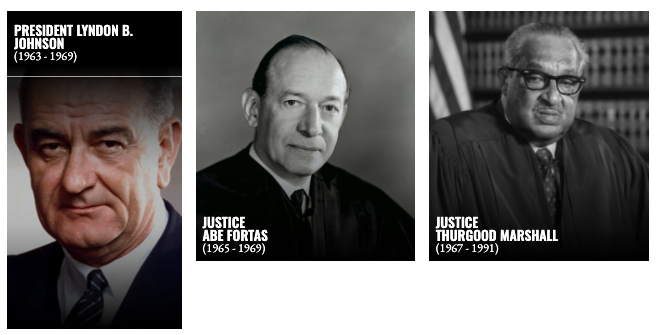
8/26/1964: Lyndon B. Johnson nominated as Democratic candidate for president. He would make two appointments to the Supreme Court: Justices Abe Fortas and Thurgood Marshall.
President Johnson's appointees to the Supreme Court
The U.S. Court of Appeals for the Eighth Circuit has decided that ATF's Final Rule determining that most pistols with stabilizing braces are short-barreled rifles is arbitrary and capricious. The case is Firearms Regulatory Accountability Coalition, Inc. v. Garland ("FRAC"), decided on August 9 and authored by Judge Steven Grasz.
The decision is filled with illustrations, beginning with a shooter with the brace's strap wrapped around his forearm and a cuff further supporting the forearm. The device facilitates holding a heavy pistol with one hand. At the peak of their popularity in 2020, there were seven million braces owned by the public. Untold numbers were sold between then and when the Final Rule was published in 2023. ATF previously said the braces are legal. However, as the court notes, "The consequence of the ATF's about-face is that many individuals, relying on the ATF's previous classifications, were apparently committing felonies for years by possessing braced weapons."
The ATF rule's first step is to see if the rearward attachment of a brace "provides surface area that allows the weapon to be fired from the shoulder," but it gives no mathematical guidance as a standard. ATF implies that, if actual dimensions are set, cheaters will circumvent the rule. The court responds: "That the regulated parties wish to see more specific metrics does not mean they wish to skirt or circumvent the law, as ATF insinuates. They may simply wish to comply with the law, by producing or equipping stabilizing braces that do not have a rear surface area that allows for shoulder firing a weapon."
From Miller v. Sawant, decided Thursday by Ninth Circuit Judges William Fletcher, Carlos Bea, and John Owens:
In February 2016, Miller and Spaulding [two Seattle police officers] fatally shot Che Andre Taylor, a Black man, as they tried to arrest him. Miller and Spaulding's [defamation] complaint … against [Seattle City Council member Kshama] Sawant [was] based on her remarks, at public protests, that Taylor's shooting was a "blatant murder at the hands of the police," and that Taylor was "murdered by the police."
Summary judgment was proper because Miller and Spaulding did not establish essential elements of their defamation claim, namely: that Sawant's statements were actionable statements of fact (as opposed to nonactionable opinions); that Sawant's statements were false; and that Sawant acted with actual malice.
A wedding proposal. (Tunahan Karadongel | Dreamstime.com)
In June, the Biden Administration granted "parole in place" to undocumented immigrant spouses of US citizens. Predictably, 16 GOP-controlled states led by Texas have filed a lawsuit challenging the legality of the program. I think the lawsuit deserves to fail. But there may well be a lengthy legal battle before the case is resolved.
Here's my brief summary of the parole in place program (written at the time it was announced):
Today, President Biden announced a policy granting "parole in place" to undocumented immigrant spouses of US citizens who have been in the US for at least 10 years, and meet some other criteria. Those eligible can apply for parole status. If they get it, they will then have a three-year period during which they will have work permits and can apply for "green card" permanent residency (that status will eventually also enable them to apply for citizenship). Currently spouses of US citizens are already eligible to apply for green cards. But if they entered the US illegally, they are required to meet onerous conditions, such as first leaving the United States, and staying away for up to ten years. About 500,000 people could potentially benefit from the program.
The grant of parole will enable them to dispense with these requirements. Under Section 245 of the Immigration and Nationality Act, undocumented immigrants who have been granted parole may have their status adjusted to that of temporary legal residents. That adjustment would dispense with various penalties for unlawful entry, including the requirement to leave the US for a long period of time before applying for a green card.
And here's my summary of why the program is legal (which anticipated many of the key legal arguments raised by the plaintiff states):
The relevant statute gives the president the power to grant parole entitling non-citizens to temporary legal residence, "on a case-by-case basis for urgent humanitarian reasons or significant public benefit."
As in the CNVH case, there is a strong argument that parole for spouses of US citizens is backed by "urgent humanitarian reasons." Deporting such people (or requiring them to leave the country for many years to become eligible for legal residency) inflicts serious harm on their families, including many children. There is also a strong case that this grant of parole creates "significant public benefit." As already noted, keeping families intact benefits the larger community, as well as the families themselves. Again, don't take my word for it! Take that of pro-family social conservatives (as well as many social scientists across the political spectrum).
If, as is likely, conservative red states challenge the new policy in court, they will probably focus on the requirement that parole only be granted on a "case-by-case basis and claim that the administration's rules are too categorical [update: they do indeed emphasize this point]. This issue has come up in the CNVH case, and I addressed it in some detail in my amicus brief in that case (filed on behalf of the Cato Institute and MedGlobal, as well as myself) (pp. 11-20). I think most of the points made there apply to parole for spouses of citizens, as well. I summarize the most important points in a September 2023 article in the Hill:
[A]ny case-by-case decision-making must be guided by rules and presumptions, if it is not to be completely random and arbitrary. And it is entirely reasonable to presume that migrants from nations with horrifically oppressive governments, widespread violence and economic crisis, have urgent humanitarian needs….
Similarly, it is reasonable to presume that families have an "urgent humanitarian need" to stay together, and that keeping them together is a significant public benefit.
It is worth noting that parole in place has been used since 2007 to protect spouses of US military servicemembers from deportation (a policy begun by administration of Republican President George W. Bush). That policy, too, relies on general rules and presumptions: that keeping servicemembers' families intact is a humanitarian imperative, and that it creates significant public benefits.
The plaintiff states do make a couple arguments I didn't anticipate. They note that the the the parole statute empowers the executive branch to parole migrants "into" the United States, and thus - they contend - cannot apply to those already in the US. The answer to this is that, in context, the phrase "into the United States" refers to the legal status of the of the migrants' entry, not mere physical presence. Moreover, if the courts accept this argument, it would mean the longstanding parole program for spouses of US servicemembers is also illegal (almost all of these spouses are physically present i the US, as well).
The states also contend that the parole-in-place program violates the Take Care Clause of the Constitution, which requires the president to "take Care that the Laws be faithfully executed." But if the program is otherwise legal, it can't possibly violate the Take Care Clause, because the president would not be failing to enforce any binding federal laws by implementing it. To the contrary, he would be exercising authority duly granted by Congress. Moreover, given the vast quantity of federal laws, presidents cannot possibly enforce them all against every violator and thus much necessarily exercise substantial discretion in deciding which violations to to target, and which to let go.
The states also raise various claims under the Administrative Procedure Act. I will leave this to experts on administrative law. But I am skeptical any of these arguments can succeed if the federal government's (and my) interpretation of the parole statute is correct.
Finally, this case, like the CNVH case noted above, raises standing issues. Courts might end up dismissing this case on standing grounds, just as the district court in the CNVH case did. My own view is that states should have broad standing to challenge federal policies, including those that I believe should be upheld on the merits (like this one should be). But in recent years, federal courts - including the Supreme Court - have taken a significantly narrower view of state standing, and that might end up foiling the states in this case.
Whatever happens, it may well take many months to resolve this issue. Whoever loses in the district court will almost certainly appeal to the US Court of Appeals for the Fifth Circuit. The case could even eventually land in the Supreme Court. The CNVH case has dragged on for almost a year now, and this one could also take at least that long. A quick resolution is only likely if Trump wins the election, at which point he would almost certainly revoke the policy soon after taking office.
If that happens, it would resolve legal uncertainty, but at the cost of perpetrating a grave injustice. I discussed the moral considerations raised by this policy in more detail in my previous post about it. Legal issues aside, it is deeply reprehensible that conservative state governments that claim to be committed to "family values" are so intent on breaking up families when it comes to immigration issues.
This action concerns Dr. Cristobal Rodriguez's allegations of defamation and trade libel against Taylor & Frances Group, LLC …. Dr. Rodriguez is the Associate Dean of Equity, Inclusion, and Community, as well as an Associate Professor of Educational Leadership and Policy studies, at the Mary Lou Fulton Teachers College at Arizona State University. He researches inclusion and equity in education for "dual language learners, Black, Latino, and Indigenous" families and students. On March 7, 2022, Dr. Rodriguez and two other authors published an article in Educational Studies entitled "Our Separate Struggles Are Really One: Building Coalitions and Solidarity for Social and Racial Justice in Education" …. Educational Studies is an education journal published by Defendant.
Within days of publication, Plaintiff became aware of a potential issue with the Rodriquez Article. Plaintiff and his co-authors researched other published works and discovered that the Rodriquez Article and an article published by Dr. Sonya Douglass Horsford shared references to a conversation between Dr. Martin Luther King, Jr. and Cesar Chavez and had similar titles. Dr. Horsford titled her article "Our Separate Struggles are Really One: Building Political Race Coalitions for Educational Justice ….
On March 12, 2022, Dr. Rodriguez contacted Defendant to inform them of the overlap due to an oversight to "check for title similarities with other publications," to offer a revised title, and to address certain references in the Rodriguez Article. Plaintiff and his co-authors submitted a revised draft of the Rodriguez Article that included different references and a new title. Defendant accepted the changes and updated the print and online publication. Defendant informed Plaintiff that the editorial board was reviewing the matter but ceased all further communications with Plaintiff.
On June 20, 2022, Defendant informed Plaintiff that it would remove the Rodriguez Article from the issue of Education Studies and issue a retraction on its website with the basis for the retraction. Defendant provided Plaintiff no specific basis for the removal or the specific content of the retraction statement. Defendant then retracted the Rodriguez Article and published a public notice of retraction on its website. The notice referenced both the Rodriguez Article and the Horsford Article and included a brief explanation of Defendant's reasoning:
Since publication, significant concerns have been raised about the fact that this article has substantial overlap with the following article, particularly in title, references, and ideas pertinent to the content … As plagiarism is a serious breach of publishing ethics, we are retracting the article from the journal. We have been informed in our decision-making by our policy on publishing ethics and integrity and the COPE guidelines on retractions.
From Judge John Kralik's decision in Dylan v. Doe (Cal. Super. Ct. L.A. County Aug. 2, 2024); the private school has identified itself as Campbell Hall, a prominent L.A. school, though the ex-player's name has not yet been noted in a court filing:
Plaintiff Haylsey Dylan f/k/a Hayley Mendell ("Plaintiff") alleges that in the summer of 1987, she was 15 years old and was attending summer school at Defendant Private School Doe when she was sexually assaulted by an adult male, Defendant John Doe (alluded to as a "Former Professional Athlete"), in a locked janitor's closet in the high school gymnasium. Plaintiff alleges that the Los Angeles Lakers were filming an instructional basketball video in Private School Doe's gym and that students and faculty were allowed to meet and interact with the players during breaks in the filming.
Plaintiff alleges that during one of the breaks, the production staff began ushering out the students, faculty, and parents to resume filming, but John Doe pointed toward her and said to the production staff, "She can stay." Plaintiff alleges that Private School Doe faculty members and staff were present in the gym that day, saw John Doe single Plaintiff out to remain with him, left her unattended, and did not provide any safeguards.
Plaintiff alleges that she took photographs with John Doe, he invited her to eat lunch with him, and he asked her for a school tour. Plaintiff alleges that during the tour, he took her to a janitor's closet and sexually assaulted her….
There has never been a basis, consistent with the constitutional right of the public to open proceedings, to conceal the names of the parties in this case. There is a general constitutional right of access by the public to all court proceedings….
Urban planners, land-use scholars, and other experts often advocate for greater density. But economist Tyler Cowen has an interesting blog post suggesting the US would do better to promote mobility, instead. His argument for mobility has considerable merit. But much depends on what kind of mobility we are talking about. Currently, increasing mobility in the sense of speed of transportation is less significant than increasing mobility in the sense of making it easier for people to "move to opportunity" by migrating from one place to another. Increasing the latter type of mobility often requires allowing greater population density (though, as discussed below, that may be compatible with increasing per-person living space).
Here's Tyler's argument:
American history is much more about rapid and cheap transport than about extremes of population density. Even New York, our densest major city by far, became dense relatively late in American history. To this day, the United States is not extremely dense, not say by European or East Asian standards.
But in American history, themes of horses, faster ships, safer ships, turnpikes, canals, our incredible river network, railroads, cars, and planes have been absolutely central to our development. America has put in a very strong performance in all those areas. When it comes to density, we have a smaller number of victories….
These days I see an urbanist movement that is more obsessed with density than with mobility. I favor relaxing or eliminating many restrictions on urban density, and American cities would be better as a result. Upward economic mobility would rise, and Oakland would blossom. But still I am more interested in mobility, which I see as having a greater upside.
One issue is simply that urban density seems to lower fertility. It is not obvious the same can be said for mobility.
And do you really want to spread and replicate the politics of our most dense areas?….
The density crowd is very interested in high-speed rail, which I (strongly) favor for the Northeast corridor, but otherwise am not excited about, at least not for America. Otherwise, the density crowd works to raise the status of a lot of low-speed means of transport, for instance bicycles…..
I prefer to look to a better future where higher-speed transport is both affordable and green. Ultimately, low-speed transport is a poor country thing….
I do not want to see the United States moving in poor country directions.
If you are obsessed with mobility, you will attach great importance to Uber, Waymo, self-driving vehicles more generally, and better aviation. To me these are major advances, and they all can get much, much better yet….
These points were obvious to many people in the 1960s. The Jetsons had their (safe) flying cars. The ultimate innovation in Star Trek was the transporter.
I share Tyler's enthusiasm for high-speed transport. It would be great to have flying cars like the Jetsons! The Star Trek transporter would be even better. I also love the Uber, Lyft, and other similar enterprises that have made transportation faster and cheaper. I even share some of Tyler's relative distaste for bicycles, and dislike how they tend to slow down traffic.
Still, I think Tyler is emphasizing the wrong type of mobility. What really built America is not so much fast transportation (though that surely helped), but the ability of people to "vote with their feet" by moving to places where there is greater freedom and opportunity. Foot voting opportunities, not mere speed of transportation, is the more important secret of America's success. Most obviously, America developed as a result of large-scale foot voting through international migration. But, in addition, we have a long history of internal foot voting, through such things as westward expansion, and migration of groups to places where there was greater economic opportunity and freedom from various types of oppression. I provide an overview of that history and its significance in "Foot-Voting Nation."
Today, the US suffers far more from constraints on foot-voting mobility, than limitations on transportation speed. Exclusionary zoning prevents millions of people from moving to opportunity, thereby denying them better work and educational options, and slowing down growth and innovation. Immigration restrictions have a similar damaging impact on international migrants, and also greatly impede growth and innovation.
Cutting back on these barriers would lead to greater population density, especially in major metro areas that have many job and educational opportunities. That's often good! Density often creates useful "agglomeration" effects that increase productivity.
We usually think of density as causing crowding. But it can be increased in ways that simultaneously increase per person living space. Breaking down barriers to housing construction would make it cheaper and easier for people seeking more living space to purchase or rent larger homes. Reducing immigration restrictions would increase the construction work force (recent immigrants are disproportionate contributors), thereby also expanding the amount of housing and making it cheaper. In this way, contrary to Tyler's fears that density leads to lower birthrates, the extra density created by breaking down barriers to foot voting, can actually be pro-natalist, by making housing cheaper and more plentiful.
Tyler and I agree more than we differ. I too am a fan of increasing transportation speed. By all means, bring on the flying cars! But real-world Jetsons and others like them could benefit even more from increasing the kind of mobility that enables foot voting.
Lionsgate pulled a trailer for the forthcoming Francis Ford Coppola movie, Megalopolis, this week. The trailer, which meant to show that some of Coppola's most well-regarded works were not always appreciated by movie critics at the time, contained multiple fabricated quotes.
Where did the fabricated quotes come from? Variety reports they were AI generated.
Sources tell Variety it was not Lionsgate or Egan's intention to fabricate quotes, but was an error in properly vetting and fact-checking the phrases provided by the consultant. The intention of the trailer was to demonstrate that Coppola's revered work, much like "Megalopolis," has been met with criticism. It appears that AI was used to generate the false quotes from the critics.
For instance, the trailer claimed that Pauline Kael wrote in the New Yorker that "The Godfather" was "diminished by its artsiness." Kael in fact loved the movie.
When Variety prompted AI service ChatGPT to provide negative criticism about Coppola's work from well-known reviewers, the responses provided were strikingly similar to the quotes included in the trailer.
It seems lawyers are not the only ones who need to be careful relying on the veracity of AI-generated sources.