The Volokh Conspiracy

Mostly law professors | Sometimes contrarian | Often libertarian | Always independent | Est. 2002

The Volokh Conspiracy

Guns

Court Allows Maryland Rabbi (and Apparently Congregation's Volunteer Security Guards) Right to Carry Guns in Synagogue

|

An Montgomery County ordinance bans all carrying of guns at places of worship (except by security guards licensed to carry a gun), even when the administrators of the place want to allow such carrying. The decision yesterday by Judge Deborah Chasanow (D. Md.) in Silver Spring Jewish Center v. Montgomery County is long, and also deals with some other matters. But, among other things, it concludes that the ordinance likely violates the Second Amendment and, because it sets up a special limitation on places of worship, the Free Exercise Clause.

Andrew Morris and Jacob Huebert of the New Civil Liberties Alliance represent the synagogue; Rabbi Menashe Shapiro, who is also a law student, represents himself.

Politics

9/11/2001 in Staten Island, New York

My annual remembrance of September 11, 2011.

|

I post this essay every year in honor of September 11th, 2001 (see 2010, 2011, 2012, 2013, 2014, 2015, 2016, 2017, 2018, 2019, 2020, 2021, 2022, 2023, 2024, and 2025).

Every generation has a defining moment. For my generation, it was 9/11/2001.

Here are my memories of 9/11/2001. It was a Tuesday.

I was a Senior at Staten Island Technical High School, which is about 20 miles from ground zero. We were about 1 week into the school year. I was sitting in Ms. Endriss's 2nd Period A.P. Political Science class. We were going over some NYC Public School discipline policy, and discussing what kinds of weapons were forbidden in schools (brass knuckles were a no-no). A student walked into the classroom late. He had heard a rumor that a Cessna airplane had hit the World Trade Center. A girl in my class exclaimed that her father worked in the World Trade Center. I could see the look of fear in her eyes, even though none of us had any clue what was going on. She wanted to call her dad. I was the only student in the class with a cell phone, which I promptly gave her. The call did not go through–he worked on one of the upper floors of the tower, and passed away.

We finished second period, apprehensively. I logged onto a computer, and attempted to check the news. I recall one friend told me to check MTV.com for news. At that point, the reports were unclear, and no one knew what was going on. We proceeded to 3rd period A.P. Calculus with Mr. Curry. At that point, someone told us that it was not a Cessna, but in fact a passenger jet. We were all getting nervous, and didn't quite know what was going on. Later in class, a student came into the class and said a second plane had crashed into the other tower. We also heard that there was an explosion at the Pentagon. At that point, we knew it was not an accident.

I remember leaving the class (something I never did) and walked up to the library where I knew there was a T.V. Just as I arrived in the library, I saw the first tower collapse. I watched it live. I was stunned and could not believe what was happening before my eyes. I grabbed my cellphone to call home, and almost immediately after the tower collapsed, I lost all service. I was not able to call my mom in Staten Island, though I could call my dad who was working in Long Island. Long distance calls seemed to work, but local calls were not working. I remember my dad told me that this was a life-changing event, and he had no idea what would happen. I heard some rumors on TV that there were 15 planes that were hijacked, and unaccounted for in the skies.

By lunch time, the school guidance counselor set up a conference room where students could go to talk. I remember seeing student after student who had a family member or friend who worked in the World Trade Center or in Manhattan. A large number of firefighters and police officers reside in Staten Island. Tragically, many of the emergency responders who perished were from Staten Island. What could we even tell those students?

After that, the day become a blur. I remember hearing that the second tower had collapsed, though I did not see it.  I remember watching the entire United States Congress sing God Bless America on the steps of the Capitol. I had never been so afraid in my life. Later that night, I took a bus home. The New York City public buses were still running, and I remember the driver was not collecting fares.  On the bus, people were talking about the imminent war (against whom,  no one knew) and the imminent draft. Some were saying that students were exempt from the draft.

The next morning, September 12, 2001, I woke up and smelled this horrible smell. The air had this pungent odor, that reminded me of burned flesh at a BBQ. I went to school that morning, and attendance was low. In all of my classes, we were talking about war. I asked whether the US would need to use nuclear weapons. My teacher explained that carpet bombing–a phrase I had never heard of–could wreak plenty of damage in Afghanistan. Later that week students began making sandwiches for the relief workers, and collecting goods to donate to the relief effort.

From Staten Island, I could see the smoldering Ground Zero. It was surreal. The skyline looked so very empty. To this day, whenever I look at the Skyline, a sight I had seen thousands of times, I have the most bizarre feeling. Additionally, whenever we saw an airplane fly overhead, we all freaked out. This lasted for months.

For days, weeks, and months after 9/11, people in Staten Island were waiting for their loved ones to come home. Many patients were alive, but were so badly burned that they could not be identified. People prayed that these unnamed patients would soon come home. One woman whose husband was a firefighter waited outside her home every single night for months. She eventually put a candle in her window every night. Later, she put a memorial lamp in her window. He never came home. Others were simply waiting for remains of their loved ones to be returned. Many were never identified.

I ordered a gas mask from eBay, which I kept in my car, fearing a biological weapon attack on New York City. I remember I tried it on once and I almost suffocated. I wanted to order some Cipro for an anthrax attack, but I could not locate any.

It is hard to encapsulate what a New Yorker went through on 9/11. Thinking back on that day, when I was just 17 years old, I realized that I had to grow up awfully quick. It was a new world we were living in.

Never forget. Ever.

The Supreme Law Without 9/11

|

In my new Civitas Essay, I discussed how our present legal order stems from the events of 9/11.

Here, I will spin out a counterfactual: what would the legal order in 2026 look like if the terrorist attacks of 2001 had never happened? This compressed thought experiment will elucidate to the modern generation how significant 9/11 was to the very issues that define the Supreme Court today.

Counterfactuals are just that–--contrary to fact. Take everything I write here with two towers of salt.

Imagine that September 11, 2001 was a date like any other. Perhaps the dots were connected and the terrorist attacks were foiled. Or perhaps the plan fell apart when Saudi nationals were only interested in piloting jumbo jets and not landing them. Let's walk through three significant assumptions.

First, consider the 2002 midterms. In our reality, President Bush helped beat the historical odds, and his party gained seats in both houses. But in our hypothetical, Bush, who was not buoyed by a post 9/11 bounce, lost seats in both houses. Given that strong Democratic majority in the Senate, it is unlikely that John Roberts would have ever been confirmed to the D.C. Circuit. Likewise, many of Bush's strongest nominees likely would never have made it to the judiciary. The bench would have been much smaller for a future Supreme Court vacancy.

Second, incumbent presidents more-often-than-not win re-election. But without a war on terror, an unpopular Bush--elected by a razor thin majority--may have had a tough time pointing to legislative accomplishments. The parallels with his own father may have seemed clear enough. Indeed, there is common speculation about whether Bush would have won re-election without 9/11. Let's assume he didn't, and a Democrat--John Kerry, Al Gore, or someone else--won the White House in 2004. Chief Justice Rehnquist's cancer would have progressed, regardless of who was in the White House. His death in September 2005 was likely unavoidable. The bigger wildcard is whether Justice Sandra Day O'Connor would have still stepped down in June 2005 to take care of her husband's worsening dementia. O'Connor reportedly wanted to retire during a Republican Administration. Perhaps she would have wanted to make amends for her vote in Bush v. Gore, which was ridiculed by elites as partisan. Or, perhaps her duty to care for John O'Connor may have been too strong to keep her on the bench for another three years or longer.

Third, assuming that both O'Connor and Rehnquist left the bench in 2005, a Democratic President would have been able to flip the balance of the court for a generation. What was once a right-leaning 5-4 majority would have become a solid 6-3 liberal majority. Justices Antonin Scalia and Clarence Thomas would have been the only full-time conservatives, with Justice Anthony Kennedy likely finding more in common with the Court's left flank. There's more. With the benefit of hindsight, we know that Justice David Souter announced his retirement shortly after President Obama took the oath of office. Souter, who hated D.C., would likely have gladly stepped down in 2005 with a Democratic President. Justice John Paul Stevens, who would ultimately leave the Court in 2010, may have also moved on a few years earlier.

One could imagine that a Democratic president might have appointed Judge Sonia Sotomayor to fill Justice O'Connor's seat. For Chief Justice, the pick might have been Merrick Garland, who would come so tantalizingly close to the Supreme Court. Or jumping ahead a generation, Elean Kagan could have brought her leadership skills from Harvard Law School to the Supreme Court. Other possible nominees could have included Judge Diane Wood and Robert Katzmann. Then again, Republicans may have employed a judicial filibuster to block the Democratic takeover of the Supreme Court. In that case, I would have fully expected Senate Democrats to use the "nuclear" option a few years ahead of schedule.

In this alternate reality, the liberal 6-3 majority would have likely had four members under the age of fifty, while the conservative minority would have averaged nearly 70 years old. As conservative as the Supreme Court is today, this bizarro Supreme Court would be even more liberal. Decisions like Dobbs, Kennedy v. Bremerton School District, and Students for Fair Admission would have been unthinkable. Indeed, earlier rulings like District of Columbia v. Heller and even Free Enterprise Fund would never have happened. The unitary executive theory would never have escaped the academy.

New in Civitas Outlook: The Supreme Law: A Quarter Century after 9/11

"But for September 11, 2001, and the events that followed, constitutional law likely would be unrecognizable today."

|

My new essay in Civitas Outlook tries to trace modern-day constitutional law to that fateful day twenty-five years ago.

Every generation has a defining moment. For my generation, it was September 11, 2001. But a quarter century later, more than 30 percent of Americans have no living memory of 9/11. The conflicts in Afghanistan and Iraq have wound down, Guantanamo Bay is mostly closed, and Ground Zero is a museum. Young law students, in particular, might even think that this historical event has no meaningful impact on the law today. Not quite. Indeed, but for September 11, 2001, and the events that followed, constitutional law likely would be unrecognizable today.

Perhaps the most salient connection concerns the Supreme Court's executive power decisions:

The seeds planted by Bush's nominations in 2005, and watered with Free Enterprise Fund in 2010, would begin to grow in 2020. In Seila Law LLC v. Consumer Financial Protection Bureau, Chief Justice Roberts, again writing for the Court, ruled that the president must be allowed to fire the single director of the important financial agency. Over the next six years, the Supreme Court would extend the doctrine in two landmark cases that reaffirmed the strength of executive power. Trump v. United States expanded the scope of presidential immunity from the Nixon era. And Trump v. Slaughter at last overruled Humphrey's Executor v. United States. 

None of these cases were even thinkable in 2001, let alone in 2005 when Roberts and Alito were nominated to the Court. But a straight line can be drawn between the actions taken by Bush in the immediate aftermath of 9/11 and the elimination of the century-old Humphrey's Executor. Even though President Bush's terrorism policies would never succeed in court, the expansion of presidential power after 9/11, and the complementary judges that followed, helped solidify the unitary executive theory over the next quarter century. Indeed, these judges also effected a revolution in substantive due process with Dobbs, the Establishment Clause with Kennedy v. Bremerton School District, the Equal Protection Clause with Students for Fair Admission, and more. I've described this run of cases as the conservative equivalent of drawing a full house after six decades of folding. 

It may be possible to forget 9/11 itself, but we can never forget the consequences of that day.

I would also commend Justice Kavanaugh's excellent interview in USA Today about 9/11:

The message Bush communicated to his staff Sept. 12 was: "This will not happen again. This will never happen again in the United States," Kavanaugh remembers.

"For him … every day was Sept. 12 for the next seven-plus years. Even when he was doing other things and doing all the things of government − economic negotiations, dealing with all the other issues in the world − he felt very responsible for making sure it never happened again," Kavanaugh said. "And if something did happen, they'd say, 'Bush, why didn't you prevent this?' It was a huge responsibility for him to carry."

. . .

Having seen 9/11 up close, the weight it placed on the president, and the ability of the country to recover gave Kavanaugh perspective when times get tough.

"People talk about: 'This is a crisis and that's a crisis. That was a crisis,'" he said. "America has lots of legal and policy debates, which are important. That's a different level than what I think we felt on the night of Sept. 11 and the morning of Sept. 12."

Kavanaugh gets it.

Free Speech

"The Why of Public Access to Judicial Records in Civil Cases"

An excellent article by media lawyers Steve Zansberg and Michael Beylkin.

|

The ABA kindly allowed me to post it; it was originally published in Communications Lawyer. It answers a question that I've often seen asked, including in comments responding to some of my posts about the law of pseudonymity and sealing:

Why is it, after all, that the documents filed in all civil cases—including those in which now-irreconcilably-separated private parties ask a judge to divide their assets, craft shared parenting plans, and so on—should be readily available to nosey reporters or neighbors, and worse yet, have those sordid private facts posted online, worldwide, in perpetuity?

It answers this in detail, but here are a few key excerpts; read the whole thing for more:

Foremost in the justifications for openness of the judicial branch's operations, and the records that serve as the basis for its resolution of cases, is to "keep all of the players honest," allow the public to understand and respect both the process and the results, and to hold the decision-makers (judge and jury) accountable for their decisions. Openness guards against unfairness and inequity in the application of the law, as "the sure knowledge that anyone" may monitor the operation of the courts "gives assurance that established procedures are being followed and that deviations will become known.

But what makes all judicial records, both criminal and civil, presumptively open to public inspection? Why should the public be allowed to inspect court filings in routine, mundane cases like probate, trust and estates, employment, and domestic relations cases?

Read More

Politics

President Trump Is Bold, Brave, and Right on the Iran War

He defied almost all his advisors, including Vice President J.D. Vance, and has done all the right things on the Iran War.

|

Iran has been a mortal enemy of the United States in the 47 years since its Islamic Revolution of 1979. The Ayatollah Ruhollah Khomeini began his theocratic dictatorship by imprisoning 52 Americans including the U.S. Ambassador to Iran from November 4, 1979, until President Reagan took office at noon on January 20, 1981. The Ayatollah Khomeini repeatedly led crowds in chants of "Death to America," which he called the "Great Satan." Chants of "Death to America" and America is the "Great Satan" have been made repeatedly down to the present day by all of Khomeini's successors. Iran has financed proxies like Hezbollah, Hamas, and the Houthis in Yemen who have attacked American allies in the Middle East and who are trying to export Iran's theocratic revolution to Saudi Arabia and Palestine, while closing both the Strait of Hormuz, in the Persian Gulf, and the Strait of Bab-El Mandeb, in the Red Sea, to international maritime oil and natural gas trading thus causing a global economic crisis.

There is an appreciable and unacceptable possibility that if Iran had a nuclear bomb, it would first use it on Israel and then on the United States. Although the atheistic Soviet Union and Red China have been deterred by fear of a U.S. nuclear counterstrike, the theocrats who rule Tehran might not be. They might think that all who die in a jihad holy war to spread Shiite Islam would go straight to heaven. If Iran lacked an intercontinental ballistic missile that could penetrate U.S. air defenses, it might put such bombs on boats, sail them to the harbors of New York City and San Francisco, and detonate them in those U.S. harbors, massacring millions of American civilians.

Six U.S. Presidents since 1979—Ronald Reagan, George H.W. Bush, Bill Clinton, George W. Bush, Barack Obama, and Joe Biden—have done nothing meaningful to curtail Iran's ambition to destroy what it sees as the U.S.'s atheistic and materialistic culture. None of them have treated Iran as the mortal and dangerous enemy that it is. Like the French democracy in the 1930's, which failed effectively to deal with Adolf Hitler building up the Nazi military that would crush the French army and conquer France in 1940, Americans for 47 years have ignored Iran's desire to bring death and destruction to our shores by building nuclear bombs.

Iran is zealously determined not just to wrest back control of neighboring countries, as Russia is with Ukraine, and China is with Taiwan (dangerous as both those countries' ambitions are): Iran also wants to destroy the United States and all that it stands for. While Iran is less powerful than China and Russia, with their nuclear missiles, it is more committed than those two powers to destroying completely the ideas of religious tolerance, the rights of women and gays and lesbians, and our national creed that "All human beings are born free and equal."

Iran is a revolutionary theocracy that wants to pave the way to an entirely Shiite Islamic World. China and Russia in 2026 do not have a moral program about how all people everywhere ought to live in the way that Iran has such a moral program. Iran's goal of Shiite Islam über alles is shown by the Ayatollah Ruhollah Khomeini's 1989 fatwa calling on all Muslims everywhere to kill Salman Rushdie, the author of the book The Satanic Verses—a fatwa that the second Ayatollah of Iran, Ali Khamenei, reiterated in 2017. An attempted assassination in 2022 in Chautauqua, New York, on U.S. soil, left Rushdie blinded in one eye for writing a book that some jihadists saw as disrespectful of the Koran (though others thought its criticisms of Islam to be sound).

Read More

The Contempt Judgment From Missouri

The Secretary of State was subject to dueling injunctions from state and federal court. It was a lose-lose.

|

The wild ride in Missouri continues. Around the same time that the United States Supreme Court stayed Judge Clark's ruling, the Missouri Supreme Court held an emergency hearing about whether Secretary of State Denny Hoskins should be held in contempt. By that time, because Judge Clark's ruling was stayed by the Supreme Court, Hoskins was no longer subject to dueling injunctions, and thus agreed to enforce the 2022 maps. Ultimately, the court ruled that Hoskins "purged himself" of contempt, and therefore imposed no punishment.

Yet, for a period of about 16 hours, the Secretary of State was subject to two sets of injunctions. The Missouri Supreme Court ordered him to use the 2022 maps. And the U.S. District Court for the Eastern District of Missouri ordered him to use the 2026 maps. Which of these two courts prevails? Neither. They are both courts of competent jurisdiction that issued binding orders. One is not higher than the other. Indeed, conflicting rulings from the Missouri Supreme Court and the Eighth Circuit would present the same issue.  Hoskins, if push came to shove, would have to choose which judgment he wishes to comply with. But that choice entails costs. If he complied with the state court ruling, Judge Clark could have held him in contempt. If he complied with the federal court ruling, the Missouri Supreme Court could have held him contempt.

Under these very unusual circumstances, the Supreme Court in the span of 48 hours declined to disturb the state court ruling and stayed the federal court ruling, so Hoskins got some definitive guidance from up to. But in the normal course, these sorts of dueling injunctions would co-exist for days, weeks, or even longer.

This sort of dynamic played out in Alabama during the same-sex marriage litigation. State probate judges who issued our marriage licenses were subject to conflicting orders from a federal judge in Mobile and the Alabama Supreme Court. Ultimately, Obergefell settled the matter, but in the interim, the state probate judges had to pick which court might threaten them with contempt.

Howard Wasserman and I explained the dynamics in our 2016 article:

While the days immediately following Obergefell were marked by scattered attempts by some probate judges to avoid issuing licenses to same-sex couples or to avoid issuing licenses at all, the now effective class injunction quickly ended those efforts by ensuring compliance without need for that additional step. A couple denied a license by a probate judge would not have to initiate a new lawsuit or obtain a new injunction. They instead could go directly to [Federal] Judge Granade for an order enforcing the existing injunction, with no further constitutional analysis required. The court would promptly order the probate judge to issue licenses under the terms of the injunction, with failure to comply sanctioned by civil contempt.

The Missouri Supreme Court probably should have waited until the Supreme Court ruled before it set oral argument for contempt proceedings. I hope cooler heads prevail in the Show-Me state. Things are a bit too hot right now.

Marijuana

Marijuana Contracts Are Not Enforceable in Federal Court

Just because marijuana is legal under state law does not mean marijuana is legal -- a useful reminder.

|

Two-dozen states have legalized the adult possession of marijuana under state law. Many more have legalized the possession and use of marijuana for medicinal purposes. Yet marijuana distribution and possession remain illegal under federal law.

The federal government may not devote significant resources toward enforcing federal marijuana prohibition, but the fact that marijuana is illegal under federal law can still have meaningful consequences (though fewer for gun owners than before, thanks to the Supreme Court's decision in United States v. Hemani).

A case in point that federal marijuana prohibition can have legal significance is today's decision by the U.S. Court of Appeals for the Sixth Circuit in Hello Farms Marketing MI v. GR Vending MI, holding that a marijuana contract is unenforceable in federal court given the illegal subject matter and throwing out a contrary district court ruling.

Judge Nalbandian summarizes the case in his opinion for the court:

Hello Farms, a Michigan marijuana grower, entered a contract to supply marijuana to Defendants GR Vending and CURA MI. When GR Vending breached, Hello Farms sued. And a jury awarded Hello Farms $31.8 million. Defendants argue that because the contract was illegal under federal law, the district court erred by not granting them judgment as a matter of law on their illegality defense.

When the parties contracted, federal law made the growth, distribution, and possession of marijuana a crime. Michigan, like many other states, made it a business. But despite the legalization of marijuana in Michigan, federal courts cannot enforce agreements to commit federal crimes. We reverse.

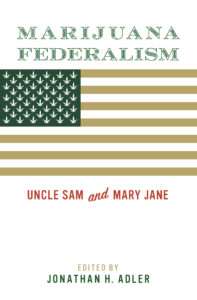
This case underscores a point I have tried to make in my work on this subject (including in my book Marijuana Federalism: Uncle Sam and Mary Jane): If we want to have real marijuana federalism, in which states can experiment productively with different approaches to marijuana, it is not enough for the federal government to do nothing. It must make state experimentation legal, such as by ending the criminalization of conduct that is legal under applicable state law (while continuing to prohibit conduct that is illegal under applicable state law, including interstate trafficking in violation of the such laws). This was the federal government's approach to alcohol at the end of prohibition, and it is the only way to have a marijuana federalism that is free of the distorting effects of federal prohibition.

Conservatism

Why Postliberalism Failed--And Is Likely to Fail Again

Contemporary postliberalism may be a fitting ideology for the age—but that hardly makes its agenda a good one, let alone an American one.  

|

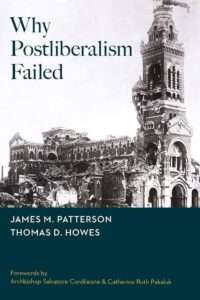
Today Civitas Outlook published a mini-symposium responding to the new book, Why Postliberalism Failed by James Patterson and Thomas Howes. Contributors include Richard Reinsch, David Schaefer. and yours truly.

My own contribution to the symposium, "The Pre-History of Postliberalism," explains how the postliberal critique of the American political tradition and American conservatism is not new, nor are the theoretical claims upon which it relies. As Patterson and Howes point out, the underlying ideas have been deployed before--and to quite ill effect--in other countries. As I add, these ideas have had adherents on the American right before, and they should be no more convincing today than they were then.

From my essay:

A conservative disposition is rarely conducive to contentment with contemporary politics. The existing order is always threatened by chaos and decay. So it is understandable why some may find the postliberal critique engaging, and perhaps even refreshingly transgressive. Yet aside from the political moment in which it is put forth, there is little in this critique of classical liberalism, the fusionist consensus, or the American project which is particularly new. Whether recognized by its adherents or not, the postliberal indictment rehashes arguments and propositions made many times before and proposes a model of governance that has never delivered the moral state its proponents claim it seeks. This ground is well-trod, but not to good effect.

In Why Postliberalism Failed, James M. Patterson and Thomas D. Howes usefully dissect and expose the postliberal project, particularly as it has manifested itself within the Catholic political tradition, including Catholic integralism. The result is an ideology less concerned with the preservation of traditional religious communities than with harnessing "a powerful, centralized government imposing from the top down a theologically-informed vision of the public good on all national subjects regardless of their faith." It is, Patterson and Howes note, "authoritarianism dressed up in Catholic vestments."

Perhaps most valuably, they show how the ideas embraced by postliberal thinkers are not new, have been tried before, and have ended in failure. There were multiple, Catholic-oriented postliberal regimes in the twentieth century, and all were nasty, brutish, and short. None yielded a sustainable or workable—let alone desirable—polity. Whether in Portugal, Brazil, Argentina, Austria, Slovakia, or Vichy France, Catholic-aligned postliberal regimes all ended in failure, often leaving oppression, misery, and death in their wakes. . . .

Much of the postliberal indictment of American conservatism—if not the tactical agenda—echoes arguments debated within the conservative movement in the late 1960s and early 1970s, largely (but not exclusively) at the Philadelphia Society and in the pages of National Review. . . .

America is fortunate that advocates of postliberalism failed to find a following here. While some sought to import a reactionary European conservatism to these shores, they failed to dislodge the fusionist consensus that has defined the American conservative movement since World War II—a consensus committed to individual liberty and traditional morality within a constitutional order that limits and decentralizes government power.  . . .

My essay concludes:

As Archbishop Salvatore Joseph Cordileone notes in his foreword to Why Postliberalism Fails, "A fantasized idealism of the past that would reassert such ideas is not a sign of originality, but of historical amnesia." In that regard, contemporary postliberalism is perhaps a fitting ideology for the age—but that hardly makes its agenda a good one, let alone an American one.

All three contributions may be found here.

Voting

First Circuit Refuses to Stay District Court Injunction Against Trump's Executive Order on Mail-In Voting

The Court rightly ruled the executive branch has no authority to restrict mail-in voting.

|

NA

I recently wrote about how Donald Trump's executive order seeking to curb mail-in voting is an attack on federalism and separation of powers. The Constitution gives states primary authority over election administration, subject to potential modification by congressional legislation. Today, in League of Women Voters v. Trump, a unanimous panel of the US Court of Appeals for the First Circuit rejected the Trump Administration's motion to stay the trial court injunction blocking implementation of the US Postal Service rule implementing Trump's order. Here is a key excerpt from the ruling:

Appellants have not demonstrated entitlement to a stay. Most prominently, appellants have not made a strong showing that the district court erred in determining that the Final Rule is likely unlawful. The district court concluded, and we agree, that the Final Rule is likely a regulation of the manner of holding elections for members of Congress, which the Elections Clause of the Constitution assigns to the States and Congress, and not to an executive agency, such as the Postal Service, acting without congressional authorization.2 See U.S. Const. art. I, § 4, cl.  Appellants seek to avoid the constitutional problem by denying that the Final Rule regulates the manner of holding elections. The district court charitably concluded that "[t]his denial rings hollow." League of Women Voters of Mass. v. Trump, Nos. 26-cv-11549, 26-cv-13917, 2026 WL 2620871, at *14 (D. Mass. Sep. 4, 2026). The title of the Final Rule is "Ballot Mail for Federal Elections," and the Final Rule explicitly and exclusively regulates election mail. 91 Fed. Reg. at 54966, 54990-92. It requires action by the States' "chief election official[s]" and its policy justification is "protect[ing] the integrity of federal elections…."

To the extent that appellants argue that we should read statutes authorizing the Postal Service to issue general postal regulations as supplying the necessary congressional authorization for the Final Rule, see 39 U.S.C. § 401(2) (authorizing USPS to make "such rules and regulations, not inconsistent with this title, as may be necessary in the execution of its functions"); id. § 401(10) (authorizing USPS to exercise "all other powers incidental, necessary, or appropriate to the carrying on of its functions or the exercise of its specific powers"); id. § 404(a)(1) (conferring on USPS the power "to provide for the collection, handling, transportation, delivery, forwarding, returning, and holding of mail, and for the disposition of undeliverable mail"), their argument likely fails. Appellants have not convinced us that it is likely that Congress would delegate constitutionally assigned tasks relevant to maintaining our electoral system to the Postal Service through the "wafer-thin reed" of a general grant of authority to manage the postal system. Biden v. Nebraska, 600 U.S. 477, 499 (2023). As appellees point out, Congress historically has been explicit in its exercise of authority under the Elections Clause when it seeks to displace the background assumption that the States will act as the primary regulator of elections. The general authority on which appellants rely here is far removed from that sort of specific congressional action.

I think this is exactly right. And it's notable the court cited the major questions doctrine case of Biden v. Nebraska, which rightly rejected President Biden's effort to use vague statutory language as a tool for forgiving hundreds of billions of dollars in federal student loan debt. As explained in my earlier post on this issue, and by the district court, Trump's claim to be able to use the Postal Service authorization law to leverage massive changes in state mail-in ballot rules also creates a major questions issue, as control over rules for tens of millions of ballots is clearly an issue of vast political significance and (in the words of Chief Justice John Roberts in the recent Learning Resources tariff case) a "highly consequential power."

When the executive claims Congress has delegated it such a vast power, the major questions doctrine requires proof that the delegation is clearly stated in the relevant statute. Here, there is nothing like that.

Trump has also asked the Supreme Court to stay the district court ruling, and that court will have the final say, if it wants it. Hopefully, the justices will recognize that the district court and the First Circuit got this issue right.

While recent events have led me and some other scholars (e.g. - prominent election law specialist Rick Hasen) to take a more favorable view of election-law federalism, there are still plausible arguments for increasing federal control over some aspects of election administration. But any such increase must be properly enacted by Congress, not unilaterally imposed by the executive. There are good reasons for the Constitution's rejection of the idea that any one person should have sweeping power to alter electoral rules - especially so close to the date of a major federal election.

Free Speech

Journal of Free Speech Law: "Regulating LGBTQ Speech in the Classroom," by Caroline Mala Corbin

Part of a Knight First Amendment Institute Symposium on Managing Government Employee Speech in a Democracy, which the Journal is publishing.

|

The article is here; the Introduction:

Public school teachers have found themselves in a free speech vise. Their speech has become more regulated than ever by both the left and right. In particular, public school teachers across the country have found their speech relating to LGBTQ students and issues tightly regulated by government-mandated speech codes. In left-leaning states, some religious teachers have objected to schools forcing them to address their transgender and nonbinary students by their preferred names and pronouns under anti-discrimination policies. In right-leaning states, teachers have objected to the silencing of any discussion around LGBTQ issues under "Don't Say Gay" laws. In both cases, the government seeks to regulate the content of the teachers' speech, an action which would, in other circumstances, raise serious First Amendment questions. Does this level of control over what public school teachers may say in their classrooms violate the Free Speech Clause? Should it?

Under existing free speech jurisprudence, anything that teachers say while discharging their job responsibilities is not protected by the Free Speech Clause. When teachers speak "pursuant to their official duties," like classroom instruction, they are deemed to be speaking as the government and not as a private citizen. This classification as government speech is significant because the Free Speech Clause protects private speech from the government, not government speech from itself. In fact, the relatively new government speech doctrine declares that the Free Speech Clause does not cover government speech.

This essay argues that the fundamental problem with the government employee speech doctrine is that it mistakenly assumes that the Free Speech Clause protects only speakers and not audiences. After all, the premise of denying any free speech protection to public employees speaking pursuant to their official duties is that the government, rather than a private person, is the real speaker. But the Free Speech Clause cares as much about ensuring an unimpeded stream of speech for audiences as it does about ensuring that speakers have the freedom to speak their mind. Prior cases involving government employee speech astutely recognized that the Free Speech Clause protected audiences as well as speakers; indeed, it trained its sights on protecting audiences rather than speakers. Unfortunately, this insight has been lost in the abrupt adoption of the government speech doctrine.

Read More

A Remarkable 48 Hours In Missouri

Justice Kavanaugh rules against Missouri twice, likely without even reading all the papers.

|

The fight in Missouri has had a surreal 48 hours. Here is a grossly compressed summary.

First, the Missouri Supreme Court ruled that the state must use the 2022 congressional maps. The state court ruled that the 2026 maps were effectively a legal nullity because about 3% of voters in the state put the validity of the 2026 maps on the ballot for a referendum.

Second, Missouri filed an emergency application for a stay on September 4. Circuit Justice Kavanaugh set a response for September 7. Shortly after midnight on September 8, Missouri filed its reply brief. Around 4:30 PM, Circuit Justice Kavanaugh denied Missouri's application in chambers. I suppose there was enough time for Kavanaugh to read all the briefing, but I am skeptical. There was no noted dissent.

Third, a few minutes after Kavanaugh ruled, Judge Clark in the Eastern District of Missouri enjoined the use of the 2022 maps. This case was brought by Missouri voters and candidates for office. Later that day, an Eighth Circuit panel declined to grant a stay of the district court's injunction.

Fourth, in the evening of September 9, the group that supported the ballot referendum field an emergency application to stay the District Court's ruling. Circuit Justice Kavanaugh set the response for 10:00 A.M. on September 10--that deadline was about 16 hours away. Over that ensuing period, Missouri filed a 51-page opposition, the representatives and voters filed a 50-page brief, and the Solicitor General filed an 18-page brief. Around 10:30 A.M., less than 30 minutes after those briefs were filed, the application was granted without any noted dissents.

Application (26A326) for stay presented to Justice Kavanaugh and by him referred to the Court is granted.

This 48 hours sequence is remarkable. A case went to the Supreme Court twice with full briefing, and Missouri lost both cases. While the first application was denied in chambers, the second application was referred to the Court. Needless to say, none of the Justices read any of the reply briefs in the federal case. I suspect that Justice Kavanaugh discussed the matter with all of his colleagues at a informal conference Wednesday evening, even if by email. The order was baked. I suppose it was nice to at least let Missouri reply, but frankly a lot of hours were wasted. If the Court was going to grant the stay, why bother going through the motions?

Here is my tentative take. I think Justice Kavanaugh clearly accepted the AISG arguments that the referendum group raised. (The Amars discussed these points on SCOTUSBlog.) On the merits, it is extremely problematic if a tiny percentage of voters in a state (3%) can get a free two-year pass on any map. I've seen many reports that the majority of the Missouri Supreme Court are appointed by a Republican Governor, but remember Missouri is the home of the Missouri plan. This is not a conservative court. Alas, state courts get to interpret their own constitutions.

Then, when Judge Clark issued his injunction, Justice Kavanaugh saw an attempt to circumvent his ruling. It is true that the facts were different in the federal case. The "unclean hands" argument was not present, and the AISG issue as gone. But the underlying premise was the same: an attempt of a federal court to depart from a state supreme court's reading of a state constitution. Did Justices Thomas and Alito agree? Who knows. They did not signal their dissent. They may not have thought this fight was worth it, especially if Justice Kavanaugh was indignant. They might be saving their energy for another case.

There is another takeaway. The speed at which this all happened suggests the Justices are capable of holding emergency conferences for interim docket cases. Justice Kagan recently complained that there was no opportunity to discuss a case prior to ruling. I discussed this in my SCOTUSBlog post on empowering the minority:

A common criticism of the emergency docket is that complicated cases are decided without fulsome deliberations. The justices usually don't hold oral argument on emergency cases. Indeed, they may not even hold private conferences to discuss the outcome. In 2025's Department of State v. AIDS Vaccine Advocacy Coalition, Kagan dissented from an emergency docket order. She wrote, "Per usual on our emergency docket, we have had to consider this application on a short fuse—less than three weeks." Kagan added, "We have done so with scant briefing, no oral argument, and no opportunity to deliberate in conference."

At the time I asked why the court couldn't schedule emergency docket conferences. I wrote that "Roberts could convene a conference on short notice," but failed to do so, even as three of his colleagues demanded one. As things stand now, we can only surmise that the justices decided the entire matter over email or through the circulation of memos. Indeed, we learned from the leak of the "shadow papers" that the Supreme Court resolved the Clean Power Plan case in 2016 entirely through memos. This is no way to resolve questions affecting the national interest.

There was certainly a conference here, and it moved with speed.

"The Emergency Presidency at Twenty-Five"

|

A very interesting article by my colleague Prof. Michael McConnell (Stanford Law, Hoover) in the City Journal; in addition to being a leading scholar of the Religion Clauses and constitutional law generally, Michael has written extensively on Presidential power. Here are the opening paragraphs, though the whole article is much worth reading:

Twenty-five years ago, we suffered the most devastating attack on U.S. soil since Pearl Harbor. Ratcheting up the shock from the death and destruction at the heart of Manhattan was uncertainty about the future: When might the terrorists strike again? Three days after the attack, President George W. Bush visited Ground Zero and delivered, impromptu, some of the most stirring words any president has spoken. Climbing atop a pile of rubble with a megaphone in hand, he was interrupted by voices in the crowd, complaining that they could not hear him. "I can hear you!" Bush responded. "I can hear you, the rest of the world hears you, and the people who knocked these buildings down will hear all of us soon." Loud chants of "U.S.A., U.S.A.," ensued.

That same day, the president declared a national emergency. The attacks, he explained in Proclamation 7463, and the "continuing and immediate threat of further attacks," required the government to activate extraordinary powers, effectively putting the nation on a wartime footing. The directive would lead to far-reaching changes to the national security apparatus, to domestic surveillance practices, to immigration and travel policies—and to a string of wars that seems never to end.

Bush's statement that the dangers were "continuing" as well as "immediate" proved more prescient than he could have known. We live in the shadow of the 9/11 emergency a quarter of a century later. Every president since Bush has extended the emergency declared that day. The extraordinary powers that the nation's 43rd president invoked on September 14, 2001, have become ordinary.

The effect is to concentrate power in the hands of one person, the president of the United States. In one sense, this would be no surprise to the Framers of the U.S. Constitution. They created a single executive in part because the contingencies of public affairs demand what Alexander Hamilton called "decision, activity, secrecy, and dispatch"—features characteristic of a one-person executive but inherently lacking in a numerous legislative assembly. Hamilton further pointed out that "energy in the executive … is essential to the protection of the community against foreign attacks."

Yet the Constitution contains no emergency clause. An emergency may provide occasion for the exercise of powers that are latent in ordinary times, but it does not create new constitutional powers. This, too, was deliberate. As Justice Robert Jackson wrote during the Korean War, the Founders "knew what emergencies were, knew the pressures they engender for authoritative action, knew, too, how they afford a ready pretext for usurpation. We may also suspect that they suspected that emergency powers would tend to kindle emergencies." …

Free Speech

Court Blocks Investigation of AI-Generated Video About Vermont Political Candidates Because Video Is Obviously "Ridiculous"

|

From Friday's decision by Judge William Sessions (D. Vt.) in Poitras v. Clark:

This case concerns a video that plaintiff Henry L. Poitras ("Poitras") posted on June 7, 2026, titled "Mark Helps Vermont Take Out the Trash." The subjects of the video include Representative Becca Balint and her "expected Republican challenger," Mark Coester. {The video includes a "realistic" depiction of Balint, as well as audio that "criticizes [her] New Jersey ties, her position on taxation and government spending, her agricultural policies, her autocratic tendencies, and other aspects of her personality and politics." In the video, Balint makes statements such as "straws are banned, and if those farmers don't like it, they can leave," before Coester comes to "stop her" and uses heavy machinery to drop her into a dumpster.} The video also features audio that criticizes Balint.

On June 12, 2026, the Vermont Attorney General's office ("AGO") served Poitras with a civil investigative demand ("CID") pursuant to Vermont's recently-enacted synthetic media law, 17 V.S.A. § 2032, asking him to answer certain questions about the video under oath….

Section 2032 provides:

Read More

More