
Why Postliberalism Failed--And Is Likely to Fail Again
Contemporary postliberalism may be a fitting ideology for the age—but that hardly makes its agenda a good one, let alone an American one.
Today Civitas Outlook published a mini-symposium responding to the new book, Why Postliberalism Failed by James Patterson and Thomas Howes. Contributors include Richard Reinsch, David Schaefer. and yours truly.
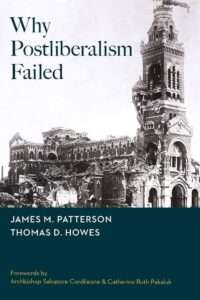
My own contribution to the symposium, "The Pre-History of Postliberalism," explains how the postliberal critique of the American political tradition and American conservatism is not new, nor are the theoretical claims upon which it relies. As Patterson and Howes point out, the underlying ideas have been deployed before--and to quite ill effect--in other countries. As I add, these ideas have had adherents on the American right before, and they should be no more convincing today than they were then.
From my essay:
A conservative disposition is rarely conducive to contentment with contemporary politics. The existing order is always threatened by chaos and decay. So it is understandable why some may find the postliberal critique engaging, and perhaps even refreshingly transgressive. Yet aside from the political moment in which it is put forth, there is little in this critique of classical liberalism, the fusionist consensus, or the American project which is particularly new. Whether recognized by its adherents or not, the postliberal indictment rehashes arguments and propositions made many times before and proposes a model of governance that has never delivered the moral state its proponents claim it seeks. This ground is well-trod, but not to good effect.
In Why Postliberalism Failed, James M. Patterson and Thomas D. Howes usefully dissect and expose the postliberal project, particularly as it has manifested itself within the Catholic political tradition, including Catholic integralism. The result is an ideology less concerned with the preservation of traditional religious communities than with harnessing "a powerful, centralized government imposing from the top down a theologically-informed vision of the public good on all national subjects regardless of their faith." It is, Patterson and Howes note, "authoritarianism dressed up in Catholic vestments."
Perhaps most valuably, they show how the ideas embraced by postliberal thinkers are not new, have been tried before, and have ended in failure. There were multiple, Catholic-oriented postliberal regimes in the twentieth century, and all were nasty, brutish, and short. None yielded a sustainable or workable—let alone desirable—polity. Whether in Portugal, Brazil, Argentina, Austria, Slovakia, or Vichy France, Catholic-aligned postliberal regimes all ended in failure, often leaving oppression, misery, and death in their wakes. . . .
Much of the postliberal indictment of American conservatism—if not the tactical agenda—echoes arguments debated within the conservative movement in the late 1960s and early 1970s, largely (but not exclusively) at the Philadelphia Society and in the pages of National Review. . . .
America is fortunate that advocates of postliberalism failed to find a following here. While some sought to import a reactionary European conservatism to these shores, they failed to dislodge the fusionist consensus that has defined the American conservative movement since World War II—a consensus committed to individual liberty and traditional morality within a constitutional order that limits and decentralizes government power. . . .
My essay concludes:
As Archbishop Salvatore Joseph Cordileone notes in his foreword to Why Postliberalism Fails, "A fantasized idealism of the past that would reassert such ideas is not a sign of originality, but of historical amnesia." In that regard, contemporary postliberalism is perhaps a fitting ideology for the age—but that hardly makes its agenda a good one, let alone an American one.
All three contributions may be found here.