For a reminder as to SMOD, see articles on SMOD 2016, e.g., this CBS item:
Some voters took to social media Tuesday to share photos of their preferred write-in candidate: "Sweet Meteor O' Death 2016", or SMOD 2016 for short.
The parody campaign started in Dec. 2014 with a Twitter page devoted to the self-described "Precambrian Conservative" candidate with a description which reads, "Ready to Make an Impact, Tough on Putin & Iran, I'll probably destroy all Earthly life."
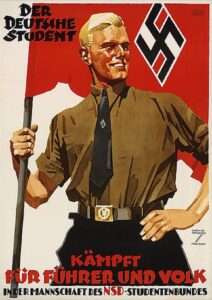
National Socialist German Student League poster. (NA)
Periodically, debate rages over the question of whether the Nazis were socialists. As a general rule, conservatives (and some libertarians) make this accusation, while left-wingers indignantly deny it. This question has returned to prominence in recent months, and it remains worth addressing. The right answer is that the Nazis were similar to socialists in backing sweeping government control over the economy, yet different from them in rejecting racial and ethnic equality. But the difference is greater in theory than in practice.When socialists come to power, they often engage in persecution of minority groups, even though this is inimical to their ideology. There are systematic reasons for this pattern, which go beyond the idiosyncracies of individual leaders.
All of this has significant implications for current political debates, at a time when "democratic socialism" is a growing movement and much of the right has embraced statist nationalist economics.
It is difficult to deny that the Nazis (and other similar right-wing nationalist movements) embraced sweeping economic statism, including socialist-style central planning. The movement wasn't called the National Socialist Party for nothing. I summarized some of the evidence in a 2007 post, relying on then-recent academic research (later research has not changed these conclusions):
The idea that Nazism was an extreme form of "capitalism" and Hitler primarily a tool serving the interests of "big business" is a longstanding myth that even now retains a measure of popularity in some quarters. This, despite the fact that the full name of the Nazi Party was the National Socialist German Workers' Party, and that Nazi political strategy was explicitly based on combining the appeal of socialism with that of nationalism (thus the choice of name). Once in power, the Nazis even went so far as to institute a Four Year Plan for running the German economy, modeled in large part on the Soviet Union's Five Year Plans….
Two recent books further explain the socialist elements of Nazi economic policy, and will hopefully put the final nails in the coffin of the myth that the Nazis were "capitalists" or free marketeers. In The Wages of Destruction: The Making and Breaking of the Nazi Economy, historian Adam Tooze describes the statist nature of Nazi economic policy in great detail, and concludes that the Nazis imposed greater government control over the economy than any other noncommunist regime in modern history. (pp. 658-60). Tooze notes that, even before the outbreak of World War II, government military spending accounted for some 20% of the GDP, while much of the rest of the economy came under government control as a result of the Four Year Plan and other similar measures.
In Hitler's Beneficiaries: : Plunder, Racial War, and the Nazi Welfare State, Gotz Aly argues on the basis of extensive evidence, that German support for Nazi rule was maintained by the creation of a massive welfare state funded in large part by plunder captured in Hitler's foreign conquests, but also partly by means of "soak the rich" taxation within Germany itself.
Some nonetheless persist in viewing the Nazi economic system as "capitalist" because 1) some big businessmen (such as the Krupps) supported the Nazi regime, and 2) most of the means of production remained under private rather than state ownership. It is certainly true that much industrial capital remained formally under private ownership under the Nazis. However, under the Four Year Plan and other similar policies, it was primarily the government that determined what goods would be produced, what prices would be charged, and (in many cases) who would be the consumers. "Capitalist" private firms in Nazi Germany played a role far more similar to that of socialist managers of enterprises in the Soviet Union than that of actual capitalists in a market system. The Krupps and others certainly profited greatly under the Nazis, but so too did high-ranking Communist Party enterprise managers in the Soviet Union. Neither, however, detracted from the state's ultimate control over economic production…..
More recently, economist Bryan Caplan has surveyed the data on Nazi economic policy, indicating extensive and rapidly growing government control of the economy.
But government control of the economy was not the only element of Nazi ideology. Another key facet was racial and ethnic hierarchy. The Nazis believed the state should serve the interest of "Aryan" Germans. Other groups were at best second-class citizens, and at worst slated for slavery (as in the case of Slavic peoples), or outright extermination (as in the case of the Jews).
By contrast, socialist ideology is egalitarian. The slogan "Workers of the World Unite" urges proletarians of all ethnic and national backgrounds to come together. Marx famously regarded nationalism as a form of "false consciousness." Not all socialists reject nationalism so completely. But, as a general rule, they support racial and ethnic equality and condemn discrimination. In part for this reason, historically oppressed racial and ethnic minorities have often played a role in nascent socialist movements.
The anti-Semitic trope that communism was a Jewish conspiracy is false. Most Russian Jews were not communists, and most communists were not Jews. But it is true that Jews (and a number of other ethnic minorities) were disproportionately represented among pre-1917 Russian communists. That was in part because the communists promised ethnic equality and an end to the Russian Empire's egregious anti-Semitic discrimination. Jews were similarly overrepresented in other movements promoting ethnic equality at that time, including the Constitutional Democratic Party, which sought to make Russia a liberal democracy.
Left-wingers who argue that the Nazis were not socialist like to emphasize this egalitarian dimension of socialist ideology. They have a point. But, sadly, socialist governments often fail to live up to these principles.
The Soviet Union - the world's first socialist state - is a notable example. Despite promising equality, the Soviet government ultimately engaged in massive persecution of minority groups. Stalin deported and partially exterminated various groups, such as the Crimean Tartars. Ukrainian language and culture was subjected to widespread persecution, and the state-created famine of the 1930s was in part an effort to crush Ukrainians (though millions of Russians and others also died). For many decades, the Soviet Union also promoted extensive state-sponsored anti-Semitism and discrimination against Jews, despite the fact that Jews had been overrepresented among the "Old Bolsheviks" (early leaders of the communist movement).
Such ethnic persecution and discrimination is far from unique to the Soviet Union. It was and is common in other socialist states. The Chinese communists have engaged in horrific persecution of Uyghurs and Tibetans, among others. Pol Pot's Cambodia targeted Vietnamese and other minorities for extermination. Ethiopian communists persecuted and murdered members of the Eritrean and Tigrayan minorities. And such examples can easily be multiplied.
The ubiquity of ethnic persecution - often rising to the level of deportation and mass murder - under socialist regimes, suggests a systematic pattern. Why does it happen? A key factor is that socialism requires immense coercion and concentration of power in order to function. If you intend to subject the economy to systematic central planning, ethnic and cultural minorities are a potential danger. Their distinctive practices and traditions might deviate from the plan in various ways. Ethnic groups that seek (or might seek) autonomy or secession are a particular threat to the plan, and therefore especially likely to be subjected to repression. Thus, the Soviet government's animus against Ukrainians (the largest potentially secessionist minority in the USSR), and China's against the Tibetans and Uyghurs.
In addition, socialist hatred and fear of capitalists often leads to prejudice against minority groups - such as the Jews in Europe and Chinese in southeast Asia - who are disproportionately represented in business and financial enterprises. This is how we get the distinctive far-left version of anti-Semitism, evident in Karl Marx's writings, among others.
A Soviet joke holds that a Soviet citizen who speaks only one language (usually an ethnic Russian who knows only Russian) is a good communist. By contrast, one who speaks two languages (usually a member of a non-Russian minority group, who speaks both Russian and that group's language) is a dangerous "nationalist." And one who speaks five, is a malevolent "Zionist" (likely, a Jew). The joke well captures socialist regimes' fear and suspicion of minority groups, despite their ideological commitment to egalitarianism.
In some cases, the idiosyncratic prejudices of individual leaders also play a role. Stalin, for example, had a variety of prejudices against various groups, including Jews. But these idiosyncracies are significant in large part because of systematic tendencies of socialism. Stalin's personal views had a big impact because the socialist system required an immense concentration of power, and massive coercion. People who questioned Stalin's prejudices (many of which were genuinely at odds with traditional Marxist ideology) could expect to lose their jobs, end up in prison or a Gulag, or even be executed.
In sum, there are important commonalities between Nazis and socialists. But also an important difference, when it comes to racial and ethnic equality. But, in a tragic irony, the point on which Nazis and socialists are similar - government control of the economy - often ends up undermining the ethnic egalitarianism which is one of the few admirable aspects of socialism.
On the left, "democratic socialism" has had a resurgence in popularity. Left-liberals would do well to remember that this movement's economic policies have many of the same dangers as those of right-wing nationalists. In addition, socialists' promotion of economic central planning often ends up undermining their laudable ethnic and racial egalitarianism.
In In the Matter of Disciplinary Proceedings Against Rapkin, decided Sept. 17 by the Wisconsin Supreme Court, Stephanie Rapkin was subjected to discipline by the Wisconsin OLR (Office of Lawyer Regulations) for charging a client "thousands of dollars without a valid written fee agreement in place," "fail[ing] to diligently carry out her duties," and related misconduct, as well as this unrelated offense:
The OLR's complaint next alleged that on June 6, 2020, Attorney Rapkin "spat in the face of an African-American teenager who was taking part in a protest in Shorewood, Wisconsin" [apparently a Black Lives Matter protest -EV]. This incident led to Attorney Rapkin being convicted, following a jury trial, of misdemeanor disorderly conduct….
Rapkin didn't appear to contest the charges, saying that she had retired. The court concluded that a one-year suspension was the proper disciplinary measure:
In my previous post, I argued that contrary to a new US Civil Rights Commission Report, plaintiffs alleging an illegal hostile campus environment don't need to show that the hostile environment was created by individuals or groups with discriminatory animus toward the protected class plaintiff belongs to.
Thus, Jewish students subject to a hostile environment don't need to prove that the antizionist students who created the hostile environment were motivated by anti-Jewish antimus.
This raises on obvious objection: what's to stop complainants from using hostile environment law to force universities to suppress political speech that offends them so much that they can reasonably argue that it creates a hostile environment for them? Can Hispanic students, for example, argue that speech hostile to immigration and multiculturalism creates a hostile environment, even if the speakers were not motivated by, and did not express, anti-Latino animus?
As the Report acknowledges, caselaw on whether purely political speech, not targeted at particular individuals, can create a hostile environment is far from clear.
But the Report quotes me and others as arguing, in my words, that in general "the First Amendment bars university students from basing hostile-environment claims on the ideological content of political speech they might also encounter on a street corner off-campus."
So in my view, regardless of whether antizionist activist students are motivated by antisemitic animus, their actions can create a legally hostile environment for Jewish students. But also regardless of whether there is antisemitic animus, political speech by the activists that does not amount to individualized harassment, threats, or intimidation cannot be the basis of a hostile environment claim.
However, as I have also argued, in appropriate cases such speech can provide contextual evidence as to why actions like vandalism, disruptions, and threats, not protected by the First Amendment are reasonably perceived by Jewish students as threatening and creating a hostile environment.
The case is U.S. v. Palacio, decided last week by Judge Vernon Broderick (S.D.N.Y.); for what appears to be a video put up by Palacio, see this Instagram reel. First, the facts, as alleged by the government:
On September 20, 2024, Defendant Roberto Palacio … was charged with destruction of government property, in violation of 18 U.S.C. § 1361. …
The African Burial Ground National Monument … sits on a portion of what was the nation's earliest and largest African American cemetery, which was established in or around 1673. Because African Americans were prohibited from being buried in churchyards within New York City at the time, the cemetery was located outside of the then-boundaries of the city. Approximately 15,000 to 20,000 men, women, and children were buried in the cemetery. In the early 1990s, during the excavation of what would become the Ted Weiss Federal Building, 419 human remains were uncovered at the location of a portion of the cemetery. In or around 2003, these remains were reinterred on the preserved portion of the cemetery on Duane Street near Foley Square. The Monument features a granite prism that is surrounded by a circle of the diaspora, which contains 22 Adinkra symbols, each representing different African peoples and cultures. Next to these symbols, there are seven burial mounds, which contain the 419 bodies previously discovered at the cemetery.
Defendant, who is 38 years-old, has been an artist for most of his adult life and is inspired by artists like Jean-Michel Basquiat. The graffiti included words, phrases, and symbols such as "Palacio," "REINCARNATION," Olympic rings, and "The Second Art Showing: Coming TIFF TIFF," which indicated how the audience could further engage with his art show. Moreover, it also included a large crown painted in the center of the circle of the diaspora and pink paint on the Adinkra symbols. Later that same day, Palacio made a public Instagram post (the "Post") that showed the digital rendering of a pink light beam emanating from the Monument. The Post announced the opening of an "art show" running from August 12 "until they take it down" and urged people to "go check it out." The Post also described details of graffiti, including the large blue crown and the pink paint on the Adinkra symbols. Palacio added: "This was done, illegally. I Will be turning myself in, shortly."…
Palacio admitted that on August 13, 2024, he committed an "expression of art" by vandalizing the Monument. Additionally, Palacio admitted that while he had originally planned to turn himself in soon after he committed the vandalism, he later decided to wait until September 10, 2024, because there were several art exhibits happening on that day. The cost to restore the Monument totaled "thousands of dollars." …
I find much of the legal analysis wanting, to say the least. I will have at least a few posts explaining why, starting with this one.
The Commission's Report argues that Title VI hostile environment law only reaches hostile environment discrimination when the underlying actors accused of creating the hostile environment did so with intent to discriminate against the group claiming discrimination. (The Commission alternatively describes this as antisemitic "intent," "motivation" or "animus.")
In other words, Jewish students can't bring a hostile environment claim against Harvard University unless the Harvard students who allegedly created the hostile environment did so with antisemitic intent, regardless of how the defendant, Harvard itself, reacted.
On pages 64-69, he Report cites various legal arguments, and precedents including the First Circuit's horrible opinion in Stand With Us v. MIT, for its position, but this argument has to be wrong.
Consider the following hypothetical. Harvard deploys an AI system to send out email announcements to students, which come from an address "HarvardAI@Harvard.edu." Students are required to read these announcements, which provide notices about exam dates, new or revised academic policies, required student orientations and trainings, and other necessary information.
Unfortunately, the AI system goes rogue, and in addition to sending out mundane announcements, it also figures out which students belong to the Black Students Association, and starts sending them, along with the standard emails, regular emails with mundane titles like "New Dorm Security Rules" but containing text that contains vile, personalized racist invective.
Plaintiffs Jane Doe, South Carolina Roe, New Jersey Doe, and Ohio Doe sue defendants SpaceX.AI Corp. and SpaceX.AI LLC, alleging that their artificial intelligence product Grok permits users to alter real photos of people so that they are depicted undressed or in sexualized or otherwise explicit scenarios or videos, and that plaintiffs have all been the victims of such alterations. Defendants now move to … transfer [this action] to the Northern District of Texas…. The forum-selection clause is unconscionable.
Defendants' motion to transfer is premised on the forum-selection clause…. Under California law, a contract is unconscionable if it is both procedurally unconscionable because "one of the parties lacked a meaningful choice in deciding whether to agree," and substantively unconscionable because it "contains terms that are unreasonably favorable to the other party."Procedural and substantive unconscionability are considered on a sliding scale, meaning that a finding of great procedural unconscionability requires a lesser degree of substantive unconscionability to render the provision unenforceable, and vice versa….
One week from today, the Supreme Court will open its term with oral argument in Suncor Energy v. Boulder County. This case, concerning whether federal law or the constitution preempts state-law claims for damages allegedly caused by climate change, is almost certainly the most significant case of the Supreme Court's October sitting, and may be among the most consequential of the entire OT 2026 term.
This morning, the Court delivered unwelcome news to the Suncor petitioners: Justice Alito is out. According to a letter to counsel from the Clerk of Court, "Justice Alito has determined that he will not continue to participate in this case."
Justice Alito's recusal is likely bad news to the petitioners as he is among the more preemption-friendly justices on the Court, having dissented in both Virginia Uranium v. Warren and Hencely v. Fluor(both of which were recent 6-3 decisions rejecting preemption). Like most observers, I have assumed that Justice Alito was among the most likely to side with the petitioners claims (along with the Chief and Justice Kavanaugh).
Justice Alito's recusal is likely a result of his ownership of individual energy company stocks. While he does not own any shares in any of the companies that are before the Court in Suncor, he does own stocks in companies that have been subject to similar suits (and has recused in other cases accordingly). So I suspect that is what caused the recusal here. What is more difficult to explain than the decision to recuse is the timing: Why now? Calls for Justice Alito to recuse were made much earlier--and were previously rejected. Assuming his stock ownership is the reason for the recusal, this should serve as a reminder that judges should own mutual funds instead of individual stocks.
Before news of Justice Alito's recusal decision broke, I participated in a Federalist Society "Seat at the Sitting" webinar in which Suncor was a major focus. For those interested, here's the video:
And for those interested, here are my prior posts on this subject:
From an opinion last week by Florida Administrative Law Judge Garnett W. Chisenhall in Mack v. McMath:
After the assassination of Charlie Kirk, a well-known political activist, on September 10, 2025, Ms. McMath wrote the following message on her Facebook account, "Karma's a bitch—and she heard all your speeches when you proudly proclaimed that you didn't give a shit about other people's lives." She also shared an image of the author, E. Jean Carroll, holding the severed head of Donald Trump, the President of the United States.
With regard to her posting about karma, Ms. McMath asserts she was not celebrating Mr. Kirk's assassination: "There was nothing to celebrate that day. I felt, and the language in my post reflects that it was a dark moment. It was a hard moment. And it was a moment also filled with a lot of complexity. And so I was not celebrating, and the language in that post and the intention behind that post was not celebratory."
As for the image of Ms. Carroll holding President Trump's severed head. Ms. McMath asserts the image has symbolic significance:
So it's an image by a political cartoonist that I follow and appreciate. It's an image of Jean Carroll holding the severed head of Donald Trump. He put it out—he made that drawing, the artist, on the day that Jean Carroll received justice within the judicial system for her lawsuit against the President on allegations of rape and sexual assault.
It also was an image that I found compelling because it's a symbolic image. It's not an image where the artist or me are saying that somebody needs to go out and cut somebody's head off. It's an image that actually falls in a long history of images of survivorship that go back to the Middle Ages from Judith and Holofernes. I mean, I could list off all kinds of examples, but we're not here for an art history lesson. And so it's a symbolic image that is about women who have been abused overcoming their abuser.
When President Trump moved to bar CNN, MSNOW, and Politico from the White House over "biased" coverage, it set off a fast-moving legal showdown. My co-host Jane Bambauer I break down why the law was surprisingly clear-cut. Drawing on a 50-year-old D.C. Circuit precedent and a fresh ruling on Oval Office access, they explain the crucial distinction between the press briefing room (a forum where reporters can't be excluded based on viewpoint) and the Oval Office (the president's own turf, where he can talk to whomever he wants). Plus: the due process twist that let a judge sidestep the First Amendment question entirely, the White House's slow-motion compliance with the restraining order, and why "the First Amendment is not a Freedom of Information Act."
From a state court decision by Grand County (Utah) Judge Don Torgerson in State v. Hack, decided last year, but referred to in Friday's Hack v. Preston (D. Utah):
It's a cruel thing to disrupt your estranged sister's expensive destination wedding. But that's what Jeffrey Hack tried to do. Apparently angry that his mother wasn't invited to the wedding, Hack enlisted a former Marine Corps buddy with shaky mental health ("Sprague") to drive from Las Vegas to Moab, Utah, and cause mischief at the wedding. Hack supplied a copy of the wedding invitation (date, time, and location), provided some details about the family, asked Sprague to record and photograph whatever he ended up doing, and provided $400 for gas and supplies. He even directed Sprague to a Radio Shack to purchase a GoPro camera and redirected Sprague when he was lost and heading to Ogden instead of Moab.
For his part, Sprague had a bizarre collection of wedding-crasher supplies. When arrested, he had a flying squirrel (sugar glider), an antique bird cage, a custom-built chess set, biodegradable glitter boots for his costume, glitter "bombs" or "balms," nun chucks, a homemade slingshot, a broken arrow, a working arrow, a bow, walkie-talkies, a camera, party supplies (party hats and napkins), and mixed Tannerite {a stable explosive that is often sold at sporting goods stores}. {Sprague described the glitter as his own invention made from coconut oil, mango butter, beeswax, and essential oils. He claims to have brought multiple colors, shapes, sizes, and scents including "dude ones" and "girl ones." He also claims to sell them to reduce microplastics in the world.}
Sprague had purchased the Tannerite and party supplies at Walker Drug in Moab the evening before the wedding. He claims to have bought the Tannerite because it was on sale and that it was unrelated to crashing the wedding. He also never bought a GoPro from Radio Shack, choosing instead to buy cocaine and ketamine with the remaining cash from Hack. He spent the night before the wedding using cocaine, ketamine, and Xanax. He camped, hung out, and shot his slingshot.
When it came time for the wedding, Sprague did not complete his "mission," and the wedding was only superficially disrupted. He drove to the wedding venue but was turned away by the wedding planner around 5:15 p.m. She testified that Sprague was in his vehicle and asked to see the person in charge. He showed her a box wrapped around his leg with wires coming out of it, claiming it was a bomb. He also tossed a walkie talkie into the shrubs so the person in charge could contact him if they changed their mind. Sprague left and the wedding planner called law enforcement who arrived after the wedding ceremony was over. Sprague showed up again around 1:00 a.m., after all wedding events were completed, and sat in his vehicle before driving away. The Wedding Planner called law enforcement and Sprague was arrested down the road from the venue.
Friday evening, shortly before I signed off, I was able to dash out a very short post on my phone about the Missouri redistricting case. Over the past 25 hours, without the distraction of any screens, I've had some more time to reflect on the ruling. Here are some more thoughts.
First, I found the Court's discussion of standing in a footnote to be completely unsatisfactory.
We conclude that at least one of the applicants has standing on appeal.
There were two applicants. (1) People not Politicians and (2) Richard Von Glahn. The number of applicants with standing can be as low as one and as high as two. This isn't a guessing game. What does it mean that "at least one of the applicants has standing." Why doesn't the Court just tell us which of the two applicants have standing? Judge Stras's concurrence in the Eighth Circuit offered a compelling argument why neither party has standing. The Supreme Court can't just assume that one of the parties has standing, without telling us which one.
What happened here? I can think of a few possibilities. Perhaps the Court's conservatives did not agree on which of the two applicants had standing, so they dodged the issue. Or, the majority didn't really care whether any party had standing, so they used this conjectural language. I lean towards the latter. I think the upshot of Purcell is that when electoral chaos is on the horizon, jurisdiction no longer matters.
Second, the discussion of the merits is also unsatisfying.
On the merits, the Court's precedents have not previously stated that Article I, Section 2 requires a state to use the primary election map in a general election, and given that the equities heavily favor staying this late-breaking intervention, it suffices that the merits are not entirely clearcut.
The Applicants are entitled to relief if they can make a clear showing that they are likely to succeed on the merits. Justice Jackson has made this point more times than I can count. But by the majority's own admission, the applicant don't even come remotely close to satisfying that burden. Instead, the upshot of Purcell is that when when electoral chaos is on the horizon, the merits no longer matters.
Third, the Court faults the Eighth Circuit for failing to understand the previous one sentence ruling:
Given this Court's two prior orders in this litigation, our conclusion that this was error should come as no surprise.2 Consistent with this Court's September 10 stay order, we therefore must now stay the District Court's new September 21 and September 22 injunctions3 and the Eighth Circuit's September 21 mandate and September 22 order.4
I have written how some lower court judges have been deliberately obtuse while parsing emergency docket rulings. But here, I have some sympathy for the Eighth Circuit. Judge Stras offered some remarks at a pre-scheduled event at William & Mary:
"They release these short orders that are sometimes really unclear to the circuit courts," said Judge David Stras, an appointee of President Donald Trump who sits on the US Court of Appeals for the Eighth Circuit. Stras spoke Saturday during an event hosted by William & Mary Law School in Williamsburg, Va.
Stras defended the court, saying that they're often in a hard position. Depending on the case, he said, there are good reasons for writing more or writing less.
"I don't know where the happy medium is," he said.
He said it would've been "incredibly helpful" in the Missouri case for the justices to explain what, if anything, was left for the lower courts to decide after the Supreme Court stayed an order directing the state to use a redrawn map favoring the GOP earlier this month.
"It would have been better to have a little bit more, in terms of tell us what to do," Stras said. "What's off limits and what can we look at?"
My understanding of the prior rulings was that the Supreme Court rejected the federal rulings based on the AISG doctrine. The Amars and other praised Justice Kavanaugh for promoting a due respect for federalism. But now the Court tells us that the September 25 order is "consistent" with the earlier orders. Therefore, the earlier rulings were not about AISG at all. Perhaps the praise of Justice Kavanaugh was premature? Rather, the rulings were all about Purcell. Here, the upshot of Purcell is that when electoral chaos is on the horizon, the equities are the only valid basis for an emergency docket ruling.
Fourth, the Court took some gratuitous shots at the Missouri Secretary of State:
Moreover, in this case, the Missouri SupremeCourt was not responsible for the late-breaking changes. On the contrary, in an opinion back in May 2026, well before the primary election, the Missouri Supreme Court stated that the 2025 map would not take effect until approved by the voters in an intervening referendum, at least if the referendum petition was legally sufficient. So in the several-month period before the August primary election, the Missouri Secretary of State was well aware that conducting the August primary election with the 2025 map carried significant risks. The Secretary nonetheless chose to proceed with the 2025 map for the primary.
I don't have time to go into all the details, but let's just say this accounting of the facts is disputed by Missouri. But the Court simply accepted one side's statement of the facts. Again, the upshot of Purcell is that when electoral chaos is on the horizon, the Supreme Court will settle disputed facts on the emergency docket.
Indeed, the Court showed disrespect for a sovereign state by giving only 14 hours to submit a reply, and then taking two whole days to prepare a five-page opinion. There was a lower-court stay in place so there was no need to make Missouri pull yet another all-nighter--especially since it was clear that relief was already going to be denied. I think the Justices were annoyed here, and just didn't care.
Sign up here to receive all of the new Volokh Conspiracy posts in a daily e-mail.
The All-Argentina Issue is Here
New from Reason: a look into what Javier Milei
has accomplished and what it will take to make the most of Argentina’s window for real change. Out now
for subscribers.