
Transgender Athletes, Guns, and the Federal Reserve: 3 SCOTUS Cases To Watch in January
The Supreme Court’s January docket is packed with big cases.

The Supreme Court’s January docket is packed with big cases.
The ruling, which emphasizes the lack of historical support for such a law, is unlikely to survive en banc review.
If the decision doesn't go en banc, it may go to the Supreme Court, because the Second Circuit held the opposite (and there's thus a circuit split).

The basis for the attempt was that the girl had texted a classmate that she was thinking of hanging herself.

Individuals and communities must take responsibility for their own safety.

Plus: Universal child care polls well, DEI and generational dynamics, and more...

Plus: Chile elects a right-winger, Jimmy Lai gets convicted, midair collision narrowly averted, and more...
So concludes the Louisiana Supreme Court, though my sense is that other courts may well have decided this differently.

The Justice Department's litigation positions are at odds with its avowed intent to protect Second Amendment rights.

It's not surprising that the NRA and other Second Amendment advocates spoke out against a trans firearm ban floated by the Trump administration.
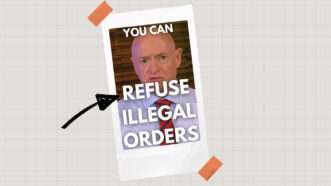
Much of what the federal government does on a daily basis flouts constitutional protections and offends human decency.
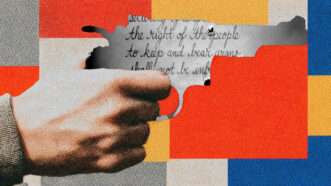
The right to keep and bear arms occupies a curious place in American legal history.

Once we let our rights become privileges, government officials can revoke them on a whim.

According to California lawmakers, Kamala Harris’s pistol is a potential machinegun.

The law is one of several attempts to override the right to bear arms by making it impractical to exercise.

The decision, which hinges on an exception to the Gun-Free School Zones Act, does not say whether that law is consistent with the Second Amendment.
Critics of Prof. William English's survey sometimes miss the mark, but also raise valid questions.

All liberty involves tradeoffs. So does repressing liberty.

The phrases are a mix of anti-fascist sentiments and irony-poisoned internet memes.
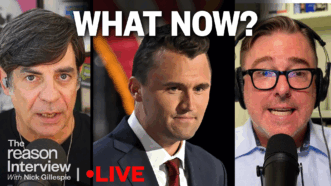
Nick Gillespie and Matt Welch discuss the murder of Charlie Kirk and how political violence is reshaping the national climate.

A unanimous three-judge panel concluded that "no historical tradition supports" the 1987 law.
She had admitted that some (though not all) of the speech was false, but the injunction (entered in a restraining order case, not following a full defamation trial) extends to all speech, not just falsehoods: "Even speech otherwise protected by the First Amendment may be enjoined if it disturbs the petitioning party's peace."

The NRA says it won't support "any policy proposals that implement sweeping gun bans that arbitrarily strip law-abiding citizens of their Second Amendment rights without due process."

Minnesota's proposed firearm restrictions raise serious constitutional questions—and offer little in return.
The Justice Department has proposed a pathway to restore gun rights for millions of Americans.
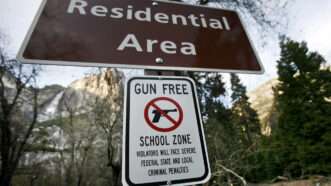
The federal law relies on a risible reading of the Commerce Clause to restrict a constitutional right.
Plus: Beware of distorted data, inside the mind of Curtis Sliwa, a thong-related clarification, and more...
There’s no historical precedent for trying to ration constitutionally protected rights.

DIY firearms aren’t just an end-run around the law; they represent a libertarian political movement.


The case argues that, since the One Big Beautiful Bill Act eliminated taxes on the transfer of certain weapons, the constitutional basis for registering those weapons no longer exists.

Plus: AI reanimations of those who've died, Elizabeth Warren x Zohran Mamdani, and more...

Despite record seizures and restrictive laws, New York City has struggled to stem the tide of untraceable firearms.

Golden State ammunition restrictions have been voided for violating the Second Amendment.

The contrast between the two cases illustrates the haphazard impact of an arbitrary, constitutionally dubious gun law.

In response to a Second Amendment lawsuit, the government says the restriction "serves legitimate objectives" and "only modestly burdens" the right to arms.

The taxes on sound suppressors, short-barreled rifles, and short-barreled shotguns, originally enacted in 1934, were meant to be prohibitive, imposing bans in the guise of raising revenue.


New from Reason: a look into what Javier Milei has accomplished and what it will take to make the most of Argentina’s window for real change. Out now for subscribers.

