

New Mexico Cop Charged With Taking Bribes Also Was Involved in a Bizarre Case of Drug War Infighting
Former sheriff's deputy Paul Jessen was convicted of obstructing justice because he tried to protect a confidential informant from the DEA.
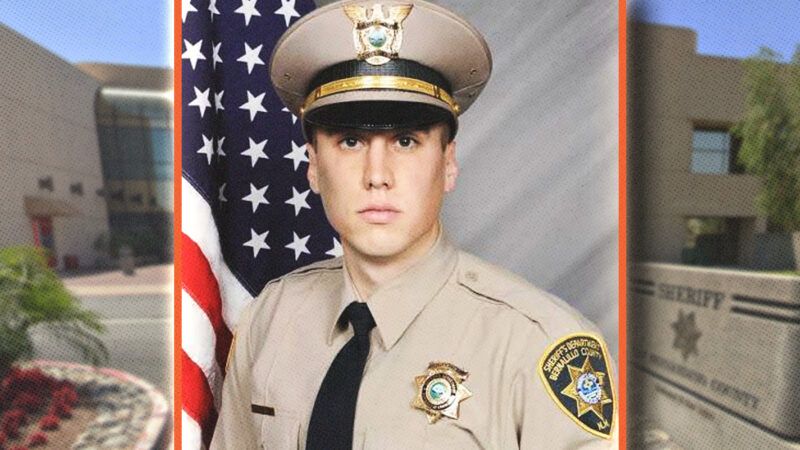
Like many other police officers in New Mexico, Paul Jessen Jr., a Bernalillo County sheriff's deputy, was willing to accept bribes from Albuquerque defense attorney Thomas J. Clear III in exchange for compromising DWI cases against Clear's clients. But according to a federal indictment filed this week, Jessen was leery of taking cash. After talking it over with a supervisor who was in on the long-running bribery scheme, the indictment says, Jessen agreed to accept other forms of compensation, including a big-screen TV, a cabinet of Craftsman tools, a generator, gift cards, hotel rooms, and "free legal services."
Jessen is accused of conspiring to interfere with commerce by extortion, a federal felony punishable by up to 20 years in prison under 18 USC 1951. The indictment is the latest development in the biggest law enforcement scandal that New Mexico has ever seen, involving an arrangement that began three decades ago: Clear would promise DWI arrestees that if they hired him, he could make their cases disappear, which he was able to do by paying cops to absent themselves from administrative and criminal proceedings where their testimony was crucial.
So far, 13 people, including Clear, his paralegal, and a bunch of former officers, have pleaded guilty to participating in that lucrative conspiracy. But Jessen's case is also interesting for another reason. The "free legal services" he received from Clear in 2022, according to the indictment, involved an investigation that resulted in "criminal charges unrelated to the conspiracy described herein." Those charges, which stemmed from animosity between local and federal narcotics investigators, provide a window on the petty infighting and dubious tactics fostered by the war on drugs.
Jessen, who was hired by the Bernalillo County Sheriff's Office in 2013, worked for its DWI unit from 2016 until 2020, when he switched to drug cases. Last July, a federal jury found him guilty of obstructing justice, conspiring to obstruct justice, and lying to FBI agents, charges that carry combined maximum penalties of 65 years in prison. The gist of the case was that Jessen and another sheriff's deputy, Kyle Linker, had repeatedly tipped off a drug dealer, Rod White, about impending federal raids.
Why did they do that? Unlike in the bribery case, Jessen and Linker were motivated by a combination of professional rivalry and personal pique rather than the promise of cool prizes. They were keen to protect White because he was a confidential informant who had helped implicate drug suspects. But they also resented the Drug Enforcement Administration (DEA) for horning in on their cases and were therefore happy to disrupt its operations.
That much was clear from text messages that prosecutors presented during Jessen's trial. When Linker suggested that he would alert White about a planned DEA raid, adding "hahahaha," Jessen encouraged him: "Do it!" Jessen added that "it would be a shame if there is nothing there." Linker agreed: "Gonna be a real shame."
In December 2021, federal prosecutors say in a press release they issued after Jessen's conviction, "the DEA executed a search warrant at [White's] residence and located more than 470 grams of methamphetamine, fentanyl pills, and a firearm. During the ensuing interview, [White] admitted to the agents that he had been previously tipped off by Linker. The DEA devised a plan to confirm [White's] statement."
A DEA agent "contacted Linker to inform him the DEA was planning to conduct a controlled purchase" from White, the press release explains. "Although the agent specifically instructed Linker not to contact the informant, Linker messaged the informant to 'call me ASAP.' Unbeknownst to Linker, [White] was still in the presence of law enforcement. The informant called Linker, who told him he was 'on DEA's radar' and instructed him to have someone else deliver drugs to the DEA."
In a subsequent text message, Jessen said Linker should tell White "not to sell to anyone" and "go to a hotel or stay with someone else for a bit." Linker told Jessen he should be the one to deliver that message so "I can show them my call logs and be like I haven't talked to him since this morning." Jessen agreed, although prosecutors said Linker ultimately made the call, using Jessen's cellphone.
Linker pleaded guilty to obstruction in September 2024 and was later sentenced to 30 days in federal prison. But Jessen insisted on making the government prove its case.
During Jessen's trial, his defense attorney, Joel Myers, argued that his client's role in protecting White from the DEA was tangential and that jurors should not trust the account offered by White, whom he portrayed as a liar who would have said anything the government wanted in exchange for a shorter prison sentence. Myers also argued that the case against Jessen was payback by DEA agents who were engaged in a drug-war turf battle with local police.
Notably, the U.S. Attorney's Office in New Mexico recused itself from the obstruction case against Jessen, which was instead handled by federal prosecutors in the Northern District of Texas. That switch, the Albuquerque Journal reported, aimed to "avoid a potential conflict," since federal prosecutors in New Mexico handle "cases involving the DEA and other law enforcement agencies." So do federal prosecutors in Texas, of course, so it is hard to see why they would be free of the bias that Myers perceived.
Myers questioned the government's public-safety rationale for prosecuting Jessen, noting that the DEA let White continue to operate while it was investigating Linker and Jessen. He also noted that New Mexico Attorney General Raúl Torrez had recently launched a criminal investigation of DEA operations in his state. That probe was prompted by a whistleblower's allegation that the DEA deliberately allowed hundreds of thousands of fentanyl pills to reach New Mexico consumers from 2023 to 2025 because it was hoping to build cases against traffickers higher up in the distribution chain.
According to "current and former DEA agents," the Associated Press reported in June, "the strategy amounted to a gamble with public safety and may have violated U.S. Justice Department rules intended to safeguard the public." A.P. noted that "the fentanyl went unseized amid the deadliest drug epidemic in U.S. history and as the DEA led a public awareness campaign—'One Pill Can Kill'—emphasizing that even a few milligrams of the substance can be lethal."
New Mexico Gov. Michelle Lujan Grisham, who asked Torrez to investigate the DEA, was dismayed by the agency's calculated indifference. "There are no words to describe how reckless and dangerous these decisions were," she said in June. "Make no mistake: the DEA knew people would die if these pills made it into New Mexico communities, and the agency let it happen anyway."
The reasoning here is questionable, since Lujan Grisham seems to assume that traffickers do not compensate for seized pills by sending more. But Myers thought the DEA's alleged recklessness was relevant to Jessen's case because it showed the agency was more interested in taking credit for big busts than protecting the public from potentially deadly drugs.
The jury evidently was not impressed by that argument. But it is hard to see how protecting one drug dealer who was providing useful information to local police can be a crime when turning a blind eye to many drug dealers in the hope of nabbing bigger fish is business as usual at the DEA.



