

Despite a Notable Victory in Oklahoma, Legal Challenges to Flock Cameras Still Face Long Odds
State and federal courts have almost uniformly ruled that searches of ALPR databases do not implicate the Fourth Amendment.
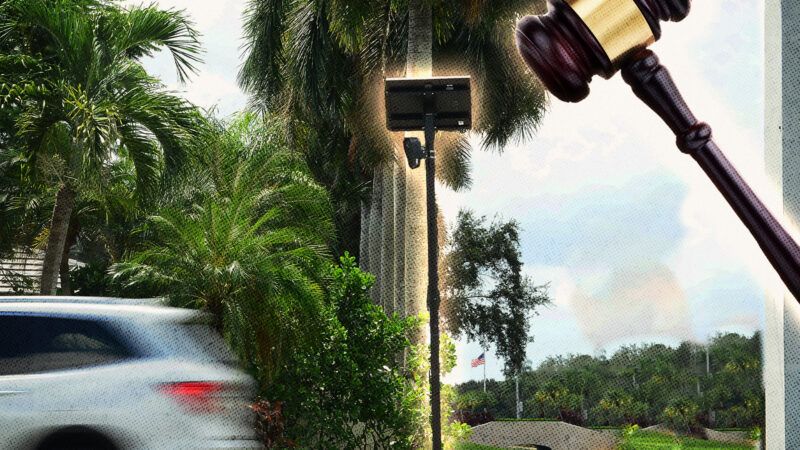
Last week, a federal judge in Oklahoma ruled that querying a database of information collected by automated license plate readers (ALPRs) counts as a search under the Fourth Amendment. As Reason's Elizabeth Nolan Brown noted, that decision was welcome news for critics who argue that warrantless access to ALPR data threatens the privacy of innocent motorists across the country. But a decision that a California judge issued the following day, which dismissed a lawsuit arguing that San Jose's ALPR network violates the state constitution, is much more typical of litigation in this area, which so far has been almost uniformly unsuccessful.
The contrast between those two decisions suggests the challenges such lawsuits face as judges grapple with the implications of Supreme Court precedents involving cellphone location data. Although the relevance of those precedents might seem obvious, state and federal courts generally have perceived important differences between cellphone tracking and police use of roadside cameras that record images of passing cars.
The Oklahoma case, United States v. Kyle, stemmed from Tulsa County Deputy Sheriff Freddie Alaniz's search of a database maintained by Flock Safety, the leading ALPR supplier. Alaniz obtained historical location information for a car that had California plates, which at that point was the only grounds for suspecting the driver was involved in criminal activity. As rationales for the search, Alaniz typed "traffic violation" and "investigation," which gives you a sense of how slight the pretext for accessing ALPR data can be: When Alaniz typed those words, he had neither witnessed a traffic violation nor collected any evidence that would justify a criminal investigation.
The basis for the database search, in other words, was at best a hunch and probably closer to idle curiosity. It did not amount to reasonable suspicion, let alone the probable cause required for a warrant.
In concluding that the ALPR query violated the Fourth Amendment, U.S. District Judge Sara E. Hill relied on the logic of the Supreme Court's 2018 decision in Carpenter v. United States, which involved location data collected by cell sites, and its 2026 decision in Chatrie v. United States, which involved information collected by Google's Location History feature. In both cases, the Court perceived a "search" within the meaning of the Fourth Amendment and an exception to the "third party" doctrine, which says people generally do not have a reasonable expectation of privacy when they voluntarily share information with others.
Alaniz's query generated "fifty sightings across multiple states," Hill noted. Although "this is not the same fine-tuned level of detail that something like a cell phone reveals about the whole of someone's physical movements," she said, "Alaniz and other officers using these systems have access to a continuously updated location history for all vehicles caught on ALPR cameras within the network. This is a type of indiscriminate mass surveillance. It is not targeted on a single individual, as in Carpenter. It is a tool that collects information about all vehicles that pass by any network-connected camera at all times, and it serves up the information to law enforcement on demand."
As Hill saw it, ALPR networks are in that sense even more invasive than the data demand at issue in Carpenter. "Freedom from persistent, dragnet-style surveillance while in public is not a foreign concept in our society, and it is a reasonable expectation that society already accepts," she wrote. "This is the same expectation of privacy that the Supreme Court has continued to recognize in cases like Carpenter and Chatrie."
Like cars, cellphones "move in public places where people can see you in plain view," Hill noted. "But it becomes constitutionally problematic when law enforcement can indiscriminately and passively catalog your whereabouts over an extended period of time and then use that information for any purpose whenever convenient."
Last Friday in SIREN v. Joseph, Santa Clara County Superior Court Judge Jeffrey B. El-Hajj reached a starkly different conclusion about San Jose's network of Flock cameras. In that case, the American Civil Liberties Union (ACLU) of Northern California and the Electronic Freedom Foundation (EFF) argued that "San Jose's warrantless ALPR database searches violate the California Constitution, which guarantees the people's right to be free from unreasonable searches and seizures as well as the people's inalienable right to privacy."
The lawsuit, filed in November 2025, noted that San Jose "has blanketed its roads with nearly 500 ALPRs," enabling "location surveillance of all residents" that is "especially pervasive in both time and space." Citing Carpenter, the ACLU and the EFF argued that "location information reflecting people's long-term physical movements, even in public spaces, is entitled to constitutional protection under the Fourth Amendment." Since Carpenter established that people "have a reasonable expectation of privacy in the whole of their movements," they reasoned, San Jose's ALPR network violates Article I, Section 13 of the California Constitution, which likewise forbids "unreasonable seizures and searches."
El-Hajj disagreed. In the 2024 case People v. Cartwright, he noted, the 5th District California Court of Appeal held that San Diego police did not need a warrant to examine video footage collected by a street-light camera. The appeals court said the defendant incriminated by that evidence "did not have an objectively reasonable expectation of privacy when he traversed a public right-of-way in downtown San Diego in the middle of a business day." It thought that conclusion was consistent with Carpenter, "which specifically indicated that its holding was intended to be narrow and did not extend to 'conventional surveillance techniques and tools, such as security cameras.'"
Cartwright involved footage recorded on one afternoon by a single camera in one location, as opposed to images collected for months by many cameras scattered throughout the city, as in San Jose. That network, the ACLU and the EFF noted, generated "extensive information about a driver's exact whereabouts at precise times, dozens of times a day, stretching back at least 365 days." They said San Jose's system is "far more privacy invasive" than the "small number of conventional security cameras" at issue in Cartwright.
El-Hajj did not think that distinction mattered. "This court is bound by Cartwright," he wrote. The plaintiffs "do not state sufficient facts" to establish a constitutional violation, he said, "because there is no reasonable expectation of privacy in license plate data collected from cameras directed solely at public streets."
El-Hajj conceded that "the scope of Defendants' system is broader than that at issue in Cartwright." But he thought "this case is not so factually distinguishable from Cartwright as to allow the court to disregard that binding appellate authority." He added that "recording automobile license plate information from fixed cameras on public streets over time is less invasive than the continuous cell cite location data at issue in Carpenter."
El-Hajj's decision is not the final word on this case, since an appeals court might disagree with his analysis. And a federal lawsuit challenging San Jose's ALPR system, which the Institute for Justice filed last April, is pending in the U.S. District Court for the Northern District of California.
At this point, however, Hill's ruling is an outlier. "It appears that nearly every court examining the issue to date has determined that ALPR technology use is not a search under the Fourth Amendment because people have no reasonable expectation of privacy in their movements on public streets," she noted.
Last month, for instance, a federal judge in the Central District of California ruled that ALPR database searches are "clearly distinguishable from and less extensive than the 'near perfect surveillance' achievable through the historical [cell-site location information] at issue in Carpenter and the Google Location History data at issue in Chatrie." The near consensus that Hill described also includes the U.S. District Court for the Eastern District of Virginia, where the Institute for Justice challenged Norfolk's Flock camera network in October 2024.
Although U.S. District Judge Mark S. Davis thought the Fourth Amendment argument in that case was plausible enough for the lawsuit to proceed, he ultimately did not buy it. "Federal and state courts analyzing ALPR claims have almost uniformly concluded that neither taking photos of the license plate of a vehicle on a public roadway nor maintaining and querying a database of ALPR photos constitute a warrantless 'search,'" he noted last January, when he ruled in the city's favor.
"It is well-established that police pole cameras or security cameras that photograph or record public areas do not violate any objectively reasonable expectation of privacy," Davis wrote. As for the resulting database, he said, the plaintiffs had not shown that Norfolk's ALPR system was "capable of tracking the whole of a person's movements." The city's police chief had conceded that "it would be difficult to drive anywhere [for] any distance without running into a camera somewhere." But Davis noted that the cameras were "grouped into 75 clusters in Norfolk rather than placed in 176 isolated locations spread throughout the city."
Although the information those cameras captured could be more precise than the cell site data at issue in Carpenter, Davis said, it was less comprehensive and collected less frequently. But like other judges in similar cases, Davis acknowledged that "the constitutional balancing could conceivably tip the other way" as "the number and capabilities of ALPR cameras expand."
Despite the belated backlash against untrammeled use of ALPRs, the number of cameras mapped by the website DeFlock (over 144,000 as of today) continues to grow. The capabilities of those devices expand every time companies like Flock update their software, and they could be further enhanced by new features such as Bluetooth detectors. At some point, perhaps, the courts will intervene. But it is not clear yet whether Hill's ruling signals the tipping point that Davis imagined.




