

The 5th Circuit Rejects Qualified Immunity for Cops Who Searched a Driver After a Bogus Traffic Stop
"It is clearly established that an officer cannot pull someone over without reasonable suspicion and thereafter concoct a fabricated traffic violation," the appeals court says.
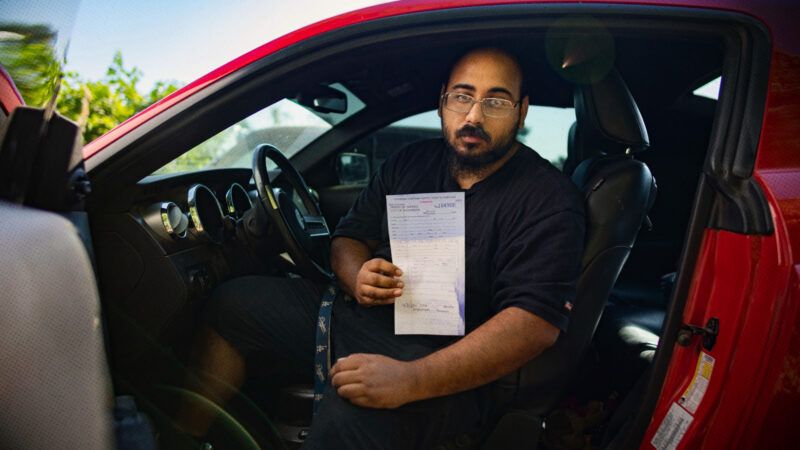
Around 5 p.m. on a Wednesday in June 2022, Mario Rosales was driving his red Mustang on Jackson Street in Alexandria, Louisiana, waiting to turn left onto Dorchester Drive, when a police SUV pulled up behind him. After the traffic light turned green and Rosales made his turn, Officers Samuel Terrell and Jim Lewis activated their lights and pulled him over.
The officers later claimed Rosales had "failed to signal" his turn. But as dashcam video showed, that was not true: The Mustang's left-turn signal was blinking as Rosales waited at the intersection. And after stopping Rosales and his girlfriend, Gracie Lasyone, who was sitting in the front passenger seat, Terrell and Lewis detained them for 21 minutes, during which the cops asked if there was anything illegal in the car, grilled them about drug use, frisked Rosales, instructed him to empty his pockets, and gave him and Lasyone the Miranda warning that typically accompanies an arrest.
Rosales and Lasyone sued Terrell and Lewis in federal court that November, arguing that the officers had violated their Fourth Amendment rights under color of law. Terrell and Lewis claimed they were protected by qualified immunity, a doctrine that bars such lawsuits unless they allege violations of "clearly established" law. A federal judge disagreed, and last week the U.S. Court of Appeals for the 5th Circuit upheld that decision, concluding that Rosales and Lasyone's allegations were sufficient to defeat qualified immunity at this stage of the case.
That ruling by a unanimous three-judge panel is striking for two reasons. It illustrates the limits of the broad leeway that the Supreme Court has given police officers to stop and interrogate motorists. It also illustrates the limits of qualified immunity, which in many cases has prevented victims of outrageous police misconduct from pursuing constitutional claims because they were unable to cite sufficiently specific precedents.
In the 1968 case Terry v. Ohio, the Supreme Court ruled that police may stop someone when they reasonably suspect he is involved in criminal activity and may frisk him if they reasonably suspect he is "armed and dangerous." Three decades later in Whren v. United States, the Court said reasonable suspicion of a traffic violation is enough to justify stopping a car, even when that allegation is a pretext for an unrelated criminal investigation. And when a traffic stop is legally justified, the Court has held in other cases, police may question the driver about unrelated matters and may order both the driver and any passengers out of the car in the interest of officer safety.
The impact of those rulings was clear when Terrell and Lewis pulled over Rosales and Lasyone. The cops ordered both of them to exit the car, and they interrogated them about their places of residence, itineraries, criminal histories, and personal habits.
Rosales, whose car was registered in New Mexico, explained that he was originally from Roswell, that he was planning a move to Louisiana, that he worked for Atlas Home Service in Alexandria, and that he stayed with Lasyone's sister in Dry Prong while in Louisiana but was hoping to buy a home there. He said he and Lasyone had just gotten off work, had stopped at a bank, and were on their way to buy a car part that had been advertised on Facebook. Lasyone gave the same account.
When asked if he was armed, Rosales said he had a Taurus pistol in a bag in the backseat but declined to let Terrell fetch it, saying, "I don't want anybody searching my vehicle." Terrell frisked Rosales and found no weapons. Despite that search, Lewis asked Rosales to empty his pockets and place the contents—a wallet and keys—on the hood of the police SUV. When Rosales said that was all he was carrying, Lewis asked, "Do you mind if I check?" After Rosales noted that Terrell had already frisked him, Terrell explained that "I just patted you down" but didn't "search you."
Lewis asked Rosales about drugs. Was there any marijuana in the car? Meth? Heroin? Fentanyl? Pills prescribed for someone else? Cocaine? Crack? Rosales answered no to each query, saying he did not use illegal drugs. He also said he had never been arrested and had "a clean record."
Lasyone fielded similar questions, saying she had never been arrested and did not use illegal drugs. Not marijuana. Not meth. Not heroin. Not cocaine. Not crack. Not other people's prescription pills.
When Lasyone wondered why the cops were asking all these questions, Terrell said they were "just curious." Unsatisfied by that explanation, Lasyone asked, "You just pull people over because you're curious?" Well, not exactly, Terrell said: "He failed to signal, so that's why I pulled you over, and then once we started talking, I got curious."
Lewis gave Rosales a similar explanation. "You know a traffic stop is a legal detainment, right?" he said. "You were detained on a traffic stop." He explained that he was "just letting you know" because "you seem like a constitutionalist to me." He improbably added that "I'm a lot a constitutionalist."
When records checks found no criminal histories or outstanding warrants, Lewis was disappointed. "Aaaw," he said. "What are the chances of that?!…Aw, man!"
Terrell and Lewis had a drug-sniffing dog but decided not to deploy it. "I really didn't see a whole lot of indicators of him [Rosales] not being completely truthful," Lewis explained.
In addition to citing Rosales for "failure to signal," the officers claimed he had failed to register his car, which also was not true: His car was registered in New Mexico, and that registration did not expire until October 2022. The charges were eventually dismissed.
If Rosales had in fact "failed to signal," the stop itself would have been justified under Whren, which allows even "pretextual" stops when officers have reason to believe a driver has violated any of the myriad state rules governing the operation and maintenance of motor vehicles. But as the 5th Circuit noted, dashcam footage showed that Rosales had activated his turn signal, although it was not clear from the record whether he had done so at least 100 feet before the intersection, as required under Louisiana law.
According to the lawsuit, the appeals court notes, Rosales "legally turned left," meaning the cops "fabricated a traffic violation." And "it is clearly established that an officer cannot pull someone over without reasonable suspicion and thereafter concoct a fabricated traffic violation."
By itself, that allegation would be enough to state a Fourth Amendment claim under Terry. But even if the stop was justified, Rosales and Lasyone argued, the officers impermissibly extended their detention without reasonable suspicion of criminal activity and unconstitutionally searched Rosales without reasonable suspicion that he was "armed and dangerous."
Terrell said the frisk was justified because Rosales was wearing "baggy clothing," did not mention his pistol until he was asked about weapons, and described himself as "agitated." But "an officer cannot search or seize a person simply because he is keeping or bearing a firearm," the 5th Circuit notes, quoting its 2025 decision in United States v. Wilson. Rosales' self-description "at best suggests 'nervousness,'" which is not enough to establish reasonable suspicion, the appeals court says. "Nor does 'baggy' clothing alone justify a pat-down."
Since "these facts do not support a reasonable suspicion—either in isolation or under the totality of the circumstances—that Rosales was armed and dangerous, he has plausibly alleged Officer Terrell frisked him unlawfully," the 5th Circuit says. It adds that "Officer Lewis searched Rosales's pockets after he observed Officer Terrell conduct a pat-down that revealed no weapons," which likewise was not justified in the circumstances described by the plaintiffs. In short, Rosales "plausibly alleged those searches were unlawful under the Fourth Amendment."
Even if those searches violated the Fourth Amendment, Terrell and Lewis said, they did not have fair notice to that effect. But as the 5th Circuit notes, "the law that prohibited Officers from searching Rosales has long been clearly established."
The 5th Circuit was less impressed by the claim that Terrell and Lewis had violated the First Amendment by repeatedly refusing to let Rosales or Lasyone record the encounter with their mobile phones. In the 2017 case Turner v. Lieutenant Driver, the appeals court recognized that the First Amendment protects a "right to record the police," subject to "reasonable time, place, and manner restrictions." But Turner "does not clearly establish the First Amendment right" that Rosales and Lasyone "assert in this case," the 5th Circuit says, because it did not involve "persons detained during a traffic stop."
This decision does not mean Rosales and Lasyone will ultimately prevail, but it at least gives them a chance to make their case. "This is the third ruling denying the officers qualified immunity," notes Marie Miller, an attorney at the Institute for Justice, which represents the plaintiffs. "The magistrate judge and district court had already determined the officers were not entitled to qualified immunity. The years Mario and Gracie have spent pursuing their rightful remedies are a testament to their willpower and strength. They are fighting not just for their own rights, but to protect the rights of all motorists moving forward."




