

Thomas and Alito Shortchange the Bill of Rights in Another Criminal Justice Case
Plus: a few words about my new book
Greetings and welcome to the latest edition of the Injustice System newsletter. It's now the first week of June, which means the U.S. Supreme Court has begun its annual mad dash to release all of its opinions in argued cases from its current term before the justices depart for their summer break. If past SCOTUS terms are any indication, we'll get one or more big opinion drops each week for the next three or four weeks, usually on Thursdays, with everything wrapped up neat and tidy by the final days of June.
By my reckoning, there are still nearly a dozen huge cases left to be decided, dealing with issues ranging from executive power to immigration to digital privacy and the right to be free from unreasonable search and seizure.
You’re reading Injustice System from Damon Root and Reason. Get more of Damon’s commentary on constitutional law and American history.
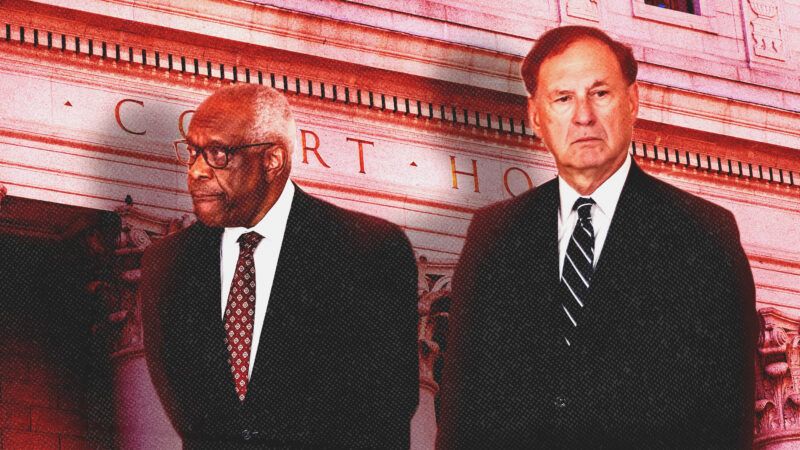
There have also been some notable occurrences in criminal justice cases happening just slightly to the side of the SCOTUS main stage. As I noted last week, Justices Clarence Thomas and Samuel Alito went out of their way to protest the Supreme Court's refusal to review a lower court decision that denied qualified immunity to a police officer facing credible allegations of misconduct. Pointing to that case and others, I observed that "when viewed from a libertarian legal perspective, Thomas and Alito tend to stand out as the worst on criminal justice issues."
Well, Thomas and Alito were at it again this week, once again protesting a Supreme Court action that cut against the interests of law enforcement. Yesterday, the Supreme Court issued an unsigned opinion in a case called Whitton v. Dixon. At issue was whether a lower court erred by weighing post-trial DNA evidence in its assessment of a state Supreme Court decision. In its per curiam opinion, the Court held that the lower court "should not have considered the post-trial DNA evidence in assessing whether the Florida Supreme Court reasonably determined that [a jailhouse informant's] testimony was immaterial to the jury's verdict. Because the post-trial DNA evidence was not presented to the jury (indeed, did not exist at the time of the trial), that evidence could not have influenced the jury's verdict."
Thomas dissented from this ruling, joined by Alito. "If the Eleventh Circuit erred at all in mentioning the DNA test results," Thomas wrote, that error was "harmless" because the lower court also "thoroughly examined the overwhelming evidence against Whitton, which was more than sufficient to justify its decision."
At its core, this case was about whether or not the failure to adhere to proper procedures in a criminal justice matter counted as a violation of the due process of law. The 7–2 majority held that because post-trial evidence was considered when such evidence should not have been considered, proper procedures had not been followed, and justice had not been done. SCOTUS therefore sent the case back to the judicial drawing board "for further proceedings consistent with this opinion."
Thomas and Alito, by contrast, argued that the majority's focus on procedural niceties was wholly misguided. According to Thomas's dissent, the majority was overly focused "on 'technicalit[ies]' that do not 'really affec[t]' the outcome of a case."
Complaining about criminal defendants skirting their comeuppance on account of legal "technicalities" is the hallmark of what is sometimes called "law and order conservatism." One problem with this particular brand of conservative thought is the fact that the Constitution in general, and the Bill of Rights in particular, are devoted to the very sort of procedural safeguards that necessarily benefit criminal defendants from time to time precisely because that is what it takes to impose consistent and principled limits on government power.
When Thomas and Alito are complaining about pesky "technicalities" that aid criminal defendants, in other words, they are really complaining about the pesky Constitution.
In Other News
Please forgive the shameless self-promotion, but my latest book was officially published this week, and I wanted to tell you just a little bit about it.
It's called Emancipation War: The Fall of Slavery and the Coming of the Thirteenth Amendment. It's my attempt to understand and explain the legal, political, and military factors that made an antislavery constitutional amendment possible. You can read a short excerpt from it here and acquire a copy of your own here. I hope you'll check it out.




