

Reason.com - Free Minds and Free Markets
Reason logo Reason logo
  • Latest
  • Magazine
    • Current Issue
    • Archives
    • Subscribe
    • Crossword
  • Video
    • Reason TV
    • The Reason Roundtable
    • Free Media
    • The Reason Interview
  • Podcasts
    • All Shows
    • The Reason Roundtable
    • The Reason Interview With Nick Gillespie
    • Freed Up
    • The Soho Forum Debates
  • Volokh
  • Newsletters
  • Donate
    • Donate Online
    • Ways To Give To Reason Foundation
    • Torchbearer Society
    • Planned Giving
  • Subscribe
    • Reason Plus Subscription
    • Print Subscription
    • Gift Subscriptions
    • Subscriber Support

Log In

Create new account

Civil Liberties

Thomas and Alito Shortchange the Bill of Rights in Another Criminal Justice Case

Plus: a few words about my new book
Damon Root | 6.2.2026 7:00 AM

Share on FacebookShare on XShare on RedditShare by emailPrint friendly versionCopy page URL Add Reason to Google
Media Contact & Reprint Requests
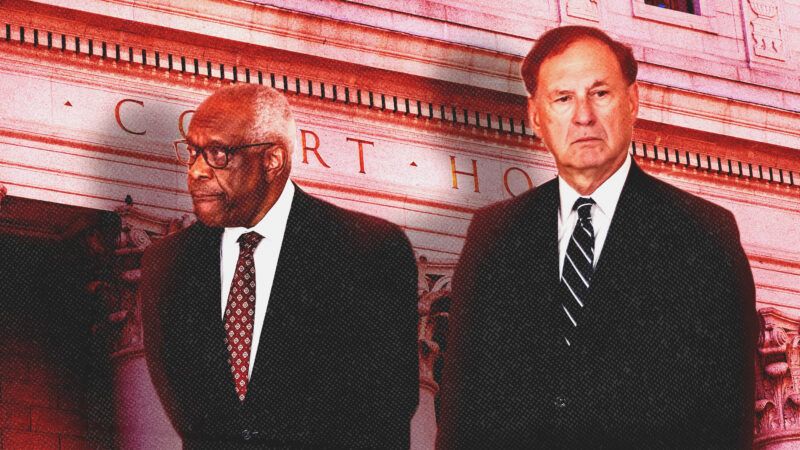
06.01.26-v1 | Illustration: Jacquelyn Martin-Pool via CNP/picture alliance/Consolidated News Photos/Newscom/Yukchong Kwan/Dreamstime
(Illustration: Jacquelyn Martin-Pool via CNP/picture alliance/Consolidated News Photos/Newscom/Yukchong Kwan/Dreamstime)

Greetings and welcome to the latest edition of the Injustice System newsletter. It's now the first week of June, which means the U.S. Supreme Court has begun its annual mad dash to release all of its opinions in argued cases from its current term before the justices depart for their summer break. If past SCOTUS terms are any indication, we'll get one or more big opinion drops each week for the next three or four weeks, usually on Thursdays, with everything wrapped up neat and tidy by the final days of June.

By my reckoning, there are still nearly a dozen huge cases left to be decided, dealing with issues ranging from executive power to immigration to digital privacy and the right to be free from unreasonable search and seizure.

You’re reading Injustice System from Damon Root and Reason. Get more of Damon’s commentary on constitutional law and American history.

This field is for validation purposes and should be left unchanged.

There have also been some notable occurrences in criminal justice cases happening just slightly to the side of the SCOTUS main stage. As I noted last week, Justices Clarence Thomas and Samuel Alito went out of their way to protest the Supreme Court's refusal to review a lower court decision that denied qualified immunity to a police officer facing credible allegations of misconduct. Pointing to that case and others, I observed that "when viewed from a libertarian legal perspective, Thomas and Alito tend to stand out as the worst on criminal justice issues."

Well, Thomas and Alito were at it again this week, once again protesting a Supreme Court action that cut against the interests of law enforcement. Yesterday, the Supreme Court issued an unsigned opinion in a case called Whitton v. Dixon. At issue was whether a lower court erred by weighing post-trial DNA evidence in its assessment of a state Supreme Court decision. In its per curiam opinion, the Court held that the lower court "should not have considered the post-trial DNA evidence in assessing whether the Florida Supreme Court reasonably determined that [a jailhouse informant's] testimony was immaterial to the jury's verdict. Because the post-trial DNA evidence was not presented to the jury (indeed, did not exist at the time of the trial), that evidence could not have influenced the jury's verdict."

Thomas dissented from this ruling, joined by Alito. "If the Eleventh Circuit erred at all in mentioning the DNA test results," Thomas wrote, that error was "harmless" because the lower court also "thoroughly examined the overwhelming evidence against Whitton, which was more than sufficient to justify its decision."

At its core, this case was about whether or not the failure to adhere to proper procedures in a criminal justice matter counted as a violation of the due process of law. The 7–2 majority held that because post-trial evidence was considered when such evidence should not have been considered, proper procedures had not been followed, and justice had not been done. SCOTUS therefore sent the case back to the judicial drawing board "for further proceedings consistent with this opinion."

Thomas and Alito, by contrast, argued that the majority's focus on procedural niceties was wholly misguided. According to Thomas's dissent, the majority was overly focused "on 'technicalit[ies]' that do not 'really affec[t]' the outcome of a case."

Complaining about criminal defendants skirting their comeuppance on account of legal "technicalities" is the hallmark of what is sometimes called "law and order conservatism." One problem with this particular brand of conservative thought is the fact that the Constitution in general, and the Bill of Rights in particular, are devoted to the very sort of procedural safeguards that necessarily benefit criminal defendants from time to time precisely because that is what it takes to impose consistent and principled limits on government power.

When Thomas and Alito are complaining about pesky "technicalities" that aid criminal defendants, in other words, they are really complaining about the pesky Constitution.


In Other News

Please forgive the shameless self-promotion, but my latest book was officially published this week, and I wanted to tell you just a little bit about it.

It's called Emancipation War: The Fall of Slavery and the Coming of the Thirteenth Amendment. It's my attempt to understand and explain the legal, political, and military factors that made an antislavery constitutional amendment possible. You can read a short excerpt from it here and acquire a copy of your own here. I hope you'll check it out.

Start your day with Reason. Get a daily brief of the most important stories and trends every weekday morning when you subscribe to Reason Roundup.

This field is for validation purposes and should be left unchanged.

NEXT: 1776 All-Stars: Benjamin Franklin Reminds Us To Just Do Things

Damon Root is a senior editor at Reason and the author of A Glorious Liberty: Frederick Douglass and the Fight for an Antislavery Constitution (Potomac Books). His next book, Emancipation War: The Fall of Slavery and the Coming of the Thirteenth Amendment (Potomac Books), will be published in June 2026.

Civil LibertiesSupreme CourtConstitutionCriminal JusticeLaw & Government
Share on FacebookShare on XShare on RedditShare by emailPrint friendly versionCopy page URL Add Reason to Google
Media Contact & Reprint Requests

Hide Comments (1)

Editor's Note: As of February 29, 2024, commenting privileges on reason.com posts are limited to Reason Plus subscribers. Past commenters are grandfathered in for a temporary period. Subscribe here to preserve your ability to comment. Your Reason Plus subscription also gives you an ad-free version of reason.com, along with full access to the digital edition and archives of Reason magazine. We request that comments be civil and on-topic. We do not moderate or assume any responsibility for comments, which are owned by the readers who post them. Comments do not represent the views of reason.com or Reason Foundation. We reserve the right to delete any comment and ban commenters for any reason at any time. Comments may only be edited within 5 minutes of posting. Report abuses.

  1. Stupid Government Tricks   12 minutes ago

    This summary is clear as mud. What actually happened here?

    At issue was whether a lower court erred by weighing post-trial DNA evidence in its assessment of a state Supreme Court decision. In its per curiam opinion, the Court held that the lower court "should not have considered the post-trial DNA evidence in assessing whether the Florida Supreme Court reasonably determined that [a jailhouse informant's] testimony was immaterial to the jury's verdict. Because the post-trial DNA evidence was not presented to the jury (indeed, did not exist at the time of the trial), that evidence could not have influenced the jury's verdict."

    Thomas dissented from this ruling, joined by Alito. "If the Eleventh Circuit erred at all in mentioning the DNA test results," Thomas wrote, that error was "harmless" because the lower court also "thoroughly examined the overwhelming evidence against Whitton, which was more than sufficient to justify its decision."

    This summary makes it sound like the Florida Supreme Court made some decision (why not tell us what that decision was?), the appeals court (the "lower court") "assessed" (what a strange word; why not affirmed or reversed?) the Florida Supreme Court's unknown decision using DNA evidence that the jury could not have heard, and the US Supreme Court, 7-2, said the appeals court erred in using that DNA evidence which was done after the jury verdict. Then Thomas and Alito complained that the DNA evidence error was harmless because the other evidence was sufficient to justify its decision, which, again, Damon Root's summary does not mention.

    Why go out of your way to leave us in the dark as to what all these decisions were? The trial court must have convicted the defendant or there would have been no post-trial DNA and no appeal to the Florida Supreme Court, but did the Florida Supreme Court reverse or affirm the trial court verdict? Did the "lower court" affirm or reverse the Florida Supreme Court?

    On the face of it, I'm all for new evidence after a verdict. If it confirms the guilt, it's harmless; if it throws doubt on the verdict, then figure out why. One of my many pet peeves is when courts spend years trying to decide if newly available DNA testing should be applied to some old murder evidence, instead of just doing the damn test, as if the prosecutor is afraid it would exonerate a convicted prisoner. DNA testing may be expensive, but it sure can't be more expensive than two more years in prison and all that lawyering.

    We have a ritual system, not a justice system. Due process errors should not lean in the government's favor. The DNA evidence exists; to throw it out because it came too late is a travesty, a sign of ritual over justice, and if Thomas and Alito think the late DNA evidence should not be cause for throwing out the entire appeals court decision, I'm on their side.

    I'm on the side of justice. Damon Root is apparently on the side of ritual, and considering his constant barbs against Thomas and Alito, as shown in this very article, I'm inclined to think he doesn't even give a shit about the ritual at stake as long as he can rant about Thomas and Alito.

    Log in to Reply

Please log in to post comments

Mute this user?

  • Mute User
  • Cancel

Ban this user?

  • Ban User
  • Cancel

Un-ban this user?

  • Un-ban User
  • Cancel

Nuke this user?

  • Nuke User
  • Cancel

Un-nuke this user?

  • Un-nuke User
  • Cancel

Flag this comment?

  • Flag Comment
  • Cancel

Un-flag this comment?

  • Un-flag Comment
  • Cancel

Latest

How To Sell a War

Brandan P. Buck | 6.2.2026 8:00 AM

Thomas and Alito Shortchange the Bill of Rights in Another Criminal Justice Case

Damon Root | 6.2.2026 7:00 AM

1776 All-Stars: Benjamin Franklin Reminds Us To Just Do Things

Eric Boehm | From the July 2026 issue

Brickbat: Pawned Off

Charles Oliver | 6.2.2026 4:00 AM

Why did the FBI Want Dilbert Creator Scott Adams' Twitter Data?

Matthew Petti | 6.1.2026 4:53 PM

Recommended

  • About
  • Browse Topics
  • Events
  • Staff
  • Jobs
  • Donate
  • Advertise
  • Subscribe
  • Contact
  • Media
  • Shop
  • Amazon
Reason Facebook@reason on XReason InstagramReason TikTokReason YoutubeApple PodcastsReason on FlipboardReason RSS Add Reason to Google

© 2026 Reason Foundation | Accessibility | Privacy Policy | Terms Of Use

This site is protected by reCAPTCHA and the Google Privacy Policy and Terms of Service apply.

r

I WANT FREE MINDS AND FREE MARKETS!

Help Reason push back with more of the fact-based reporting we do best. Your support means more reporters, more investigations, and more coverage.

Make a donation today! No thanks
r

I WANT TO FUND FREE MINDS AND FREE MARKETS

Every dollar I give helps to fund more journalists, more videos, and more amazing stories that celebrate liberty.

Yes! I want to put my money where your mouth is! Not interested
r

SUPPORT HONEST JOURNALISM

So much of the media tries telling you what to think. Support journalism that helps you to think for yourself.

I’ll donate to Reason right now! No thanks
r

PUSH BACK

Push back against misleading media lies and bad ideas. Support Reason’s journalism today.

My donation today will help Reason push back! Not today
r

HELP KEEP MEDIA FREE & FEARLESS

Back journalism committed to transparency, independence, and intellectual honesty.

Yes, I’ll donate to Reason today! No thanks
r

STAND FOR FREE MINDS

Support journalism that challenges central planning, big government overreach, and creeping socialism.

Yes, I’ll support Reason today! No thanks
r

PUSH BACK AGAINST SOCIALIST IDEAS

Support journalism that exposes bad economics, failed policies, and threats to open markets.

Yes, I’ll donate to Reason today! No thanks
r

FIGHT BAD IDEAS WITH FACTS

Back independent media that examines the real-world consequences of socialist policies.

Yes, I’ll donate to Reason today! No thanks
r

BAD ECONOMIC IDEAS ARE EVERYWHERE. LET’S FIGHT BACK.

Support journalism that challenges government overreach with rational analysis and clear reasoning.

Yes, I’ll donate to Reason today! No thanks
r

JOIN THE FIGHT FOR FREEDOM

Support journalism that challenges centralized power and defends individual liberty.

Yes, I’ll donate to Reason today! No thanks
r

BACK JOURNALISM THAT PUSHES BACK AGAINST SOCIALISM

Your support helps expose the real-world costs of socialist policy proposals—and highlight better alternatives.

Yes, I’ll donate to Reason today! No thanks
r

FIGHT BACK AGAINST BAD ECONOMICS.

Donate today to fuel reporting that exposes the real costs of heavy-handed government.

Yes, I’ll donate to Reason today! No thanks


