
Allowing Censorship of Military Retirees Like Sen. Mark Kelly Would Set a Chilling and Dangerous Precedent
To justify punishing a legislator for his speech, a FIRE brief notes, Defense Secretary Pete Hegseth relies on a Supreme Court precedent that is clearly inapposite.
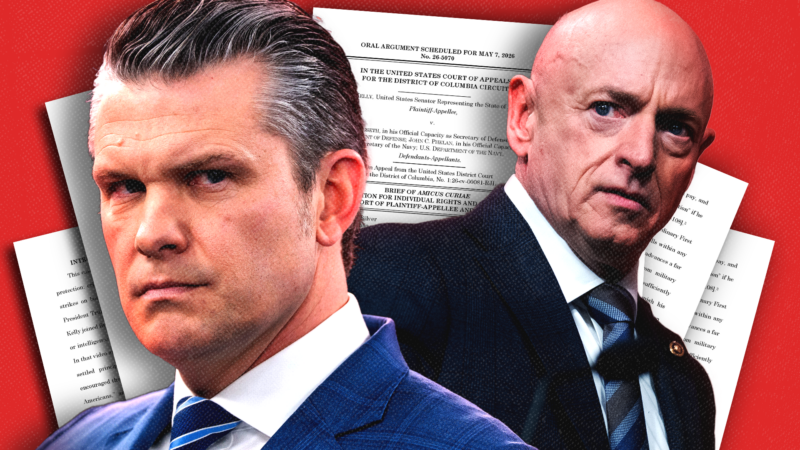
Defending his supposed authority to punish a member of Congress for criticizing him, Defense Secretary Pete Hegseth argues that retired military officers like Sen. Mark Kelly (D–Ariz.) are subject to speech restrictions because of their continuing connection to the armed forces. Hegseth relies mainly on the Supreme Court's 1974 decision in Parker v. Levy, which involved an active-duty U.S. Army captain who urged soldiers to defy deployment orders during the Vietnam War.
That precedent is clearly inapposite, the Foundation for Individual Rights and Expression (FIRE) argues in a brief urging the U.S. Court of Appeals for the D.C. Circuit to uphold a preliminary injunction that bars Hegseth from taking disciplinary action against Kelly. Extending the speech restrictions upheld in Parker to military retirees, FIRE warns in Kelly v. Hegseth, would create a new, status-based exception to the First Amendment that would have a chilling effect on political debate and invite censorship of other former government employees.
Hegseth's beef with Kelly, a retired Navy captain, stems mainly from a November 18 video in which the senator and five other Democratic legislators reminded military personnel of their well-established duty to "refuse illegal orders." Although the video did not mention any specific orders, it was produced in the midst of President Donald Trump's domestic military deployments and his murderous military campaign against suspected cocaine smugglers, both of which Kelly has criticized.
Hegseth cited that video in a letter of censure that he sent Kelly on January 5, which also noted other public remarks that Hegseth deemed "prejudicial to good order and discipline in the armed forces." The offending comments included Kelly's defense of the video, his accurate description of the principle it reiterated as legally uncontroversial, his promise that he would "ALWAYS defend the Constitution," and his statement that "intimidation would not work" to silence him. The defense secretary also was angry that Kelly had criticized the Pentagon's missile strikes on suspected drug boats, which Hegseth thought implied he was guilty of war crimes. And he complained that Kelly had faulted him for "firing admirals and generals" and surrounding himself with "yes men."
Kelly's remarks, Hegseth averred, represented an intolerable threat to national security because they undermined military discipline. Based on that conclusion, Hegseth threatened to penalize Kelly by reducing his retirement rank and pension. "If you continue to engage in conduct prejudicial to good order and discipline," Hegseth warned, "you may subject yourself to criminal prosecution or further administrative action."
The government "neither defends those actions under ordinary First Amendment rules nor contends Senator Kelly's speech falls within any recognized category of unprotected expression," FIRE notes. "Instead, it advances a far more sweeping claim: Because Senator Kelly retired from military service rather than receiving a discharge, he remains sufficiently connected to the armed forces that the Executive may punish his speech—expression that no doubt receives full constitutional protection coming from a civilian speaker."
That claim "depends entirely" on extending Parker "far beyond the operational demands of active-duty service that justified it," the brief says. Parker involved Capt. Howard Levy, an Army physician assigned to Fort Jackson in South Carolina, who had publicly said black soldiers "should refuse to go to Viet Nam and if sent should refuse to fight because they are discriminated against and denied their freedom in the United States."
In upholding Levy's court-martial punishment, the Supreme Court emphasized that he was part of a "separate" and "specialized society" where the "fundamental necessity for obedience" justified speech restrictions that otherwise "would be constitutionally impermissible." Parker therefore "did not announce a permanent, speaker-based reduction in constitutional protection for anyone with some continuing tie to the armed forces," FIRE says. "And it certainly did not authorize punishment of retirees speaking from civilian life on matters of public concern. Extending Parker here would sever it from its active-duty rationale and convert a contextual rule tied to present command relationships into a status-based exception untethered from actual military necessity."
According to the Trump administration, FIRE notes, "a military retiree's speech may receive less protection not because the speaker is acting in an official role, not because the speech occurs within an actual command structure, nor for any operational necessity, but because the government believes the speaker's continuing status makes the speech sufficiently risky. That is precisely the kind of untethered, status-based reduction in First Amendment protection that established doctrine rejects."
There is no historical precedent for carving out such an exception. Since the Founding, FIRE notes, former military officers, including the 274 Revolutionary War veterans who later served in the House of Representatives, have played a prominent role in politics, and even their bitterest enemies never suggested that their backgrounds constrained what they were allowed to say.
The brief cites an example that seems especially relevant to this case: After he retired in 1931, Marine Major Gen. Smedley Butler, a highly decorated veteran of several wars, "traveled the country to give speeches, radio addresses, and interviews railing against American military intervention, eventually publishing his views in his 1935 book, War Is a Racket. Whatever one thinks of Butler's views, his free expression of them shows that retired military leaders have long engaged in vehement public criticism of military policy." FIRE adds that "the government identifies no practice—settled or otherwise—of treating such speech as categorically outside the First Amendment because speakers continued to receive retirement pay or other military benefits."
Accepting the government's position, FIRE warns, "would effectively establish a new category of unprotected expression: speech by retired servicemembers which the Secretary of Defense unilaterally deems too dangerous, disruptive, or influential—contrary to the Supreme Court's repeated rejection of such doctrinal innovation." As a result, the defense secretary would be empowered to punish retired officers whenever they said anything that he viewed as "prejudicial to good order and discipline."
According to a brief that 73 former admirals, generals, and service secretaries filed last week in Kelly v. Hegseth, that threat already has deterred military retirees from speaking out on issues of public concern. "If the government may censure a retired officer, threaten his benefits, and hold out the prospect of further sanction because the Secretary believes the retiree's public criticism has become too disruptive, other military retirees will understand the message," FIRE says. "They may continue to praise current military operations, policy, or leadership without consequence, but criticism will face retribution at steep personal cost."
Given their experience, retired officers "can illuminate questions of war powers, military law, readiness, procurement, veterans' affairs, and the conduct of current operations, among other topics," FIRE notes. "The public benefits precisely because those speakers combine experience with independence. If the price of speaking candidly is censure, threatened loss of benefits, or the prospect of further punishment, the public will hear less from one of the constituencies best equipped to inform debate on matters of national consequence."
The threat to freedom of speech does not end there, FIRE warns: "If a passive but continuing relationship with the government is enough to reduce constitutional protection, it is not hard to envision that [the] government would invoke the same reasoning in future cases involving retired civil servants, law-enforcement officials, intelligence personnel, or other speakers receiving pensions or with some other lingering government affiliation. The government could try to argue ordinary First Amendment scrutiny gives way whenever such speakers criticize the institutions to which they once belonged and officials assert some continuing institutional interest in their silence. That would mark a serious departure from both military and public-employee speech doctrines, each of which ties diminished protection to actual operational demands rather than mere identity."
Such arguments might appeal to a thin-skinned president who views dissent as treason and especially resents criticism from former intelligence and law enforcement officials. But this is not a road that Republicans should be eager to take, since such doctrinal innovations could easily be turned against them under a Democratic administration.
The government's theory "is untenable because it cannot be confined to the facts that supposedly justify it," FIRE concludes. "A rule untethered from present command, present duty, and present operational necessity is not a military-specific rule at all. Rather, it is a speaker-based exception masquerading as one. Because any such exception has no clear stopping point, this Court should reject it lest it distort First Amendment law well beyond the context of retired servicemembers."
