

Trump Can't TACO His Way Out of Iran
The president is good at backing out of a losing bet—but this time, it's out of his hands.
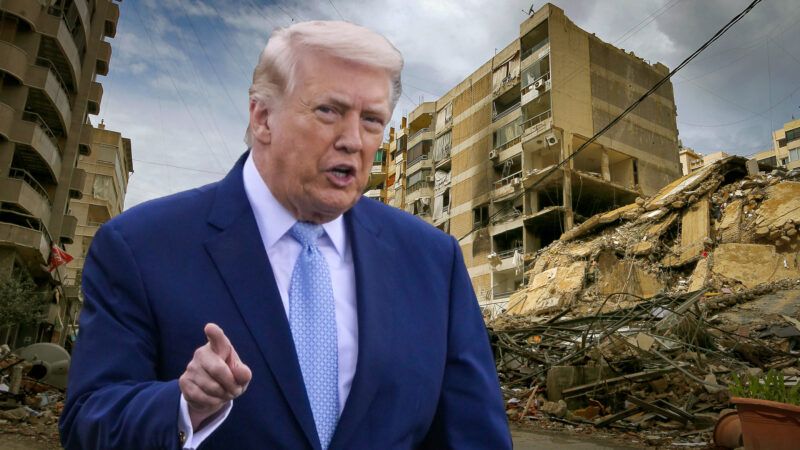
The U.S.-Iranian war has taken on a strange rhythm. Several times, often just before the end of the trading day or weekend, U.S. President Donald Trump announced that Iran is about to fold and the war will be over soon. Billions of dollars through markets moved as traders bet that oil prices would fall and stock prices would rise. Then they came into work the next business day to discover that the war was still happening.
The latest iteration happened this week when Trump claimed to have held "very strong talks" with Iran, setting a five-day deadline for an agreement. He then hinted at a planned peace summit in Pakistan. Iran publicly rejected both a U.S. peace proposal and the very idea of direct talks. An Iranian official told Al Jazeera that Trump's opening offer, sent through Pakistani middlemen, was "unreasonable" and nothing like the media leaks from the American side suggested.
"The end of the war will occur when Iran decides it should end, not when Trump envisions its conclusion," Iranian state television broadcast on Wednesday, laying out some of Iran's conditions, including war reparations and an end to Israel's war with Hezbollah in Lebanon.
While Trump claimed on social media that Iran was privately "begging" for a deal, the U.S. military moved more troops into the Middle East, and Rep. Nancy Mace (R–S.C.) came out of a briefing hinting to the media that the administration was planning a ground invasion. Markets finally internalized that the war wasn't really ending, and crude oil futures rose 5 percent on Thursday morning.
At the beginning of Trump's second term, traders coined the acronym "TACO," short for "Trump Always Chickens Out," to describe his tendency to back out of destructive threats. But there's also a more charitable way to look at it: Trump is good at getting out of bets just before they turn bad. His preference is to escalate conflicts where he smells weakness, then de-escalate as soon as he hits diminishing returns, usually leaving the option open to escalate again later.
That was the case on Liberation Day, the planned U.S. tariff offensive against the rest of the world last year, which Trump postponed and weakened after the stock market crashed. It was also the case with the Greenland crisis earlier this year. After successfully overthrowing Venezuelan President Nicolás Maduro, the Trump administration set its sights on conquering Greenland, only to back down when European countries threatened economic sanctions and deployed troops to the territory.
Trump also successfully played this game in the Middle East, breaking ceasefires in Yemen and Gaza in March 2025, then quietly backing out of the war in Yemen two months later, and renewing the ceasefire in Gaza a few months after that.
But the war in Iran is radically different. It is the first conflict whose pace Trump simply can't control—and whose consequences can't be contained to a few days of market panic.
The fundamental problem is that Trump put Iran's back against the wall. He began the war trying to kill "past, present, and future" Iranian leaders and threatening the rank-and-file with "certain death." Worse yet, Trump played the same trick on Iran twice. In June 2025, he treated U.S. negotiations with Iran as a ruse to enable an Israeli attack. Half a year later, Trump did exactly the same thing, bombing Iran right before the next round of talks.
Iranian leaders now believe (and have said so publicly) that the only way to avoid being attacked again in six months is to extract a high enough price as a guarantee against future attacks. That doesn't mean they will succeed. But it does mean that Trump alone cannot decide when the war will end. And the economic damage has moved beyond investor panic into the world of physical shortages.
The main way Iran is inflicting pain is by harassing shipping in the Strait of Hormuz, the only waterway connecting the Persian Gulf to the open ocean. Many of the world's resource flows—oil, gas, aluminum, plastics, pharmaceuticals, fertilizer, even helium for electronic semiconductors—have been disrupted. Even if ships start moving through Hormuz this instant, energy production will take months to restart, and the lack of fertilizer for this growing season will cause shortages at the next harvest.
Over the weekend, Trump threatened to blow up the Iranian power grid if Iran did not open the Strait of Hormuz. In response, Iranian officials threatened to blow up "vital infrastructure" in other Middle Eastern countries, including power plants, oil production plants, and banks, though Iranian Foreign Minister Abbas Araghchi also claimed that "Hormuz is not closed." Trump postponed his threat on Monday, when he claimed negotiations with Iran were going well.
From the beginning of the war, Trump has been searching for the one weird trick to force Iran to surrender without a major U.S. military commitment. The opening strategy, which the administration is still pursuing, seems to have been threatening Iranian leaders with death until a compliant one takes over. Early in the war, the Trump administration also tried to incite a Kurdish rebellion; the Kurdish parties themselves got cold feet after it started to seem like a suicide mission.
Trump's advisers are now presenting him with several options for a ground attack, claiming that this operation would be a "final blow" rather than the beginning of a larger invasion, Axios reports. According to Axios, the options include seizing or blockading the Iranian oil shipping terminal on Kharg Island, capturing Iranian islands near the Strait of Hormuz, and raiding deep inside Iran to dig up buried nuclear material.
Of course, an occupation of Iranian soil by American troops would be much harder to back out of than an air campaign. "I tell people about this war, if you like this war, enjoy this first part, because this is the best part," Gen. Stanley McCrystal, who led U.S. forces in Iraq and Afghanistan, told The New York Times on Monday. "Because everything after this will be harder, because it will be more equal, even though we will have bombed them."




