

Facebook Guilty
Plus: Trump declares victory over Iran again, Afroman trial reflections, and more...
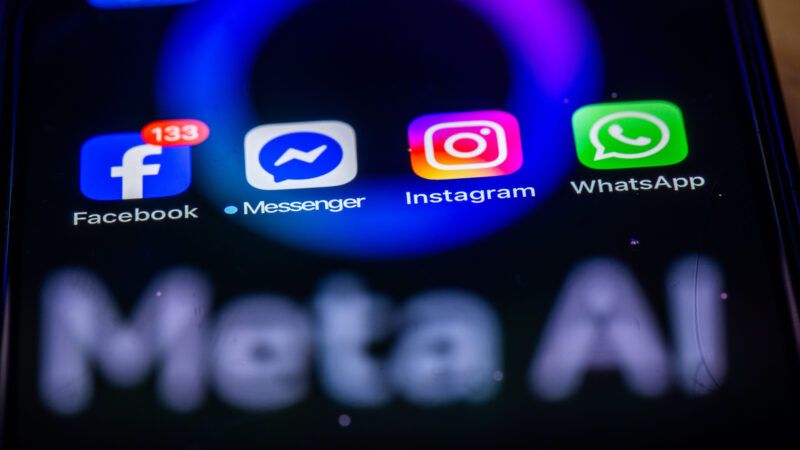
Social media conglomerate Meta faces a $375 million penalty after a New Mexico jury decided that the company could be held liable for not doing enough to protect children from sexually explicit content.
That decision came at the end of a landmark seven-week trial that tested a legal cornerstone of the internet age: Can platforms be punished for content and speech created by users? The jury in New Mexico said that Meta—the parent company of Facebook, Instagram, and the WhatsApp messaging service—had violated a state law banning deceiving or misleading business acts.
The Reason Roundup Newsletter by Liz Wolfe Liz and Reason help you make sense of the day's news every morning.
"The jury's verdict is a historic victory for every child and family who has paid the price for Meta's choice to put profits over kids' safety," New Mexico Attorney General Raúl Torrez said in a statement. "Meta executives knew their products harmed children, disregarded warnings from their own employees, and lied to the public about what they knew."
A spokesperson for Meta told CNBC that the company will appeal the verdict: "We work hard to keep people safe on our platforms and are clear about the challenges of identifying and removing bad actors or harmful content."
The New Mexico decision is the first major court ruling that holds Meta liable for how its products have been used, but it may not be alone for very long. A jury in Los Angeles is currently deliberating in a different lawsuit that accuses Meta and YouTube of harming mental health by causing "social media addiction," The New York Times reports.
As usual, what starts with an effort to protect the children rarely stops there. There has been a cultural backlash to social media building for quite some time, but the crossover from moral panic to jury trials with nine-figure penalties is a significant one—and probably not a positive signal for the future of free speech on the internet.
Mission accomplished. (Again. Maybe?) President Donald Trump once again declared victory in the war against Iran, even as more American troops and military assets are flowing toward the Middle East.
Trump's press conference on Tuesday evening was pretty chaotic. He said Iran gave him a secret gift. He bragged about America accidentally shooting down American planes. He claimed the war had been won—then later claimed it wasn't really a war in the first place.
The handling of the Iran War is giving me flashbacks to the early days of the COVID-19 pandemic, when Trump would stand in front of a microphone every day and engage in a bunch of free association. This seems like a bad way to manage a crisis!
What is happening, it seems, is that the U.S. government sent Iran a list of demands for a ceasefire. The Iranian government reportedly responded with a very different list of demands. Both sides remain far apart, the Strait of Hormuz is still closed (except to countries that have cut deals with Iran), and tons of American marines and paratroopers are on their way to the region.
That doesn't sound like a war that's been won.
As far as I can tell from the various public reports circulating today, Trump's demands in any negotiations with Iran—no Iranian enrichment; cuts in Iran's ballistic missile arsenal; Iran ending support to proxies; Iran's main nuclear facilities eliminated—are essentially the…
— Daniel DePetris (@DanDePetris) March 25, 2026
How about one more slice of lemon pound cake? Greg Lukianoff, president of the Foundation for Individual Rights and Expression (FIRE), writes on Substack about what made the Afroman defamation trial such a fun time:
Part of what makes this story so satisfying is that it feels both current and gloriously old-fashioned. It has the spirit of Cohen v. California running through it: the old "Fuck the Draft" energy; the old American idea that when power wrongs you, you get to answer back in anger, mockery, profanity, and contempt. Not because those things are always pretty. Oftentimes they are not. Rather, it's because free people are not required to speak to authority in the tone of a worried assistant dean. They are allowed to tell power to go to hell.
And few things say "Go to hell" with quite the same style as turning a failed raid into a diss track about lemon pound cake.
As Lukianoff writes, there is a long, proud tradition of American musicians telling the authorities where to stick it, from Woody Guthrie through Public Enemy.
Scenes from Washington, D.C.: The D.C. Streetcar will stop running later this month, a decade after it first started trundling along a short stretch of H Street. Reason's Christian Britschgi looks back at the silly, wasteful public transit project:
As someone whose decade of living in D.C. has run concurrently with the streetcar's life, I can say that I can only remember riding it one time. The last time I considered using it to travel from one end of H Street to the other—the only trip the streetcar can perform—it was faster to just walk.
Given that even the most rosy-eyed transit enthusiasts have become D.C. Streetcar critics, bemoaning its failures as a mode of transportation feels a bit like beating a dead horse, with the only real difference being that the dead horse will probably get you to your destination faster.
QUICK HITS
- President Trump's approval rating on the economy is in freefall.
- The number of U.S. households worth over $50 million has reached an all-time high.
- An extended war in Iran would "be something more akin to Gallipoli than Vietnam." Yikes.
- The war in Iran might make beer more expensive, as major brewers are warning about disruptions in supply chains for bottles, cans, and packaging.
- Lawmakers in California proposed a new license for interior designers, because poorly designed homes are an obvious threat to public health and safety.
- Former Minnesota Gov. Jesse "The Body" Ventura says Barron Trump should enlist in the military—and, frankly, it's tough to find fault with this logic:
Jesse Ventura: "There's a simple thing as a leader, and you know this having been in the military, Trump wouldn't know it because he's a draft dodging coward. A war is justified if you're willing to send your kids. So I'm calling right now for Barron Trump, enlist in the US… pic.twitter.com/o21SBZsP1y
— Marco Foster (@MarcoFoster_) March 24, 2026




