

Department of Homeland Security
Markwayne Mullin's History of Condoning Murder and Resisting Transparency Makes Him Ill-Suited To Run DHS
The Oklahoma senator, nominated to replace Kristi Noem, is blasé about the use of deadly force.
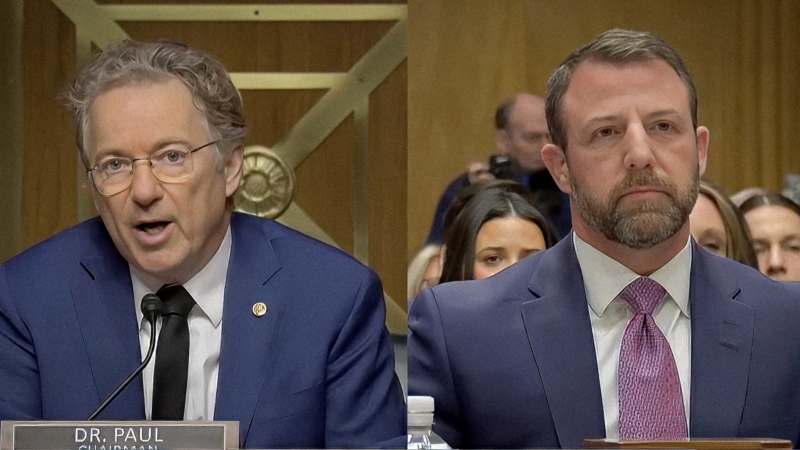
Sen. Markwayne Mullin (R–Okla.), President Donald Trump's nominee to replace Kristi Noem as secretary of homeland security, appeared before the Senate Committee on Homeland Security and Governmental Affairs today as part of the confirmation process. Inconveniently for Mullin, the chairman of that committee is Sen. Rand Paul (R–Ky.), who has a grudge against him because of comments that Mullin recently made about Paul.
While answering questions from voters at the McGrath Breakfast Group in Tulsa last month, Mullin called Paul "a freaking snake," adding that "I understand completely why" Paul's neighbor in Bowling Green, Rene Boucher, assaulted him in November 2017. That attack, which left Paul with six broken ribs and a damaged lung, resulted in a federal charge against Boucher, who was sentenced to 30 days in jail and a $10,000 fine for assaulting a member of Congress.
Paul opened Mullin's confirmation hearing by castigating the nominee for implicitly condoning violence against a Senate colleague, which he said cast doubt on whether Mullin has the right temperament to "lead an agency that has struggled to accept limits to the proper use of force." Paul also noted that Mullin had threatened International Brotherhood of Teamsters President Sean O'Brien with violence during a 2023 Senate hearing. Paul asked Mullin if he could "explain to the American public why they should trust a man with anger issues to set the proper example for ICE [Immigration and Customs Enforcement] and Border Patrol agents."
If Mullin's hotheadedness raises questions about his suitability for this job, so do things he has calmly said with ample opportunity for reflection. Mullin is an enthusiastic supporter of Trump's murderous military campaign against suspected cocaine smugglers, and his defense of that policy makes you wonder whether he recognizes legal and moral constraints on the use of deadly force.
"I have zero problems with sending them to the bottom of the ocean," Mullin told reporters in December, referring to men on suspected drug boats in the Caribbean and eastern Pacific, "and I hope they rot in hell for it because they know what they're doing when they get on that boat and they're trafficking the drugs to our streets." Unlike Paul, Mullin is completely unfazed by the fact that Trump is summarily executing criminal suspects without statutory authorization or any semblance of due process.
Mullin compared cocaine couriers to suspected terrorists killed by drones during the Obama administration. In light of that precedent, he said, it was "ridiculous" to worry about whether Trump was justified in killing people, from a distance and in cold blood, based on nothing more than suspected violations of U.S. drug laws. "These are drug terrorist organizations," he said. "The same people that Obama went after."
You may wonder in what sense people who make money by supplying Americans with the cocaine they want are equivalent to terrorists bent on murdering people for religious or ideological reasons. It is an important question, but not one that Mullin has given much thought.
"These are terrorist organizations that are poisoning our streets," Mullin said. "They killed more people in 2024 on our streets than we lost in an entire Vietnam war." Even if you accept the dubious equation between drug-related deaths and wartime casualties, Mullin's numbers are wrong. In 2024, the Centers for Disease Control and Prevention counted about 22,000 fatalities involving cocaine consumers. Nearly three times as many American soldiers were killed in the Vietnam War.
More to the point, supplying people with drugs they voluntarily consume is not morally or legally equivalent to shooting them dead. If it were, alcohol suppliers, who distribute a drug implicated in about 178,000 U.S. deaths each year, would be guilty of murder.
Anyone on a boat believed to be carrying cocaine deserves to die, Mullin thinks, because drug traffickers are "poisoning our streets." By the same logic, police officers would be justified in summarily executing suspected drug dealers rather than arresting and charging them. But under U.S. law, those police officers would be guilty of murder, and the same is true when U.S. military personnel deliberately kill suspected cocaine smugglers who pose no imminent threat instead of intercepting and arresting them.
Mullin emphasized that the men whose deaths Trump has ordered were suspected of working for drug cartels that the State Department has designated as "foreign terrorist organizations" (FTOs). But that designation, which authorizes the Treasury Department to block transactions involving a listed group's assets and triggers criminal penalties for providing it with "material support or resources," is not a license to kill anyone who the government thinks is associated with an FTO. If it were, there would be no constraints at all on the government's use of deadly force, since the only requirements would be the unilateral listing of an FTO and a bare assertion that a particular target was linked to it.
The fact that Mullin is completely untroubled by such a situation seems relevant in assessing his qualifications to run the Department of Homeland Security (DHS), which employs about 80,000 armed law enforcement officers. So does his reaction when Defense Secretary Pete Hegseth decided to keep footage of a particularly controversial attack on a suspected drug boat under wraps.
That September 2 operation, which inaugurated Trump's deadly anti-drug campaign, drew congressional scrutiny because it included a follow-up missile strike that killed two survivors of the initial attack as they clung to the smoking wreckage. Mullin not only had no problem with killing helpless men who were struggling to avoid drowning; he did not think the public had a legitimate interest in seeing a video showing what happened. Given the "sensitivity" of "the assets used," he suggested, releasing the video could compromise national security.
Was that a legitimate concern? If so, might it have been addressed by editing the video to excise sensitive information? Mullin, who was sure there was nothing wrong with the operation even though he himself had not seen the video, was not interested in asking such questions. It was a classification issue, he said, and "if you don't like the classification, talk to the White House."
Mullin's history of condoning murder and resisting transparency is especially salient in light of recent DHS violence. In January, DHS employees fatally shot two Minneapolis protesters whom Noem and other federal officials described as "domestic terrorists." The initial DHS accounts of those shootings were immediately contradicted by video evidence, which suggested that neither Renee Good nor Alex Pretti posed the sort of imminent threat that would justify the use of deadly force. But according to Mullin, the government is free to kill anyone it views as a terrorist, based on nothing more than allegations that may prove to be completely unfounded.
Paul was alluding to those incidents, along with other troubling examples of DHS violence, when he noted that the department "has struggled to accept limits to the proper use of force." Given Mullin's blasé approval of deadly violence in situations where it is not morally or legally justified, he may not be the right person to correct that problem.




