

In Tariffs Dissent, Clarence Thomas Embraced a Dangerous Theory of Executive Power
The conservative justice’s regrettable opinion in Learning Resources v. Trump.
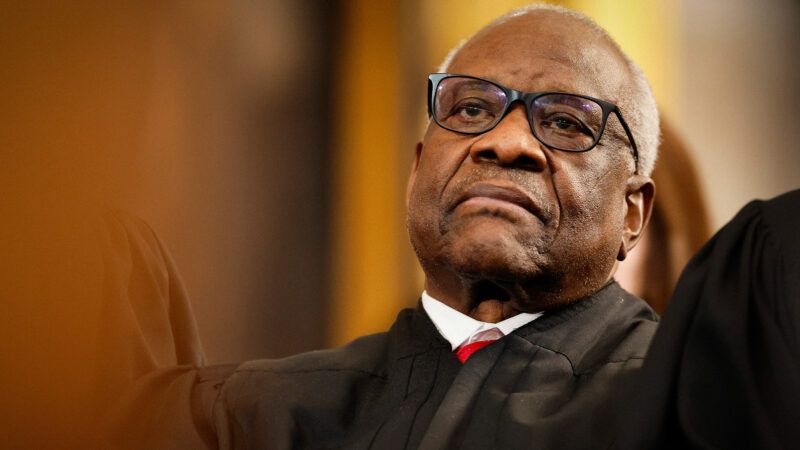
When the U.S. Supreme Court heard oral arguments in Learning Resources v. Trump, Justice Neil Gorsuch highlighted a particularly troubling aspect of President Donald Trump's case for unilateral tariff-making power. Under the administration's legal theory, Gorsuch asked Solicitor General John Sauer, "what would prohibit Congress from just abdicating all responsibility to regulate foreign commerce, for that matter, declare war, to the president?"
Thankfully, Trump lost. But one of the three justices who supported Trump in dissent declared himself perfectly content with the dangerous idea that Congress could entirely surrender constitutionally granted powers to the president.
You’re reading Injustice System from Damon Root and Reason. Get more of Damon’s commentary on constitutional law and American history.
As he has often done before, Justice Clarence Thomas penned a solo dissent in Learning Resources v. Trump that staked out a legal position far beyond anything embraced by his other colleagues. In the tariffs case, that far-out position was the argument that Congress "has many powers that are not subject to the nondelegation doctrine."
The nondelegation doctrine says that Congress may delegate its legislative authority to the president only under certain limited circumstances. Those limits are there to enforce the constitutional separation of powers.
Thomas would eliminate many of those limits. In his view, the nondelegation doctrine simply should not apply when a case involves what he characterizes as a non-core legislative power. What is a non-core legislative power? Thomas offered a few examples, including "the powers to raise and support armies" and "to regulate foreign commerce." According to Thomas, because these powers originally descended from the kingly authority of the British crown, it is entirely proper for Congress to surrender them without limit to the executive branch.
One problem with this argument is that it runs counter to the text of the Constitution. Article I, Section 1, says that "all legislative Powers herein granted shall be vested in a Congress of the United States." Article I, Section 8, then lists the various "legislative Powers herein granted"; that list includes the powers "to raise and support armies" and "regulate Commerce with foreign Nations." As Justice Gorsuch pointed out in his Learning Resources concurrence, there is nothing in Article I that "speaks of some divide between true legislative powers" and "'other kinds of power[s]' that may be given away and possibly lost forever to the President."
Similarly, Thomas asserted that "the power to regulate external affairs" is not a "core legislative power" and therefore should not be subjected to the limits imposed by the nondelegation doctrine. Yet Article I, Section 8, contains several "legislative Powers herein granted" that clearly involve the regulation of external (meaning, foreign) affairs, such as the aforementioned authority to "regulate Commerce with foreign Nations" as well as the authority "to declare War, grant letters of Marque and Reprisal, and make Rules concerning Captures on Land and Water."
Let's assume, for the sake of argument, that the various legislative powers that Thomas wants to exempt from the nondelegation doctrine did descend from kingly sources and thus possess a kind of executive pedigree. So what? The framers of the Constitution still placed them in Article I, which is where the legislative power is vested in our system. What the framers specifically did not do was to place such powers in Article II, which is where the president's limited and enumerated powers are spelled out. There are, after all, supposed to be some differences between the authority of a British monarch and the authority of a U.S. president.
This is all pretty disappointing stuff from Thomas. Perhaps the one good thing to be said about his dissent is that its attempted end run around the separation of powers failed to attract any other votes.

Editor's Note: As of February 29, 2024, commenting privileges on reason.com posts are limited to Reason Plus subscribers. Past commenters are grandfathered in for a temporary period. Subscribe here to preserve your ability to comment. Your Reason Plus subscription also gives you an ad-free version of reason.com, along with full access to the digital edition and archives of Reason magazine. We request that comments be civil and on-topic. We do not moderate or assume any responsibility for comments, which are owned by the readers who post them. Comments do not represent the views of reason.com or Reason Foundation. We reserve the right to delete any comment and ban commenters for any reason at any time. Comments may only be edited within 5 minutes of posting. Report abuses.
Please to post comments
Learning Resources v. Trump.
What about Learing Center vs America?
No he didnt Damon.
I get you are a failed lawyer who pushes the leftist view of the constitution, but this take is just wild.
Thomas went deep into the history of delegation and separation of powers from the start of the nation. It was well cited, well defended.
The reason you hate his dissent is he didnt argue from ignorance or feels unlike all your hot legal takes.
What most of the ignorant leftist lawyers dont get is the laws allowed congress to vote against executive determination. They chose not to. They had power they didnt utilize. You ignore this.
You also ignore congress can take back their power.
Youre not arguing for separation of powers. Youre arguing that congress didnt do what you wanted while you stomped your feet.
It would be very difficult for Congress to take back what they delegated to the president because the president can veto it. I don't like the NDD and it was just made up by SCOTUS. But the difficulty of Congress getting back power is an argument for a much stronger NDD.
Congress can take it back by overriding the veto retard. They can also vote against every determination retard.
I'm genuinely interested in what an intelligent guy like yourself likes about Trump's tariff powers.
Do you see benefits for the US economy? Benefits for Trump's ability to muscle other countries? Little of both? Something I'm missing?
I manage risk for a living so no one being able to plan for shit has been profitable, but my poor friends stuck in physical industry are getting dizzy as all hell.
Ive been making the same arguments since Obama. I dont think youre actually interested because you've shown zero interest ind debate or intelligent argumentation.
The fact is what you think of as free trade is not. Unilateral trade is advantaged trade. Simple scenario for your simple mind.
There are 2 corporations. They produce the same widgets. Government regulates/taxes only on corporation B. What is the market effect of this? Corporations A is advantaged, can sell cheaper and can even sell just ubder the costs of corporations B for excess profits.
This is advantaged trade. That's all unilateral trade is. And that's not even including regulatory delta.
That's what you and globalists argue for.
And it is funny you claim you manage risk. I work with supply chain all the god damn time. If you actually managed risk you would know that accounting principles book keep supply chain disruption as a risk.
We saw under covid this risk realized when global shipping went down and china even ordered back already purchased supplies to their mainland. So forgive me if I dont think you actually manage risk because you would have seen the issue just 6 years ago.
Now. If you are truly curious about things I can do as I did for sarc and link you to game theory adoption into trade, economic algorithmic competitions where tit for tat is the optimal strategy in large trading scenarios, etc. I just dont think you are curious because you fail to recognize the actual system the last few decades was pushing advantaged and managed trade, not free trade. It was sub optimal.
Even is Thomas prevailed, and the court ruled that Congress could delegate that power, Thomas would still be stuck with the losing argument that Congress did delegate that power and that Trump used it correctly.
Even Roberts agreed and wrote congress could delegate the power retard. Just not under IEEPA.
When Biden increased terrifs did anyone at reason raise this much of a stink? No?
Okay reason I get it orange man bad.
Damon Root has hit a new low in personal partisanship. Not even a hint of objective analysis. The plain fact of the matter is that laws mean only what judges say they mean, that they have no clear objective meaning, and pretending the Rule of Law says otherwise is gaslighting.
Go back to one of my favorite examples of amending the constitution in the government's favor by reinterpretation in lieu of Article III: the Open Fields Doctrine. The Supreme Court made it up in 1924 (Hester v. United States), ruling that fields around a house are not listed in the Fourth Amendment ("persons, houses, papers, and effects"), and so not protected. Hester didn't just stretch its reinterpretation of the Constitution; it was out and out fraud (https://reason.com/2025/12/31/if-you-give-a-bear-a-badge-will-it-respect-your-rights/), taking a third-party quote out of context. Police have trespassed to set up cameras in hunting areas, with the courts' blessings, including convicting property owners who disabled or removed the cameras. That link goes to a case where the state was convinced a family owning 112 acres of woodlands was illegally feeding bears, so they strapped a camera to a bear to get evidence. Anyone but a government agent would think that requires a warrant signed by a judge ... but not judges.
And Hester's loophole took 133 years to discover after the Fourth Amendment was ratified! The Rule of Law is a myth when judges can change laws' meanings 133 years after the fact.


