

A Federal Judge Explains Why Trump Can't Jail Legislators for Producing a Video That Offended Him
U.S. District Judge Richard Leon notes that Sen. Mark Kelly's comments about unlawful military orders were "unquestionably protected" by the First Amendment.
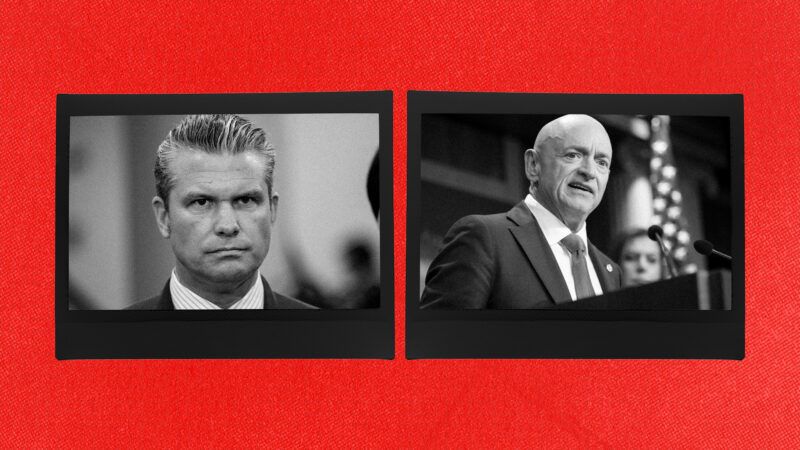
When Sen. Mark Kelly (D–Ariz.) reminded U.S. military personnel that they "can refuse illegal orders," a federal judge in Washington, D.C., ruled on Thursday, his speech was "unquestionably protected" by the First Amendment. U.S. District Judge Richard J. Leon, a George W. Bush appointee, granted Kelly's request for a preliminary injunction that temporarily bars Defense Secretary Pete Hegseth from pursuing penalties against the senator, a retired Navy captain, based on public comments that Hegseth deemed "prejudicial to good order and discipline in the armed forces."
Leon concluded that Kelly, who in November joined five other Democratic members of Congress in producing a video about the duty to disobey unlawful military orders, was likely to prevail in his claim that Hegseth had retaliated against him for his constitutionally protected speech. The video irked President Donald Trump, who said the six legislators "should be ARRESTED AND PUT ON TRIAL." Although the Justice Department has tried to deliver on that threat, a federal grand jury this week rejected a proposed indictment. Leon's opinion explains why any such prosecution would be blatantly unconstitutional.
All of the lawmakers whom Hegseth dubbed "the Seditious Six" had served in the armed forces or intelligence agencies. But Kelly was the only one who had retired with a pension, making him potentially subject to discipline under the Uniform Code of Military Justice. On January 5, Hegseth issued a letter of censure against Kelly, saying he had "engaged in a sustained pattern of public statements that characterized lawful military operations as illegal and counseled members of the Armed Forces to refuse orders related to those operations."
Kelly's statements, Hegseth said, constituted "conduct prejudicial to good order and discipline in the armed forces and conduct unbecoming an officer." The evidence, he said, was sufficient to "reopen the determination of your retired grade," a process that could reduce Kelly's rank and pension. Hegseth warned Kelly that "you may subject yourself to criminal prosecution or further administrative action" if "you continue to engage in conduct prejudicial to good order and discipline."
In addition to the video, which reiterated the well-established principle that service members "have a duty to disobey" orders that are "manifestly illegal," the letter cited several other statements that irritated Hegseth. On November 21 and November 23, Hegseth complained, "you criticized military leadership for 'firing admirals and generals' and surrounding themselves with 'yes men,' asserting you would 'ALWAYS defend the Constitution.'" A couple of days later, "you stated that intimidation would not work and called your advice to refuse orders 'non-controversial.'"
The following month, Hegseth wrote, "you continued to accuse me and senior military officers of war crimes and to frame resistance to lawful orders as protecting against overreach." In particular, Kelly criticized Trump's murderous military campaign against suspected drug boats, which became freshly controversial in late November and early December after it was revealed that the inaugural attack on September 2 included a follow-up missile strike that obliterated two survivors as they clung to the smoldering wreckage.
During a November 30 interview on CNN, Kelly was asked whether "a second strike to eliminate any survivors" would constitute "a war crime"—specifically, a violation of the rule against attacking shipwrecked sailors. "It seems to," Kelly said. "I have got serious concerns about anybody in that chain of command stepping over a line that they should never step over." He added that he would have refused to follow such an order.
Commentary on such matters is exactly what you would expect from a member of the Senate Armed Services Committee. Yet according to Hegseth, it was an offense justifying "administrative action" and possibly "criminal prosecution." To justify that take, he argued that Kelly was still subject to military discipline, including speech restrictions that would be unconstitutional if they were applied to civilians.
"Secretary Hegseth relies on the well-established doctrine that military servicemembers enjoy less vigorous First Amendment protections given the fundamental obligation for obedience and discipline in the armed forces," Leon writes. "Unfortunately for Secretary Hegseth, no court has ever extended those principles to retired servicemembers, much less a retired servicemember serving in Congress and exercising oversight responsibility over the military. This Court will not be the first to do so!"
That point was crucial because the government offered no other justification for punishing Kelly. "Under ordinary First Amendment principles, the speech at issue here is unquestionably protected speech," Leon notes. "Speech 'on matters of public concern' lies at the core of First Amendment protection. This broad category includes speech on 'any matter of political, social, or other concern to the community' or any 'subject of general interest and of value and concern to the public.' It includes 'opposition to national foreign policy,' and even 'vehement, caustic, and…unpleasantly sharp attacks on government and public officials.'"
Hegseth's letter "identifies a 'sustained pattern of public statements' including, primarily, the November 18 video in which Senator Kelly stated that members of the armed forces 'can refuse illegal orders,'" Leon writes. "It also identifies the Senator's statements characterizing certain military orders as 'unlawful' and criticizing military leadership. Under any reading of the law, Senator Kelly's statements constitute 'speech on matters of public concern' and are therefore 'entitled to special protection.'"
The defendants "rest their entire First Amendment defense on the argument that the more limited First Amendment protection for active-duty members of the military extends to a retired naval captain," Leon says. But he notes that the operational concerns underlying special speech restrictions for active-duty service members, which the Supreme Court upheld in the 1974 case Parker v. Levy, do not apply to retirees.
"As applied to a sitting Member of Congress, the Parker rule has even less force!" Leon adds. Representative government, after all, requires legislators to take controversial positions on public policy issues, and Kelly's job also involves oversight of Hegseth and other Pentagon officials. "Between the lack of precedent extending Parker outside the
context of active-duty military and the heightened free speech protection for legislators," Leon says, "Senator Kelly's speech must receive full First Amendment protection."
If so, any attempt to prosecute Kelly for that speech would be unconstitutional, and the same goes for the other legislators who participated in the video that offended Trump and Hegseth. Jeanine Pirro, the Trump-appointed U.S. attorney for the District of Columbia, nevertheless argued that Kelly and the others had committed a federal felony by reiterating a principle that Kelly accurately described as legally uncontroversial.
The grand jury did not buy it. Neither should any American who cares about freedom of speech.




