

Don Lemon's Arrest Looks Like an Assault on Freedom of the Press
A federal indictment accuses him and another journalist of conspiring with protesters who disrupted a St. Paul church service.
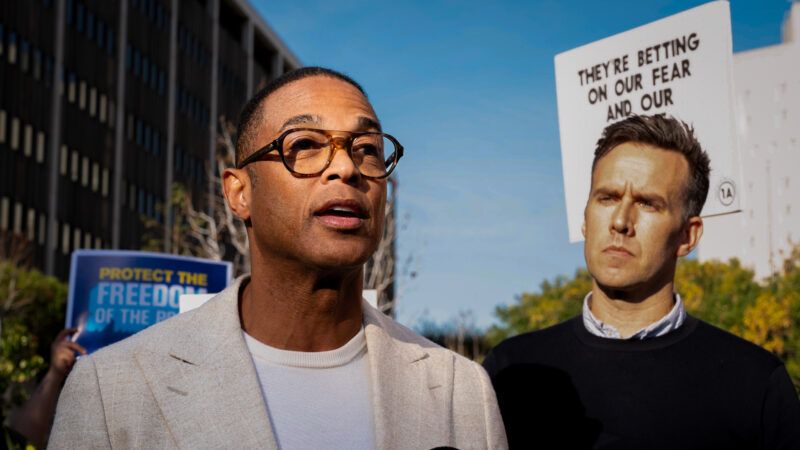
Don Lemon and Georgia Fort, two journalists who covered a protest that disrupted services at a St. Paul church on January 18, were arrested last week on federal charges punishable by up to a decade in prison. While the protest itself entailed trespassing coupled with disorderly conduct, the attempt to treat reporting on the event as a federal felony looks like a thinly veiled assault on freedom of the press.
Opponents of the Immigration and Customs Enforcement (ICE) crackdown in Minnesota targeted Cities Church because one of its pastors, David Easterwood, directs enforcement and removal operations at ICE's field office in St. Paul. Was that a good reason to interrupt a service at his church and self-righteously harangue the congregants, to the point that many of them fled?
No, it was not. Even if Easterwood had been there, the demonstration would have been misguided, misdirected, obnoxious, morally objectionable, and plainly illegal, especially after the protesters were asked to leave and refused to do so. But that does not mean Lemon and Fort should be held criminally liable for the conduct of the people they were covering.
Lemon, a former CNN anchor and longtime critic of President Donald Trump who hosts a YouTube show, and Fort, a local reporter who runs a livestreaming news outlet, covered an organizational meeting that preceded the protest, agreed not to divulge the protest's location ahead of time, and recorded the event itself. According to a federal indictment filed last Thursday, those actions made them "co-conspirators."
Lemon and Fort allegedly conspired with the protest's organizers to "injure, oppress, threaten, or intimidate" the Cities Church worshipers "in the free exercise or enjoyment" of their religious freedom—a crime that carries a maximum penalty of 10 years in prison. The evidence supporting that charge seems skimpy.
At one point, the indictment says, Lemon and Fort "approached the pastor" running the service, Jonathan Parnell, and "largely surrounded him." They "stood in close proximity to the pastor," allegedly "in an attempt to oppress and intimidate him," and "physically obstructed his freedom of movement" while Lemon "peppered him with questions to promote the operation's message."
That is one way to describe Lemon's interaction with Parnell. Here is another way: Lemon interviewed the pastor about his response to the protest.
Lemon's questions were clearly sympathetic to the protesters. But the interview looks a lot more like journalism, however biased, than a conspiracy to violate someone's constitutional rights.
The indictment says Fort "stood in front" of "a minivan full of children" outside the church while interviewing a protest organizer. Although Fort's behavior may have been inconsiderate, that interview likewise does not easily fit within the statute that the Justice Department is invoking.
The indictment also charges Lemon and Fort with violating a federal law that applies to someone who, "by force or threat of force or by physical obstruction, intentionally injures, intimidates, or interferes with" a person exercising his religious freedom at a place of worship. Again, that description does not seem consistent with their conduct or their avowed intent.
Those difficulties help explain why a federal magistrate judge who approved arrest warrants for three protesters declined to approve warrants for Lemon and Fort. When federal prosecutors asked Patrick Schiltz, a George W. Bush appointee who serves as chief judge of the U.S. District Court in Minnesota, to override that decision, he saw "no evidence" that the journalists at the scene "engaged in any criminal behavior or conspired to do so."
You can fault Lemon for implicitly condoning this protest, which he acknowledged was intended to be "traumatic and uncomfortable," and for erroneously suggesting that it was protected by the First Amendment. But those misjudgments are not the same as actively participating in what the indictment calls "a coordinated takeover-style attack" on the church.
If the evidence is not driving the case against Lemon, what is? The White House's gloating take on his arrest suggests his real offense was political.
© Copyright 2026 by Creators Syndicate Inc.




