

A 'Reformist' Legal Expert Calls for a Surveillance State
A lawyer who should know better wants to ignore the history of snooping cops to fight guns and crime.
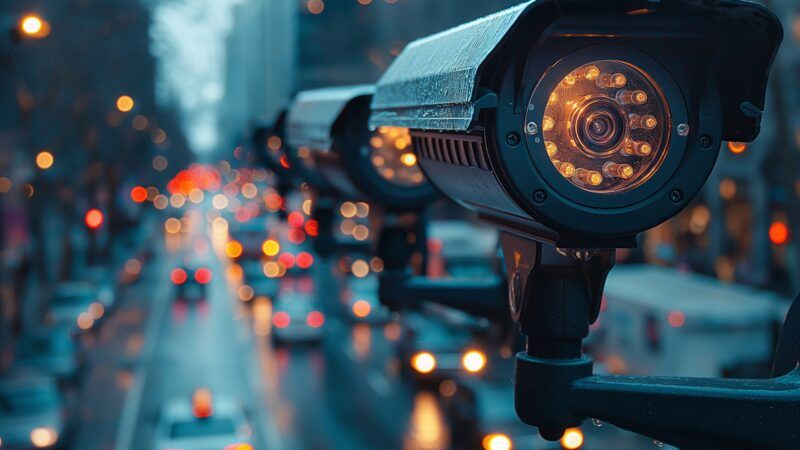
Principled advocacy of liberty is hard, we get it. Many of us find something so offensive or irksome that all live-and-let-live sentiments evaporate. For former criminal defense attorney Dana Bazelon, now policy director for reformist Philadelphia District Attorney Larry Krasner and lecturer at the University of Pennsylvania Carey Law School, that issue is guns and the violence she attributes to them. She's discarded concerns about government abuses to endorse a wide-reaching surveillance state.
You are reading The Rattler from J.D. Tuccille and Reason. Get more of J.D.'s commentary on government overreach and threats to everyday liberty.
"If the idea of more police cameras makes you queasy, I understand: I spent the first decade of my career as a criminal defense and civil rights lawyer and during that time, I would have treated a plan for more police-controlled cameras with suspicion and skepticism," Bazelon wrote last week for Slate. "But acting as the policy director for progressive prosecutor and Philadelphia DA Larry Krasner for six years changed my perspective. I saw, firsthand, the cost of unsolved shootings in Philadelphia, the misery of unwilling witnesses brought to court in handcuffs, and the way witnesses could emerge from trials feeling abused and angry."
Bazelon acknowledges that civil liberties groups are adamantly opposed to intrusive surveillance because of the implications for privacy and free expression. Surveillance is often brought in as an "emergency" measure that just never goes away as government officials find ever-more interesting ways to process the data they gather on their suffering subjects in ways that inevitably curtail liberty.
The Surveillance State's Frightening Record
The Foundation for Individual Rights and Expression (FIRE) cautions that "mass surveillance and censorship justified by war became useful tools for more general surveillance." In the past, as now, FIRE notes, "the issues that drove the push for mass surveillance and censorship at scale was national security and fears of extremism, disinformation and propaganda."
The Electronic Frontier Foundation is so worried about the growing ease and declining cost of implementing mass surveillance that it maintains a Street Level Surveillance Hub about various snoopy technologies used by police and an Atlas of Surveillance so that travelers know which of those technologies are used at different locations along their journeys. People can turn to those tools to avoid snooping or, perhaps, take more direct action to neutralize the intrusions.
The reasons to object to mass surveillance are many, frightening, and historically well-documented. In the 1970s, the U.S. Senate's Church Committee found the FBI "has placed more emphasis on domestic dissent than on organized crime." More recently, the New York City Police Department was found to be monitoring and tracking mosque congregants. Federal and local law enforcement frequently purchase tracking data from third-party brokers, who gather GPS information produced by phone apps.
Bazelon concedes that point, writing, "Americans have a well-earned fear of government surveillance: Our history is rife with stories of law enforcement overreach, from J. Edgar Hoover's FBI to National Security Agency abuses uncovered by Edward Snowden."
But guns.
When Fear Trumps the Historical Record
"Those potential harms should be weighed against the suffering of neighborhoods where shootings routinely go unsolved, against the risk and trauma that witnesses who testify take on, and against the flaws inherent in building criminal prosecutions around eyewitness testimony, which research has shown can be unreliable," she insists.
As a result, she believes, "more street cameras are not a panacea, but they can help, and they have some advantages over human witnesses." She points out that cameras are more reliable than eyewitnesses at identifying suspects, they don't hold grudges and deliberately misidentify people, and recorded images remain clear while memories fade.
But there's not a prosecutor in the country who couldn't complain about the difficulty of prosecuting cases. Catching and punishing those who break the law is difficult because of evidentiary requirements, unreliable witnesses, neighbors resistant to cooperating with police, and other challenges, no matter what crimes are involved. Citing local complaints about drugs, break-ins, sex work, car theft, violent crime, or activities undertaken without a permit, plenty of jurisdictions would love to implement surveillance cameras, facial recognition, license-plate readers, gunshot detection, and more. As Charlton Heston's Miguel Vargas observes in A Touch of Evil, "A policeman's job is only easy in a police state."
Bazelon allows that we're entitled to privacy in our homes and businesses, but argues "we have no right to privacy in public spaces." Police cameras in public places "are different because they do not target a specific person: They capture everyone and everything, the electronic equivalent of an observant police officer stationed on every block."
That chorus you hear in the background is the sound of thousands of cops and prosecutors chanting "gimme gimme gimme." Such total surveillance would undoubtedly make the job of law enforcement much easier—all laws, good and bad, by enforcers subject to the very human temptation to abuse power. And then we would all live in panopticon Hell.
You Can Have Liberty or a Surveillance State
Liberty, it should be emphasized, involves tradeoffs. Some people will inevitably abuse their freedom, take advantage of the absence of Big Brother-ish monitoring, and do harm to their neighbors. But we recognize that liberty is a matter of right, and that its abuse by some doesn't justify oppressing or surveilling the entire world. Solutions to problems caused by some must respect the rights of others.
What's interesting is that Bazelon knows the dangers of the law and of excessive enforcement. She was arrested in 2020 for briefly leaving her daughter unattended in her car (a common practice when I was young). She oversees the D.A.'s Alternative Felony Disposition program, which helps those arrested for nothing other than carrying a gun without a license (perfectly legal in many states, a misdemeanor in most of Pennsylvania, but a felony in Philadelphia) avoid prison time.
Nevertheless, she wants the unblinking eye of police surveillance monitoring the streets to decide when officers should be dispatched to jack-up people's lives? Why?
Too many of us discover that our support for liberty ends when something really bothers us. For Dana Bazelon, that means she'd implement a surveillance state to try to reduce violence in Philadelphia.




