

Reason.com - Free Minds and Free Markets
Reason logo Reason logo
  • Latest
  • Magazine
    • Current Issue
    • Archives
    • Subscribe
    • Crossword
  • Video
    • Reason TV
    • The Reason Roundtable
    • Just Asking Questions
    • Free Media
    • The Reason Interview
  • Podcasts
    • All Shows
    • The Reason Roundtable
    • The Reason Interview With Nick Gillespie
    • The Soho Forum Debates
    • Just Asking Questions
  • Volokh
  • Newsletters
  • Donate
    • Donate Online
    • Donate Crypto
    • Ways To Give To Reason Foundation
    • Torchbearer Society
    • Planned Giving
  • Subscribe
    • Reason Plus Subscription
    • Gift Subscriptions
    • Print Subscription
    • Subscriber Support

Login Form

Create new account
Forgot password

Technology

Google's Brief to the Supreme Court Explains Why We Need Section 230

There's a good reason why algorithms are still protected by Section 230.
David McGarry | 1.13.2023 5:00 PM

Share on FacebookShare on XShare on RedditShare by emailPrint friendly versionCopy page URL Add Reason to Google
Media Contact & Reprint Requests
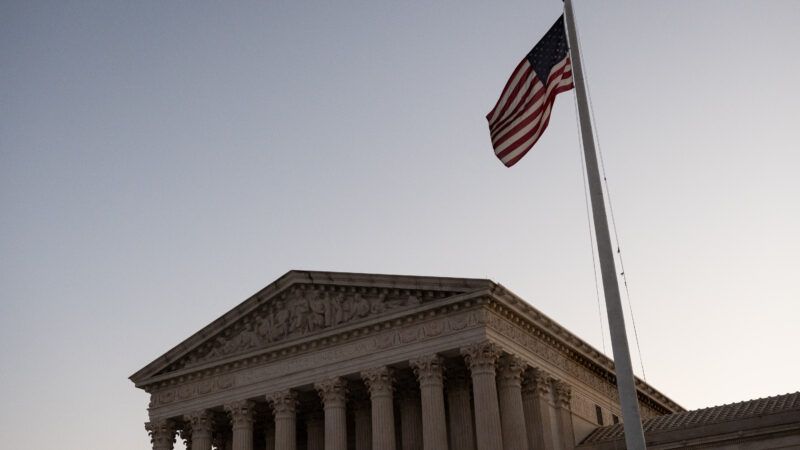
The Supreme Court of the United States |  Graeme Sloan/Sipa USA/Newscom
( Graeme Sloan/Sipa USA/Newscom)

Next month, the Supreme Court will hear Gonzalez v. Google. This lawsuit seeks to strip Google of its protections from civil liability for third-party content under Section 230 of the Communications Decency Act.

The plaintiff is Reynaldo Gonzalez, whose daughter was murdered in a 2015 terrorist attack. Gonzalez argues that YouTube, a Google subsidiary, should face liability because its algorithms recommended terrorist content posted on the platform that Gonzalez says aided the Islamic State. The case asks whether Section 230 applies to content recommended by YouTube's algorithms. Defending itself, the law, and the utility of algorithms online, Google on Thursday submitted a brief to the Supreme Court. 

Gonzalez argues that YouTube's recommendation algorithms make YouTube, to some degree, a publisher of third-party content and, thus, unprotected by Section 230. In its brief, Google rejoins that YouTube's recommendations fall squarely within the text and intent of the provision.

"If Section 230 does not apply to how YouTube organizes third-party videos, petitioners and the government have no coherent theory that would save search recommendations and other basic software tools that organize an otherwise unnavigable flood of websites, videos, comments, messages, product listings, files, and other information," Google wrote in its brief.

Virtually any online service that hosts third-party content uses algorithms to filter content to great effect, Google noted. Without algorithmic sorting, its own search engine would be an "unordered, spam-filled" mess. Further, if recommending content vaporizes a platform's Section 230 protections, the company argued, such platforms as Amazon, Lexis (which publishes law review articles), and TripAdvisor (which hosts business reviews) would be legally liable for all their user content as well. 

Both Democrats and Republicans would like to functionally repeal Section 230 in order to bring Big Tech under the thumb of Congress. In an op-ed in The Wall Street Journal, President Joe Biden on Wednesday advocated "fundamentally reform[ing] Section 230…which protects tech companies from legal responsibility for content posted on their sites." 

However, contrary to the implications of such aggrieved politicians as Biden and Sen. Josh Hawley (R–Mo.), by protecting platforms from liability, Section 230 also protects freedom of speech. Without Section 230, Google, Facebook, and numerous other platforms would have to severely restrict what they allow users to publish. A world in which Facebook could be held liable for user posts is one in which Facebook would not want users posting very much at all. Everything from restaurant reviews to criticism of government officials could be seen by platforms as too legally risky to host. 

"Unmeritorious quick removals are common in online copyright law, because the [user-generated content] copyright safe harbor is less favorable to defendants than Section 230 is," wrote Eric Goldman, a law professor at Santa Clara University. "In contrast, Internet services routinely stand up to noncopyright legal threats, legal demands, and cease-and-desist letters targeting UGC—because Section 230 provides them legal certainty at a relatively low cost."

Opponents of Section 230 misunderstand the workings and utility of algorithms and drastically underestimate the work it does to encourage free expression and debate. Without Section 230 protections, many platforms would be forced to either permit all content (to avoid any appearance of behaving like a publisher) or enforce draconian content-moderation policies to ensure no objectionable content can be used against them in court. In short, some platforms would become hateful, filthy hellscapes, and others might be too boring to retain users. 

Google's brief crystalized it best: "This Court should decline to adopt novel and untested theories that risk transforming today's internet into a forced choice between overly curated mainstream sites or fringe sites flooded with objectionable content."

Start your day with Reason. Get a daily brief of the most important stories and trends every weekday morning when you subscribe to Reason Roundup.

This field is for validation purposes and should be left unchanged.

NEXT: Phoenix Sued After Giving the NFL Power To Censor Signs on Private Property

David McGarry is a policy analyst at the Taxpayers Protection Alliance.

TechnologySection 230Free SpeechSupreme CourtSocial MediaGoogleAlgorithmsCivil LibertiesInternet
Share on FacebookShare on XShare on RedditShare by emailPrint friendly versionCopy page URL Add Reason to Google
Media Contact & Reprint Requests

Show Comments (132)

Latest

A Texas News Vlogger Asks SCOTUS To Decide Whether Criminalizing Journalism Is 'Obviously Unconstitutional'

Jacob Sullum | 12.17.2025 12:01 AM

Even Trump's Supporters Are Slamming His Post About Rob Reiner's Murder

Robby Soave | 12.16.2025 7:40 PM

Localism and the Limits of Regulating What We Love

Christian Britschgi | 12.16.2025 3:55 PM

The Federal Government Has Shed 271,000 Jobs This Year. That's Great.

Eric Boehm | 12.16.2025 3:10 PM

17 Ways Politicians Can Make Things Cheaper, Starting With Food, Health Care, and Appliances

Ryan Bourne | 12.16.2025 1:00 PM

Recommended

  • About
  • Browse Topics
  • Events
  • Staff
  • Jobs
  • Donate
  • Advertise
  • Subscribe
  • Contact
  • Media
  • Shop
  • Amazon
Reason Facebook@reason on XReason InstagramReason TikTokReason YoutubeApple PodcastsReason on FlipboardReason RSS Add Reason to Google

© 2025 Reason Foundation | Accessibility | Privacy Policy | Terms Of Use

This site is protected by reCAPTCHA and the Google Privacy Policy and Terms of Service apply.

r

I WANT FREE MINDS AND FREE MARKETS!

Help Reason push back with more of the fact-based reporting we do best. Your support means more reporters, more investigations, and more coverage.

Make a donation today! No thanks
r

I WANT TO FUND FREE MINDS AND FREE MARKETS

Every dollar I give helps to fund more journalists, more videos, and more amazing stories that celebrate liberty.

Yes! I want to put my money where your mouth is! Not interested
r

SUPPORT HONEST JOURNALISM

So much of the media tries telling you what to think. Support journalism that helps you to think for yourself.

I’ll donate to Reason right now! No thanks
r

PUSH BACK

Push back against misleading media lies and bad ideas. Support Reason’s journalism today.

My donation today will help Reason push back! Not today
r

HELP KEEP MEDIA FREE & FEARLESS

Back journalism committed to transparency, independence, and intellectual honesty.

Yes, I’ll donate to Reason today! No thanks
r

STAND FOR FREE MINDS

Support journalism that challenges central planning, big government overreach, and creeping socialism.

Yes, I’ll support Reason today! No thanks
r

PUSH BACK AGAINST SOCIALIST IDEAS

Support journalism that exposes bad economics, failed policies, and threats to open markets.

Yes, I’ll donate to Reason today! No thanks
r

FIGHT BAD IDEAS WITH FACTS

Back independent media that examines the real-world consequences of socialist policies.

Yes, I’ll donate to Reason today! No thanks
r

BAD ECONOMIC IDEAS ARE EVERYWHERE. LET’S FIGHT BACK.

Support journalism that challenges government overreach with rational analysis and clear reasoning.

Yes, I’ll donate to Reason today! No thanks
r

JOIN THE FIGHT FOR FREEDOM

Support journalism that challenges centralized power and defends individual liberty.

Yes, I’ll donate to Reason today! No thanks
r

BACK JOURNALISM THAT PUSHES BACK AGAINST SOCIALISM

Your support helps expose the real-world costs of socialist policy proposals—and highlight better alternatives.

Yes, I’ll donate to Reason today! No thanks
r

FIGHT BACK AGAINST BAD ECONOMICS.

Donate today to fuel reporting that exposes the real costs of heavy-handed government.

Yes, I’ll donate to Reason today! No thanks


