
10/21/1919: Abrams v. United States argued.

Mostly law professors | Sometimes contrarian | Often libertarian | Always independent | Est. 2002
10/21/1919: Abrams v. United States argued.
The ruling is based on badly flawed reasoning, and may well be overturned on appeal. Even if it isn't, the plaintiff states have an obvious way to get around it.

Earlier today, US District Judge Henry Autrey issued a decision dismissing a lawsuit filed by six states challenging the legality of President Biden's massive $400 billion loan forgiveness plan. The court dismissed the case based on the procedural doctrine of standing, which - among other things - requires plaintiffs to show the government policy they are challenging has caused them some sort of "injury." The standing ruling is based on very dubious reasoning, and I think it is highly likely to be overturned on appeal. Even if stands, the states have a pretty obvious way to get around it.
Standing is a genuine problem for efforts to challenge the loan forgiveness plan in court. But, like most other observers, I thought the state lawsuit could easily get over this hurdle because at least one of the plaintiff states - Missouri - has a state agency - the Missouri Higher Education Loan Authority (MOHELA) - that services student loans, including some that will be partially or fully forgiven by the Biden plan. The Biden loan forgiveness program will predictably reduce MOHELA's revenue from those loans, and even a small financial loss is enough to qualify for standing under Supreme Court precedent.
Importantly, Judge Autrey doesn't deny that MOHELA suffers an injury from the student loan program. Rather, he concludes that the state of Missouri lacks standing to sue on MOHELA's behalf:
Missouri…. fails to connect the alleged harms to MOHELA as harms to the State of Missouri, i.e., does Missouri establish it has standing to sue on MOHELA's behalf? Missouri maintains it can sue for MOHELA because MOHELA is a state entity that performs "essential public function[s]" that includes ensuring "post-secondary education students have access to student loans" and providing financial support to Missouri's public colleges and universities….
Missouri does impose some control over MOHELA, which is assigned by statute to its Department of Education, like authorization for the Governor to appoint five members of the seven-member board and requiring a yearly report on its income, expenditures, bonds, and other forms of indebtedness issued. Mo. Rev. Stat §§ 173.445, 173.360. However, when it was established, MOHELA's revenues and liabilities were specifically and completely independent of the State of Missouri. The enabling legislation stated in relevant part that "[t]he proceeds of all bonds or other forms of indebtedness issued by the authority and of all fees permitted to be charged by the authority and of other revenues derived shall not be considered part of the revenue of the state…shall not be required to be deposited into the state treasury, and shall not be subject to appropriation by the general assembly." Mo. Rev. Stat. § 173.425. The statute also states that "[t]he state shall not be liable in any event for the payment of the principal of or interest on any bonds of the authority or for the performance of any pledge, mortgage, obligation, or agreement of any kind whatsoever which may be undertaken by the authority." Mo. Rev. Stat § 173.410….
These provisions make clear that the legislature intended to create a self-sustaining and financially independent agency. The express financial separation of MOHELA established by Missouri law and the lack of any obligation for Missouri to pay MOHELA's debts, strongly militates against finding MOHELA to be an "arm of the State."
This reasoning makes little sense. As Judge Autrey acknowledges, MOHELA is a state-controlled entity, part of the state Department of Education. Missouri law describes the agency as "a public instrumentality and body corporate" and describes its powers as "the performance of an essential public function." The fact that its revenues and finances are separate from those of the rest of the state's operations does not make it any less an agency of the State of Missouri. If MOHELA's revenues suffer, the state necessarily suffers, as well, because the state ultimately owns MOHELA. If a single entity owns two different firms, A and B, that owner obviously suffers an injury when either A or B loses revenue - even if A's funds are completely segregated from B's, and vice versa. The same reasoning applies here.
For this reason, I believe it is likely that the US Court of Appeals for the Eighth Circuit will overturn this decision. But even if it does not, Missouri has an easy way to fix the problem: they can simply have MOHELA file a lawsuit in its own name, rather than having the State do so on its behalf. As Judge Autrey notes in his opinion, Missouri law specifically gives MOHELA the right to sue and be sued. Five of the seven members of MOHELA's board are appointed by the governor (and subject to reappointment by him), so the state can likely prevail on MOHELA to file a lawsuit of its own.
Judge Autrey's ruling also dismissed the claims of the other five states, all based on standing. Most notably, Arkansas' claims on behalf of its loan servicing agency, the Arkansas Student Loan Authority (ASLA), are dismissed because ASLA only services Federal Family Education Loan Program (FFELP) loans, and the Biden Administration recently exempted FFELP loans from the loan forgiveness program, in a move likely intended to defeat standing. Interesting, Judge Autrey does not deny that Arkansas has the right to sue on ASLA's behalf!
Regardless, as Judge Autrey acknowledges, MOHELA, unlike ASLA, also services conventional Direct Loan Program (DLP) student debt, and DLP loans remain covered by the loan forgiveness program. For that reason, MOHELA pretty obviously has standing to sue. If so, it is silly to conclude that the state of Missouri, which established and owns MOHELA, doesn't have a right to file a lawsuit on its behalf. But even if it somehow does not, Missouri can refile the lawsuit by having MOHELA sue in its own right.
For reasons I outlined in earlier posts on standing and the loan forgiveness litigation (e.g. here and here), the issues at stake here arise because there are multiple flaws in current Supreme Court standing jurisprudence. For example, it is ridiculous that taxpayers lack standing to sue to challenge massive illegal diversions of public funds, such as Trump's attempted border wall funding diversion (which has striking similarities to the loan forgiveness policy), and Biden's plans in this case. Judge Autrey's ruling adds yet another level of ridiculousness to this already insane edifice by concluding that a state lacks standing to sue on behalf of a public agency the state itself established and owns.
There are other types of litigants that might well get standing to challenge the loan forgiveness program. The ongoing lawsuit brought by the Pacific Legal Foundation on behalf of Frank Garrison is an example of a more speculative, but still plausible standing theory. But loan servicers like MOHELA, pretty obviously have standing under even a narrow interpretation of current precedent. Sooner or later, I expect courts will recognize that, one way or another.
If the state plaintiffs in this case ultimately get standing, courts will have to address the merits. For reasons I have written about in previous posts, the Administration's legal rationale for the program doesn't add up, and the same is true of a possible alternative justification under the 1965 Higher Education Act.
NOTE: The Pacific Legal Foundation—the public interest firm litigating the Garrison case—is also my wife's employer (though she herself is not working on the case). My interest in this issue—and other similar separation of powers matters—long predates PLF's involvement. I do not have any connection to the lawsuit filed by the six states. As a university professor, I actually stand to benefit from Biden's plan, if courts uphold it, because loan forgiveness essentially subsidizes consumption of the services universities and their faculty provide.
UPDATE [Oct. 21, 2022]: A day after the district court ruling, the US Court of Appeals for the Eighth Circuit issued an "administrative stay" temporarily blocking the Biden administration from discharging any student loan debt while it considers the states' motion for a temporary injunction against the loan program. This stay will likely last only a few days, and it doesn't necessarily mean the appellate court will reverse the district judge's ruling on standing, much less that it will rule in favor of the states on the merits. But it does suggest the Eighth Circuit is at least seriously issuing a preliminary injunction that would block the loan forgiveness program for a longer time.
Filed today, Niemann v. Carlsen (E.D. Mo.). I can't opine on the facts, but I was particularly interested in one of the many claims in the lawsuit:
By insisting that the Sinquefield Cup impose enhanced anti-cheating measures after his loss to Niemann, resigning from the tournament immediately thereafter, and then referencing a famous video of a soccer coach refraining from publicly accusing referees of misconduct, Carlsen conveyed a clear and unmistakable message to the public: that Niemann only beat Carlsen because Niemann cheated….
As Carlsen intended, the chess world and the public at large received Carlsen's defamatory message loud and clear. On September 6, 2022, worldchess.com posted an article titled "Did Hans Niemann Actually Cheat? All the Info So Far," which stated
Yesterday, Magnus Carlsen withdrew from the Sinquefield Cup 2022 after his loss to Hans Niemann in Round 3. Multiple tweets, streams, comments, and security checks later, the accusation of Niemann cheating is pretty obvious!
[Further examples omitted.]
Other claims involve more express statements as well. Thanks to Paul Alan Levy for the pointer.
What's on your mind?
From Rosen v. Tiffany of Bal Harbour Condominium Ass'n, Inc., decided yesterday by the Florida Court of Appeal, in an opinion by Judge Monica ordo, joined by Chief Justice Ivan Fernandez and Justice Edwin A. Scales, III:
Rosen, a condominium owner at Tiffany, has previously filed a series of lawsuits alleging Tiffany was violating its association rules, depriving its condominium owners of their rights to elect members of the board, making defamatory comments about Rosen and more. In June 2018, Tiffany filed a complaint against Rosen seeking an injunction to prevent him from harassing, intimidating and attempting to control Tiffany's board of directors and staff. Rosen filed an answer, affirmative defenses and counterclaims. After Tiffany amended its complaint in February 2020, Rosen again filed an answer and affirmative defenses, this time raising thirty separate counterclaims. In the years between Tiffany's original complaint and amended complaint, Rosen filed over eighty motions, responses and letters with the trial court—many of which were irrelevant to the case, reasserted claims that were previously rejected, personally attacked opposing counsel and accused the presiding judge of misconduct.
Throughout the proceedings in the trial court, Rosen consistently engaged in overly contentious and litigious behavior. As an example, Rosen filed five motions to disqualify Tiffany's counsel, four motions to impose sanctions against Tiffany's counsel and nine motions to disqualify the different trial court judges assigned to the case. Because of the number of contentious filings by Rosen, the trial court was delayed in resolving the dispositive issues of the case and was often forced to reserve an entire day to hear and rule on pending motions. Rosen has also filed at least four petitions for a writ of prohibition before this Court. During this time, Tiffany filed a motion to show cause why Rosen should not be declared a vexatious litigant and/or required to have all future filings by him be made by a member of the Florida Bar in good standing.
An insightful point from oral argument in National Pork Producers v. Ross -- and its implications.
The so-called "dormant" Commerce Clause restricts state authority over interstate commerce, even though the text of the Commerce Clause is a grant of authority to Congress.
While there are some originalist defenses of this doctrine, and much evidence that something in the Constitution is supposed to restrict state authority over interstate commerce, a common opinion among many originalist judges and scholars is something like what Justice Thomas argued in his dissent in Camps Newfound: the Commerce Clause should not be read as a restriction on state authority, and instead those restrictions should come from the Import/Export Clause, Article IV's Privileges and Immunities Clause, and the like. (Thomas relies among other things on the great William Crosskey, one of my predecessors as a constitutional law professor at the University of Chicago, and long overdue for a revival.)
This point loomed in the background of the recent oral argument in National Pork Producers v. Ross, the dormant Commerce Clause challenge to California's ban on poorly-housed pork. (For discussion, here is a recent podcast episode.) If the dormant Commerce Clause is on shaky ground, then perhaps it should not be extended to the kinds of extraterritoriality problems in that case.
Justice Kavanaugh had an interesting and insightful rejoinder to that kind of skepticism:
JUSTICE KAVANAUGH: To the extent we have historically overinterpreted the Commerce Clause, I think you were getting at something that the amicus briefs also point out, is that you couldn't correct that without correcting also a historical underinterpretation perhaps of the export/import clause and the privileges and immunities clause. And Justice Thomas and Justice Scalia wrote about the export/import clause, and others have written about the privileges and immunities clause. Correct?
. . . the point there . . . is the principle behind it is embedded in our Constitution, even if mislabeled. . . You couldn't just say, oh, let's get rid of all those cases because they're mislabeled without thinking about the other clauses . . . [that] might pick up that same principle.
This is a good point -- reconsidering some of the Supreme Court's potentially mistaken precedents while holding constant some other potentially mistaken precedents could actually take the Court further away from the correct principles and results. This is something I wrote about a few years ago under the general label of "the problem of constitutional law and the second best" and better-known under Justice Alito's label of "halfway originalism." So it's nice to see Justice Kavanaugh attuned to the problem.
But here's the thing. The Court does sometime do exactly what Justice Kavanaugh criticizes here -- decide a case that it thinks is mistaken under one Clause without thinking about other clauses that might pick up the same principle.
To take an example that I have been obsessed with, the Supreme Court is repeatedly narrowing and on the verge of finally obliterating the direct cause of action for damages under the 4th Amendment known as Bivens. But as many people have pointed out, that same principle -- the availability of a tort remedy against federal officers who violate constitutional rights -- may be embedded in other parts of the Constitution, which would protect common law rights against abrogation by federal law. (See my earlier blog post, Mike Ramsey's blog post, a related claim from Vasquez and Vladeck, the last few pages of this amicus brief, etc.) Yet the Supreme Court curtails the Bivens remedy without ever mentioning, worrying about, or granting cert. on the other problem.
If Justice Kavanaugh is right, then the way the Court is handling Bivens is wrong -- and there are plenty of other examples of this problem, ranging from the exclusionary rule to the incorporation of the bill of rights and the privileges or immunities clause, to the commerce clause, to Erie RR v. Tompkins. So it's great to see attention to this problem, but I'll be even more excited to see a consistent approach in dealing with it.
UPDATE: But wait! It turns out the decision was overturned on appeal, see below. (I've changed the title to a question; it originally said such a statement was indeed "harassment, intimidation, or bullying," summarizing the initial decision.)
From N.U. v. Bd. of Ed., decided June 27 by Administrative Law Judge Jeffrey Wilson but just posted on Westlaw a few days ago:
[I]n December 2017, M.U. was eleven years old and in the sixth grade. At that time, he approached a fellow classmate, while at school, who had gotten a haircut and bleached a portion of his hair. M.U. told his classmate that he looked like Donald Trump. The classmate took offense to the comment and the incident was reported. A HIB [Harassment, Intimidation, or Bullying] investigation was conducted, and it was determined that M.U.'s conduct towards his classmate constituted HIB….
Glenn Kershner has been employed by the Mansfield Township Board of Education for thirteen years as the building principal for the grade three through grade six building. He holds a principal certificate, teaching certificate, and school safety specialist certification.
Mr. Kershner stated he first became familiar with M.U. in the fifth grade when M.U. first enrolled in the District. He identified the letter he sent to N.U. regarding the bullying investigation that took place. Mr. Kershner testified he received a phone call from the victim's parents stating the student was being bullied in school and they wanted to meet with him and Julie Katz, the school anti-bullying specialist, to discuss the situation.
Mr. Kershner and Ms. Katz met with the parents of the victim during the 2017-2018 school year. At the meeting, the student's parents and the student identified M.U. as specifically targeting the student in a myriad of ways, including referring to the student as "Donald Trump" as a result of his hair color and style. Mr. Kershner was told the student went home the night that M.U. called him Donald Trump and shaved the blond hair off his head because he was so insulted by the remark.
10/20/1973: The Saturday Night Massacre occurs.
From Disciplinary Counsel v. Carr, decided yesterday:
The [Board of Professional Conduct] panel accepted the parties' stipulations of fact and misconduct and issued a 58-page report recounting limited—but representative—examples of Carr's admitted misconduct. The panel found that Carr "ruled her courtroom in a reckless and cavalier manner, unconstrained by the law or the court's rules, without any measure of probity or even common courtesy" and that she "conducted business in a manner befitting a game show host rather than a judge of the Cleveland Municipal Court." The panel concluded that Carr's actions "could not help but seriously compromise the integrity of the court in the eyes of the public and all who had business there." …
Count One—Issuing Capias Warrants and Making False Statements …
Count Two—Ex Parte Communications, Improper Plea Bargaining, and Arbitrary Dispositions …
Count Three—Improper Use of Capias Warrants and Bonds to Compel Payment of Fines and Costs …
Count Four—Lack of Decorum and Dignity Consistent with Judicial Office …
Count Five—Abuse of Contempt Power and Failure to Recuse …
I can't do justice to the whole analysis, but it's quite interesting and readable. Here's one more excerpt, though (from Count Three, as it happens, not Count Four):
Carr admitted at the disciplinary hearing that her use of capias warrants and incarceration as a means to compel the payment of fines and costs by tying the bond to the amount of the fine and costs essentially created a modern-day debtors' prison. The board found that Carr eventually discontinued this approach to enforcing the payment of fines and costs and that she gave a "characteristically colorful explanation for doing so" in open court:
You notice I'm no longer the bill collector for the Clerk's Office. I'm not your b-i-t-c-h. See, you get it? Collect your own money. There you go, player, mm-hmm. Collect your own money, player, mm-hmm. I'm not your b-i-t-c-h. Run tell that, mm-hmm. Mmhmm. How you like them apples? Suckas.
From Luo v. Wang [UPDATE: link fixed], decided today by Judge Regina Rodriguez (D. Colo.):
Plaintiff first objects to Magistrate Judge Hegarty's oral order during Plaintiff's September 22, 2022 deposition to answer questions regarding Plaintiff's travel to and in the United States. Magistrate Judge Hegarty states in his Recommendation that:
In the Complaint, Plaintiff alleges that in July 2013, she came to the United States at Defendant's invitation. At the deposition, Defendant was exploring this allegation and asked Plaintiff to identify the legal basis for her entry into the United States. Plaintiff refused to answer. I found the question sufficiently relevant for discovery purposes and ordered Plaintiff to answer. I advised her of the following:
- If she thought the answer might incriminate her, she could invoke her Fifth Amendment right to refuse to answer. She affirmatively stated the answer would not involve any potential criminal conduct and declined to invoke her right to remain silent.
- I would be willing to order Defendant out of the courtroom, restrict this line of questioning to "attorneys' eyes only," instruct counsel not to disclose to anyone the information provided by Plaintiff without further order of the Court, and mark the transcript as restricted. Plaintiff declined.
- If she persisted in disobeying my Order to answer the questions, this could be construed as a contempt of court, and the sanction could include, without limitation, dismissal of her lawsuit with prejudice. She understood.
In knowing and deliberate disobedience of my direct Order after these options and my advisement were provided to her, in my presence she refused to answer the questions concerning immigration status on the grounds of "relevance." Indeed, she refused to answer many questions on relevance grounds despite my Order that she may not do that. She fully understood my Order and its meaning. She intentionally and knowingly violated that Order, which leads to this Recommendation.
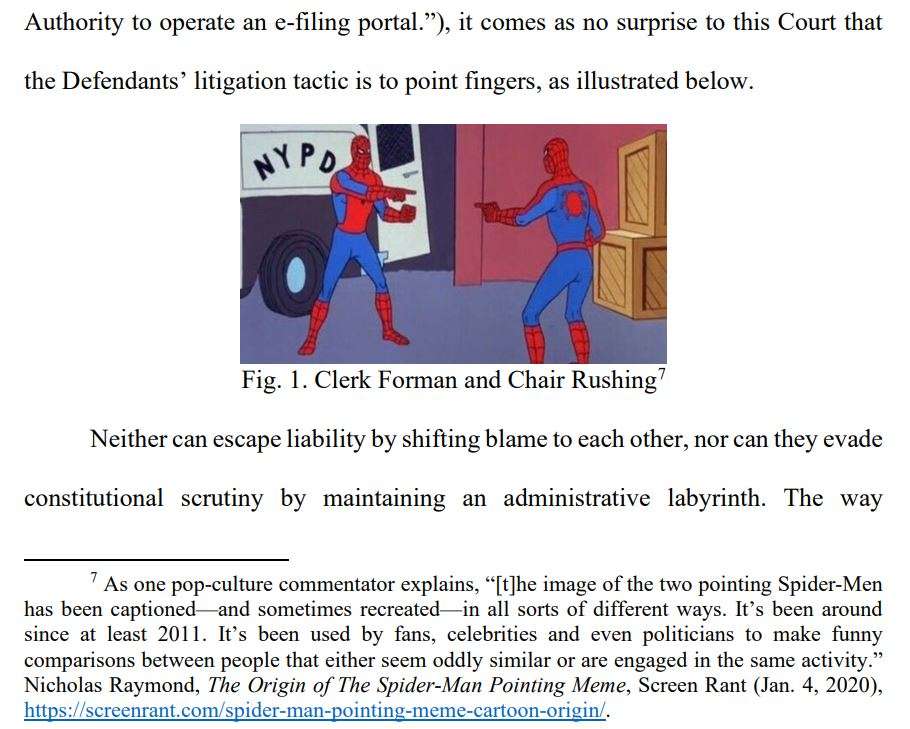
An interesting post by Prof. Eric Goldman (Technology & Marketing Law Blog) about Chief Judge Mark Walker's opinion in Courthouse News Service v. Forman. The meme itself, with some context, is this:
Axios (Shawna Chen) reports, as does an opinion piece in the Washington Post (Josh Rogin) (paywalled). From the Post:
[L]ast November, when [American citizen Saad Ibrahim Almadi] traveled to Riyadh to visit family, he was detained regarding 14 tweets posted on his account over the previous seven years. One of the cited tweets referenced Jamal Khashoggi, the Post contributing columnist who was murdered by Saudi agents in the Saudi Consulate in Istanbul in 2018. Other tweets criticized the Saudi government's policies and the corruption in the Saudi system.
From a report released yesterday:
We recommend that New York (and other states) impose criminal liability for the creation by the perpetrator, or someone acting in concert with the perpetrator, of images or videos of a homicide. Such videos are an extension of the original criminal act and serve to incite or solicit additional criminal acts. In addition, these videos are obscene on their face. Importantly, appropriate legislation should avoid covering videos created by bystanders or passively, such as those captured by police officers' body-worn cameras.
It's certainly a crime to commit homicide (assuming the proposal would be limited to criminal homicide, and not to self-defense and the like), and to conspire with others to commit homicide. (Even if the only "acting in concert" is recording the images, that may well be viewed as purposeful aiding and abetting the killing, much as yelling words of encouragement during a crime can so qualify.) It's not clear whether the First Amendment would allow the law to tack on extra punishment for photographing or videorecording the homicide. But certainly there are ample tools to punish such people for the homicide itself.
But the report goes on:
We also recommend imposing civil liability for the distribution and transmission of this content, including making liable online platforms that fail to take reasonable steps to prevent unlawful violent criminal content from appearing on the platform. Significant penalties, sufficient to realize the goal of deterrence, should be levied in cases where an online platform fails both to take such reasonable steps and to prevent the transmission of content that is captured by or created by the perpetrator of a homicide, or one working in concert with the perpetrator of a homicide, and that depicts a homicide.
That, I think, is unconstitutional, precisely because it's not limited to the killer or people working with the killer. The First Amendment protects people's rights to convey images of crime, which often reveal important information about what happened, how it might have been prevented, and the like—whether those images were captured by criminals or by innocent witnesses. And the First Amendment protects people's rights as recipients of information to view such images.
From Stilp v. Borough of West Chester, decided Monday by Judge Gene Pratter (E.D. Pa.):
The practice of law is not easy; it demands thorough research and writing, nearly always on a deadline. A quick turnaround does not excuse a lawyer's ethical duties to the Court, and there is never an excuse for appropriating the work of another lawyer—let alone opposing counsel—and presenting it as one's own….
The underlying lawsuit involved flag-burning, of all things (see here), but this opinion stemmed from the filing of a motion in limine seeking to exclude a code enforcement officer's (Officer Gore's) testimony as to certain matters. Plaintiffs' lawyers sent a copy of the motion to the Borough's lawyer the evening before the deadline for the motions.
The next day, Ms. Munion [the lawyer for filed a motion in limine on behalf of the Borough seeking to preclude lay opinion testimony by [plaintiffs] Mr. Stilp and Mr. Connolley for essentially the same reasons that Mr. Stilp and Mr. Connolley argued Officer Gore's opinion testimony should be excluded.
The blatant similarities between these two motions and the accompanying briefs are inescapable. Nearly every paragraph of Ms. Munion's motion and brief contain language lifted word-for-word from Mr. Stilp and Mr. Connolley's motion. That this was the product of plagiarism is apparent from the fact that Ms. Munion's motion and brief even reproduce three editing errors—two missing closed quotation marks and a missing space—from Mr. Stilp and Mr. Connolley's filings. Compare Defs.' Mot. in Lim., Doc. No. 21, at ECF 1, 6, with Pls. Mot. in Lim. ¶ 1, Doc. No. 30. It also appears that, in her rush to submit her brief by the Court's deadline, Ms. Munion failed to change the names of the parties in several places, such that the brief as filed decries the failure of the Borough (her client) to produce and serve documents on the Plaintiffs. In light of these telltale markers, there can be no serious argument that Ms. Munion's filings were not the product of plagiarism.
Katy Glenn Bass summarizes and links to the four essays, from Helen Norton, Deborah Pearlstein, Mark Tushnet, and me:
The … essays … focus on doctrinal and definitional questions about the regulation of lies in public discourse: What is the First Amendment status of false speech? What rules do or should apply to different kinds of false speech, like intentional lies, mistaken statements, or opinions based on falsehoods? What justifications exist for those rules? These are critically important questions to answer because the First Amendment provides the primary constraint on the government's power to punish speakers who deceive…. Later this fall we'll publish the next set of papers from this symposium by RonNell Andersen Jones and Sonja West, Sam Lebovic, and John Witt.
I found the symposium to be very interesting, and I thought some of you might, too.
From Luo v. Wang, just decided this morning by Magistrate Judge Michael Hegarty (D. Colo.):
Plaintiff requests that the Court [redact certain documents]…. Intervenor Volokh continues to argue that documents filed unrestricted should stay in the public record … (citing Gunn v. WCA Logistics, LLC (D. Colo. 2016) [Hegarty, J.] ("The cat has already been let out of the bag.")). Defendant joins Volokh's position….
[Plaintiff] alleges that she faces "harassment and violence" but does not connect any specific harm of harassment or violence to the currently public documents. She cites to a restraining order that she sought against Intervenor but does not connect the information she seeks to restrict to any of her allegations in the restraining order. While the Plaintiff has a general fear that "haters" will threaten and harass her, this Court maintains once again, "the public [should not] be prevented from reaching its own conclusion in this case." ….
[Plaintiff] fails to "identify a clearly defined and serious injury that would result if access is not restricted," especially considering that many of the documents were submitted by her (while represented by counsel) without redaction…. "There is a presumption that documents essential to the judicial process are to be available to the public…. It is critical that the public be able to review the factual basis of this Court's decisions and evaluate the Court's rationale so that it may be confident that the Court is functioning as a neutral arbiter."
Here, Plaintiff makes conclusory allegations that the public documents at issue violate her privacy rights and predicts that the availability of these documents will lead to harassment and violence. She provides no facts to support her claim that the public documents at issue will cause her to experience harassment and violence.
To the contrary, the Ninth Circuit has cautioned that Plaintiff's habit of attempting to restrict judicial records could abuse the judicial process. O.L. v. Jara (9th Cir. May 12, 2022). Because Plaintiff fails to provide specific facts, much less explain why filing the documents as restricted outweighs the presumption of public access, Plaintiff's Motion is denied….
You can also read the plaintiff's motion, and the magistrate judge's earlier decision to depseudonymize the plaintiff (now on appeal to the Tenth Circuit).
Disclosure: Luo has unsuccessfully sued me to try to force me to remove certain posts about her, and to block me from writing more about her, and is appealing her loss. But of course I was writing about her cases even before she sued (that was the whole point of her lawsuit), and am now just continuing my earlier practice.
A Telemundo debate resulted in this colloquy between the moderator and mayoral candidate Rick Caruso:
"The next mayor of Los Angeles will be either an African American woman or a white man." Elvir said, referring to Bass and Caruso respectively.
"I'm Italian," Caruso shot back in apparent objection.
"Italian American," Elvir responded.
"That's 'Latin,' thank you," Caruso said in an apparent attempt to correct Elvir.
Caruso's reference to his Italian heritage was widely mocked, exacerbated by his apparent suggestion that he is "Latin," seen as a silly ploy to associate himself with Latinos who make up a substantial part of the LA electorate.
And yet… one reason that "Hispanic" was initially chosen in the 1970s as the government's official appellation for people of Spanish-speaking descent is that some people feared that Italian Americans would claim Latino status if that were the available option, given that they were traditionally considered to be "Latins." Caruso is 63, and thus grew up a time when referring to Italians as "Latins" was common.
Also, there seems to be some rather arbitrary distinctions being made by various pundits. In 2021, one of the two finalists in the Boston mayor election was Annissa Essaibi George. Ms. George is of half-Polish and half-Tunisian descent. She described herself, and was described by the media, as "a person of color," even though she was half-Polish and Tunisians are officially classified as white both by federal and state policy. While some would claim that Muslim identity has been "racialized" and thus Muslim Arab Americans should be considered people of color, Ms. George was raised Catholic.
Is there some objective reason why Mr. Caruso should be mocked for suggesting that his Italian ethnicity differentiates him from being described as generically white, but one should respectfully accept Ms. George's claim that she isn't white at all? Not that I can think of.
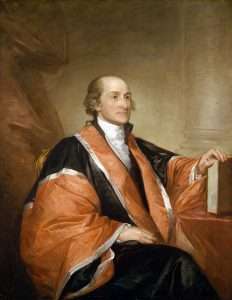
10/19/1789: Chief Justice John Jay takes oath.
Celebrate your independence with a subscription to Reason magazine, your most trusted source of honest, insightful news and analysis.




