
Thursday Open Thread
What's on your mind?

Mostly law professors | Sometimes contrarian | Often libertarian | Always independent | Est. 2002
What's on your mind?
...with love and thanksgiving. (Turn up your volume.)
11/24/2001: Salim Hamdan was captured in Afghanistan. The Supreme Court would decide his case in Hamdan v. Rumsfeld (2006).
From today's decision in TGP Communications LLC v. Sellers by Judge John Tuchi (D. Ariz.):
TGP is an online news and opinion publication. Founded in 2004, TGP has developed a large readership and now averages more than two- and-a-half million readers daily. It describes itself as "a trusted news source for the stories and views that are largely untold or ignored by traditional news outlets." Mr. Conradson is a reporter with TGP who covers Arizona politics. Neither TGP nor Mr. Conradson are shy about their libertarian conservative political leanings. Mr. Conradson testified that his favorite political party is the Republican Party "but I wear that on my sleeve." He noted that his readers understand his political views: "everybody who reads my work knows that I am very transparent about it."
On September 27, 2022, Mr. Conradson applied for credentials to attend press conferences given by Maricopa County officials and to access certain County facilities. The County requires reporters to obtain such credentials—a "press pass"—in order to attend press conferences at, or otherwise enter, the Maricopa County Tabulation and Election Center ("MCTEC") and the tenth floor of the County Administration building in Phoenix, Arizona.
Roy Fields Moseley, the Communications Director for the County, explained that the County instituted the press-pass requirement in light of logistics and security concerns. For example, the Board of Supervisors' conference room on the tenth floor of the County Administration building can accommodate approximately 50 seats for reporters; after the extensive media interest in the 2020 election in Maricopa County, Mr. Moseley testified it was fair to say that they were anticipating there would be a lot more people wanting to attend press conferences. He also testified that there were security issues at MCTEC after the 2020 election, including an incident in which
[s]everal people were not members of the media but perhaps might say they are, but they are not what we would call news reporters. They managed to follow legitimate news crews into the lobby of MCTEC. This was a security concern. They had to be removed. There was a large crowd gathered outside and we didn't want a repeat of that type of situation when we came up on 2022.
The County also has installed temporary and permanent fencing at MCTEC, where the Maricopa County Sheriff's Office maintains security.
Reporters can apply for a press pass through a page on the County's website. The webpage states that "[t]he official press pass will allow members of the press to attend news conferences or enter the Elections Department's office to conduct interviews, take photos, and/or video." The webpage states that the County evaluates "member of the press" based on the following criteria:
I was chatting with Prof. Lorianne Updike Toler (Northern Illinois), and she mentioned some thoughts of hers on this subject, based on her recent University of Chicago Law Review article, The Missing Indian Affairs Clause. I encouraged her to write up a blog post, and she kindly passed along the following:
In the November 9th oral argument for Haaland v. Brackeen, which challenges the constitutionality of the Indian Child Welfare Act, Justice Amy Coney Barret's question about the impact of overruling Congress' plenary power over tribes underscores a centuries-old confusion about federal Indian Affairs.
It's not just the Court that is confused. Former Volokh Conspiracy posts on point reveal the deep academic fissures over the historical context of the Indian Commerce Clause. Unknown to the Court and most of academe is the root cause of all the confusion: that the Constitutional Convention initially forgot (and then later intentionally excluded) the Articles of Confederation's Indian Affairs Clause in the Constitution.
Despite a recent Fifth Circuit case, Carter v. Carter Coal Co. (1936) doesn't limit private delegations.
This is one of a series of posts on the Fifth Circuit's recent "private nondelegation case", National Horsemen's Benevolent & Protective Ass'n v. Black, where it struck down the Horseracing Integrity and Safety Act for delegating power to a private organization, the Horseracing Integrity and Safety Authority. In Monday's post, I explained how A.L.A. Schechter Poultry Corp. v. United States (1935), the main case that proponents of a "private nondelegation doctrine" usually rely on, gives no support to any view that delegations are judged more harshly if the recipient of the delegation is private instead of public. And in Tuesday's post, I talked about how the Supreme Court upheld private delegations four times between 1905 and 1939, and cited two of those cases in Schechter Poultry as examples of cases where private delegation was unproblematic; unfortunately it mischaracterized Schechter Poultry a few times in the 1940s as being about private delegation, but fortunately that was dictum.
Today, I'll talk about the second case that people often rely on when they want to argue that there's a rule against private delegations: Carter v. Carter Coal Co. (1936). Just like Schechter Poultry, this case has been widely misunderstood: (1) if you read it as an Article I Nondelegation Doctrine case, it doesn't support any special rule against private delegations; (2) it's probably best read as a Due Process case (based on the presence of financial bias); (3) if you read it as a Due Process case, it likewise doesn't support any special rule against private delegations.
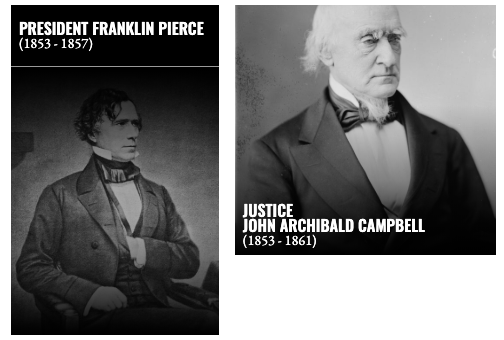
11/23/1804: President Franklin Pierce's birthday. He would appoint Justice John Archibald Campbell to the Supreme Court.
From a Complaint filed today in Bell v. Pollock (paragraph numbers omitted):
On July 30, 2021, the documentary film Finding Kendrick Johnson (the "Documentary Film") was first released, and by December 27, 2021, it was available for internet users to stream on multiple online platforms…. The Documentary purports to tell the story of the murder of Kendrick Johnson (the "Decedent"), a Lowndes County High School student whose body was discovered in a rolled-up gym mat in the high school's gym in January 2013.
Defendants maliciously exploited the mysterious death of the Decedent and the imagery and controversy surrounding the Decedent's death to fabricate a wholly false narrative and profit financially by painting the Bells as modern-day versions of those responsible for one of America's most brutal and infamous hate crimes. The Documentary Film represents that the Decedent's death was a murder. The Documentary Film further portrays that the murder was the result of criminal acts committed by Brian and Branden, two other Lowndes County High School students who it represents had "problems" with the Decedent around the time of his death. Defendants present the central thesis of the film, which is that the Decedent's murder was a second iteration of the horrific, racially motivated murder of Emmett Till….
[T]he Documentary propagates a conspiracy theory that the Decedent's death was improperly ruled an accident, and it claims that Rick, the father of Brian and Branden, who worked as an FBI agent, engaged in a cover up operation to conceal his sons' involvement in the Decedent's murder.
From a decision today by Judge John Sinatra (W.D.N.Y.) in Christian v. Nigrelli:
Another one of New York's new restrictions imposed in the immediate aftermath of the Supreme Court's Bruen decision is the private property exclusion. That new provision makes it a felony for a license holder to possess a firearm on all private property, unless the relevant property holders actually permit such possession with a sign or by express consent….
Property owners indeed have the right to exclude. But the state may not unilaterally exercise that right and, thereby, interfere with the Second Amendment rights of law-abiding citizens who seek to carry for self-defense outside of their own homes. Thus, the motion for a preliminary injunction enjoining Defendants' enforcement of this private property exclusion is granted.
I have to run to class, but hope to have a bit more on this tonight or tomorrow. Congratulations to David Thompson, John Tienken, Nicolas Rotsko, and Peter Patterson of Cooper & Kirk, who represent plaintiffs. Note: One of the plaintiffs is the Firearms Policy Coalition, for which I sometimes consult; I wasn't involved in this case.
The Supreme Court has never held that private delegations have any special unfavorable treatment under the Article I Nondelegation Doctrine: quite the opposite!
This is one of a series of posts on the Fifth Circuit's recent "private nondelegation case", National Horsemen's Benevolent & Protective Ass'n v. Black, where it struck down the Horseracing Integrity and Safety Act for delegating power to a private organization, the Horseracing Integrity and Safety Authority. In yesterday's post, I explained how A.L.A. Schechter Poultry Corp. v. United States (1935), the main case that proponents of a "private nondelegation doctrine" usually rely on, gives no support to any view that delegations are judged more harshly if the recipient of the delegation is private instead of public.
Today, I'll talk about private delegations before and after Schechter Poultry -- the bottom line is that the Supreme Court has actually upheld private delegations on at least four occasions. Two of those were before Schechter Poultry, and Schechter Poultry actually mentioned them as examples of cases where private delegations were acceptable. Two of them were after Schechter Poultry. In two of the cases, the Court explained why the delegation was unconstitutional by analogizing the delegation to a delegation to a public party -- which shows that the private nature of the delegate wasn't relevant. None of these cases -- neither Schechter Poultry nor the other four -- has ever been overruled, and some of them (particularly Schechter Poultry, which approved of two of those cases) continue to be cited regularly.
And this makes sense: the Article I Nondelegation Doctrine is about how Congress can't give up too much power; so far, the formulation it's used is whether the delegate is limited by an "intelligible principle". Provided that's present and Congress hasn't given up too much power, what does it matter who has been the recipient of the power? There might be other principles at work (I'm looking at you, Due Process Clause or Appointments Clause), but the Article I Nondelegation Doctrine doesn't seem to be one of them.
Alas, Schechter Poultry has been mischaracterized since then. In a couple of cases since Schechter Poultry, the Court has mischaracterized that case -- when it has upheld a delegation, it has sometimes distinguished Schechter Poultry on the ground that it involved a private delegation. This was clearly wrong, but fortunately it's only dictum, and fortunately I've only found a handful of instances of this in Supreme Court caselaw. So the strongest case that there's a private Article I nondelegation doctrine stems from dictum in a couple of 1940s cases.
I inadvertently went there a few days ago instead of going to our Mastodon host, liberdon.com, and realized that the site is all about this:
Awesome, especially starting at about 1:25.
In People v. Cannata, decided a year ago but just posted on Westlaw, defendant was being prosecuted for violating New York's third-degree coercion law, which in relevant part reads,
A person is guilty of coercion in the third degree when he or she compels or induces a person to engage in conduct which the latter has a legal right to abstain from engaging in, …
by means of instilling in him or her a fear that, if the demand is not complied with, the actor or another will [among other things, such as causing physical injury,]
[5.] Expose a secret or publicize an asserted fact, whether true or false, tending to subject some person to hatred, contempt or ridicule; or …
[9.] Perform any other act which would not in itself materially benefit the actor but which is calculated to harm another person materially with respect to his or her health, safety, business, calling, career, financial condition, reputation or personal relationships.
New York City Court judge Nichelle Johnson threw out the charge:
The accusatory instrument alleges that on or about April 9, 2021 the defendant engaged in a telephone conversation with [Janice Duarte] during which defendant attempted to "broker" a political deal which is commonplace in politics. The Defendant stated in sum and substance that there were consequences for [Duarte's] brother's objection to defendant's petition to be on the Mount Vernon City Council ballot; that he took the objections personally; that if Ms. Duarte did not withdraw the petition objection it would be his singular focus between then and June 22nd to work against her individually and that he would do everything he could to tell every democrat they should not vote for her; that he would be ruthless and would send out weekly emails blasting her every chance he got; if he was off the ballot he would be attacking her personally by attacking what she had done on the council specifically mentioning her name; and he also stated that if his demand was not met he would bring a lawsuit against Duarte pursuant to the Mount Vernon City Charter, for waste.
[UPDATE 8/2/23: Yesterday, the Court of Appeals reversed the District Court decision I wrote about below.]
From Day v. California Lutheran Univ., decided by Judge Josephine Staton (C.D. Cal.) Aug. 30 but just posted on Westlaw (appeal pending):
In their FAC [First Amended Complaint], Plaintiffs allege that in January 2020, the Softball Team "held a team-bonding lip-sync event with makeup and costumes." Jane Does 1-5 decided to perform The Fresh Prince of Bel-Air theme song and "dress like 'dudes' in a 'Boy Band' with the style of Hip-Hop clothing worn by 'Boy Bands.'" They also "decided to add hats or wigs to hide their feminine hairstyles, and makeup to portray facial hair to make their faces appear more masculine." Two of the girls wore "dirty-blond 'Napoleon Dynamite' wigs." The lip-sync routines were observed by members of the Softball Team, as well as by Plaintiff Coaches Day, Gluckman, and Young. Plaintiffs note that Does 1-5 took part in the lip-sync routine and Does 6-24 did not. The Softball Team later "posted pictures and videos of said routine to their Team Instagram page."
Plaintiffs allege that Defendants Chris Kimball, then the President of CLU and Melissa Maxwell-Doherty, then CLU's Vice President of Mission and Identity, "viewed said pictures and confirmed with the Softball Team, their coaches, and their parents that said Softball Team members: a) were under the supervision of an African-American Softball coach; b) had makeup on their faces to resemble men's facial hair in the form of beard stubble and goatees; and c) were not engaged in any racially motivated activities."
However, Plaintiffs note that "[d]espite such confirmation, Defendants Kimball and Doherty publicly proclaimed to the entire Ventura County community and national press that: a) said conduct constituted 'Blackface'; b) Plaintiffs intentionally participated in and/or allowed 'comedic performances of 'blackness' by whites in exaggerated costumes and makeup'; c) CLU intended to 'call attention' to the event to the entire Ventura County community – not just the CLU community; and d) '[t]hose who are responsible will be held accountable.'" Plaintiffs further allege that "Defendants Kimball and Doherty in particular, allowed the Softball Team and their Coaches to be publicly shamed and harassed, placed in fear for their safety, be the subject of unabated racial slurs by other students in violation of CLU written policy, and to otherwise suffer lifelong injury to their mental health and reputations."
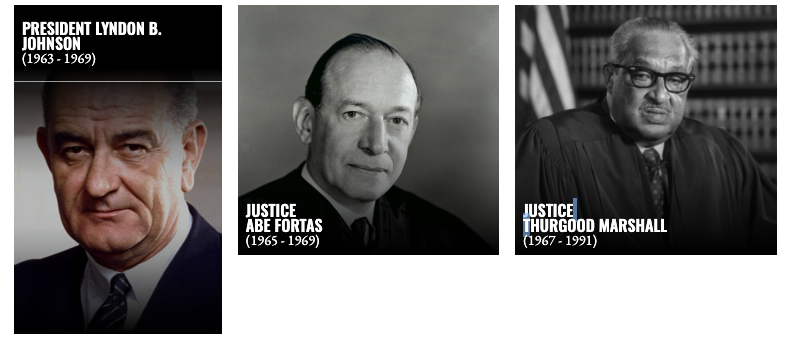
11/22/1963: President Lyndon B. Johnson takes the oath of office. He would appoint two Justices to the Supreme Court: Abe Fortas and Thurgood Marshall.
What podcasts do you like, on any topic (history, science, history of science, law, politics, or whatever else)?
Episode 431 of the Cyberlaw Podcast
The Cyberlaw Podcast leads with the growing legal cost of Elon Musk's anti-authoritarian takeover of Twitter. Turns out that authority figures have a mean streak, and a lot of weapons, many grounded in law, as Twitter is starting to learn. Brian Fleming explores one of them -- the apparently unkillable notion that the Committee on Foreign Investment in the U.S. (CFIUS) should review Musk's Twitter deal because of a relatively small share that went to investors with Chinese and Persian Gulf ties. CFIUS may in fact be seeking information on what Twitter data those investors will have access to, but I am skeptical that CFIUS will be moved to act on what it learns. More dangerous for Twitter and Musk, says Charles-Albert Helleputte, is the possibility that the company will lose its one-stop-shop privacy regulator for failure to meet the elaborate compliance machinery set up by European privacy bureaucrats. At a quick calculation, that could expose Twitter to fines up to 120% of annual turnover. That would smart. Finally, I reprise my take on all the people leaving Twitter for Mastodon as a protest against Musk allowing the Babylon Bee and President Trump back on the platform. If the protestors really think Mastodon's system is better, there's no reason Twitter can't adopt it, or at least the version that Francis Fukuyama and Roberta Katz have proposed.
If you are looking for the far edge of the Establishment's Overton Window on China policy, you cannot do better than the U.S.-China Economic and Security Review Commission, a consistently China-skeptical but mainstream body. Brian reprises the Commission's latest report. Its headline is about Chinese hacking, but the report does not offer much hope of a solution to that problem, other than more decoupling.
Chalk up one more victory for Trump-Biden continuity, and one more loss for the State Department. Michael Ellis reminds us that the Trump administration took much of Cyber Command's cyber offense decisionmaking out of the National Security Council and put it back in the Pentagon. This made it much harder for the State Department to stall cyber offense operations. When it turned out that this made Cyber Command more effective and no more irresponsible, the Biden Administration followed its predecessor's lead, preparing a memo that will largely ratify Trump's order, with a few tweaks.
I unpack Google's expensive (nearly $400 million) settlement with 40 States over location history. Google's promise to its users that it would stop storing location history if the feature was turned off was poorly and misleadingly drafted, but I doubt there is anyone who actually wanted to keep Google from using location for most of the apps where it remained operative, so the settlement is a good deal for the states, and a reminder of how unpopular Silicon Valley has become in red and blue states alike.
Michael tells the doubly embarrassing story of an Iranian hack of the U.S. Merit Systems Protection Board. It is embarrassing enough for the board to be hacked using a log4j exploit that should have been patched long ago. But it is worse that an Iranian government hacker got access to a U.S. government network – and decided that its access is best used for mining cryptocurrency.
Brian tells us that the U.S. goal of reshoring chip production is making progress, with Apple planning to use TSMC chips from a new fab in Arizona.
In a few updates and quick hits:
Download the 431st Episode (mp3)
You can subscribe to The Cyberlaw Podcast using iTunes, Google Play, Spotify, Pocket Casts, or our RSS feed. As always, The Cyberlaw Podcast is open to feedback. Be sure to engage with @stewartbaker on Twitter. Send your questions, comments, and suggestions for topics or interviewees to CyberlawPodcast@steptoe.com. Remember: If your suggested guest appears on the show, we will send you a highly coveted Cyberlaw Podcast mug!
The views expressed in this podcast are those of the speakers and do not reflect the opinions of their institutions, clients, friends, families, or pets.
I have been Twitter sober now for nearly three years. I do not miss it at all. And I do not plan to join Mastodon, because if it survives (no guarantee), the site will suffer from the same flaws as Twitter.
Social media is premised on a simple idea: Person A posts something that Person B will find useful. Invariably, Person A, desirous of more fans, will try to post things that are of interest to a bigger audience. But in doing so, Person A will start pushing the envelope. Person A, on social media at least, becomes something of a persona. And that persona will differ from how Person A operates in reality. As the persona grows, Person A will garner critics, who I'll refer to as Person C. Person C will try to use Person A's platform to increase Person C's presence. Person C engage Person A--seemingly in good faith--but with a jab in the background. Person A may respond, at least initially, until response seems a waste of time. Person C will fault Person A for not debating. Eventually, Person A stops replying all together, and simply uses Twitter to promote his own work.
Every successful media platform starts off in this period of digital bliss, where only a small cadre of people in a small social network engage with each other. Facebook was launched when I was a junior in college, and it was initially limited to college students on certain campuses. It was great! There was some check on who could participate. But eventually Facebook opened up to people outside the campuses, and eventually everyone around the world. It became much less useful. I also remember when Twitter launched. I used to be able to read all of the tweets my friends wrote. Chronologically, I would just scroll through, and see all the tweets. That task is now impossible.
When any social media site reaches a critical mass, it no longer serves that initial purpose of socialization. So something new comes along. No one can fix that problem. Not even Elon Tusk.
[I asked Prof. Alan Rozenshtein (University of Minnesota) to write a post about Mastodon and one particular recent controversy related to it, and he very kindly agreed. -EV]
Ever since Elon Musk purchased Twitter, Mastodon, a decentralized microblogging platform, has seen millions of new users. I've written elsewhere about the architecture that make Mastodon unique—specifically, each Mastodon server (known as an "instance") can choose its own content moderation standards, blocking whatever content, users, or even other instances that it wants. This leads to what I've called "content moderation subsidiarity" and allows users to tailor their experience while still generally being able to follow and be followed by users on other instances.
Mastodon thus represents a novel solution to the "content moderator's trilemma": the challenge of (1) running a social media platform with a giant and diverse user base, (2) using one set of content moderation standards, and (3) managing user dissatisfaction with the content moderation they experience. Centralized platforms like Twitter respond to the trilemma by accepting that user dissatisfaction is inevitable; decentralized platforms like Mastodon try to satisfy users by giving up on centralized moderation standards.
But it will take time—months, maybe years—for the millions of new Mastodon users to find, and in some cases create, the instances that best suit their needs. In the meantime, we should expect a difficult period of growing pains.
An illustrative example is the ongoing controversy at journa.host, an instance set up for journalists. Mike Pesca, host of The Gist (and formerly at Slate) and a member of the journa.host instance, posted a link to a recent New York Times story about the potential negative effects of treating transgender children and teenagers with puberty blockers, describing the story as "careful, thorough reporting." Parker Molloy, another journa.host user and herself a transgender woman, responded by strongly criticizing the piece and calling Pesca a "bigot" and an "anti-trans ghoul".
Celebrate your independence with a subscription to Reason magazine, your most trusted source of honest, insightful news and analysis.




