Being a Judge is a great job. But it comes with downsides. What we do, we do in public, and we subject ourselves to public discussion and criticism of our decisions, both fair and unfair. Federalist No. 78 noted the importance of Judges being independent of the "effects of those ill humors, which are the arts of designing men, or the influence of particular conjunctures [that] sometimes disseminate among the people themselves." That remains just as true today as it was in the 18th Century. Being a judge requires a thick skin and a willingness to make decisions in the face of criticism, even unfair criticism, and to remember that sticks and stones may break my bones, but names can never hurt me.
After Judge Paula Patrick issued a controversial decision about a statue of Christopher Columbus in South Philadelphia, she came in for scrutiny and criticism. An article in the Daily Beast referred to her as "QAnon-linked" in her headline. Judge Patrick says that's neither true nor fair, so she filed suit, claiming that the article paints her in a false light. But Judge Patrick has failed to plead facts that make it plausible that the Daily Beast or its reporter Laura Bradley acted with actual malice in their reporting. Because Judge Patrick failed to plead an element of her false light claim and admitted she has nothing more to plead, I will dismiss her Amended Complaint with prejudice….
Judge Patrick has served on the Philadelphia Court of Common Pleas since her election in 2003. In 2021, she lost a bid for the Pennsylvania Supreme Court in the Republican primary. Judge Patrick participated in many events as part of her Supreme Court campaign.
Among these campaign events was a 40-minute video interview on Up Front in the Prophetic with QAnon supporter Prophetess Francine Fodsick. QAnon supporters believe, without evidence, that President Trump was elected to defeat a purported cabal of cannibalistic pedophiles in the government. During the interview with Prophetess Francine, Judge Patrick did not refute that she was considering attending a conference associated with QAnon that year. Judge Patrick's name later appeared on a list of speakers for the conference, though she did not attend. Judge Patrick disavowed any QAnon link in an interview with The Philadelphia Inquirer.
"[O]ne [tree-cutting] crew member made sexually suggestive gestures towards his fiancée and another waved a running chainsaw towards his dogs with the apparent threat to dismember them ...."
From Burns v. State, decided today by the Florida Court of Appeal, in an opinion by Judge Ed Artau, joined by Judges Cory Ciklin and Burton Conner:
That a person's home is his or her "castle" is one of the most basic tenets of our jurisprudence. However, for Richard Burns …, charged with aggravated assault with a deadly weapon for openly carrying and loading his firearm in the yard of his own home, the "castle" our law entitled him to protect was relegated to a defenseless dungeon. We conclude that the trial court erred in denying his motion for immunity from prosecution pursuant to Florida's Stand Your Ground law. We therefore grant his petition for writ of prohibition because he is legally entitled to immunity from prosecution on the aggravated assault charge….
The State charged Burns with aggravated assault with a deadly weapon for his response to a verbal confrontation with a five-man tree-cutting crew that occurred in the yard of the home he leases as a residence for himself and his family, which includes his fiancée and her son.
After one crew member made sexually suggestive gestures towards his fiancée and another waved a running chainsaw towards his dogs with the apparent threat to dismember them, Burns demanded that the crew members leave his property. Following their refusal to immediately leave, Burns retrieved his handgun from his residence and openly carried it in his yard while loading it by advancing a bullet into its chamber.
Burns moved to dismiss the aggravated assault charge on grounds that he used a justifiable level of force during the incident. After considering the evidence presented at the immunity hearing prompted by the motion, the trial court found that Burns neither pointed the firearm at any member of the tree-cutting crew nor did he verbally threaten any of them after loading the weapon. Instead, as the trial court determined, Burns simply "held the firearm by his side and continued to engage in a verbal confrontation demanding that the workers leave." …
By law, the US Department of Education must issue periodic guidance to state and local authorities on the constitutionality of prayer in public elementary and secondary schools. Earlier this month, the Biden administration issued updated guidelines "in order to provide information on the current state of the law." It's a good bet that the new guidelines are meant to respond to the Supreme Court's decision last term in Kennedy v. Bremerton School District, the high school football coach case, which held that a school district violated the Free Exercise Clause when it disciplined the coach for praying midfield after games.
The school district argued in Kennedy that it had to discipline the coach in order to avoid violating the Establishment Clause—more specifically, to avoid violating the endorsement test under the Lemon line of cases—and also because the coach's practice of praying midfield could coerce students in violation of a different line of cases, including Lee v. Weisman, the graduation prayer case. The Supreme Court disagreed. "Endorsement" is not the appropriate test under the Establishment Clause; rather, the test is whether a practice is consistent with American history and tradition. (Apparently the Court had overruled Lemon and the endorsement test on a prior, unspecified occasion). In addition, the Court ruled, the coach's private prayer, which he didn't offer in his official capacity and in which he didn't encourage students to participate, was not coercive for purposes of the Court's caselaw.
The new guidelines correctly indicate that school officials can't pressure students to join in private prayer. But, puzzlingly, they make only glancing reference to the Kennedy decision itself, which has a lot to say about what does and doesn't constitute pressure. As the dissenters in Kennedy pointed out, there's a pretty good argument that the coach's practice of praying midfield after games could exert a subtle pressure on students to join in. The Court nonetheless believed the practice was constitutional. Kennedy thus suggests that the Court's view of coercion has become more lenient since Lee. Also puzzlingly, the guidelines say nothing at all about the Court's new "history and tradition" test. That seems a pretty big omission.
What explains this reticence, particularly about the new test? In a recent Legal Spirits podcast, my colleague, Marc DeGirolami, and I discuss different possibilities. One possibility, of course, is that the Biden Administration doesn't approve of the new test and so has submerged it. Another, which I prefer, is that the Administration, like the rest of us, doesn't quite know what to make of the new test. Kennedy stands for the proposition that that non-coercive prayers by school officials in their private capacity are consistent with America's traditional understanding of free exercise and don't violate the Establishment Clause. But that still leaves a lot for future development. The new guidelines should have done more to alert schools to the new test. Until the Court clarifies things, though, all of us—scholars, federal bureaucrats, and school officials—are still a bit in the dark.
Last March, the Securities and Exchange Commission proposed a rule that would require companies to provide greater disclosure of climate-related risks and of their greenhouse gas emissions, both direct and indirect. The 500-plus-page proposal prompted substantial controversy and several industry groups and state attorneys general announced they planned to file suit if the SEC proceeded with the rule as planned.
It was widely anticipated that the SEC would issue a final rule this spring. Now, however, it looks as if the final rule will be issued in the fall, at the earliest.
former SEC commissioner Robert J. Jackson Jr. stated on a webinar last month that the agency wanted to take more time to craft the rule after extensive public input.
"I've just understood over the last few weeks it looks like the rule is going to be pushed back a little further than many had thought, including myself. It looks more like the fall of this year," S&P Global Market Intelligence quoted Jackson as saying.
That would likely mean public companies would likely not begin making climate disclosures until next year.
But even that could be optimistic.
As the story notes, the SEC appears to be behind schedule with a controversial cyber-security regulation too. Observers suggest the Commission is taking extra time to ensure its regulatory measures will survive judicial review. Depending on the content of the ultimate rules, however, extra time might not do all that much to insulate the rules from legal attack.
For more on the issues surrounding SEC-mandated climate disclosure, see this post from 2022 and the 2021 webinar linked therein.
Critics of the limit are right that it wasn't intended as an ex post check on spending, but its history makes constitutional objections difficult to fathom.
This is a big week for the debt limit. Since 1941, the federal government has had a statutory limit on the overall face value of securities—bonds, notes, bills, etc.—that can be outstanding at one time. Because the government has become increasingly reliant on borrowing, the limit now acts as a kind of ex post occasion to bargain over government expenditures: If the limit isn't raised, the government doesn't have an obvious path to raise immediate revenue and will (as spending continues) eventually run short of cash. This week, President Biden and Speaker McCarthy are negotiating over the limit. Next week, if Treasury's estimates are correct, the government is expected to run short of cash.
I left the Justice Department's Office of Legal Counsel last week to begin the move to academia. (I'm starting as an associate professor of law at Washington University in St. Louis this summer.) Leaving the Department also seemed like the right time to post my job-market paper, which is about the debt limit. I wrote the paper in 2022, after thinking a lot about the showdown over the debt limit in the fall of 2021—and also thinking about appropriations law for much of the previous four years at DOJ—but encountering only a small number of articles on the limit. (The most stimulating of these was Neil Buchanan and Michael Dorf's paper on the presumed constitutional "trilemma."). Obviously, the issue has now recurred.
Depending on what happens in the days to come, I hope to write a series of posts that address some of the technical legal details of debt limit—such as why reaching the so-called "X Date" doesn't lead to a default on the national debt, where I think Buchanan and Dorf get it wrong on the constitutional "trilemma," and the scope of the federal government's authority and obligation to make payments when it runs short of cash. (Some of these views are previewed in a short Wall Street Journalop-ed I wrote with my friend and OLC colleague Kristin Shapiro, and a short piece in The Atlantic.) But in this initial post I'll address a historical question and some of its implications: Why do we have a debt limit at all?
From H.B. v. F.K., decided Monday by the California Court of Appeal (Superior Court Judge Ruth Ann Kwan, joined by Justices Victoria Chavez & Brian Hoffstadt):
H.B. obtained a domestic violence restraining order (DVRO) against her estranged husband, appellant F.K., pursuant to the Domestic Violence Prevention Act (DVPA). The trial court issued the DVRO on the grounds that appellant "called the mother of his children 'fat,' 'lazy,' 'trailer trash.'" The trial court misinterpreted the purpose and scope of the DVPA, which "prevent[s] acts of domestic violence, abuse, and sexual abuse." Puerile name-calling by a spouse is lamentable but does not warrant a DVRO. We reverse….
I'm delighted to report that Prof. Conor Clarke of the Washington University (St. Louis) School of Law will be guest-blogging over the coming days about his new article, The Debt Limit. The abstract:
Every couple of years, the debt limit shows up to wreak havoc in American law and public finance. By capping the face value of government securities that can be "outstanding at one time," the statutory limit threatens Treasury's ability to raise the revenue needed to fund required government spending.
And yet, despite its importance, much of the conventional wisdom surrounding the limit is wrong. Debt limits—authorities for the Executive Branch to borrow that come with limits attached—have existed since 1790, and flow naturally from the Constitution's reservation of the borrowing power to Congress. I provide a corrective account of those early limits, and draw on public laws and Treasury borrowing records to provide an overview of the Executive Branch's borrowing authority between 1790 and 1910.
That historical excavation has important doctrinal and policy implications for how we think about public finance today, and helps clear the myth and confusion surrounding the debt limit. Under current doctrine, the limit is lawful: It is a form of statutory direction and commitment that was common at the ratification of both the Constitution and the Fourteenth Amendment. The limit is binding: When the limit conflicts with spending provisions, longstanding practice suggests that it is spending—and not the limit—that must yield.
And, finally, the implications of the modern limit remain woefully misunderstood. There is no good reason to think that a "default" follows from a binding limit: tax revenue is more than sufficient to cover debt service. But there is excellent reason to think that the modern limit has become so divorced from its original appropriations purpose—which was to make spending cheaper, not harder—that the case for reform is ripe.
The Thomas Jefferson High School for Science and Technology. Fairfax, Virginia.
Earlier today, the US Court of Appeals for the Fourth Circuit issued a divided 2-1 decision rejecting a lawsuit challenging anti-Asian discrimination in admissions at the Thomas Jefferson High School for Science and Technology (known as "TJ"), a selective public school in Fairfax County, Virginia. In 2020, TJ adopted a new admissions policy that, while racially neutral on its face, was actually intended to reduce the percentage of Asian-American applicants accepted at the school, in order to increase the percentage of other groups, so as to get a student body closer to the population demographics of Fairfax County. Federal district Judge Claude Hilton ruled that the new policy unconstitutional because it was adopted for the purpose of promoting "racial balancing" and also motivated by hostility towards Asians.
Today's Fourth Circuit decision not only (wrongly, in my view) reverses the district court decision, but does so in a way that sets a dangerous precedent that would allow a wide range of government policies discriminating against various minority groups.
Before going further, I should note that my wife, Alison Somin, is one of the Pacific Legal Foundation attorneys representing the plaintiffs in this case, on a pro bono basis. Readers who wish to discount what I say because of this connection are free to do so. But my interest in both anti-Asian discrimination in education and the more general issue of the use of "facially neutral" policies for discriminatory purposes long predates Alison's work on this case. Anyone who cares to check will, I think, find that my take on the TJ case is completely consistent with my previously expressed views on these two interconnected topics.
Longstanding Supreme Court precedent holds that evidence of unconstitutional motivation for "facially neutral" policies shifts the burden of proof to the government to show that they would have enacted the same policy even in the absence of illicit motives. If they fail to prove that, then the policy must be subjected to strict scrutiny, which it would be unlikely to survive. In the TJ case, the Fourth Circuit majority opinion by Judge Robert Bruce King holds that even the most blatant discriminatory motivations do not trigger strict scrutiny so long as the group being targeted for discrimination by "facially neutral" means is still represented in proportion to its percentage of the relevant population (or more). Under the new admissions policy, Asians were still 54% of accepted applicants (as compared to 73% under the old one). Since that is still higher than the Asian percentage of the applicant pool, evidence of discriminatory intent becomes irrelevant:
The proper metric in these circumstances requires, first, an evaluation of a given racial or ethnic group's share of the number of applications to TJ versus that group's share of the offers extended — in other words, the group's "success rate" in gaining admission to TJ under the challenged admissions policy….
When the proper disparate impact analysis is applied in this situation, it is clear that Asian American applicants to TJ suffer from no such detriment. The admissions data for TJ's class of 2025, the first class selected using the challenged admissions policy, tells much of — if not all of — the story.In 2021, Asian American students accounted for 48.59% of the applications to TJ's class of 2025, but actually secured 54.36% of the admission offers made for that class….. Asian American applicants were thus the only racial or ethnic group to receive offers notably in excess of its share of the applicant pool in 2021, producing the highest admissions "success rate" of any such group.
Judge Allison Jones Rushing effectively explains the dangerous flaws in this reasoning in her dissenting opinion:
[T]he majority rejects the very possibility that a State could ever discriminate against a racial group by intentionally reducing its success in a competitive process to a level equal with that of other races. According to the majority, the Board could not have discriminated against Asian students by reducing their success rate—even intentionally and with a discriminatory purpose—so long as Asian students remain nolesssuccessful than students of other races. I don't see why not. "Invidious discrimination does not become less so because the discrimination accomplished is of a lesser magnitude."Feeney, 442 U.S. at 277. If a State enacts a policy with the purpose and effect of trimming down the success of one particular racial group to a level the State finds more appropriate, it has discriminated against that racial group.
I and others have previously compared today's anti-Asian discrimination in selective educational institutions to discrimination against Jewish applicants in earlier eras. Under the Fourth Circuit's reasoning, old-time policies using facially neutral means to reduce the percentage of Jewish students at elite universities would be perfectly legal, so long as Jewish applicants were admitted in the same percentages as other groups. And that would be true no matter how extensive the evidence that the new policy was motivated by anti-Semitic prejudices, or that Jewish applicants had to have stronger academic records to be admitted than those required of gentiles.
The same point applies all kinds of discrimination against racial, ethnic, and religious minorities. So long as facially neutral means are used and the overall success rates of different groups are similar, this reasoning would allow even the most blatant discriminatorily motivated policies intended to reduce the participation of some groups for the benefit of others. There are many situations where members of some minority groups are "overrepresented" in educational institutions, government contracting, and elsewhere, relative to their percentage of the applicant pool or of the general population. Jews, Muslims, Asians, atheists, and Mormons are obvious examples of groups that fit that bill in a variety of educational and professional settings.
If a federal or state government adopted a seemingly neutral policy to try to reduce the percentage of blacks among professional football or basketball players, that too would pass muster, so long as the percentage of blacks in the the relevant pro sports leagues remained at least as high as the percentage of blacks among those seeking employment as players. Following the Fourth Circuit's approach, Donald Trump's travel ban targeting residents of several Muslim-majority nations would also be perfectly fine, so long as Muslim applicants for visas to enter the United States had an overall success rate comparable to that of non-Muslims (the Supreme Court in fact upheld the ban based on badly flawed reasoning of a different type). Progressives and others inclined to support today's decision should consider whether they are really willing to live with these troubling implications.
Even if you generally support the use of racial preferences for affirmative action or believe that the evidence of illicit motivation in the TJ case wasn't strong enough to justify striking down the new admissions policy, you have good reason to oppose the Fourth Circuit's awful disparate impact reasoning. It sets a dangerous precedent that goes far beyond the facts of this specific case, or even the education setting more generally.
In addition to the badly flawed reasoning on "disparate impact," the majority also claims that there wasn't sufficient evidence of discriminatory motivation. I will not go over all the relevant details here. But I think Judge Rushing does a good job of going over the extensive evidence that the Fairfax County school board was motivated by considerations of racial balancing generally, and hostility to Asians specifically (see pp. 53-66 of her dissent). As she notes, members of the School Board themselves admitted (in private communications) that anti-Asian bigotry played a major role in the process:
For example, in text messages, Board members Stella Pekarsky and Abrar Omeish agreed that "there has been an anti [A]sian feel underlying some of this, hate to say it lol"and that Asian students were "discriminated against in this process."J.A. 119.They observed that [Fairfax County school superintendent Eric] Brabrand "ha[d] made it obvious" with "racist" and "demeaning" remarks and that he "[c]ame right out of the gate blaming" Asian students and parents. J.A. 119, 125, 128.They reasoned that Brabrand's proposals would "whiten our schools and kickou[t] Asians," J.A. 119….
I summarized some additional evidence of anti-Asian motivation here and here. It includes such things as claims that having too many Asians would damage TJ's "culture," negative stereotypes about Asian-American parents and students, and Virginia state legislator Mark Keam's complaints about the "unethical ways" Asian-American parents "push their kids into [TJ]," when those parents are "not even going to stay in America," but instead are "using [TJ] to get into Ivy League schools and then go back to their home country." Keam's sentiments are relevant because, as the district court found, Fairfax County school officials were influenced in part by pressure from the state government.
The majority also relies, in part, on the Supreme Court's precedents authorizing the use of racial preferences to pursue the benefits of "diversity" in education. Those precedents are far from a model of clarity. But as Judge Rushing notes, they do not permit the pursuit of racial and ethnic balancing in order to more closely align the percentages of different groups in the student body with the demographic balance in the general population. They also don't permit the deliberate targeting of a specific minority group for purposes of reducing its representation, as Fairfax did here.
A final problematic aspect of the Fourth Circuit ruling is that the court didn't delay it to take account of the Supreme Court's upcoming decisions in the Harvard and University of North Carolina cases assessing the legality of "diversity"-based racial preferences in higher education. These cases feature a number of issues relevant to the TJ litigation, including the extent to which "diversity" can justify racial preferences, and (in the Harvard case) the apparent use of facially neutral policies to reduce the number of Asian students. When a pending Supreme Court decision is likely to be relevant to a case before a lower court, the latter will often withhold judgment until the Supreme Court ruling comes down. The Fourth Circuit would have been well advised to follow that practice here.
If the Supreme Court severely restricts or abolishes "diversity" preferences in the Harvard and UNC cases, and especially if it also cracks down on facially neutral anti-Asian admissions policies, it might in time also vacate and remand the Fourth Circuit ruling, so that the latter can be reevaluated in light of the new Supreme Court decision. Unless and until that happens, today's decision is likely to stand as a dangerous precedent.
The Sedition Act of 1798 famously expired on March 3, 1801, and purported to punish false and malicious statements about the Federalist President John Adams and the majority-Federalist Congress, not about the Democratic-Republican Vice-President Thomas Jefferson. This is often mentioned as evidence of the Federalists' partisanship in enacting the Act.
But what I hadn't known for a long time is that the Federalists tried to reenact the Act in early 1801, when it would have outlawed criticism of the newly-elected Democratic-Republican President and Congress. The bill was defeated in the House by a 53-49 vote; nearly all Federalists voted for it, and all Republicans voted against it. The four Federalists who voted against consisted of one (George Dent) who voted against the 1798 Act, two who weren't in the House for the 1798 Act vote, and one who was in the House in 1798 but didn't vote.
This episode of the Cyberlaw Podcast features part 1 of our two-part interview with Paul Stephan, author of The World Crisis and International Law – a deeper and more entertaining read than the title suggests. Paul lays out the long historical arc that links the 1980s to the present day. It's not a pretty picture, and it gets worse as he ties those changes to the demands of the Knowledge Economy. How will these profound political and economic clashes resolve themselves? We'll cover that in part 2.
Meanwhile, in the news roundup, I tweak Sam Altman for his relentless embrace of regulation for his industry during testimony last week in the Senate. I compare him to another Sam with a similar regulation-embracing approach to Washington, but Chinny Sharma thinks it's more accurate to say he was simply doing the opposite of everything Mark Zuckerberg did in past testimony. Chinny and Sultan Meghji unpack some of Altman's proposals, from a new government agency to license large AI models, to safety standards and audit.
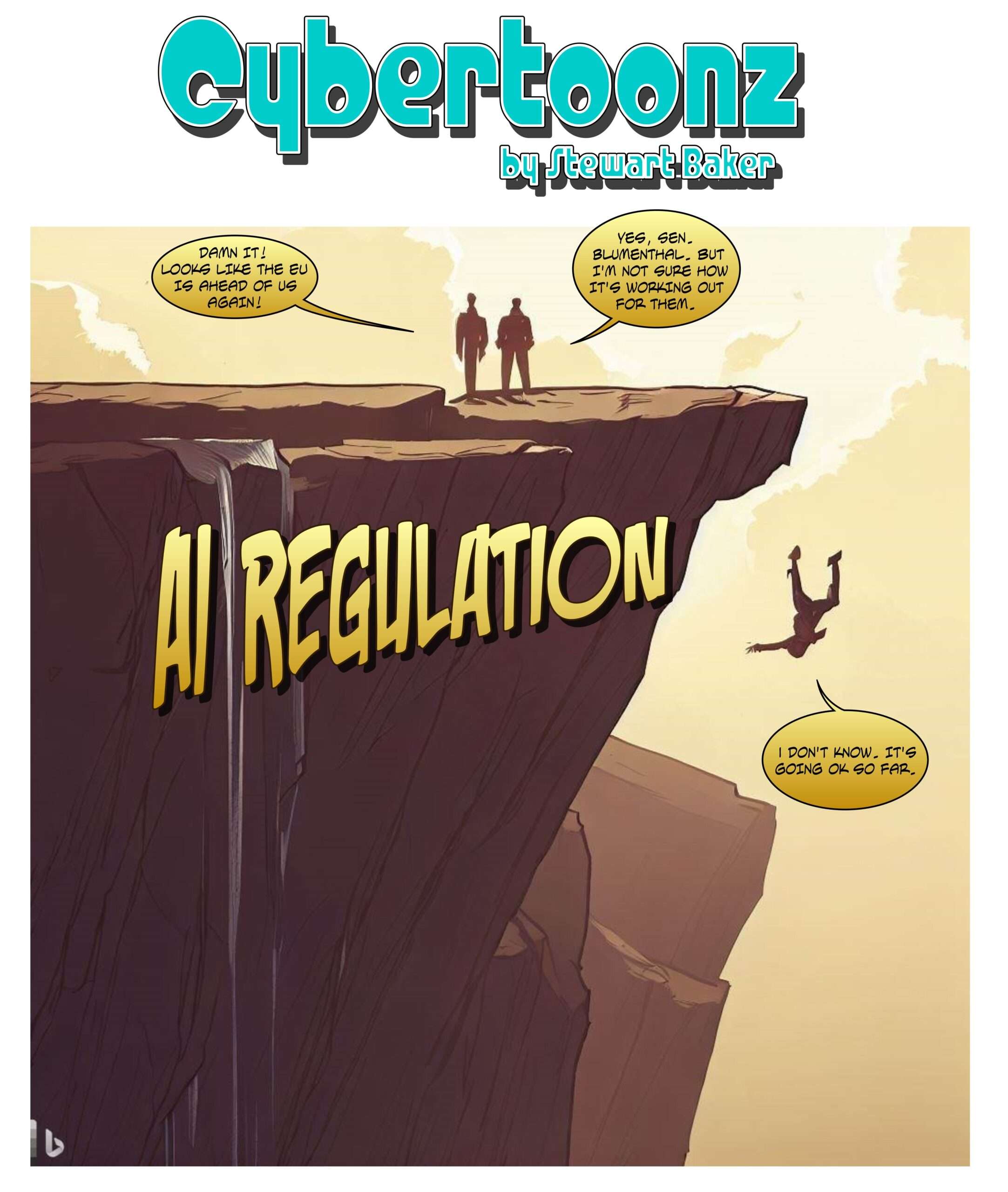
I mock Sen. Blumenthal for his complaint that "Europe is ahead of us" in industry-killing regulation. That earns him immortality in the form of a new Cybertoon, below (as before, a hat tip to Bing Image Creator for the graphic help).
Speaking of Cybertoonz, I note that an earlier Cybertoon scooped a prominent Wall Street Journal article covering bias in AI models – by two weeks.
Chinny and I analyze reports that the FBI misused its access to a section 702 database. All of the access mistakes came before the latest round of procedural reforms, and, on reflection, I think the fault lies less with the FBI and more with DOJ and the DNI, who came up with access rules that all but guaranteed mistakes and didn't ensure that the database could be searched when security requires it.
Chinny reviews a bunch of privacy scandal wannabe stories
The UK flap over efforts to create a modern version of pen/trap records. I explain that this initiative is largely a reaction to bad data protection law.
Two surveillance camera stories,
one story that documents the use of surveillance cameras and facial recognition to monitor public housing residents. In a rare moment of "check your privilege" one-upsmanship, I chide Chinny for not honoring the needs of public housing residents who value security from crime higher than privacy in the laundry room, and
another story on the more or less inevitable networking of cheap surveillance cameras in the suburbs
And finally, a government privacy scandal ripped from the headlines of the 1920s: It turns out that the US Post Office can keep track of what's written on the outside of the envelopes it delivers. Several Congressmen are shocked.
You can subscribe to The Cyberlaw Podcast using iTunes, Google Play, Spotify, Pocket Casts, or our RSS feed. As always, The Cyberlaw Podcast is open to feedback. Be sure to engage with @stewartbaker on Twitter. Send your questions, comments, and suggestions for topics or interviewees to CyberlawPodcast@gmail.com. Remember: If your suggested guest appears on the show, we will send you a highly coveted Cyberlaw Podcast mug! The views expressed in this podcast are those of the speakers and do not reflect the opinions of their institutions, clients, friends, families, or pets.
From Leichty v. Bethel College, decided April 20 by the Tenth Circuit (Judge Robert Bacharach, joined by Judges Bobby Baldock & Joel Carson):
This appeal involves the scope of rights that come with attendance at a conference. Upon paying the required fee, individuals obtain rights to attend the conference. But under what circumstances can the conference organizers expel attendees? And does expulsion subject individuals to arrest if they reappear at the conference? Here we conclude that purchase of a ticket created an irrevocable right to attend the conference. But once the attendee was expelled, his reappearance could support an arrest for trespass….
These issues arise from a two-day conference sponsored by Bethel College, which is a Mennonite college in the City of North Newton, Kansas. The subject of the conference was the Mennonites' role in the Holocaust.
Mr. Bruce Leichty paid the $100 attendance fee to attend the conference and planned to conduct his own program in the evening. At the evening program, Mr. Leichty and two associates would present "unusual perspectives on the Holocaust."
Before the conference had begun, Mr. Leichty distributed flyers about his own program. The organizers asked Mr. Leichty to stop distributing the flyers on the conference grounds. But Mr. Leichty refused to stop until the organizers called the police.
The conflicts resumed at the conference when Mr. Leichty stood to make a comment. One of the conference organizers reminded Mr. Leichty to stay on topic. Mr. Leichty then commented that Jewish people had different perspectives on the Holocaust. One of the conference organizers instructed someone to cut Mr. Leichty's microphone. Though his microphone had been cut, Mr. Leichty continued to speak about his upcoming program.
Later that day, another organizer of the conference told Mr. Leichty that he was "out of the conference." In front of Mr. Leichty, the organizer told a colleague to call the police if Mr. Leichty attended the next day.
Undeterred, Mr. Leichty returned the next day. The college president told him to leave, but Mr. Leichty refused. College officials called the police, who arrived and arrested Mr. Leichty for trespass. He then sued Bethel College and the City of North Newton.
The court concluded that, under Kansas law, Leichty's paying the $100 registration fee gave him a contractual right to attend the conference, and that ejecting him could breach that contract:
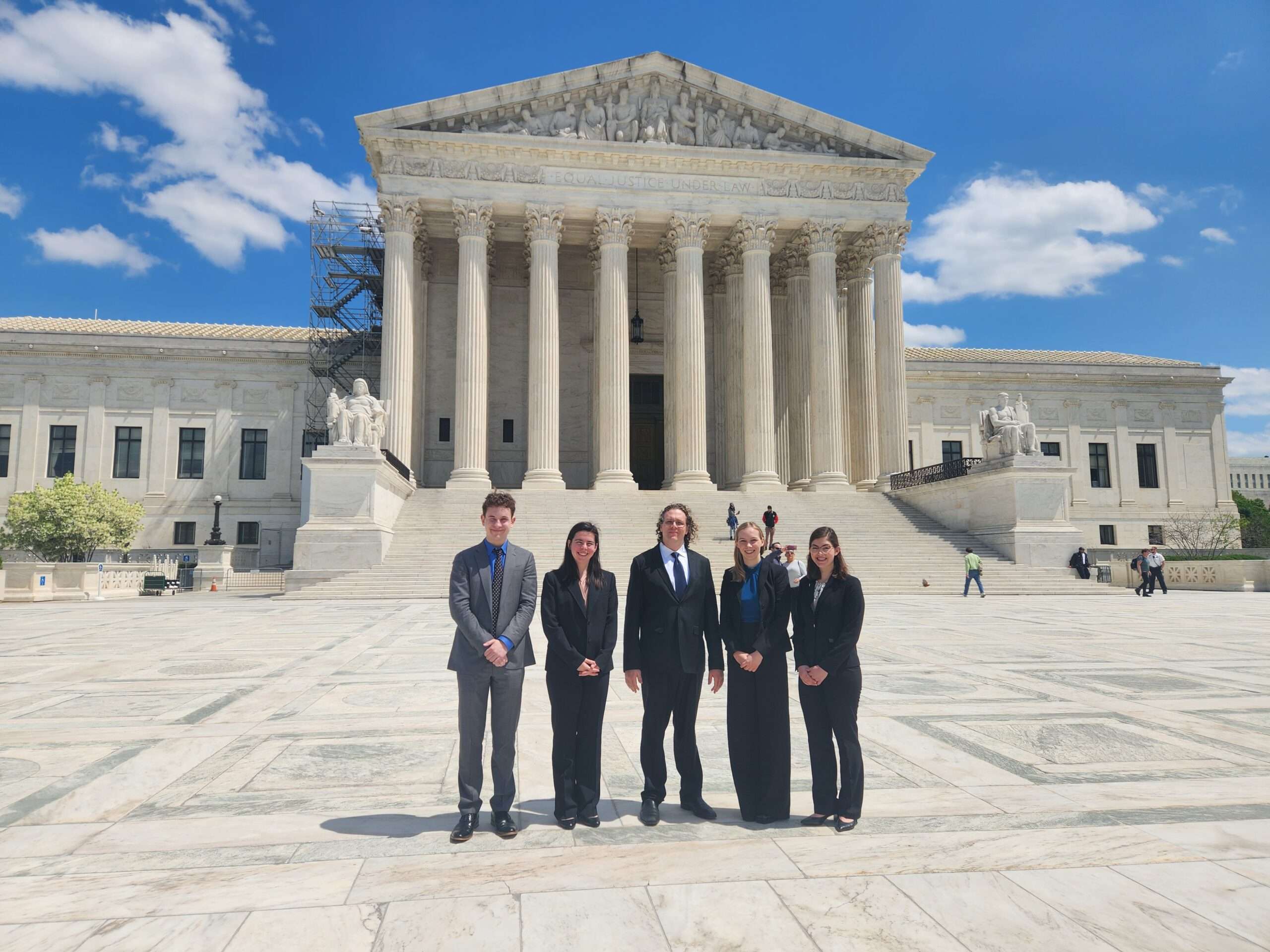
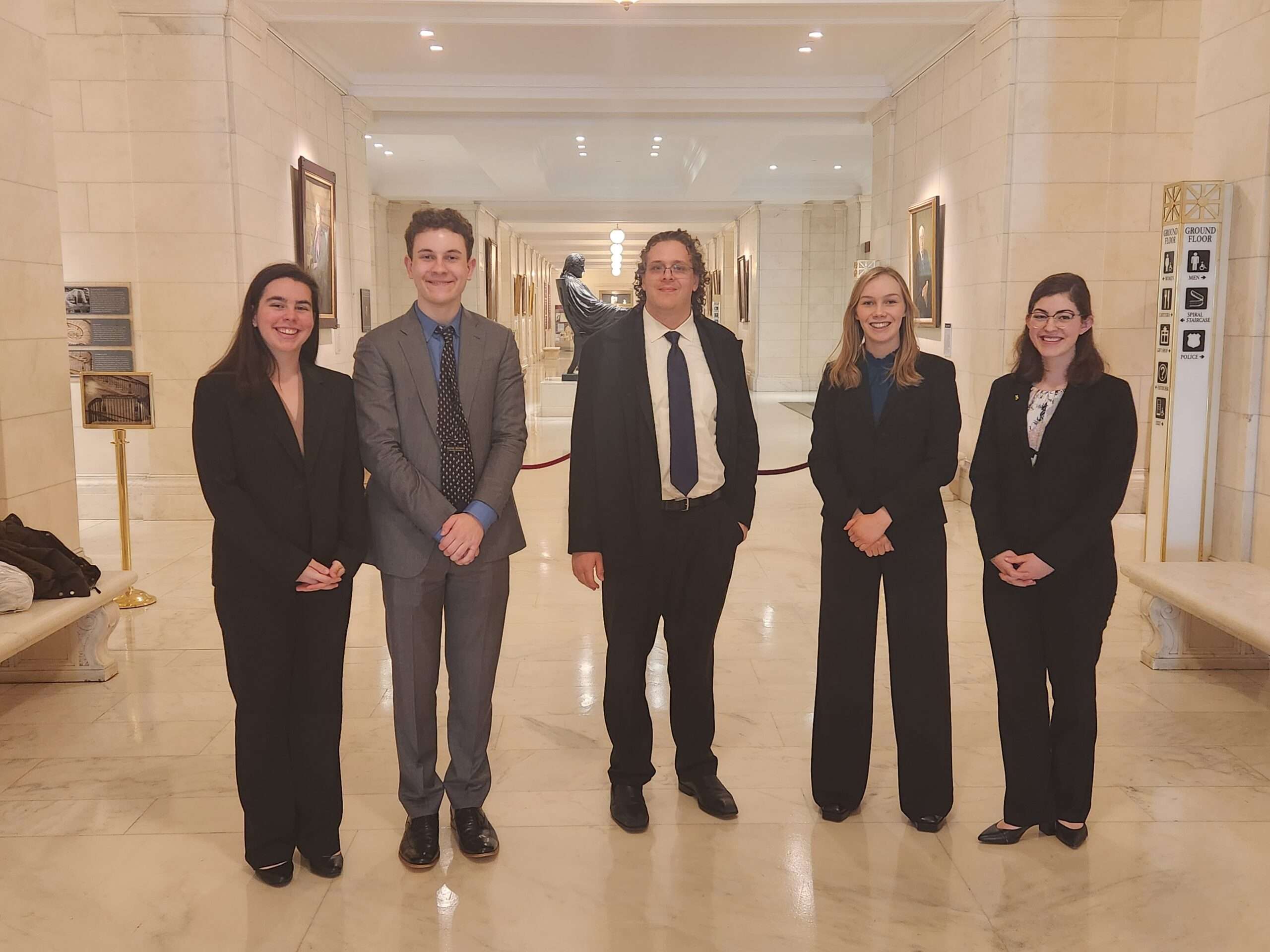
On April 24, 2023, the Harlan Institute and Ashbrook held the championship round for the 11th Annual Virtual Supreme Court competition. The top two teams presented oral argument at the Georgetown Supreme Court Institute in the case of Students For Admission v. University of North Carolina. Presiding were Judge Gregory G. Katsas (D.C. Circuit), Judge Thomas B. Griffith (D.C. Circuit, Retired), Judge Trevor McFadden (District Court for the District of Columbia). Campbell Collins & Gabriella Lovins from Austin, Texas represented the Petitioner. Catherine Gutowski & Quinn Speck from the Joel Barlow High School in Connecticut represented the Respondent. After a well-argued round, the judges selected the Petitioners as the Champions, with Campbell Collins as best oralist.
The students and their coaches offered these generous comments about the competition:
The Harlan Institute Moot Court Competition transformed my high school experience. As a homeschooler, it was difficult to find opportunities for debate. Finding this program gave me a chance to research complicated issues and hone my writing and speaking skills in a way I never would have been able to otherwise. I've made great friends through the program, too, and connected with students from other schools. And the experience itself has been once-in-a-lifetime: mentorship from federal judges and Supreme Court attorneys, sitting in on a Supreme Court argument, and counting all the turtles in the Supreme Court building. My college and career trajectory has completely shifted because a friend and I decided to try moot court in 10th grade.
Campbell Collins, Senior
The Harlan Institute fosters not only good speaking skills, but also the ability to think quickly and deeply to answer difficult questions. Each round presents a new set of challenges that force us to adapt. Through the competition, I've learned in depth about specific constitutional law topics but the skills readily transfer to debate and general presentations. Perhaps most importantly, the Harlan Institute is simply a lot of fun for anyone interested in law.
Gabriella Lovins, Senior
Participating in the Harlan Institute-Ashbrook Virtual Supreme Court was among the most rewarding experiences of my time in high school. Learning to argue three different, undecided Supreme Court cases has greatly improved my critical thinking, public speaking, and legal acuity over the past three years. Not only did this hands-on approach to studying law give me an awareness of the critical role constitutional law plays in our judicial system, it also ignited my interest in pursuing a career in the legal field.
Catie Gutowski, Senior
"The Harlan Institute's Virtual SCOTUS Competition is unique, and gives high school students the opportunity to truly explore relevant and interesting areas of law beyond the classroom in a thought-provoking and fun fashion. The opportunities that it offers, such as seeing a real Supreme Court oral argument and traveling to DC were incredible and the experience overall was once-in-a-lifetime."
Quinn Speck, Senior
The Virtual Supreme Court offers unique challenges that push students to read, think, study, write, plan, and speak at their best. In terms of the number of skills and amount of civic knowledge it imparts, it is one of the most beneficial events I've participated in during my 20 years of coaching students for competitions in debate, speech, economics, and ethics.
Randall Smith, Coach
The students had a jam-packed day. In the morning they attended oral argument at the United States Supreme Court.
From Livingston Parish School Bd. v. Kellett, decided Thursday by the Louisiana Court of Appeal (Judge Allison Penzato, joined by Judges Duke Welch & Walter Lanier):
[T]he School Board discovered that Ms. Kellett, the mother of a child attending Live Oak Elementary School, "repeatedly concealed" electronic devices in her child's clothing or personal belongings in November 2019. Ms. Kellett purportedly used these devices to "intercept communications by and between faculty, students, and others in the school and/or classroom during school hours and while on school property." One such device, an AngelSense, had GPS capability to track the child's whereabouts and also allowed verbal communications between Ms. Kellett and her child. The School Board obtained a temporary restraining order (TRO) on January 27, 2020, then a preliminary injunction on April 8, 2020, prohibiting Ms. Kellett's use of these devices on school property.
The School Board also accused Ms. Kellett of being critical of the School Board and publicly discussing "her child's special needs" and individual education plan with the media. Ms. Kellett allegedly maintained a "live web blog and other ongoing social media posts" that involved discussion and disclosure of information related to the School Board, the special education program, and other identified individuals. According to the School Board, these posts have "caused concern for parents of other [Livingston Parish School System] students and have defamed and slandered the reputations of [the School Board] and Live Oak Elementary staff." The January 27, 2020 TRO and April 8, 2020 preliminary injunction addressed this additional complaint by the School Board. Pertinently, the April 8, 2020 preliminary injunction enjoined, restrained, and prohibited Ms. Kellett from:
… d) … engaging in any form of written, verbal, or physical displays of hostility, anger, or disparagement, and/or from making threats of any physical assault, and/or any disorderly conduct that results in fear or disruption of activities through hostile and inappropriate behavior toward any LPSB [Livingston Parish School Board] member, administrator, faculty or staff at Live Oak Elementary School and/or on any LPSS [Livingston Parish School System] public school bus or other school property, and/or while participating in any educational or other school related business or function, including but in no way limited to any Individual Education Plan (IEP) or Individual Health Plan (IHP) meetings or evaluations required to facilitate the minor child's special education and health care needs;
f) … making or publishing and/or from engaging in any activity to make, disseminate, publish or broadcast defamatory, slanderous, libelous, frivolous and/or fraudulent claims or statements concerning [the School Board], its faculty, staff and employees, as defined by R.S. 14:47-48, 13:3381(B), directly or by her enlisting the assistance of any other person(s) on her behalf ….
In Texas, there are several single-judge divisions. Over the past few years, I've written about those courts in places like Amarillo, Victoria, Wichita Falls, and Lubbock. But one single-judge division, which is closest to home, has not attracted nearly as much attention. The Galveston Division of the Southern District of Texas is about 50 miles from downtown Houston. And the lone judge there is Judge Jeff Brown, who previously served on the Texas Supreme Court. Brown's most high-profile case was Feds for Medical Freedom v. Biden.
The lead plaintiff, Feds for Medical Freedom, has "more than 6,000 members spread across every state." But the plaintiffs chose to file in the Galveston Division of the Southern District of Texas--not Houston, not Corpus Christi, not Brownsville. And under longstanding precedent, plaintiffs have that discretion to choose their venue, so long as they comply with the rules of procedure, federal statutes, and judicial precedent. Their complaint provided this statement with regard to venue:
Venue is proper under 28 U.S.C. § 1391(e)(1)(B) because the United States, one or more of its agencies, and one or more of its officers in his or her official capacity are Defendants; and a substantial part of the events giving rise to Plaintiffs' claims occurred in this District. Venue is also proper under 28 U.S.C. § 1391(e)(1)(C) because the United States, one or more of its agencies, and one of its officers in his official capacity are Defendants, and Plaintiffs Joshua Roberts, Deborah Lawson, Laura Brunstetter, Julia Badger, Patrick Mendoza York, Patrick Wright, and Jana Spruce reside in this District, and no real property is involved.
A few of the plaintiffs resided in Galveston. The Department of Justice did not contest whether venue was proper in the Galveston division. In January 2022, Judge Brown issued a nationwide injunction against Biden's vaccine mandate for federal employees. In March 2023, the en banc Fifth Circuit affirmed Brown's ruling. (As best as I can tell, the SG has not filed a cert petition yet.)
This case is typical of so-called strategic litigation. It is all too common for lawyers to seek nationwide relief in particular courts. There is nothing unethical about this practice. As far as I know, misconduct complaints have not been filed against lawyers in private practice and in government, who file such suits. Yet, this practice has come under vigorous attack over the past few years. Critics assail these lawyers, and indeed, the judges themselves, for participating in "judge shopping." Congress could, of course, change the rules for venue. Indeed, Majority Leader Schumer would be much better off writing a letter to his colleagues in the Senate, than to the Chief Judge of the Northern District of Texas. It is also possible that a particular district as a whole could adopt certain rules regarding case assignments. I do not think a Chief Judge can make this decision unilaterally.
This background brings me to the rules of practice that Judge Brown adopted in February 2023. Rule 16 provides:
Rule 16: Cases With No Factual Nexus to the Galveston Division
Occasionally, plaintiffs file matters in the Galveston Division with no factual nexus to the division. The court will screen for such situations at the initial scheduling conference. In any case with no obvious factual nexus to the Galveston Division, the court will order the plaintiff, within 14 days, to explain the case's connection to the division and how the court should weigh the In re Volkswagen private- and public-interest factors. See 545 F.3d 304, 315–18 (5th Cir. 2008) (en banc). The defendant will have 7 days to respond. The court will then determine whether, for the convenience of the parties and witnesses and in the interest of justice, it should transfer the case to a more appropriate division under 28 U.S.C. § 1404. The court will also entertain parties' motions to transfer such cases under § 1404, whether filed before or after the initial scheduling conference.
Longtime critics of single-judge divisions have heaped praise on Judge Brown for taking proactive steps to reduce so-called judge shopping. I don't think this adoration is warranted. First, under longstanding precedent, Judges can raise venue sua sponte. Venue is not jurisdictional, but judges are allowed to raise this issue on their own. There is nothing improper about a judge screening cases at a scheduling conference for venue issues. And for those who keep track, scheduling conferences occur after motions for preliminary injunctions are resolved. Second, Judge Brown's order cites Fifth Circuit precedent concerning venue and district. To state the obvious, a district court in Texas is bound to follow Fifth Circuit precedent. Third, all federal courts must consider the 1404 factors, whether on its own motion, or a motion to transfer. That's it! I think the text of this order is much ado about nothing.
This order has also attracted some ire from the right. Some conservative have contended that Judge Brown is shying away from strategic litigation, or even worse, signaling that he does not want these cases. On some reflection, I do not think this criticism is warranted here, but a Judge who followed such a path would be in the wrong. Beyond congressional action, or district wide rules, an individual district court judge has little control over what cases he receives. It would be improper for a federal judge in active service to state "I will transfer any case that requests nationwide relief," or "I do not want any case brought under the APA." (Federal judges with senior status can pick and choose which cases they receive.) Can you imagine if a federal judge automatically recused from any case involving a high-profile issue like abortion or gay rights? (Though one elected justice on the Texas Supreme Court recused from a pre-Obergefell same-sex divorce case, without any obvious cause.) A federal judge can only transfer a case to another division, or another district, if the federal rules and circuit precedent support that result. Stated differently, a federal judge cannot super-add new requirements to keep a case in his particular venue.
If Rule 16 merely restates the existing precedent, why would Judge Brown issue such a policy? I am deeply doubtful he was trying to curry favor with the real law professors of Twitter. I also don't think he was trying to turn away strategic litigation. Nor do I think this rule even accomplishes that goal, since he is only restating existing law. Moreover, under longstanding precedent, the state of Texas is understood to have an interest over every inch of Texas--including the sands of Galveston beach. And at least in Feds for Medical Freedom, Judge Brown thought venue was proper. Was Judge Brown trying to signal that litigants should file elsewhere--basically an in terrorem nudge to stay away? I hope not, because such a rule would be inappropriate. Judges cannot hang "do not enter" signs on the courthouse doors. The tenure protections of Article III are designed to protect judges who must decide cases of public import, even in the face of internal and external pressure. My inclination is there is a mundane explanation for this rule.
Until fairly recently, parties seeking to file an amicus brief before the Supreme Court had to seek the consent of the petitioner and respondent. Generally, this experience was pro forma. It was rare for consent to be denied. And if consent was not granted, amici could file a motion for leave, which was regularly granted. But this process was changed, effective January 1, 2023. Rule 37.2 removed the requirement to obtain consent of the parties. Rather, amici need to simply provide notice to the parties ten days before the day date:
An amicus curiae fling a brief under this subparagraph shall ensure that the counsel of record for all parties receive notice of its intention to fle an amicus curiae brief at least 10 days prior to the due date for the amicus curiae brief, unless the amicus curiae brief is fled earlier than 10 days before the due date.
Today, the Court denied two motions for leave to file an amicus brief where insufficient notice was filed. And both briefs were authored by law professors.
First, the Court denied cert in Cohen v. Apple. Professor Lawrence Lessig represented the City of Berkeley as amicus curiae. On March 15, the Court rejected Lessig's initial filing. That same day, Lessig filed a motion for leave to file the amicus brief. Lessig's brief was due on March 15, so notice would have been due on March 5. But Lessig did not provide such notice. The motion begins:
Amicus moves this Court to permit it to file this brief, despite failing to give notice to Respondent Apple Inc. ten days before the Amicus brief was due. Respondent has objected to Amicus filing its brief because of this failure of notice. But because Respondent itself received a thirty-day extension of its own deadline for filing, Respondent received not only notice of Amicus' intent to file a brief more than ten days before its own brief was due, but the actual brief 30 days before its brief was due. Respondent was not in any sense disadvantaged by Amicus' omission. Therefore, because any error was harmless to Respondent, Amicus asks this Court to accept its filing.
The Court, without any explanation, denied the motion for leave. The upshot here is that the due date of top-side amicus briefs is based on the original deadline, and not the extended deadline.
The Court likewise denied a motion for leave to file an amicus brief in Grayson v. No Labels. Here, Professor David Logan filed an amicus brief on April 24, 2023. Here, notice was due on April 14. But his request came on April 18. The Respondent offered this response:
Respondents' counsel would not ordinarily oppose the filing of an amicus brief that complies with Rule 37, but Professor Logan proposes filing an amicus brief that does not conform to the rule and, worse, he misstates the facts to this Court in seeking his relief. His motion should be denied.
Professor Logan brings his motion pursuant to "Rule 37.2(b)," which no longer exists, and he inaccurately states: "Counsel of record for the Respondents were notified on Tuesday, April 18, 2023, that Prof. Logan intended to submit the enclosed brief. Counsel for the Respondents has not responded to this notification. Petitioner has consented." Motion at 1. This is false.
On April 18, 2023, Joyce Hughes sent Respondents' counsel an email entitled "Please Be Advised Under Supreme Court Rule 37." The email stated in its entirety: "To Mr. Lowell and Mr. Man: Under Supreme Court Rule 37, please be advised that Prof. David Logan will be filing an amicus brief in support of the petition in No. 22- 906, Grayson v. No Labels. If you wish to consent, please reply here." The message clearly mentions filing an amicus brief under Rule 37, not filing a motion to file an amicus brief that does not comply with Rule 37.2.
Within fifteen minutes, Mr. Man responded to Ms. Hughes: "Under the recent amendments to Rule 37, you no longer need our consent. But you do need to provide notice of your intent to file an amicus brief within 10 days of its due date and, with any amicus brief being due by April 24, your notice to us today (the 18th) fails to comply with that rule." Thus, Professor Logan misrepresented to this Court that "Counsel for the Respondents has not responded to this notification." Motion at 1. Because he failed to provide Respondents with timely notice of his intent to file an amicus brief under Rule 37(2), Professor Logan's motion should be denied.
And Logan's motion was denied.
In both cases, the Court enforced Rule 37.2 strictly. Lawyers, take note!