This morning the Supreme Court will hear argument in Lackey v. Stinnie, a major case about attorneys's fees and preliminary injunctions. The case has so far escaped much attention in the press, but its implications are important. These include implications for litigation funding, for incentives to settle after a preliminary injunction, and for how the preliminary injunction operates in the federal courts.
The preliminary injunction is designed to protect the Court's ultimate remedial options (as explored at length in The Purpose of the Preliminary Injunction). It is an interim measure that does not determine the merits, and instead, to use a felicitous phrase of Professor Bert Huang, it "sets a holding pattern." But there has been a major shift in the federal courts toward merits-dominated decisionmaking. It has become a central front in many of the most important public law cases. It is not designed for that role, and the error costs at the preliminary stage are high. Those costs are exacerbated by heightened judicial polarization and forum-shopping. And these shifts in preliminary injunction practice have contributed to many of the cases that come to the Court in an emergency posture. A win for the respondents would be likely exacerbate these trends still more, moving the preliminary injunction further from its traditional function and towards being a merits determination.
Here is my discussion of the briefs from last week, here at the Volokh Conspiracy.
And here is The Purpose of the Preliminary Injunction, which explores these questions about this interim measure's function and the problems with how it is now being used in the federal courts.
This is the second of five posts about my new book, Historical Gloss and Foreign Affairs: Constitutional Authority in Practice. In the first post, I addressed some general points about the role of historical gloss in constitutional interpretation, and I explained why gloss has had particular relevance in the foreign affairs area.
In this post, I discuss the phenomenon of executive agreements.
Article II of the Constitution describes how treaties are to be made: by the President with the advice and consent of two-thirds of the Senate. But from early in our history, presidents have sometimes concluded international agreements through other processes.
Agreements concluded with either the ex ante or ex post approval of a majority of Congress are sometimes referred to as "congressional-executive agreements" and those concluded based solely on the President's authority are sometimes referred to as "sole executive agreements." The term "executive agreements" is used in the United States to distinguish them from agreements concluded through the Article II process, but under international law these are all treaties.
There were executive agreements even in the early days of the nation, but the practice grew over time. According to one widely cited calculation, in the first fifty years after the adoption of the Constitution, the federal government concluded 60 Article II treaties and only 27 executive agreements. The executive agreements concerned matters such the international exchange of mail and the settlement of American claims against foreign governments.
By contrast, in the fifty-year period from 1939 to 1989, there were, according to a State Department calculation, 702 Article II treaties and 11,698 executive agreements. In other words, executive agreements constituted almost 95% of the overall international agreements during that period.
New National Bureau of Economic Research study shows this notorious law not only harmed would-be immigrants, but also damaged the US economy and reduced employment opportunities for native-born whites.
The Chinese Exclusion Act of 1882, which barred most Chinese immigration, was one of the most important immigration restrictions in American history. It barred large numbers of Chinese immigrants, condemning them to a life of poverty and oppression. It also set the stage for later immigration restrictions. Perhaps even more significantly, it led to the Supreme Court's awful ruling in the 1889 Chinese Exclusion Case, which ruled that the federal government had a general power to restrict migration, despite the absence of any textual or originalist basis for it. That, of course helped make future immigration restrictions possible. Elsewhere, I have argued the Chinese Exclusion Case should be added to the "anti-canon" of constitutional law.
A new study for the National Bureau of Economic Research, authored by economists Joe Long, Carlo Medici, Nancy Qian and Marco Tabellini assesses the economic impact of the Act. One of the main rationales for its passage was to benefit white workers, who were supposedly victimized by competition from the Chinese. Did it achieve that goal? Turns out not. Here is the abstract of the new NBER study:
This paper investigates the economic consequences of the 1882 Chinese Exclusion Act, which banned immigration from China to the United States. The Act reduced the number of Chinese workers of all skill levels residing in the U.S. It also reduced the labor supply and the quality of jobs held by white and U.S.-born workers, the intended beneficiaries of the Act, and reduced manufacturing output. The results suggest that the Chinese Exclusion Act slowed economic growth in western states until at least 1940.
The study does not prove that no white workers were ever displaced by Chinese immigrants. Some almost certainly were. The authors of the NBER study point this out, and note that the Exclusion Act benefited "local" white miners competing with Chinese miners. But such effects were outweighed by the much larger number of white workers who benefited from Chinese migration, including the associated job opportunities it created. The economy is not a zero-sum game, and the interests of workers from different ethnic and racial groups are more mutually reinforcing than conflicting. I explained this dynamic in a bit more detail here.
Today is the one year anniversary of the horrific October 7, 2023 Hamas terrorist attack on Israel. The resulting war continues. I wish there was something I could say to ease the pain of the victims of the attack and their families. But that task is far beyond my very limited eloquence.
Still, over the past year I have written pieces on various aspects of the conflict and the reaction to it in the West, that may be of interest. This post is a compilation of them. I haven't written as much about this conflict as the Russia-Ukraine War. But there is enough to be worth compiling.
I hold a somewhat unusual combination of views on the conflict. I am no great fan of the present Israeli government, or of the ideology of Zionism (the latter because of my general opposition to ethno-nationalism). Yet I nonetheless hope Israel wipes out Hamas and deals a decisive defeat to its other adversaries, as well. For all its serious flaws from the standpoint of liberal values, Israel is incomparably superior to its enemies.
A small anecdote can help illustrate the point. In December, I am scheduled to be a visiting professor at Uriel Reichman University in Israel. One of the meetings tentatively planned for my trip is one with Arab Israeli legal academic Mohammed Wattad; since we last met in 2016, he has become the president of one of the country's major universities.
Can you imagine a Jew leading any major institution under the rule of Hamas, Hezbollah, Iran, or even the Palestinian Authority? The question answers itself. Indeed, a Jew probably could not even remain alive for long under most of these regimes. Hamas and Hezbollah are severely repressive even towards Arab Muslims who dare dissent from the rulers' quasi-medieval theocracy. Iran represses Muslim dissenters, as well.
As Wattad will likely remind me, Arabs still face considerable discrimination in Israel. That is wrong, and deserves condemnation. But the rule of Hamas, Hezbollah and the PA is vastly worse. Arabs under Israeli rule not only have more rights than ethnic and religious minorities under the control of Israel's enemies; they even have more rights than do Arab (or Iranian) Muslims under the latter regimes. Things are worse for West Bank Palestinians than Arab Israelis. But even they are unlikely to be better off with a Hamas victory that would put them under the rule of a brutal theocratic dictatorship.
In any conflict, I prefer the victory of the side that better approximates liberal democratic values - at least in situations where there is a meaningful difference between the two. In this case, there is no question that side is Israel.
Without further ado, here are links to my writings on the post-October 7 conflict. For convenience, I have put them in chronological order, and divided them into one section on the war itself and one on the Western reaction, including resulting protest movements. All of these writings are posts published here on the Volokh Conspiracy blog:
Writings on the War and Related Policy Issues
"Those Who Support Israel Against Hamas Should also Back Ukraine Against Russia," Oct. 12, 2023. There are many parallels between the two conflicts. The post is primarily directed at right-wingers who back Israel, but not Ukraine. But most of the points it makes apply equally to leftists who hold the exact opposite combination of views.
"Hamas Attack Should Teach Us the Folly of Hostage Deals with Terrorists,"Oct. 17, 2023. This may be one of my most unpopular takes. It may seem like only a cruel and heartless person could possibly oppose deals that release hostages. But, as I point out in the piece, such deals incentivize further terrorism and hostage taking. The October 7 attack itself was masterminded by Yahya Sinwar, a Hamas leader released in the 2011 Shalit deal, in which the Israelis released some 1200 terrorists in exchange for one soldier captured by Hamas. I was one of the few critics of the Shalit deal at the time it happened. Things turned out much worse than even I expected.
"The Moral and Strategic Case for Opening Doors to Gaza Refugees," Oct. 24, 2023. Granting refuge to Palestinian civilians who wish to flee the war and Hamas's repressive rule is both a moral imperative, and a way to make it easier for Israel to crush Hamas. For somewhat different reasons, this view is fiercely opposed by a combination of Western right-wingers, far leftists, and supporters of Palestinian nationalism. This combination of opponents actually increases my confidence that it is right. Interestingly, this is an issue where I find myself largely in agreement with my much more conservative colleague and co-blogger Eugene Kontorovich.
"Why I Don't Buy the Idea that You Can't Kill an Idea," Feb. 24, 2024. It's often said you can't defeat movements like Hamas and Hezbollah by military means, because "you can't kill an idea." This post explains why that ubiquitous claim is wrong. Though I also emphasize that doesn't mean the Israelis should rely on force alone, or that they need not observe any moral constraints on their military measures.
Writings on Western Reactions to the War and Protest Movements
"Some Cancellations are Justified," Oct. 15, 2023. Why employers and others are often justified in refusing to hire people who express support for Hamas terrorism. As noted in the post, this is not a new position adopted in response to controversies arising from the October 7 war. It builds on arguments I advanced years before.
"Far-Left Support for Hamas is not an Aberration,"Oct. 30, 2023. Western far-leftists have a long history of supporting repression and mass murder. Thus, we should not be surprised that many of them now support Hamas. As noted in the post, "far left" is not a pejorative term for anyone to the left of me. As used here, it has a far more specific and narrower meaning.
"Student Movements Are Often Wrong," April 26, 2024. The idea that causes espoused by student-led movements are always or almost always right is a myth. Today's student anti-Israel movement is just the most recent of many counterexamples. Obviously, movements led by older people are often misguided, as well.
The Harlan Institute is pleased to announce the Thirteenth Annual Virtual Supreme Court Competition. This competition offers teams of two high school students the opportunity to research cutting-edge constitutional law, write persuasive appellate briefs, argue against other students through video chats, and try to persuade a panel of esteemed attorneys during oral argument that their side is correct. This year the competition focuses on Free Speech Coalition v. Paxton.
The Virtual Supreme Court Competition helps students gain the skills they need to understand, synthesize, and advocate for reasoned legal positions on timely and relevant constitutional issues, and in doing so deepens their commitment to the rule of law. The program directly supports the highest goals of the Center for Civic Education to develop enlightened and responsible members of our society, and it is a privilege to be a part of this important work. Christopher R. Riano President, The Center for Civic Education Member Board of Advisors, The Harlan Institute
Tournament Instructions
Teams of two high-school students will write an appellate brief, and present oral arguments, addressing the following question:
Whether Texas House Bill 1181 should be reviewed with rational-basis review scrutiny or strict scrutiny?
Petitioners will argue that Texas House Bill 1181 should be reviewed with strict scrutiny.
Respondents will argue that Texas House Bill 1181 should be reviewed with rational basis scrutiny.
Phase 1 - Research and Write Your Brief
Coaches can register their teams at the Institute for Competition Sciences (ICS). ICS will generate a number for each team. Odd-numbered teams will represent the Petitioners and even-numbered teams will represent the Respondents.
Teams will research and write their briefs. Carefully review the lesson plan. The brief must be a minimum of 2,000 words. Please download this template. The brief should have the following sections:
Table of Cited Authorities: List all of the original sources, and other documents you cite in your brief.
Summary of Argument: State your position succinctly in 250 words or less.
Argument: Structure your argument based on at least five Supreme Court precedents. The more authorities you cite, the stronger your argument will be–and the more likely your team will advance.
Conclusion: Summarize your argument, and argue how the Supreme Court should decide this issue.
Be sure to proofread your work. The work must be yours, and you may not seek help from anyone else–including attorneys or law students. Students who submit plagiarized briefs will be disqualified.
Please review the winning submissions from previous years:
Teams that register before November 4, 2024 will be invited to participate in a virtual mentoring session. These sessions will be hosted during the week of December 2, 2024. The Harlan Institute will match each class with a mentor from our network. These sessions will be helpful to finalize your briefs and prepare your preliminary round arguments.
Phase 3 - Preliminary Round
For the preliminary round, each team must prepare a YouTube video. The argument must be at least 15 minutes in length. Coaches will ask their students ten questions from the lesson plan.
Teams will upload a PDF of their brief, as well as a link to their YouTube video to the Institute of Competition Sciences. The deadline for the preliminary round will be December 16, 2024. The brief and preliminary round video will be scored based on this rubric.
Phase 4 - Virtual Rounds
We will hold the Virtual Rounds over Zoom: Read More
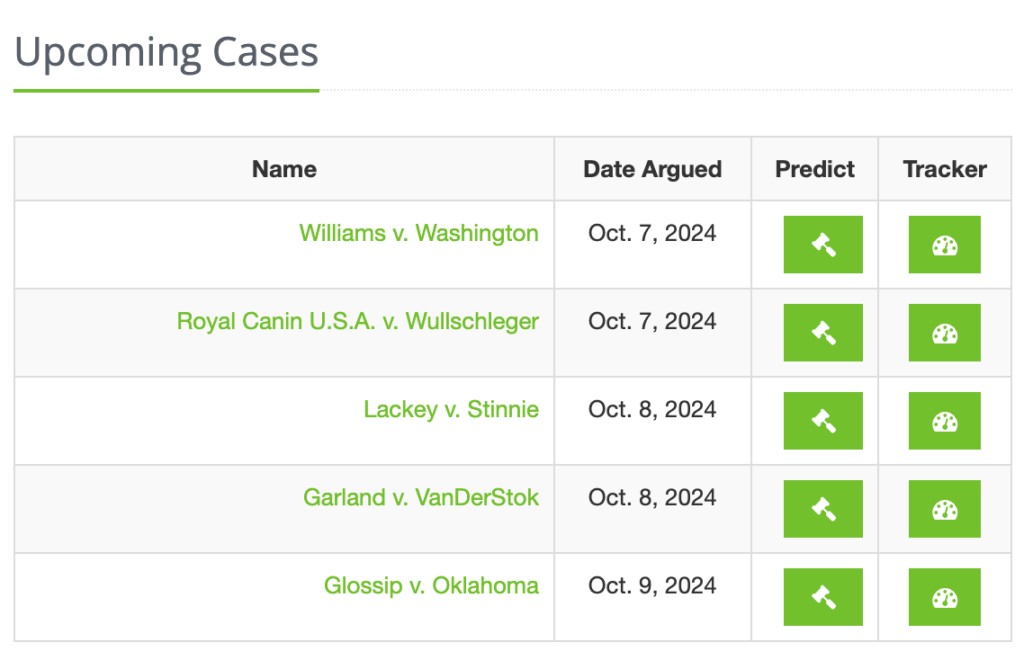
I am honored to open up the 16th Season of FantasySCOTUS. I launched the site back in 2009 when I was still clerking. Now, more than decade later, thousands of Court watchers have made their predictions. Sign up today at FantasySCOTUS.net to predict the outcome of all the blockbusters this term.
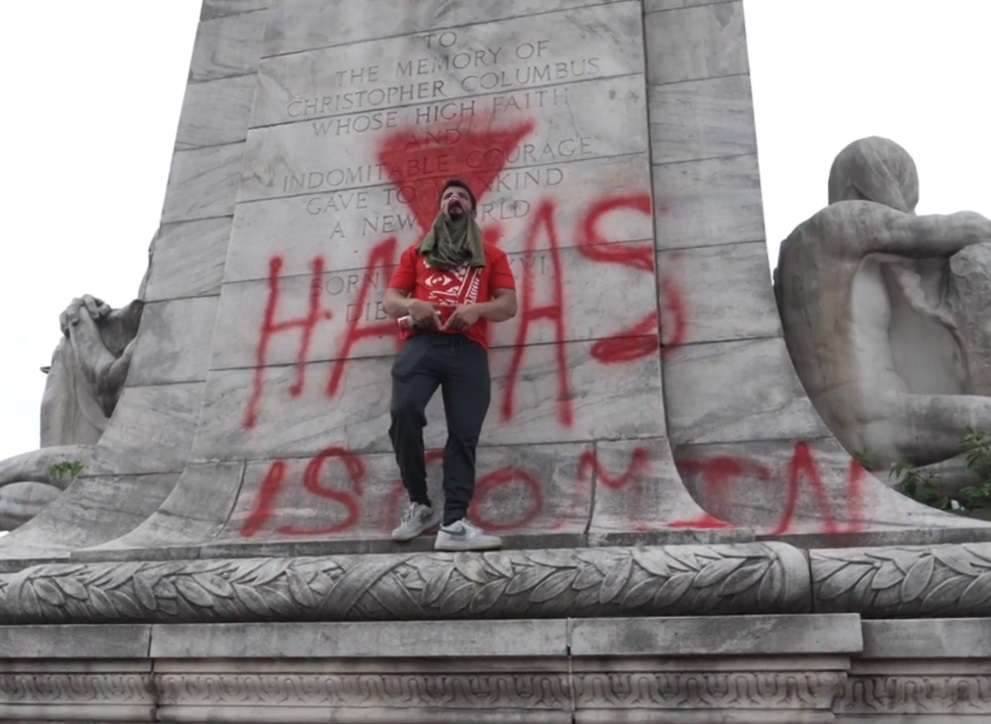
From the government's supporting affidavit in U.S. v. Mahdawi(D.D.C.); Mahdawi's actions were part of a broader demonstration at which some "individuals … pulled down flags affixed to the flagpoles; burned flags and objects; interfered with law enforcement's ability to place individuals under arrest; and sprayed graffiti on multiple statutes and structures," causing total cleanup costs of $11K:
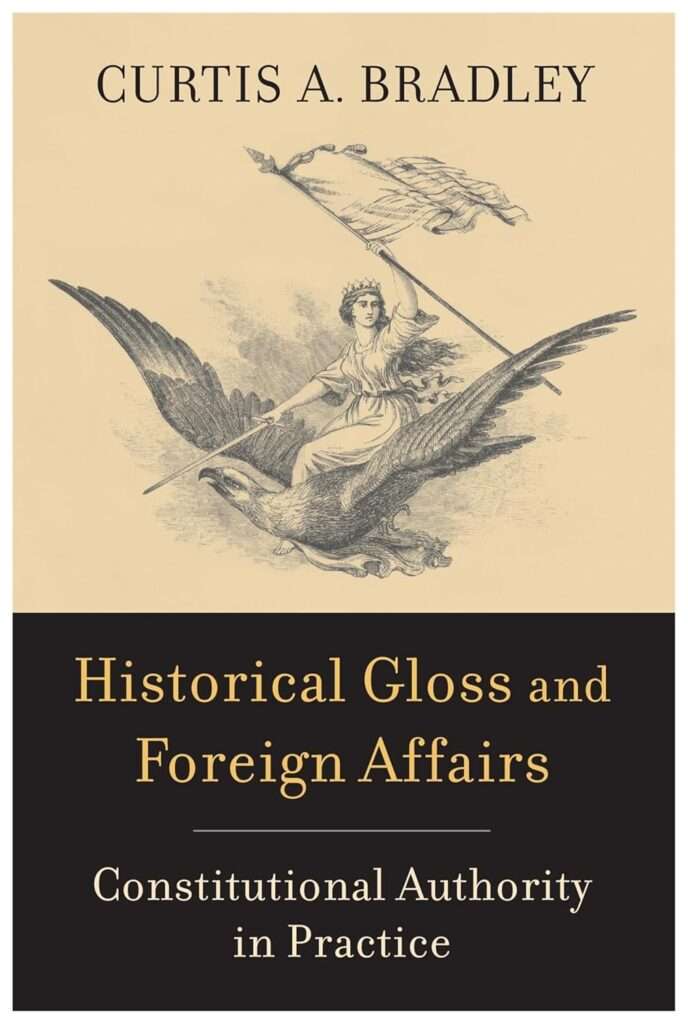
In a series of five posts this week, I will describe my new book, Historical Gloss and Foreign Affairs: Constitutional Authority in Practice (Harvard University Press 2024). This first post discusses the phenomenon of "historical gloss" and explains why it has played an especially significant role in the foreign affairs area.
The core question addressed in the book is how foreign affairs authority is distributed between Congress and the President. The first thing that you might want to do in answering this question would be to consult the text of the Constitution. You would immediately encounter a problem, however, which is that the text is silent about many key issues of foreign affairs authority. For example, there is no mention in the text of the powers to declare neutrality, issue passports, recognize foreign governments, extradite criminal suspects, enter into executive agreements, terminate treaties, regulate the exclusion and deportation of non-citizens, or wage undeclared wars. As Louis Henkin noted long ago in his treatise on foreign relations law, there are a host of what appear to be "missing" foreign affairs powers that "were clearly intended for, and have always been exercised by, the federal government."
These omissions would be less of a problem if it were easy to amend the Constitution, but it is not. Amendments normally require a two-thirds vote in both the House and the Senate and an approval by three-fourths of the states. In part because of this difficulty, none of the foreign affairs provisions of the Constitution have ever been amended in the more than 230 years since the Constitution took effect.
Yet, to state the obvious, we live in a world that is very different from that of the Founding. The country has grown from a small group of former colonies along the eastern seaboard to fifty states including Alaska and Hawaii. The United States was a party to seven international agreements at the Founding and is now a party to many thousands. The country was extremely weak militarily at the Founding, with only about 700 people in the army and no navy, and it is now a global superpower with bases around the world and nuclear weapons. The State Department at the Founding was Thomas Jefferson and a couple of clerks, but it now has over 70,000 employees. From the perspective of the constitutional text, we are managing foreign affairs with a horse-and-buggy constitution.
I was asked this question at a panel of the recent Israeli American Council national conference, and here is how I responded:
As a rule, the act of boycotting is not constitutionally protected, because it's considered an economic act, not a matter of free expression. That said, as a general matter, anyone is free to advocate a boycott, because advocacy is protected speech. In any event, regardless of constitutional considerations, no one is going to force a professor to submit a paper to an academic conference held at Tel Aviv University. So in that sense, professors are free, for example, to boycott Israeli universities as much as they want.
But a problem arises when a professor is acting on behalf of his institution.
The Boycott, Divestment, and Sanctions (BDS) movement advocates boycotting Israeli universities, which is against policy at all major universities. An individual professor has no right to go against university policy when acting on behalf of the university. The BDS movement also suggests boycotting anyone with ties to Israeli universities, and also anyone who supports what they consider Israeli violations of international law and human rights. By their lights this means, for example, anyone who supports any Israeli military action in Gaza or Lebanon, which they (absurdly) call "genocide" (and did so well before 10/7) Israel's actions. This, in turn, means boycotting almost all Israelis and most American Jews. This would be a violation of state law in many states, could be a violation of the First Amendment at state universities, would violate university policies regarding academic freedom, and likely would violate federal and state antidiscrimination laws.
And I think that's where we need to get tough. If a professor has said that he or she is personally pledged to adopt BDS and academic boycotts of Israel, we should insist that the rule that such a person may not serve as a dean, may not serve on hiring committees, may not serve on disciplinary committees, may not have any role in making decisions where they will have an opportunity to act on their stated principles and discriminate. The reason for this insistence is not because of the individuals' ideology, but because they have announced that in their professional lives they act in ways inconsistent with what would be their responsibilities acting on behalf of the university.
That said, merely stating "I think the BDS movement is a good idea," would not come within this rule, though universities would absolutely be within their rights to expect all faculty to sign a pledge that they will not discriminate based on national origin, ties to a foreign country, or political views before allowing that individual to wield university power.
Finally, I think professors have no right to refuse to write letters of recommendations to their students because they disapprove of their students' political views. There is, I think a way to do this without forcing a professor to write specifically to an organization that he disapproves of. Just tell the student, "I can't write a letter to ___ for you, but I of course will give you a generic letter of recommendation, and you can send it to whomever you wish."
There has been an apparent increase in the rate at which litigants seek--and courts award--nationwide relief against federal regulatory agencies. The Administrative Conference of the United States recently held two panels to examine the impact that such relief has had on federal regulatory programs. The two panels provide useful background and insights about how nationwide relief, including universal vacatur under the Administrative Procedure Act have affected regulatory agencies and what, if anything, to do about it.
Second, on October 2, ACUS held a panel on the Opportunities and Challenges of Nationwide Relief, featuring Amanda Frost, Alisa Klein, and myself, moderated by Adam White. As readers might expect, I reprised some of my earlier commentary on this subject.
I'm delighted to report that Prof. Curtis A. Bradley (Chicago) will be guest-blogging this coming week about his new book; here's the publisher's summary of the book:
A new interpretation of the constitutional law of foreign affairs, as it has been developed throughout its history by presidents and by Congress.
In the more than 230 years since the Constitution took effect, the constitutional law governing the conduct of foreign affairs has evolved significantly. But that evolution did not come through formal amendments or Supreme Court rulings. Rather, the law has been defined by the practices of Congress and the executive branch, also known as "historical gloss."
Curtis A. Bradley documents this process in action. He shows that expansions in presidential power over foreign affairs have often been justified by reference to historical gloss, but that Congress has not merely stepped aside. Belying conventional accounts of the "imperial presidency" in foreign affairs, Congress has also benefited from gloss, claiming powers for itself in the international arena not clearly addressed in the constitutional text and disrupting claims of exclusive presidential authority.
Historical Gloss and Foreign Affairs proposes a constitutional theory that can make sense of these legal changes. In contrast, originalist theories of constitutional interpretation often ignore influential post-Founding developments, while nonoriginalist theories tend to focus on judicial decisions rather than the actions and reasoning of Congress and the executive branch. Moreover, the constitutional theories that do focus on practice have typically emphasized changes at particular moments in time.
What we see in the constitutional law of foreign affairs, however, is the long-term accumulation of nonjudicial precedents that is characteristic of historical gloss. With gloss confirmed as a prime mover in the development of foreign affairs law, we can begin to recognize its broader status as an important and longstanding form of constitutional reasoning.
Venezuelans fleeing the socialist regime of Nicolas Maduro. (NA)
Yesterday, the Biden Administration decided not to extend the parole term for participants in the CHNV private sponsorship parole program for migrants from Cuba, Nicaragua, Haiti, and Venezuela:
The Biden administration will not be extending the legal status of hundreds of thousands of migrants who were allowed to fly to the U.S. under a sponsorship program designed to reduce illegal border crossings, the Department of Homeland Security announced Friday.
Instead, migrants who have come to the U.S. under the policy will be directed to try to obtain legal status through other immigration programs, leave the country or face deportation proceedings.
The administration first launched the sponsorship program in October 2022 to discourage Venezuelans from traveling to the U.S.-Mexico border by offering them a legal way to enter the country if American-based individuals agreed to sponsor them. It was then expanded in January 2023 to include migrants from Cuba, Haiti and Nicaragua, whose citizens were also crossing the U.S. southern border in record numbers at the time.
As of the end of August, 530,000 migrants from these four countries had flown into the U.S. under the policy, known as the CHNV program, government figures show. They were granted permission to live and work in the U.S. legally for two years under an immigration law known as parole, which presidents can use to welcome foreigners on humanitarian or public interest grounds.
Roughly 214,000 Haitians, 117,000 Venezuelans, 111,000 Cubans and 96,000 Nicaraguans have come to the U.S. so far under the policy, according to government data. The first group set to start losing their parole status this month are Venezuelans, who began coming to the U.S. through the CHNV program in October 2022. The parole periods of Cubans, Haitians and Nicaraguans will not start to expire until early next year.
This decision is simultaneously cruel and counterproductive. It's cruel because the horrific conditions that justified the creation of the program in the first place are highly unlikely to end in the next year or two. Cuba, Venezuela, and Nicaragua will likely still be ruled by brutal socialist dictatorships. And Haiti will likely still suffer from endemic violence. The statute that empowers the president to grant parole states it can be given "for urgent humanitarian reasons or significant public benefit." The "urgent humanitarian reasons" justifying it in this case are highly unlikely to end anytime soon. The same goes for the "significant public benefit" of reducing disorder at the border. CHNV reduces illegal migration by making the legal alternative easier and more widely available. Instead of curtailing the program, Biden should expand it.
The Biden administration did (rightly) extend the parole period for Afghan and Ukrainian participants in similar parole programs. The case for CHNV participants is equally compelling.
Moreover, the predictable consequence of this decision - unless it is reversed - will be to create a larger population of illegal migrants. Migrants from Cuba, Nicaragua, and Venezuela can't be deported, because those countries won't accept US deportees. And most are unlikely to leave on their own, because even living in the US illegally is less bad than returning to the terrible conditions their home countries. Haiti does accept US deportations, but many Haitians are likely to remain illegally, nonetheless.
Losing legal status will obviously be bad for the migrants themselves. But it's also bad for the US economy and society. Migrants with legal status can work at a wider range of jobs, and become more fully integrated into our society. That makes them more productive, increasing their economic and fiscal contributions. The Congressional Budget Office estimates increased migration since 2021 will reduce the federal budget deficit by almost $1 trillion over the next decade. CHNV migrants contribute to that, and can contribute more if we extend their legal status.
In sum, the net effect of Biden's decision will likely be to harm migrants fleeing violence and oppression, damage the US economy, and create more disorder. Great job, Mr. President!
Of course the real motive for this step may be political, trying to give Kamala Harris a boost in the upcoming election. If so, I doubt it will succeed. Swing voters are generally ignorant of policy details - even more so than committed partisans, and few are likely to even be aware of this decision, much less change their votes because of it. The kinds of intensely nativist voters who do know about the shift and support it are highly unlikely to vote for Harris, regardless.
Admittedly, I have not seen any good polling data on this particular issue. And it's important to guard against the temptation to think that one's own policy preferences are necessarily popular (I know all too well that many of mine are not). Perhaps new surveys will prove me wrong about the political effects of this step, though I doubt it.
Since the beginning of the Uniting for Ukraine program, on which CHNV is based, I have argued that Congress should give participants in these programs permanent legal status. They should pass a modified version of the Venezuelan Adjustment Act (sponsored by GOP Rep. Maria Elvira Salazar), and similar legislation to cover the Ukrainians, Afghans, and others. The fate of these people should not be left up to the whims of whoever occupies the Oval Office. Sadly, however, such legislation is highly unlikely to pass before the November election.
If Trump wins, it will almost certainly not pass afterwards, either. There was a time when the Republican Party would have (rightly) pilloried Biden for this betrayal of refugees from socialist oppression. Today's GOP, sadly, prioritizes nativism over anticommunism. Many also favor nationalist economic policies that resemble socialist ones.
If Kamala Harris prevails, I hope she might reverse Biden's misguided decision on parole extension, and promote adjustment acts that will resolve the issue permanently.
Next week the U.S. Supreme Court will hear oral argument in Lackey v. Stinnie, a case that presents two questions about whether and when a party who receives a preliminary injunction may recover attorneys' fees as a "prevailing party" under 42 U.S.C. § 1988. An en banc decision of the Fourth Circuit said yes to prevailing party status for the plaintiff who secured a preliminary injunction before the challenged statutory provision was repealed.
The case is interesting for many reasons. One is the unusual split among the amici. The government amici, including conservative states and the Biden administration, lined up in support of the petitioner (arguing that the PI-receiving plaintiff was not a prevailing party). The public interest organizations lined up in support of the defendant (arguing for prevailing party status). That might not seem surprising--after all, fee shifting is an important part of the latter group's business model.
But below the surface two points are worthy of note. One is that many challenges to rules and statutes, at least at the federal level, are now led by coalitions of states. In this case, the states revert to form as paradigmatic defendants, instead of being challengers. The other point of note is that the public interest organizations that engaged in the case, although from across the political spectrum, tended to be more conservative ones. Attorneys' fees help drive public interest litigation, and the valence of a substantial portion of that litigation has shifted remarkably from what the amici would have looked like, say, ten years ago. And, of course, it will shift again.
More interesting, though, are the alternative visions of the preliminary injunction sketched out by the parties and their amici. The petitioners argue that the nature of the preliminary injunction is inconsistent with treating it as a judgment or final determination on the merits. No one has prevailed yet. The respondents treat the preliminary injunction as a judgment, a full determination of the merits. And they need to treat it that way so it is the judicial action itself, not the legislature's response to it, that is decisive.
I don't think it's really open to question who is right on this point. The petitioners (and the SG) correctly state the law of the preliminary injunction, and the respondents do not correctly describe what it is. I understand that one could come at this case in terms of incentives for strategic behavior, thinking about the political economy of public interest litigation and legislative responses. And that could open up a range of normative judgments (and that is the approach taken by some amici supporting the respondents). But if we approach it from the perspective of what a preliminary injunction is, and what consequences should follow from it, there is no room for doubt.



 This is the second of five posts about my new book,



 I am honored to open up the 16th Season of