The Volokh Conspiracy

Mostly law professors | Sometimes contrarian | Often libertarian | Always independent | Est. 2002

The Volokh Conspiracy

Free Speech

TikTok Divestiture Mandate Doesn't Violate the First Amendment

|

So the D.C. Circuit just held in TikTok v. Garland, written by Judge Douglas Ginsburg, and joined by Judge Neomi Rao. Some key excerpts from the panel majority:

To summarize our First Amendment analysis: The Government has provided two national security justifications for the Act. We assumed without deciding the Act is subject to strict scrutiny and we now uphold the TikTok-specific portions of the Act under each justification. This conclusion is supported by ample evidence that the Act is the least restrictive means of advancing the Government's compelling national security interests….

[T]he Government offers two national security justifications for the Act: to counter (1) the PRC's efforts to collect data of and about persons in the United States, and (2) the risk of the PRC covertly manipulating content on TikTok. Each constitutes an independently compelling national security interest.

In reaching that conclusion, we follow the Supreme Court in affording great weight to the Government's "evaluation of the facts" because the Act "implicates sensitive and weighty interests of national security and foreign affairs." At the same time, of course, we "do not defer to the Government's reading of the First Amendment." We simply recognize the comparatively limited competence of courts at "collecting evidence and drawing factual inferences in this area." With regard to national security issues, the political branches may — and often must — base their actions on their "informed judgment," which "affects what we may reasonably insist on from the Government." …

We … reject TikTok's argument that the Government's data-related concerns are speculative. The Government "need not wait for a risk to materialize" before acting; its national security decisions often must be "based on informed judgment." Here the Government has drawn reasonable inferences based upon the evidence it has. That evidence includes attempts by the PRC to collect data on U.S. persons by leveraging Chinese-company investments and partnerships with U.S. organizations. It also includes the recent disclosure by former TikTok employees that TikTok employees "share U.S. user data on PRC-based internal communications systems that China-based ByteDance employees can access," and that the ByteDance subsidiary responsible for operating the platform in the United States "approved sending U.S. data to China several times." In short, the Government's concerns are well founded, not speculative….

Preventing covert content manipulation by an adversary nation also serves a compelling governmental interest. The petitioners object for two reasons, neither of which persuades. First, TikTok incorrectly frames the Government's justification as suppressing propaganda and misinformation. The Government's justification in fact concerns the risk of the PRC covertly manipulating content on the platform. For that
reason, again, the Act is directed only at control of TikTok by a foreign adversary nation.

Read More

crime victims

Boeing Plea Deal Rejected by Judge O'Connor

Judge O'Connor agrees with the 737 MAX crashes victims' families that the deal's proposed corporate monitor provision "marginalizes" the court and raises other concerns.

|

Today Judge Reed O'Connor rejected a proposed plea bargain between federal prosecutors and Boeing. The deal would have resolved Boeing's criminal liability for its crime of lying to the FAA about the safety of the Boeing 737 MAX—lies that led directly and proximately to two crashes killing 346 people. The victims' families objected to the deal, and Judge O'Connor agreed with them. He concluded the provisions in the proposed resolution concerning a corporate monitor of Boeing were not in the public interest. According, Judge O'Connor rejected the proposed plea. He gave the parties (Boeing and DOJ) thirty days to advise the court as to how they want to proceed now—via a trial or (as seems more likely) a new plea deal.

I've blogged about the Boeing case a number of times before. (See earlier posts here, here, here, and here.) For the last several years, I have represented families who lost loved ones in the two crashes of Boeing 737 MAX aircraft. The families want Boeing held fully accountable for the harms caused by its federal conspiracy crime of defrauding the FAA about the safety of the 737 MAX and made subject to an independent corporate monitor to ensure that no other plane will crash because of concealed safety issues. In July, DOJ and Boeing negotiated a sweetheart plea deal that did not meet these objectives. And so, in October, I argued before Judge Reed O'Connor (N.D. Texas) that he should reject the proposed plea agreement.

Today, Judge O'Connor agreed with the families and used his authority to reject the proposed plea deal. He gave two reasons. Read More

Free Speech

Sealing Decision in Sexual Assault Lawsuit Against Fox News and Ed Henry

|

From Judge Abrams' opinion Monday in Eckhart v. Fox News Network, LLC (S.D.N.Y.):

Defendants Fox News Network, LLC and Ed Henry filed motions for summary judgment in this action. Plaintiff Jennifer Eckhart and both Defendants then filed letters requesting leave to seal or redact certain portions of Defendants' motion papers, including (1) information that named or identified third-party women who allegedly had sexual or romantic relationships with Henry, (2) a full declaration submitted by one such woman, "Jane Doe 1," (3) identifying information of third-party Fox News employees who were involved in complaints and internal investigations, (4) email addresses and phone numbers of non-parties, (5) Fox News' confidential business information, including Henry's compensation and the size of certain business expenditures, (6) sexually explicit messages between Eckhart and Henry, and (7) sexually explicit photographs sent by Eckhart to Henry. The parties generally agreed that the first five categories of information should be sealed or redacted, but dispute whether the latter two should as well.

For the reasons that follow, the Court grants the motions to seal or redact these materials except (2) the full declaration of Jane Doe 1 and (6) the explicit messages between Eckhart and Henry. While the (7) explicit photographs will remain sealed, the Court will unseal the verbal descriptions of the photographs provided in Defendants' motions….

Eckhart accuses Henry of sexual harassment, sexual assault, sex trafficking, and rape. She alleges that the two met while employed at Fox News, at which point Henry pursued her, sent her unsolicited and inappropriate text messages, and manipulated her into having a sexual and often violent relationship with him. In one central incident in February 2017, Eckhart says that Henry lured her to a hotel room under the guise of giving her career advice but proceeded to handcuff and rape her. Eckhart also alleges that Fox News, their employer, knew of and facilitated Henry's misconduct by failing to discipline Henry after other employees submitted complaints against him and by retaliating against Eckhart when she sought to hold Henry and Fox News accountable for their conduct. Defendants contest these allegations against them.

Read More

Economic Liberty

Constitutional Protections for Economic Liberty in North Carolina: The Fruits of Their Own Labor Clause and Beyond

|

I've long been interested in how state courts sometimes provide protection for economic liberty under state constitutions, beyond what the federal constitution would offer. I've seen this particularly in North Carolina, under the state constitution's Fruits of Their Own Labor Clause. Here's the latest example, from Tuesday's Proctor v. City of Jacksonville, in an opinion by Judge Griffin, joined by Judges Tyson and Collins:

This case arises out of tension between business owners in Jacksonville and the City …. In 2014, the City passed the Unified Development Ordinance of the City of Jacksonville ("the UDO"). The UDO provides numerous zoning maps which dictate the areas where a food truck may operate and numerous regulations which provide the conditions food trucks and private-property owners must meet before operating on private property[, including that] …

Any Food vendor shall be at least 250 feet from any other parcel containing: 1) a food vendor, 2) a low density, medium density, high density residential or downtown residential zoning district, and or 3) a restaurant; …

Plaintiffs allege the location restrictions prevent food truck operators from conducting business in approximately ninety-six percent of property located in Jacksonville. Because of these restrictions, Plaintiffs contend their rights to engage in safe and lawful occupations are severely infringed….

The Fruits of Their Labor clause provides: "We hold it to be self-evident that all persons are created equal; that they are endowed by their Creator with certain inalienable rights; that among these are life, liberty, the enjoyment of the fruits of their own labor, and the pursuit of happiness."

Our Supreme Court has recognized substantive economic protections under the Fruits of Their Labor Clause prevent the State and consequently its political subdivisions from creating and enforcing regulations that impede "legitimate and innocuous vocations by which men earn their daily bread." State v. Ballance (N.C. 1949) (holding a licensing scheme for photographers violated the Fruits of Their Labor Clause); see also Roller v. Allen (N.C. 1957) (holding a licensing scheme for ceramic tile installers violated the Fruits of Their Labor Clause).

Read More

Judges Really Don't Like This

|

From Judge Jamal Whitehead (W.D. Wash.) yesterday in Wright v. State Farm Fire & Casualty Co.:

This matter comes before the Court on several discovery-related motions ….

Counsel for the parties have traded barbs in their briefs and during oral argument about each other's lack of professionalism and motives, and they offer competing accounts about their meet and confer efforts and who is to blame for a breakdown in communications. Counsel must act with "a high degree of professionalism and collegiality" during any meet and confer. LCR 1(c)(6). Regardless of whose story is to be believed, counsel fell short of this standard here.

Expletive-laden phone calls, hang-ups, backing out of prior agreements without explanation, and misleading emails purporting to "memorialize" phone calls demean the integrity of the legal process and show disrespect to all concerned, including the Court in having to resolve petty disputes. Let it be clear: the Court will not tolerate such conduct moving forward and it expects all attorneys to adhere to the highest standards of professionalism, civility, and ethical practice moving forward.

Setting aside the parties' hyperbole and bluster, the various phone calls, letters, and emails submitted into evidence show that the parties have discussed the issues raised in their respective motions and that they've hit an impasse, requiring judicial intervention. Thus, the Court finds that the parties have satisfied the meet and confer requirement with respect to the motions for a protective order and to compel, even if just barely.

The Sound of Silence in Skrmetti

Hushed whispers and heads nodding.

|

About twenty minutes after oral arguments wrapped in Skrmetti, I wrote a quick summary of how I expected Justice Kagan to snatch a victory from the jaws of defeat. Here, I will offer further insights on Justice Gorsuch. Though he didn't say anything on the transcript, Loper Bright taught us about the sound of silence.

I asked a few people who were in the Court about Justice Gorsuch's demeanor. One said, "He just sat there. Expressionless." A second said his demeanor was "I'm sitting back in my chair and not planning to ask anything or reveal anything of my thinking about this case."

But a third offered this useful observation:

I was in the courtroom for the argument. You may be interested to know that after the second petitioners' lawyer finished, Gorsuch and Barrett had a very animated conversation in whispers. Several rounds of talking into each other's ears.

I don't know what they said, but they both seemed to agree about something. Smiles all around, nodding of heads, and some gestures that signify "you get it" coupled with that.

Maybe Barrett and Gorsuch were exchanging recipes for turkey chili and turmeric steak rub. But I think it more likely they were talking about the case. Now was their agreement about applying rational basis scrutiny or applying heightened scrutiny? I lean towards the former, but I cannot be sure. To paraphrase Justice Alito in Obergefell, I assume that those who cling to old beliefs will be able to whisper their thoughts in the recesses of their chambers, but if they repeat those views in public, they will risk being labeled as bigots.

Finally, a colleague who was not in the Court offered this recollection:

In my experience, in cases where the opposing parties are an individual vs. the government, Justice Gorsuch's total silence at oral argument means a vote for the government. I don't have the capability of doing some big study to prove this, but you probably do. In any event, if I'm right this means that Gorsuch will vote to uphold the law.

This is something that can be tested empirically. Ahem, Adam Feldman.

Speaking of Justice Alito, I think he enjoyed making this statement a bit too much:

So my question is: Why should we look to Bostock here? Bostock involved the interpretation of particular language in a particular statute. And this is not a question of statutory interpretation. It's a question of the application of the Equal Protection Clause of the Fourteenth Amendment, and the Court has addressed the -- the question of how an equal protection claim should be analyzed when the law in question treats a medical condition or procedure differently based on a characteristic that is associated with just one sex. And that was Geduldig in 1974, reaffirmed in Dobbs in 2022. And neither Bostock nor Dobbs saw any connection between the Bostock reasoning and the Geduldig/Dobbs standard. Bostock did not mention Geduldig, and Dobbs did not mention Bostock. So why should we -- we look to this Bostock-type reasoning here?

I think the Trump Administration lets this case ride, and it goes to a final judgment.

Free Speech

First Amendment Likely Protects Referring Patients for Out-of-State Abortions

|

Planned Parenthood Great Nw. v. Labrador, decided today by Judge William Fletcher, joined by Judges Kim McLane Wardlaw, blocks Idaho—which generally bans abortions—from punishing doctors who "'refer[]' a patient 'across state lines to an abortion provider'" (presumably for an abortion that is legal in the other state):

Despite ample opportunity to do so, the [Idaho] Attorney General has not contested in our court the merits of the preliminary injunction. On appeal, he has relied only on [certain] jurisdictional challenges [see the full opinion for more on those challenges -EV] …. We take the failure to object on the merits to the district court's preliminary injunction as a concession by the Attorney General that the district court was correct in granting the injunction. But we will not permit the Attorney General, through the tactic of failing to argue the merits of his appeal of the preliminary injunction, to avoid our addressing those merits in the course of affirming the district court….

The professional medical speech at issue here is entitled to at least as much First Amendment protection as other speech. Nat'l Inst. of Fam. & Life Advocs. v. Becerra (2018) ("Speech is not unprotected merely because it is uttered by 'professionals.'"). The exception for "regulations of professional conduct that incidentally burden speech" does not apply here. Section 18-622(1), as interpreted by the Attorney General in [an] Opinion Letter [that he had issued but then withdrew], is not merely an incidental burden. It directly prohibits medical professionals from "referring" a patient "across state lines to access abortion services." That is, it prohibits speech that is distinct from the actual provision of treatment.

Read More

Kagan's Play in Skrmetti: Find that the Tennessee Law Imposes a Valid "Quasi-Suspect" Classification on Transgender People under Cleburne

And Justice Kagan will try to persuade Justices Gorsuch and Barrett to concur in the judgment, creating a 4-3-2 split.

|

I've just finished listening to the 2.5 hour oral argument in Skrmetti. A majority of the Court seems prepared to uphold the Tennessee law. There may even be seven votes for that outcome. But as always, Justice Kagan is in the middle, trying to broker a compromise that preserves future challenges for transgender litigants.

I do not have the transcript yet, so this post will based on my best recollection. I'll post from the transcript later.

Solicitor General Prelogar argued that the Tennessee law imposes a sex-based classification. But Justice Kagan pushed her former law clerk whether the law imposed a different type of a classification--on the "status" of being transgender. I immediately thought of Cleburne and Romer, which both imposed some sort of quasi-suspect classification that was subject to Rational Basis "Plus Bite" scrutiny. Here is how Randy and I describe these precedents in 100 Cases:

Nevertheless, in two Equal Protection Clause cases the Supreme Court took a different approach. In City of Cleburne v. Cleburne Living Center, Inc. (1985) and Romer v. Evans (1996), the Court applied what is sometimes called heightened rational basis scrutiny, even though the classifications at issue were not suspect or quasi- suspect. In these atypical cases, the Court returned — at least temporarily — to the type of rationality review articulated in Carolene Products. . . .

In Cleburne and Romer — two Equal Protection Clause cases — the Court employed heightened rational basis scrutiny despite the absence of a suspect or quasi- suspect class. The Court would use a similar approach in Lawrence v. Texas (2003). This case overruled Bowers, and held that Texas's criminal prohibition on sodomy violated the Due Process Clause. Critically, the Court did not hold that the sodomy ban violated a "fundamental" right. Instead, the majority still reviewed the Texas law with heightened rational basis scrutiny.

Both of those precedents have fallen by the wayside after Obergefell, but they were never overruled.  And for a time, Justice Kennedy really believed this was the way to resolve gay rights cases. Prelogar did not take the bait and suggest that transgender status should be a quasi-suspect class. I don't know if she didn't see it, or the government refused to take that position.

But you know who did pick up on Kagan's question? Justice Barrett. She asked the Solicitor General about a quasi-suspect classification under Cleburne. She asked about whether there was a history of de jure discrimination against transgender people. She asked about Arlington Heights. Barrett was 100% locked in on this issue. Justice Alito also picked up on this line of questioning as well.

Matt Rice, the Tennessee Solicitor General, forcefully pushed back against this argument. He said that the Court has effectively abandoned those cases. (Randy and I have debated whether to remove Cleburne and Romer from our casebook.) Moreover, Rice argued that deciding whether a classification is quasi-suspect was unprincipled. For example, trying to decide whether a particular group lacks political power is not subject to any meaningful judicial guardrails. This was the sort of jurisprudence that was prominent in the 1970s and 1980s, but not in the modern era. Schuette v. BAMN (2014) buried that approach. Moreover, Rice noted that any argument based on Arlington Heights, which Barrett asked about, was waived in this case. In any event, there is no argument made that there is the sort of invidious discrimination, or what Justice Kennedy would have called "animus," that was found in Romer.

Kagan's play is transparent. She will vote to uphold the Tennessee law, but say that rather than applying rational basis scrutiny, the Court should recognize transgender people as a quasi-suspect class, or some other type of class, and laws discriminating against transgender people are reviewed with rational basis "plus bite." Prior to Obergefell, this was the roadmap for gay and lesbian discrimination. Kagan will say this Tennessee law survives that deferential standard, as would bans on transgender athletes, but lower federal courts will then have cover to halt all other laws that avoid those third rails. You can see how she would pitch this to Justices Barrett and Kavanaugh. We know from Jodi Kantor's reporting that Justice Kagan tried to broker deals in the Trump immunity case, but the conservatives were not interested. Kagan is trying, once again, to broke a deal. Her ideal would be a 4-3-2 split, or even a 3-3-3 split. Tennessee prevails, but no majority opinion establishes the standard of review, giving a green light to lower courts to police transgender laws. And the liberals defensively deny cert on all trans cases for the rest of time.

Justice Barrett did ask about the quasi-suspect class, but seemed very skeptical of the Arlington Heights issue. What about Justice Gorsuch? He did not say a word. Not a peep. He skipped each of the seriatim round. Shortly after the election, I wrote that the Trump administration would closely scrutinize Gorsuch's questions to determine whether or not to try to take Skrmetti off the docket.

The case will be argued in December. I'm sure all eyes will be on Justice Gorsuch to see what he does. We remember the fallout from Gorsuch's questions in Bostock.

Gorsuch gave us nothing to go on. He said nothing. Will he go along with Justice Kagan's gambit? Let's see what the Wall Street Journal Editorial page says.

Even if Justice Gorsuch joins Kagan, I still think there are five votes to review the law with the rational basis test. Justice Barrett may concur and say that the parental rights issue was not raised here, so it is not before the Court. Of course, after many relists, the Court (and Barrett) took no action on the ACLU's petition, which squarely raised the substantive due process issue. [Update: I wrote that this petition was denied, but it was not; it remains pending.] But the Court has full control over its docket. Chief Justice Roberts was talking about deference in a fast-moving area with uncertainty. He was invoking his South Bay standard. He will be happy to stand by his precedent there. Then again, we know that Justice Gorsuch vigorously dissented in South Bay. Justice Sotomayor brought this up. She even pointed to Gorsuch and said "my colleague to the right." He said nothing. Gorsuch also did not joint the dissents from denial of cert in Tingley, Edmo, Grimm, or Kincaid. He has been silent on transgender cases since Bostock.

RIP, Ken Kersch

|

I just learned that Ken Kersch, a political science professor at Boston College, has passed away. I knew and liked Ken, a lot, and I also benefitted a great deal from his work, especially his book Constructing Civil Liberties. The book deserves more attention than it's received, especially among law professors, so I thought I would reprint my review of the book from The American Historical Review:

This is a relentlessly interesting book, one that can't help but change the way the reader understands twentieth century American constitutional development. As Kersch persuasively argues, for much of the late twentieth century, American constitutional history was dominated by a whiggish narrative in which progressive forces consistently supportive of civil rights and civil liberties triumphed over the dark forces of reaction. This whiggish narrative, however, is full of holes.

For example, progressives of the early twentieth century fought mightily against privacy rights protected by the fourth and fifth amendments, in the name of the right of publicity. More specifically, the statebuilding project supported by progressives required that American businesses be subjected to intrusive and unprecedented inspection by regulatory and other legal authorities. Even future Supreme Court Justice Louis Brandeis's famous 1890 article supporting a constitutional "right to privacy"—later cited as the progenitor of modern "right to privacy" cases such as Griswold v. Connecticut—actually did not advocate a right to privacy that modern civil libertarians would even begin to recognize. Quite to the contrary, the article advocated recognition of a tort for invasion of privacy as a means of censoring even rather tepid tabloid journalism. Only after progressives had soundly defeated the "old" right to privacy in the economic sphere and established the modern bureaucratic state did they reimagine the right to privacy in terms congenial to modern liberalism, as an island of personal autonomy in a sea of statism. This victory also allowed them to revive the Fourth and Fifth Amendments in the service of protecting street criminals.

The whiggish narrative also asserts that a defining characteristic of American progressivism has been solicitude for the rights of oppressed minorities, especially African Americans. In fact, however, before the New Deal era most progressives were at best indifferent to African Americans' plight. Indeed, some were openly hostile to African American, and launched such progressive schemes as the wave of residential segregation laws that swept through the United States in the 1910s. These laws were invalidated by a unanimous decision of the "conservative" Supreme Court in Buchanan v. Warley in 1917, to a chorus of criticism by progressive legal scholars.

Organized labor, not civil rights, was the favored cause of progressives in the early twentieth century, and labor unions, especially AFL and railroad unions, were themselves hostile to African Americans. African Americans, in turn, for the most part fiercely opposed labor unionism. In alliance with the businesses that often provided them with work over white workers' objections, African Americans supported such "reactionary" policies as labor injunctions, strikebreaking, and the legality of yellow dog contracts. Kens argues that progressives only embraced the cause of civil rights when African Americans dropped their prior attachment to pre-New Deal individualistic conceptions of rights, and, modeling themselves on the successful model of organized labor, organized themselves as a constitutional class entitled to group rights in a statist legal and economic superstructure.

Finally, progressive conceptions of appropriate education policy were for the most part driven far more by a vision of imposing a centralized, statist school system on the American people than on any principled conception of civil liberties and separation of church and state. Progressive intellectuals strongly opposed the Meyer, Pierce, and Tokushige Supreme Court opinions of the 1920s, which protected local school board prerogatives and private schooling against progressive demands for homogenization and centralization of education. Progressives, in fact, were overtly hostile to the very existence of Catholic parochial schools; the constitutionality of banning such schools was at the heart of the Pierce case. By the 1960s, progressives and their allies on the scholarly community reinterpreted the quintessentially conservative Supreme Court cases—which their roots in the "reactionary" Lochner v. New York tradition—as civil libertarian cases protecting individual autonomy from conservative religious forces (see Griswold v. Connecticut and Roe v. Wade). However, progressive hostility to traditional Catholicism continued, as the history of both of these cases makes clear.

Similarly, after the New Deal, the overtly statist progressive attempt to in the 1920s to outlaw Catholic schools morphed into an attempt to ensure that government aid to Catholic schools was beyond the constitutional pale. The "civil libertarian" doctrine promulgated to accomplish this goal was the "separation of church and state." Courts initially used this doctrine primarily to suppress government assistance to Catholic schools and Catholic-dominated "release time" programs. However, as atheists and liberal Jews became increasingly influential in separationist organizations, the attack on Catholic education morphed into a broader war against expressions of Christian religious sentiment in the public schools, culminating in the Lemon v. Kurtzman decision in 1971. Not surprisingly, whiggish narratives neglect the anti-Catholic sentiment that initially spurred these constitutional developments.

Kersch puts all of these examples into the broad framework of American political and constitutional development. Most historians, law professors, and political scientists who write about constitutional history likely think of themselves as independent liberal, perhaps even radical, critics of their government. Kersch, however, will have none of it. He accuses the scholars who spun and sustained the fanciful but entirely mainstream whiggish narrative of the development of "civil rights and civil liberties" of "being heavily implicated in the political project of justifying, institutionalizing and … defending the New Deal constitutional regime." Rather than serving as the incisive and independent critics of their own imagination, the academic establishment has served as an implicit fourth (or fifth) branch of government, rewriting American history to retroactively justify the revolutionary changes to the American conception of rights, liberties, and the proper role of government that the New Deal precipitated and institutionalized.

Ultimately, this short review cannot do justice to the brilliance of Kersch's insights, or the breadth of his research. Suffice to say that Kersch is fully up to the challenge of explaining and defending a revisionist thesis of tremendous magnitude. Constructing Civil Liberties is simply the most provocative and enlightening book on constitutional history that I have ever read.


Politics

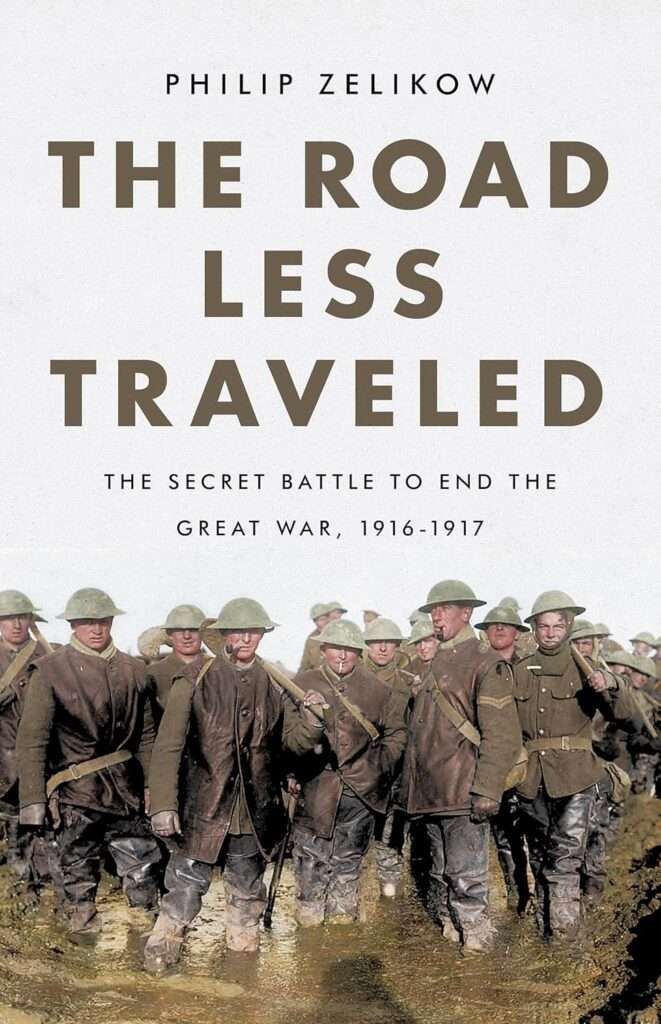
The Road Less Traveled: The Secret Battle to End the Great War, 1916-1917

|

I was talking to my Hoover colleague and noted diplomatic historian Philip Zelikow, and he mentioned this recent book of his; I asked him for a quick summary of his conclusions, and he was kind enough to put one together for me:

For five months, from August 1916 until the end of January 1917, leaders secretly struggled to end the Great War. Most of their struggle was out of public sight. It is still little understood today.

The spotlights have long been trained on how the war started. Scholars have minutely studied every move and countermove in the "July crisis" of 1914. Few have noticed or discussed why the war did not end in late 1916 and early 1917.

In many ways, these choices not to end the war are more interesting than the ones to start it. In July 1914, it was hard to see all the consequences of the choices. Time and options were extremely compressed. Between August 1916 and January 1917, the leaders had months to work and the stakes were tragically visible.

Few know that the German government secretly sought peace and pleaded for Wilson to mediate a peace conference. This was a direct move made at the top, coordinated with allies and key political figures in Germany.

Few know that Wilson entirely recognized the significance of this move and sought to act on it as quickly and emphatically as he could. He placed it at the top of his agenda as soon as he was reelected. Wilson also knew he had practically absolute leverage—mainly financial—over the Allied ability to continue the war. Given the political climate in the warring countries, much rested on the Americans, to give the peacemakers in all the warring capitals the face-saving way out.

Few know that the divided British coalition government was intensely, secretly, debating its own growing pessimism about the war and its imminent bankruptcy in the dollars to sustain it. These debates were quickened by a still deeper layer of secret knowledge. British intelligence had learned of the secret German peace move.

Read More

Free Speech

Court Rejects College Basketball Player's Defamation Suit Against Coach (Stemming from Dispute About Alleged Racism)

|

From yesterday's N.C. Court of Appeals decision in Fox v. Lenoir-Rhyne Univ., written by Judge Fred Gore and joined by Chief Judge Chris Dillon and Judge Donna Stroud:

Plaintiffs … were recruited to play women's basketball at Lenoir-Rhyne University …. During the height of COVID-19 in the 2020-2021 basketball season, there were racial tensions within the basketball team that caused the coaches and some administrative personnel to hold a meeting with the team. The team agreed to limit their team communication to only basketball-related and team goal-oriented discussions. Plaintiff Fox organized a "Symposium" for the basketball team and other university administrators to discuss racial prejudice, and later organized a second symposium, "The Talk," open to the entire university, to further discuss racial prejudice. Plaintiff Fox alleges the coaches sought to "retaliate" against her and other African American teammates after these events.

Plaintiffs attested in their affidavits that they were forced off the basketball team at the end of the 2020-2021 basketball season. Plaintiff Fox had a meeting with the coaches in which the coaches told her she did not fit into the culture of the team and that she would not be welcomed back onto the team for the 2021-2022 basketball season. The coaches offered to still give plaintiff Fox her full scholarship for the 2021-2022 basketball season. [Further details of actions taken with respect to to other plaintiffs omitted. -EV] …

{Plaintiff Fox [later] published a letter on social media, entitled "An Open Letter to Lenoir-Rhyne University" along with multiple social media pictures entitled, "The Racist 'Culture' of Lenoir-Rhyne University," "Quotes From Racist Teammates," "The Coaching Staff," "The NCAA & LR," and "Ignorance." Within the letter and social media posts, plaintiff Fox made claims of racism against coaches, basketball teammates, Lenoir-Rhyne, and claimed multiple players were forced to leave the basketball team because of racism.}

Read More

More