The Volokh Conspiracy

Mostly law professors | Sometimes contrarian | Often libertarian | Always independent | Est. 2002

The Volokh Conspiracy

Free Speech

What Alleged Behavior Could Lead to Liability for Anti-Semitic Harassment in CUNY Hunter College Case

|

As I noted earlier this morning, Friday's Report and Recommendation in Garrett v. City Univ. of N.Y. (S.D.N.Y.) (written by Magistrate Judge Robert Lehrburger) discusses the limits the First Amendment imposes on "hostile work environment harassment" law (as well as the similar rules as to education, public accommodation, and housing). It concludes that the First Amendment generally protects material on matters of public concern that isn't directly targeted to particular offended people based on their religion, race, sex, etc., but that other speech and conduct that is severe or pervasive enough to create a hostile work environment based on those attributes may be actionable.

The opinion is long, so I've divided it into several parts. Another post discusses the alleged behavior that the court concluded were protected by the First Amendment, while this post discusses the alleged incidents that are "actionable in the sense that they are within the reach of Title VII and not merely political speech protected by the First Amendment":

[1.] Accepting all allegations as pled and drawing all reasonable inferences in Garrett's favor, the anti-Hillel protest plausibly crossed the line into targeted harassment. President Kirschner described the protest as "reach[ing] a new level of aggression by targeting Hillel" and "personal[ly] targeting Jewish students." Many students—as well as Garrett—felt "compelled" to leave campus.   While protestors are free to criticize Hillel, or any campus organization for that matter, with strong and even offensive language, antidiscrimination law does not permit an employer to stand idly by when, as here, protestors "isolated or targeted individual[s]" in the protected class. Landau.

To be sure, discovery may show the protest did not involve threatening or humiliating targeted conduct. But given President Kirschner's own description of the event as "personal[l]y targeting" Jewish students and reaching a "new level of aggression" that compelled students and Garrett to leave campus, the Court concludes that Garrett has, at this early stage, plausibly pled actionable harassment from the Hillel protest.

{Generally, a plaintiff cannot transform political speech into actionable harassment by alleging, in a conclusory fashion, that the protected expression was targeted or otherwise actionable. See Gartenberg ("conclusory suggestion that [certain] speech included [actionable] 'threats of violence' … does not plausibly allege that any of this expressive conduct constituted" harassment). Here, however, the Complaint relies on Hunter President Kirschner's own account of the event.}

[2.] Garrett alleges a student was "physically assaulted, as his pro-Israel sign was forcibly taken from him" at one protest.  This allegation is actionable because the "First Amendment does not protect violence." NAACP v. Claiborne Hardware Co. (1982).

Read More

Free Speech

First Amendment Limits on Workplace Harassment Liability, in Claim of Anti-Semitic Harassment at CUNY Hunter College Following October 7 Attacks

|

I've long been interested in what limits the First Amendment imposes on "hostile work environment harassment" law (as well as the similar rules as to education, public accommodation, and housing); I wrote my 1992 law student article on the subject, and have monitored it since. Friday's Report and Recommendation in Garrett v. City Univ. of N.Y. (S.D.N.Y.) (written by Magistrate Judge Robert Lehrburger) offers an interesting analysis, and one that I think is generally sound (even if I would quibble with a few details). The opinion is long, so I've divided it into several parts; this part sets forth the general legal framework, and later parts will talk more about the details of the specific CUNY case.

In the wake of the October 7, 2023 terrorist attack in Israel, political unrest embroiled City University of New York's ("CUNY") Hunter College ("Hunter") campus. Dr. Leah Garrett, a Jewish professor who chairs the Jewish Studies department at Hunter, asserts that events during that period perpetuated antisemitism on campus and created a hostile work environment in violation of Title VII ….

Title VII makes it unlawful for an employer "to discriminate against any individual with respect to his compensation, terms, conditions, or privileges of employment, because of such individual's race, color, religion, sex, or national origin." Proscribed conduct includes subjecting employees to "harassment that, while not affecting economic benefits, creates a hostile or offensive working environment."

To state a hostile work environment claim under Title VII in this circuit, "a plaintiff must plead facts that would tend to show that the complained of conduct: (1) is objectively severe or pervasive—that is, creates an environment that a reasonable person would find hostile or abusive; (2) creates an environment that the plaintiff subjectively perceives as hostile or abusive; and (3) creates such an environment because of the plaintiff's [protected characteristic]." …

Anti-discrimination laws, including Title VII, do not operate in a vacuum. As courts and commentators have recognized, these laws may run up against the First Amendment and its protection of free expression. See, e.g., Saxe v. State College Area School District (3d Cir. 2001) ("anti-discrimination laws are [not necessarily] categorically immune from First Amendment challenge"); DeAngelis v. El Paso Municipal Police Officers Association (5th Cir. 1995) ("Where pure expression is involved, Title VII steers into the territory of the First Amendment"); Richard Fallon, Sexual Harassment, Content Neutrality, and the First Amendment Dog That Didn't Bark, 1994 Sup. Ct. Rev. 1, 17-19 (1994) (discussing "First Amendment Boundaries" on Title VII hostile environment claims); Rodney A. Smolla and Melville B. Nimmer, Smolla & Nimmer on Freedom of Speech § 13:17 (while Title VII and the First Amendment "are not on an apocalyptic collision course," there will be "difficult cases" requiring distinguishing between protected and unprotected speech).

Speech that is discriminatory, offensive, or hateful often falls within the protective ambit of the First Amendment. Matal v. Tam (2017) ("Speech that demeans on the basis of race, ethnicity, gender, religion, age, disability, or any other similar ground is hateful; but the proudest boast of our free speech jurisprudence is that we protect the freedom to express 'the thought that we hate'"); Volokh v. James (2d Cir. 2025) ("the Supreme Court has consistently held that expression motivated by bias, hatred, or bigotry falls within the First Amendment's protection"). Conversely, pure political speech—for which the First Amendment provides the most fulsome protection—may well be considered harassing. Eugene Volokh, Freedom of Speech and Workplace Harassment, 39 UCLA L. Rev. 1791, 1804 (1992) ("core protected speech can indeed constitute harassment"); see Snyder v. Phelps (2011) (political speech can "inflict great pain" on the targeted listener).

Read More

Academia

How Viewpoint Diversity Can Help Protect Academics from Themselves (and Perhaps Help Heal Our Civic Culture Too)

The lack of intellectual pluralism undermines the truth-seeking function of the university.

|

Ohio State Professor Michael Clune, who caused a bit of a stir in academia with his December 2024 essay "We Asked for It," has a new essay in the Chronicle of Higher Education responding to a recent critique of the push for heterodoxy and intellectual pluralism on campus. The essay, "Professors Can Be Ignorant. That's Why We Need Viewpoint Diversity," begins:

It's hard to succeed as an educator when you don't know what you're talking about. And yet many professors of the humanities and social sciences — teaching and writing on topics such as capitalism, police reform, and sexuality — fail a simple, classic test. To understand your own position, you must be aware of, and be able to respond to, objections to that position. We need greater diversity of political and social views in academe not because diversity is a higher value than truth, but because academics' intellectual isolation has compromised their capacity to pursue truth.

In an academic environment in which objections to the reigning political, social, and cultural assumptions are castigated as beyond the pale of academic discussion, professors find themselves dangerously isolated, ignorant of how their students and fellow citizens view their behavior. Discussing faculty posts on social media about the assassination of Charlie Kirk, a student at the University of Texas at Austin writes: "I've learned that there are people on my college campus who would cheer if someone like me, a young person who openly expresses my traditional Christian beliefs and right-wing political views, were murdered."

This is not the lesson most faculty members intend to teach, but many professors simply don't know how they appear to nonacademics and don't know how to respond appropriately to ideas that differ from their own. Professors in many fields tend to think that disagreement with their disciplines' consensus (on, say, police reform, capitalism, or gender) is equivalent to Holocaust denial, or, as Lisa Siraganian puts it in a recent essay in Academe attacking viewpoint diversity, denying the double-helix model of DNA.

As Clune discusses (and those of us with heterodox views in academia often experience) the lack of intellectual diversity in many departments and disciplines produces an epistemological failure and undermines academic inquiry, and this is particularly problematic in the humanities and social sciences.

the best case for intellectual diversity is a pragmatic one. While the sciences have hardly been immune to ideological distortions, not all fields suffer equally from a lack of different political perspectives. Some fields may not suffer any epistemological consequences at all. The goal of the university is the pursuit of truth; the pursuit of intellectual diversity is best seen as a means to that end. Physics or civil engineering may not be seriously compromised by ideological conformity; whether a biochemist is conservative or liberal may well have no effect at all on her teaching and research.

But I have come to believe that the questions asked by historians, literary scholars, and political scientists — which necessarily touch on matters of intense political controversy — cannot be adequately posed or answered in an atmosphere of ideological closure. . . .

The social sciences may well survive widespread epistemological failure and ideological closure, but the humanities may not be so lucky.

I fear that colleges' response to the political distortions of humanities disciplines will be to further marginalize and defund these disciplines. But the very feature of the humanities that renders them vulnerable to distortion by ideological conformity is also the source of their immense value to the educational enterprise. We are, ultimately, after human truths — the meaning of happiness, the nature of revolutions, the right way to organize a government, the best way to interpret a text or to judge a work of art. Our work engages passions and values that animate everyone's lives.

To see beyond our passions, to step outside our prejudices, to suspend our most powerful commitments — this is a discipline, and a difficult one. It is the humanities' proper discipline, and at this moment it requires welcoming new perspectives and voices into our classrooms and lecture halls. The creation of spaces in which the humanistic pursuit of truth can truly flourish may also be what this violent and divided nation most needs from higher education.

One way to address these concerns may to take Professor John McGinnis' advice and focus more on teaching students to disagree productively. This will help universities combat epistemic closure, and perhaps help heal our civic culture as well. In theory, law schools already do this, but the lack of meaningful ideological diversity hampers such efforts from being more effective.

An educational system should aspire to make citizens pass an "ideological Turing test," demonstrating the ability to present the strongest case for views they reject so persuasively that an examiner cannot infer their own. A person who can do so earns rapport across the aisle by grasping the full force of the arguments that motivate opponents.

Sadly, education at all stages today hinders the ability to pass this kind of test. . . .

Universities can still bend the civic arc if they return to their first vocation: truth-seeking through contestation. A democracy only functions well if its elites model respectful disagreement. That kind of respect is the first step to creating a political atmosphere free from fear and threat. This atmosphere is itself conducive to the willingness to compromise on which pluralist democracy depends.

Even With A Skewed Sample, The New York Times Survey Of Federal Judges Reveals A Brewing Judicial Crisis

And once again, you know who is to blame.

|

The New York Times surveyed nearly four-hundred federal judges, asking them about their views of the Supreme Court's emergency docket. I agree with co-blogger Jon Adler that the sample was skewed, and the small number of negative responses likely came from those judges who are "most unhappy with or critical of the Supreme Court." The biggest takeaway is that most judges ignored the survey, as they should have.

Still, I think the limited results reflects a brewing judicial crisis. After a years-long effort to delegitimize the Supreme Court, members of the Judiciary are now voicing these same concerns in off-the-record interviews, and from the bench.

Some of these judges may have simply lost their way, such as Judge Young in Boston. But other judges such as Judge Burroughs are speaking on these issues publicly.

The Times offered this smattering of quotes:

In interviews, federal judges called the Supreme Court's emergency orders "mystical," "overly blunt," "incredibly demoralizing and troubling" and "a slap in the face to the district courts." One judge compared their district's current relationship with the Supreme Court to "a war zone." Another said the courts were in the midst of a "judicial crisis."

I am almost certain the "war zone" is referring to the District of Massachusetts, which has gotten reversed many times.

Let's take a step back. The federal judiciary has a fairly well-defined hierarchy. Each federal district court has a Chief Judge, and each federal circuit court has a Chief Judge. If a member of the judiciary has a grievance with the Supreme Court, he can share that message with his Chief Judge. And, presumably, the Chief Judge can raise the message up the flagpole to the Judicial Conference. And who presides over the Judicial Conference? The Chief Justice of the United States.

We know from a leak that Chief Judge Boasberg raised concerns from other judges to Chief Justice Roberts. And what was Roberts's response? He downplayed the concerns, and said that Trump thanked him at the State of the Union for administering the oath.

If Chief Justice Roberts has adequately addressed the concerns of lower-court judges, I doubt those judges would feel compelled to talk to the press. I doubt the Chief is doing enough privately to assuage concerns. I have also heard from many judges over the years that the Chief runs the Judicial Conference with an iron fist. There is a discussion list, and any item not on the list cannot be discussed. There is no open-ended discussion. Indeed, the ill-fated judicial reassignment policy was not subject to any debate. We saw a glimpse of this parliamentary stranglehold in a piece about Roberts as chancellor of the Smithsonian. Perhaps in normal times, these Roberts Rules of Order make for an efficient process. But in times of crisis, the Judicial Conference must be a deliberative body that reflects the views of the entire judiciary, and not the agenda of the Chief Justice.

The above speaks to what the Chief has done in private. But I can say with a high degree of confidence that the Chief is not doing enough publicly to assuage concerns. Roberts maintains the same playbook of issuing short, summary orders that fail to adequately explain the Court's reasoning. Perhaps Roberts has the same view as Justice Barrett, and is afraid of "locking in" the Court on the merits.

Frankly, at this stage, we need to stop talking about "locking in." The emergency docket ruling is the whole ballgame. If the Court allows the administration to block funding, no one cares if the money is ultimately paid out in three years. NGOs and other non-profits will go out of business while waiting for the litigation to percolate. If the Court allows the administration to deport certain aliens, those individuals will be sent to countries that have no connection with. No one cares if the Court ultimately rules those people can be readmitted in a few years. If thousands of civil servants are laid off, they cannot sit idly for years waiting for claims to proceed. They will need to find other employment. And so on. This concern about "locking in" is so myopic at the present moment that Justice Barrett really should stop repeating the mantra. No one finds it persuasive.

Still, to Barrett's credit, she at least says something. Then again, she has a book to sell. Roberts says nothing at all. He just wants to pretend it is still 2006 and he has the opportunity to unite the Court with fewer 5-4 decisions. That ship sailed around the time he transmogrified a tax into a penalty.

The federal judiciary has needed new leadership for sometime, but the defection in the ranks is making this need more palpable.

Let me use a sports example. I went to Penn State, and have long been a Nittany Lions fan. At the start of this season, Penn State was ranked as high as #2 in the nation. Expectations were high for a national championship. But after three shaky victories, Penn State lost three games in a row, including two defeats to very weak teams. Penn State has lots of talent, but is badly underperforming. Fans are now chanting that James Franklin, the longtime coach, should be fired. How did Franklin respond? He took blame: "It's 100% on me." Of course, Franklin is not playing offense or defense, but the buck stops with him. Thankfully, Franklin does not have life tenure, and he can be removed. [Update: Shortly after I wrote this post, Penn State fired Coach Franklin.]

The buck stops with the Chief Justice. He can only cast one vote as a Justice, but as the swing vote, he will usually decide the fate of the Court. He is in the majority more than 95% of the time. And in an administrative capacity, Roberts has near-complete power over the structure of the judicial apparatus. If Roberts is unable to adequately address the concerns of the judiciary in private conference or through his public decisions, he should admit the problem is of his own making. These lower court judges are not blaming Trump or Stephen Miller or Pam Bondi. They are looking right at the Supreme Court. As a leader, Roberts should hold a summit with every judge who has been summarily reversed on the emergency docket to hear their concerns. There will be no discussion list. But I doubt he would brook that breach of decorum.

I have written that Justice Kavanaugh may be the right person for the moment. To his credit, he is trying to explain why the Court is doing what it is doing on the emergency docket. And he favors granting cert before judgment, followed by expedited oral argument. I am sure there are and will be things that I disagree with Justice Kavanaugh on. But unless the federal judiciary can resume regular order, the path forward is bleak.


Judiciary

Do Federal Judges Believe We Are in the Midst of a "Judicial Crisis"?

Thoughts on the New York Times' Selective Survey of District Court Judges

|

Today's New York Times reports that some federal judges are unhappy with the Supreme Court's repeated grant of interim relief to the Trump Administration in cases challenging Administration actions.

More than three dozen federal judges have told The New York Times that the Supreme Court's flurry of brief, opaque emergency orders in cases related to the Trump administration have left them confused about how to proceed in those matters and are hurting the judiciary's image with the public. . . .

The striking and highly unusual critique of the nation's highest court from lower court judges reveals the degree to which litigation over Mr. Trump's agenda has created strains in the federal judicial system.

The story is based upon the Times' selective survey of federal judges. Here's how the Times summarizes its results.

Sixty-five judges responded to a Times questionnaire sent to hundreds of federal judges across the country. Of those, 47 said the Supreme Court had been mishandling its emergency docket since Mr. Trump returned to office. . . .

In interviews, federal judges called the Supreme Court's emergency orders "mystical," "overly blunt," "incredibly demoralizing and troubling" and "a slap in the face to the district courts." One judge compared their district's current relationship with the Supreme Court to "a war zone." Another said the courts were in the midst of a "judicial crisis." . . .

Forty-two judges went so far as to say that the Supreme Court's emergency orders had caused "some" or "major" harm to the public's perception of the judiciary. Among those who responded to the question, nearly half of the Republican-nominated judges said they believed the orders had harmed the judiciary's standing in the public eye.

Twelve judges who responded to the questionnaire said they believed the Supreme Court had handled its emergency docket appropriately. But only two said public perception of judges had improved as a result of how the Supreme Court had handled its recent work.

The Times presents its analysis as "the most comprehensive picture to date about the extraordinary tensions within the judiciary." But is it really all that comprehensive? According to the story, the Times "reached out to more than 400 judges, including every judge in districts that have handled at least one legal challenge to a major piece of Mr. Trump's agenda" (emphasis added). In other words, the Times did not seek out a random or representative sample of federal judges, but instead solicited a sample weighted toward those judges most likely to disagree with the Supreme Court. [Update: Would the Times story hit quite the same way if it had reported "Fewer than fifteen percent of surveyed federal judges expressed concern about the Supreme Court's handling of the shadow docket"? Of course not, but it would be a true statement of what the Times found, even with the unrepresentative sample.]

As I have noted in prior posts (and this essay for The Dispatch), suits challenging Trump Administration initiatives are not randomly distributed among the nation's judicial districts. Rather they heave been concentrated in those districts plaintiffs expect to be most sympathetic to their claims. So by ensuring that every judge in such districts is included in its survey, the Times over-sampled those judges most likely to disagree with the Court's handling of the Trump Administration's requests for interim relief. After all, judges tend to think that their decisions were correct.

Even with the over-sampling, the Times only obtained sixty-five responses, and we have little information about the extent to which those judges are representative of those surveyed, let alone of the federal judiciary as a whole (especially if, as the story suggests at one point, that some of those surveyed are senior judges). The Times provides a breakdown of the number of responding judges appointed by Democratic and Republican presidents (and President Trump in particular).

Of the judges who responded, 28 were nominated by Republican presidents, including 10 by Mr. Trump; 37 were nominated by Democrats. While those nominated by Democrats were more critical of the Supreme Court, judges nominated by presidents of both parties expressed concerns.

This is interesting, but it only tells us so much.

Given the norms that have long prevailed with district court appointments (including the observance of blue slips), the party of the appointing president tells us far less about a district court judge than it does about appellate judges. Such norms may be breaking down, but until recently it was rare for a district court judge to get appointed without the support (or at least the acquiescence) of home state senators, and political deals were common. As a result, the political affiliation of a state's Senate delegation has long been a better indicator of a district court judge's likely judicial ideology than the party of the appointing president.

While the story quotes a handful of judges that were willing to provide comments to the Times reporters, the allegedly "comprehensive" picture comes from the responses to the Times' brief survey--survey responses that might be improper under the canons of judicial ethics. As the Times notes:

The judges responded to the questionnaire and spoke in interviews on the condition of anonymity so they could share their views candidly, as lower court judges are governed by a complex set of rules that include limitations on their public statements. . . .

The code of conduct for federal judges requires them to act in ways that promote "public confidence in the integrity and impartiality of the judiciary." They seldom comment on public controversies and almost never share their views of Supreme Court jurisprudence, outside of the carefully chosen words of their written opinions.

Given the potential ethical concerns with speaking to the press about these questions, it may also be the case that those judges most likely to respond to the survey are also those most unhappy with or critical of the Supreme Court. If so, this would be another reason to doubt whether the sentiments the Times reports are remotely representative.

Finally, one may wonder whether the Times survey was designed to elicit particularly substantive or nuanced information. I have a copy of what the Times emailed at least some of the respondents. [Screenshot below.] Here are the questions asked:

  1. The Supreme Court has made appropriate use of the emergency docket since President Trump returned to office.
    [Strongly Agree / Agree / Neutral / Disagree / Strongly Disagree]
  2. Lower-court judges have sufficient guidance from the Supreme Court about how to apply emergency docket orders.
    [Strongly Agree / Agree / Neutral / Disagree / Strongly Disagree]
  3. What effect, if any, has the Supreme Court's use of the emergency docket, since President Trump returned to office, had on the public's perception of the judiciary?
    [Major improvement / Some improvement / Little or No Effect / Some Harm / Major Harm]

The Times story ends with comments that appear to be from an interview with J. Harvie Wilkinson of the U.S. Court of Appeals for the Fourth Circuit.

A few judges were more equivocal about emergency orders, views that were echoed by Judge J. Harvie Wilkinson III of the U.S. Court of Appeals for the Fourth Circuit, a widely respected jurist and Reagan nominee who wrote a robust defense of the role that district courts play in the constitutional scheme. In an interview, Judge Wilkinson noted that the Supreme Court was largely at the mercy of circumstances beyond its control: a high volume of emergency challenges to a presidency that "would put its foot on the pedal, because it has an agenda, and it's sensitive to the fact that electoral mandates are perishable."

While noting that the emergency docket had its advantages in terms of quickly and uniformly managing a mushrooming caseload from the executive branch, Judge Wilkinson said there were good arguments for the Supreme Court to be careful about using it too much.

"You don't want too many snap judgments and emergency orders creating a public impression of either secretiveness or arbitrariness," he said.

Read More

Politics

Short Circuit: An Inexhaustive Weekly Compendium of Rulings from the Federal Courts of Appeal

SWAT raids, cats' paws, and Christian vegetarianism.

|

Please enjoy the latest edition of Short Circuit, a weekly feature written by a bunch of people at the Institute for Justice.

New case! In 2021, Maine voters approved a first-in-the-nation constitutional amendment that protects a robust, individual "right to food." And yet! Officials in Calais, Maine (pop. ~3,000) recently made it illegal for most residents to have backyard chicken coops, which is a real kick in the teeth for IJ clients Kamiwan and Paul Oliver, who rely on their meticulously maintained coop to feed their family of five. So last month, IJ and the Olivers filed suit to protect the state's new right-to-food protections. Click here to learn more.

New podcast! Short Circuit Live at UNC Law: An arbitrary and capricious Supreme Court preview with Sheldon Gilbert.

  1. Robbers steal guns, drugs, and money from an NYC stash house; the getaway driver doesn't get any of the loot before being arrested. Driver is later convicted of Hobbs Act robbery and ordered to forfeit $10k based on a pro rata share of what was stolen. He challenges the forfeiture order, arguing the Supreme Court's 2017 decision in Honeycutt limits forfeiture to property he actually acquired. Second Circuit: Sure does (deepening a circuit split)—and he acquired nothin'. Forfeiture order vacated.
  2. Were prison officials deliberately indifferent to a Connecticut inmate's severe gender dysphoria? Second Circuit: There was legitimate medical disagreement about the appropriate course of treatment, so they have qualified immunity. Dissent: Not for the 13 months they did nothing, during which the inmate attempted self-castration. Read More

Campus Free Speech

A Discussion of "Campus Free Speech After October 7" at NYU

The discussion of campus free speech that almost did not happen at NYU.

|

On Tuesday, the Federalist Society sponsored a panel on "Campus Free Speech After October 7," at New York University. The panel featured Judges Lisa Branch (Eleventh Circuit) and Roy Altman (S.D. Florida), former ACLU President Nadine Strossen, and the Manhattan Institute's Ilya Shapiro.

As detailed in the Washington Free Beacon, this event  (or, rather, a smaller event just featuring Ilya Shapiro) almost did not happen. NYU initially blocked the event, citing scheduling and security concerns, but ultimately relented once its actions were subject to public scrutiny.

The event did happen at NYU on October 7, and was live-streamed. The video is below.

AI in Court

Are We Dating the Same Vexatious Litigator Whose Filings Cite Nonexistent Cases?

|

In Souders v. Lazor, decided Wednesday by the Ohio Court of Appeals (Judge Marilyn Zayas, joined by Judges Terrance Nestor and Richard Moore), Souders sued based on "certain posts made in a Facebook group entitled, 'Are We Dating the Same Guy Cincinnati/Dayton'":

[T]wo of the named defendants … filed a motion to dismiss Souders' claims against them. The motion to dismiss asserted that the allegations against them arose from representation of their clients …. Additionally, appellees subsequently answered the complaint and filed a joint counterclaim to declare Souders a vexatious litigator under R.C. 2323.52….

The motion claimed that Souders' Hamilton County complaints "stemmed from his 'spurned attempts' to date defendant" Lazor:

After Lazor and Souders matched on a dating app and began talking, Lazor posted Souders' photo "to a community of local women" to gather background information on Souders, where she learned of several negative encounters with him. Lazor then attempted to stop communicating with Souders, but he continued to contact her—despite being blocked—on other social-media accounts, either as himself or while using a fake profile. Simultaneously, Souders sent a cease-and-desist letter to Lazor's home address, demanding that she remove the post about him.

Concerned about her personal safety and how Souders knew her address, Lazor filed for a civil stalking protection order ("CSPO") in Warren County where she resides. Shortly thereafter, Souders initiated the first Hamilton County action in the case …. Ultimately, the Hamilton County case was dismissed, and Lazor was granted a CSPO in the Warren County case. [For more on the Warren County case, see this 2024 post. -EV] Thereafter, Souder initiated the instant action.

Read More

Free Speech

Turning Point USA Chapter at Univ. of Tennessee (Chattanooga) Approved, Despite Student Government Opposition

|

From Chattanooga Times Free Press (Mason Edwards):

"While the Student Government Association may voice opinions, recognition of student organizations is determined by the UTC dean of students and chancellor," UTC spokesperson JAy Blackman said in an emailed statement. "Turning Point USA has been authorized in accordance with university policy and the law."

The Student Government Association denied the organization's approval in a vote Tuesday. The vote served as a recommendation to the Dean of Students Office.

Public universities may not deny student groups recognition or other generally available benefits based on the groups' viewpoint: "The State may not … discriminate against speech on the basis of … viewpoint." And that's true even if the group would be free to operate outside the benefits program: "If restrictions on access to a limited public forum are viewpoint discriminatory, the ability of a group to exist outside the forum would not cure the constitutional shortcoming."

Free Speech

School Allowed to Fire Teacher Whose Criticisms of School Policy Led to "Disruptive" Criticism and Insults from Public

|

From Tempel v. School Dist. of Waukesha, decided Sept. 29 by Magistrate Judge Nancy Joseph (E.D. Wis.):

Tempel was employed by the District as a dual-language first grade teacher at Heyer from fall 2018 until her termination on July 12, 2023…. In 2021, several new members were elected to the District's Board of Education, causing what many members of the Waukesha community perceived as a more conservative perspective shift.

In July 2021, the District suspended diversity, equity, and inclusion training for staff and suspended the work of the District's Equity Leadership Team…. In August 2021, pursuant to the Controversial Issues Polices, the Board enacted a policy to ban "controversial" signs in the classroom … [including] signage related to Black Lives Matter, Blue Lives Matter, Thin Blue Line, Anti-racist classroom, and other materials. The Policy also banned all flags, including Pride flags. The District's decision regarding signage garnered attention from the community, parents, students, teachers, staff, and news outlets. [Further details omitted. -EV] …

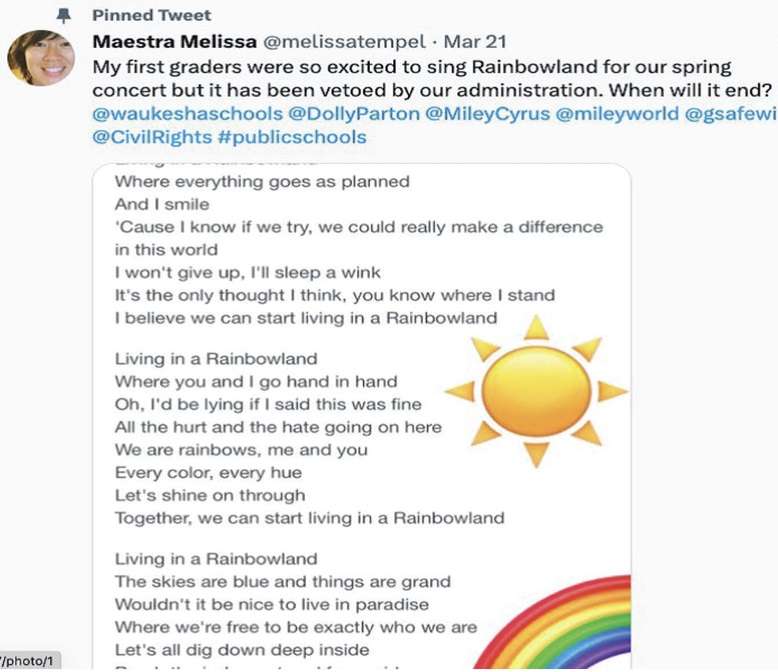
Every year, Heyer first grade students participate in a spring concert…. [One of the initially planned songs,] "Rainbowland" by Miley Cyrus and Dolly Parton … [was allegedly rejected by Principal] Schneider … [in favor of] "Rainbow Connection" by Kermit the Frog …. On March 21, 2023, at 6:39 p.m., Tempel posted the following tweet on her public Twitter account:

After this initial tweet, Tempel tweeted multiple times and conducted interviews with the news media about "Rainbowland" …. Subsequent to Tempel's tweets, the District asserts that it received numerous voicemails and emails containing "vulgar and threatening remarks" … [including]:

1."Hey, I heard your school district doesn't like gay people. Fuck you, you fucking retards! Kill yourselves!"

2."Religious based cultural ignorance-how stupid this is. You are small mindless assholes. Consider changing this or face the consequences,"

  1. "You are a fucking cunt for working for that pig. Rot in hell!"

[More details omitted. -EV]

The court concluded that Tempel could permissibly be fired under the so-called Pickering balancing test, which allows public employers to fire their employees when the employees' speech sufficiently undermines workplace efficiency:

Read More

More