The Volokh Conspiracy

Mostly law professors | Sometimes contrarian | Often libertarian | Always independent | Est. 2002

The Volokh Conspiracy

Health Care

Lawsuit Highlights the Case for Legalizing Organ Sales

The lawsuit, by a man seeking to win the right to sell his organs, is unlikely to succeed. But the law he challenges causes thousands of needless deaths every year.

|

New Jersey resident John Bellochio recently filed a lawsuit challenging the constitutionality of the National Organ Transplant Act of 1984 (NOTA), the federal law banning the sale of kidneys and other human organs for transplant:

A New Jersey man found out it was illegal to sell his own organs after he attempted to do so when he was short on cash, and he is now suing the federal government.

John Bellocchio filed a lawsuit in Manhattan federal court against U.S. Attorney General Merick Garland Thursday for the right to sell his organs, The New York Post first reported.

Bellocchio's attorney, Matthew Haicken, told the Post in a statement "if John ever had the opportunity, he should be legally free to sell his kidney."

"I believe the current law is unconstitutional. People should have the right to do with their body whatever they want," Haicken said.

Much as I wish it were otherwise, I fear the lawsuit has little, if any chance of succeeding. Under current Supreme Court precedent, laws restricting economic transactions are subject only to very minimal "rational basis" scrutiny. I believe that precedent should be reversed, or at least significantly revised. But that is unlikely to happen any time soon.

But even if the lawsuit fails, perhaps it can call attention to the enormous harm caused by NOTA. The ban on organ markets quite literally kills thousands of Americans every year, who die because they cannot get kidney transplants  in time to save them. It also condemns many more people to years of needless suffering on kidney dialysis.

I summarized some of the issues at stake in this comment quoted in a story published by Fox News, which interviewed me on the subject of the lawsuit:

Many who are opposed to a legal market for organs argue that it would lead to the exploitation of poor people, but Ilya Somin, a law professor at George Mason University and adjunct scholar at the Cato Institute, said this concern is misguided.

"Donating a kidney is actually less risky than all sorts of other things that we allow people to do all the time, including poor people, like being a lumberjack. That's much more risky in terms of risk of death and serious injury, but no one says, 'Poor people shouldn't be allowed to be lumberjacks,'" Somin told Fox News….

Even though there may be some risks, Somin argued that the benefits of a legal market for organs far outweigh the costs.

"Whatever objection you have to this, whether it's a left-wing objection or right-wing objection or something else, you have to ask: not only is there some sort of a problem, but is it a great enough problem that we should be willing to consign thousands of people to death every year, and many more thousands to kidney dialysis?" Somin said.

I also agree with Bellocchio's attorney, when he points out (in the same story), that "'My body, my choice,' shouldn't just be for abortion." Legalizing organ markets is indeed an implication of the "my body, my choice" principle at least as much as being pro-choice on abortion (which I also am). In my view, the former is actually an easier case than the latter, since there is no even remotely plausible plausible argument that organ markets are somehow equivalent to murder.

I addressed "exploitation of the poor" and other objections to organ markets in greater detail here and here.

Paranthetically, it was interesting to me that the Fox reporter who interviewed me on this issue was so sympathetic to the idea of organ markets, even though much of Fox's socially conservative audience probably opposes it based on religious or "sanctity of the body" objections. On the other hand, increasing allowable compensation was for expenses incurred by organ donors was one of the Trump administration's relatively few good policies, as explained in this piece on the liberal Vox site, which rarely had much occasion to praise the Trump administration on other issues.

The organ market issue actually cuts across conventional partisan and ideological lines, with libertarians, economists across the political spectrum, and liberals concerned about increasing access to health care aligned against other left-wingers who fear that organ markets will lead to exploitation of the poor, and social conservatives concerned about protecting what they view as the sanctity of the body.

Over time, I hope more people will see the enormous life-saving and misery-reducing potential of organ markets. Even if they don't set aside their concerns entirely, they might begin to recognize that any such issues are not weighty enough to justify forcibly consigning many thousands of people to suffering and death.


Crime

Race and Violent Crime

Do "Black and white people routinely commit crimes at similar rates," if we focus on violent crime? Is "Black-on-Black crime ... a myth"?

|

An article by a criminal law professor Thursday in the Columbus Dispatch included this assertion:

The reality is that Black-on-Black crime is a myth, and that Black and white people routinely commit crimes at similar rates, but Black people are overwhelmingly targeted for arrest.

Yet I think this is not the reality, at least as to violent crimes of the sort that are usually labeled "black-on-black" when committed by black criminals against black victims. (Blacks and whites do seem to commit drug possession and drug distribution crimes at relatively similar rates, but in this post I focus on violent crimes.) As best we can tell,

  • blacks appear to commit violent crimes at a substantially higher rate per capita than do whites;
  • there seems to be little aggregate disparity between the rate at which blacks commit violent crimes (especially when one focuses on crimes where the victims say they reported the crimes to the police) and the rate at which blacks are arrested for crimes; and
  • the black-on-black crime rate is especially high.

Of course, it's always hard to measure what the actual crime rate is for any group (whether for purposes of claiming that the rates are similar or that they are different). Still, the most reliable data, to my knowledge, is generally the National Crime Victimization Survey, and the U.S. Justice Department Bureau of Justice Statistics reports that are based on that survey. Indeed, the link in the quoted sentence from the article goes to a source that relies on such data.

Because the NCVS surveys a large group of people about their experiences with crime victimization, it is not based on what is reported to the police and what the police do with it. (The Uniform Crime Reports is based on data from police departments, and is thus generally a less reliable measure of actual crime.) Naturally, there are possible sources of bias in victim reports. But the NCVS seems to be the best data we have, and I know of no better source that yields other results. (If you do know, please let me know.)

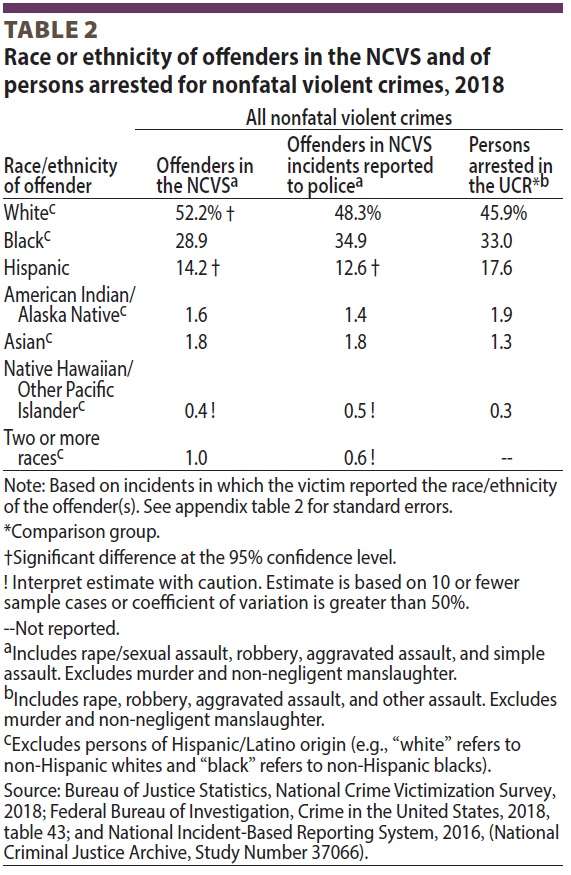
Here, then, is the data from the Bureau of Justice Statistics' Race and Ethnicity of Violent Crime Offenders and Arrestees, 2018, with regard to "rape/sexual assault, robbery, aggravated assault, and simple assault":

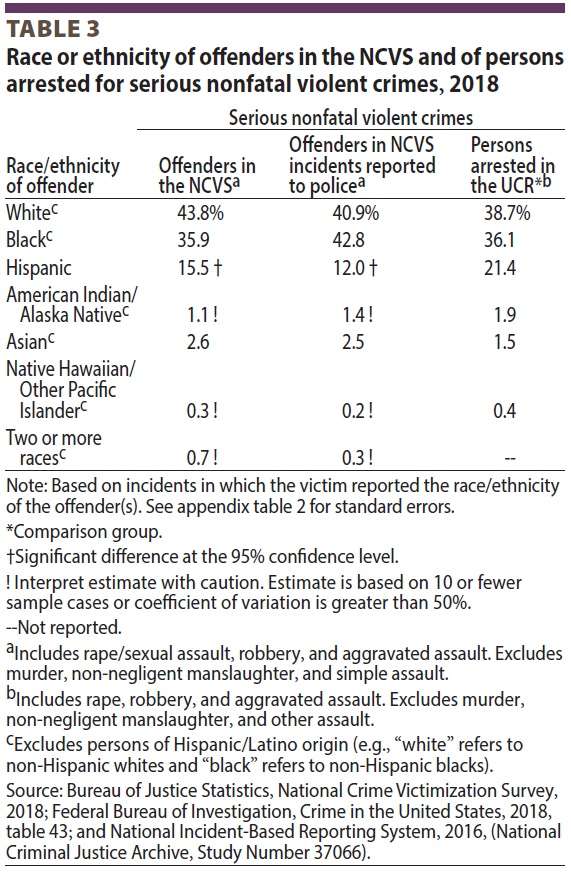
And here is the data for serious nonfatal violent crimes, which excludes simple assaults, and thus focuses on "rape/sexual assault, robbery, and aggravated assault":

Blacks, which here means non-Hispanic blacks, were 12.5% of the U.S. population, and non-Hispanic whites were 60.4%. It thus appears from this data that the black per capita violent crime rate is roughly 2.3 to 2.8 times the rate for the country as a whole, while the white per capita violent crime rate is roughly 0.7 to 0.9 times the rate for the country as a whole.

It also appears that the arrest rates for violent crime are roughly comparable to the rates of offending, especially if one takes into account those offenses reported to the police (which is a choice of the victims, not of police departments). And the great bulk of such violent crime is intraracial.

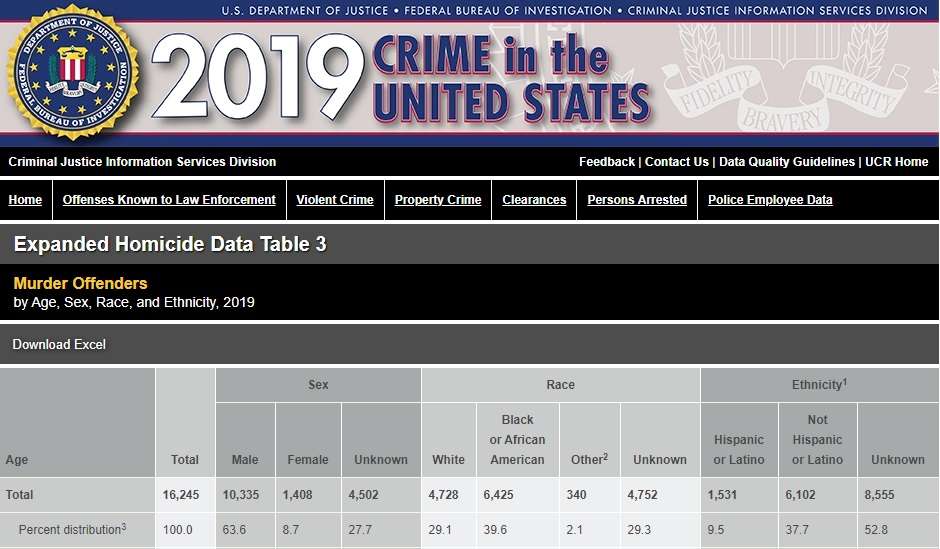
The disparity is even more striking for murder and nonnegligent manslaughter, which the NCVS doesn't measure (since the crime victim can't respond to the survey), and which thus relies on the police department reports in the UCR:

When the race of the offender was known, 55.9 percent were Black or African American, 41.1 percent were White, and 3.0 percent were of other races.

Here is the more specific data:

Many homicides are unsolved, and of course there is the risk of race-based investigation and enforcement. But again this is the best data we have, and it's consistent with victim demographics—it's clear that blacks are disproportionately likely to be murder victims—and the broadly accepted view that the overwhelming majority of homicide is intraracial.

Now naturally this reflects just aggregate statistics; the great majority of people in all racial groups don't commit violent crimes, and even the aggregate data may differ from place to place. Moreover, this doesn't tell us about property crimes (other than robbery, which is classified as a violent crime), because it's so hard to approximate the true rates of offense commission there: Most such property crimes are unwitnessed, so it's hard to gather survey data. And again, I'd love to hear any other data that might shed a different light on the violent crime statistics as well.

Still, the best data that I know of suggests that

  • black-on-black violent crime is not a myth;
  • blacks and whites generally commit violent crimes at substantially disparate rates (and, for homicides, sharply disparate rates); and
  • as best we can tell, the disparity in arrest rates for violent crimes is pretty close to the disparity in crimes that are committed, and especially crimes that the victims report to the police.

Another Spin of the Stare Decisis Broken Record

And Justice Sotomayor invites sentencers to "continue applying" Montgomery and Miller "faithfully," even if the majority did not.

|

I have written two posts about arcana in Jones v. Mississippi. Here, I will focus on the most important jurisprudential aspect of the case: stare decisis. Going forward, Justice Kennedy's 5-4 progressive decisions should no longer be treated as precedential. For sure, the Court will not overrule those cases. There is no need to. Instead, the Court will limit those cases in the most narrow fashion possible. The dissent will carp about stare decisis. And the majority will simply move onto the next case. Justices Breyer, Sotomayor, and Kagan should create a macro to save time on writing these dissents. And they will keep spinning the same broken record over and over again.

In Part II.C of her dissent, Justice Sotomayor plays the greatest hits. She cites Chief Justice Robert's concurrence in June Medical. Justice Alito's majority opinion in Gamble. Justice Kavanaugh's concurrence in Ramos, and his plurality in AAPC. So far, Justice Sotomayor treads familiar ground.

But then the dissent takes an unusual turn. Justice Sotomayor intimates that lower courts should follow Miller and Montgomery "faithfully," even if the Court narrowly confined the scope of those decisions:

For present purposes, sentencers should hold this Court to its word: Miller and Montgomery are still good law.6 See ante, at 19 ("Today's decision does not overrule Miller or Montgomery"). Sentencers are thus bound to continue applying those decisions faithfully. Thankfully, many States have already implemented robust procedures to give effect to Miller and Montgomery. In other States, the responsibility falls squarely on individual sentencers to use their discretion to "separate those juveniles who may be sentenced to life without parole from those who may not." Montgomery, 577 U. S., at 210. Failing to do so violates the EighthAmendment. 

Let's put into perspective what is going on here.

The Court adopted a very, very cramped rule reading of Montgomery, such that a sentencer need not make a finding that the defendant is "incorrigible." But the Court declined to overrule Montgomery. Justice Thomas accurately described the majority: "Montgomery gave a good-for-one-ride ticket to a class of juvenile offenders, and its errors will never be repeated." Justice Sotomayor disagreed with that reading of Montgomery. She concluded that the Eighth Amendment demands a finding of incorrigibility. And because Montgomery was not overruled, a sentencer should still adhere to Justice Sotomayor's reading of Montgomery. Why? The failure to follow that reading would violate the Eighth Amendment. After all, judges take an oath to the Constitution, and not to the Supreme Court. Wow!

When I read this passage, my mouth dropped to the floor. It is difficult for a Supreme Court decision to shock me. I am often disappointed, but usually I can predict the general range of possible decisions in advance.The last time I was this shocked was when CJ Roberts overruled Korematsu in the travel ban case. (I was in the Court during the handdown). Did not see that one coming. And before 2018, the last big shocker was probably NFIB v. Sebelius.

Here, Justice Sotomayor has opened an entirely new front in the battle over stare decisis: if the Roberts Court is unwilling to formally overrule a precedent, then lower courts should still follow those decisions "faithfully." Truly, this proposition is remarkable. Justice Sotomayor is inviting trial courts to engage in a judicial resistance of Jones. Yes, I used the phrase judicial resistance. Unless the Court is willing to bite the bullet and formally overrule the precedent, judges should still follow a rejected-reading of Montgomery and Miller. The antidote to stealth overruling is stealth underruling: lower courts should quietly fail to give a new Supreme Court precedent its fairest reading, in order to preserve a now-rejected reading of an older precedent.

This invitation is quite crafty. Let's say a sentencer declines to sentence a juvenile defendant to LWOP because the defendant is not incorrigible. That decision can be baked into the broader element of "discretion." Could an appeals court reverse a sentence, because the Supreme Court held that incorrigibility was not required? Of course not. A factor may not be required, but a judge, in his discretion, can still consider that factor. In other words, sentencers can get away with ignoring Jones, and probably will.

My, how far we've come. Several years ago, courts across the land anticipated the overruling of Baker v. Nelson. Now, judges are invited to adhere to readings of precedent that the Supreme Court formally rejected.

If we see this practice proliferate in other contexts, I suspect the Court will use the shadow docket to summarily reverse any dissidence. Still, those cases take years to bubble up. And the courts can't catch them all. Viva la resistance.

More