
Open Thread
What’s on your mind?

Mostly law professors | Sometimes contrarian | Often libertarian | Always independent | Est. 2002

What’s on your mind?
An excerpt from the longish opinion today by Judge Rudolph Contreras (D.D.C.) in Streever v. Mullin:
Americans have long voiced their displeasure with their government. The Declaration of Independence itself is a list of grievances between Americans and the British government. And Americans have not always indulged in the elevated prose of the Declaration. Government officials have long endured "vehement, caustic, and sometimes unpleasantly sharp attacks."
Today is no different. Plaintiff David Streever expressed his displeasure with the United States Immigration and Customs Enforcement ("ICE") by sending a three-paragraph email to the agency's Acting Director, Defendant Todd Lyons. Mr. Streever compared Acting Director Lyons to an infamous Nazi and predicted that he would become "a sad, despised man who eats himself alive with shame at [his] own pathetic weakness."
What is different is how the government responded in this case. ICE dispatched agents to Mr. Streever's home and delivered to him a "WARNING NOTICE." The notice threatened him with prosecution if he did not "discontinue" his criticism of ICE. Because that notice likely violates Mr. Streever's First Amendment right to free speech, the Court will grant, in part, Mr. Streever's motion for preliminary injunction, enjoining Defendants from relying on the Warning Notice, issuing similar threats, or making good on the threats in the Warning Notice…..
From today's decision in Jensen v. Minn. Bd. of Med. Practice, written by Eighth Circuit Judge David Stras and joined by Judges James Loken and Lavenski Smith:
Years of investigations by the Minnesota Board of Medical Practice caused Dr. Scott Jensen to speak less and spend more. Either would be enough for a court to hear his case, so we reverse….
Like the rest of the country, the COVID-19 pandemic divided Minnesotans. Some public officials, including Governor Tim Walz, pushed for aggressive measures to "stop the spread" of the virus. Others like Dr. Scott Jensen, then a state senator, had a different view. He opposed vaccine mandates and believed it was a mistake to close businesses and schools. He ran on that message as the Republican nominee for governor in the 2022 election.
Not everyone liked what he had to say. So much so that, from the pandemic's start until mid-2022, the Minnesota Board of Medical Practice received 18 complaints about him. The objection was almost always the same: Dr. Jensen was "spreading misinformation" and posed a "danger to public health." … [T]he 18 complaints led to four investigations. At the start of each one, the Board sent him a letter detailing the allegations. Two asked him to "respond[ ] in writing[ ]" and reminded him that, "as a licensee of the Board," he was "required to cooperate fully." When he replied to those, he provided the Board with hundreds of pages of information, including news stories about the pandemic, medical studies, and patient records.
One, which lasted more than a year, took on a life of its own. Like the others, it began with a letter informing him that the Board was investigating an allegation that he had "politiciz[ed] public health." He cooperated, but the Board waited until after the election to request an "in-person conference." The notice listed multiple possible violations, including "unethical or improper conduct" and "depart[ing] from or fail[ing] to conform to the minimal standards of acceptable and prevailing medical practice."
The subject line underscored the high stakes involved: "In the Matter of the Medical License of Scott M. Jensen, M.D." He hired a lawyer and spent countless hours preparing. After the conference ended, so did the investigation.
Jensen sued, claiming the investigations violated the First Amendment, and the court held that he had standing to raise this claim (even though he was challenging just the investigations, and not any actually implemented disciplinary measures):
Part of a Knight First Amendment Institute Symposium on Managing Government Employee Speech in a Democracy, which the Journal is publishing.
The article is here; the Introduction:
In 1909, Urban Walter, a 28-year-old mail clerk, founded a small magazine with large ambitions. According to its masthead, the Harpoon was "a magazine that hurts." It was founded in pursuit of one goal: to oppose the Post Office Department's imposition of a "gag order" on any discussion of the train wrecks that killed scores of railway mail clerks annually and maimed many hundreds more. These gag orders, first promulgated by the Postmaster General in the late 19th century and later expanded by executive orders issued by Theodore Roosevelt and William Taft, prohibited civil servants from petitioning or giving information to Congress, or advocating for improved pay or working conditions except through their departmental head. The Harpoon defied the order, promising to give the "fullest publicity" the dangerous conditions—both physical and organizational—of the work.
Walter was frequently ill with respiratory issues, exacerbated by moldy mailbags and the dusty, lamplit conditions on the mail car. To explain why he spent his precious "lay-off" time in a small print shop in Phoenix, Arizona, Walter invoked the highest of constitutional ideals. "No public official is great enough to take away the guaranteed rights of American citizenship," Walter explained. "The very constitutional rights" of "lesser public servants" were abrogated by an order that, under penalty of swift removal, prohibited a clerk from discussing his working conditions publicly and from complaining to Congress. Under what Walter saw as the pretext of maintaining "efficiency of service," postal officials had robbed 15,000 railway postal workers of their right to speech and right to petition the government. In so doing, officials had also undermined the public good by keeping Americans ignorant of the conditions under which their mail was delivered.
Urban Walter and the railway postal clerks who read and wrote for the Harpoon understood their fight for speech rights not in individualistic and expressive terms, but as a precondition for public accountability. Because of the transient, hidden nature of railway postal work, disclosure of the clerks' working conditions was the public's window into a job that also bore upon public safety. In 1909 alone, 27 railway mail workers were killed, 98 "seriously injured," and 617 "slightly injured"—the highest number of deaths on record. Under Walter's framing, the disclosure of dangerous working conditions implicated the "public good," and not just the narrow interests of an individual worker.
At the same time, Walter and other railway postal workers saw these gag orders not as a blunt instrument of "efficiency," but as an explicitly anti-union tactic designed to forestall the organization of an effective railway postal workers organization. Walter and other postal clerks fought to affiliate with the American Federation of Labor (AFL) through a breakaway faction of the Department-dominated Railway Mail Association (RMA). Many of those clerks were fired—dismissed for the "good of the service," or because of their "pernicious activity." Walter was one such worker. He sent Postmaster General Frank Hitchcock "an advance copy" of Harpoon's first issue, instructing the economy-minded Taft appointee to "carefully peruse" the enclosure. In response, the Department's informed him that his (untendered) resignation had been accepted. A clerk sent Walter a dead rat that he had found inside the drinking water of his car. A photo of the rat appeared in the Harpoon. The clerk was also fired. Other supporters of the magazine were threatened with dismissal—which intensified the newspaper's support, producing a culture of insubordination in defiance of executive orders and in support of public employee speech.
If you are someone who gets their news primarily from the New York Times and NPR, as many liberal-leaning Americans do, you often get a distorted picture of what is going on the US and the world. This is often less because of outright errors in reporting, and more about what isn't said.
For example, each outlet barely covered the widespread nationwide rioting that accompanied Black Lives Matters protests in summer 2020. I still meet people who think the the primary violence that summer was from police manhandling protestors, and are completely unaware of the deaths, injuries and massive property damage attributable to rioters.
Similarly, I keep encountering people who have no idea that there was widespread antisemitic violence, intimidation, and threats on college campuses after Oct. 7, 2023, and instead think that university officials and later the Trump administration had no justification for clamping down on what they perceive as peaceful "pro-Palestine" protests. And that's because they are being misinformed by sources like the Times and NPR.
Case in point: In a puff piece in yesterday's New York Times about a lawsuit filed by Mahmoud Khalil, alleging discrimination by Columbia University against Palestinian students and their "pro-Palestine" allies, the Times reports: "The 2023 and 2024 protests divided the Columbia campus, with thousands joining in, and others, including some Jewish students, saying they were too disruptive or made them feel unsafe."
Here, relying on a recent article of mine, is some of what happened at Columbia, limited to violence, threats, and intimidation--and this involves only the incidents that were publicly reported:
In October 2023, an Israeli Columbia student was assaulted in front of Butler Library by a former student who was no longer affiliated with the university. The assailant allegedly struck the student with a stick; police arrested and charged the suspect. During a separate student walkout "for Palestine," a Jewish student was allegedly shoved by a Columbia classmate wearing a keffiyeh and subsequently swarmed by protesters.
Another incident outside Butler Library was more explicitly antisemitic. According to a subsequent civil-rights complaint, an individual confronted a Jewish student while yelling "Free Palestine" and "Fuck the Jews." The assailant allegedly made the motivation explicit, telling the student that he had singled him out "because you are a Jew."
Other physical incidents followed. Columbia student Jonathan Lederer was assaulted while carrying Israeli flags on April 20, 2024; the source cited in my article reports that a suspect threw a rock at him. Lederer was assaulted again on December 11, 2024, while once again carrying an Israeli flag; this time, the assailant reportedly punched him and called him a "Nazi." In another incident, a Jewish Columbia student wearing a kippah was spat upon and told, "I hope you guys suffer."
These individual confrontations occurred against a background of increasingly intimidating mass protests. Demonstrators at Columbia shouted "Fuck the Jews," "Death to Jews," and "Fuck Israel," attempted to instigate fights, and screamed at a rabbi who was praying with students.
At one demonstration, protest organizer Mohsen Mahdawi used a megaphone to direct protesters to push back a small group of pro-Israel students. Columbia officials themselves later acknowledged that the campus had experienced "threatening rhetoric and intimidation."
Protesters also targeted a Columbia class dealing with Israel, distributing flyers bearing such slogans as "The enemy will not see tomorrow" and "Burn Zionism to the Ground." Jewish organizations characterized the messages as incitement.
Perhaps the most notorious individual episode involved Columbia student protest leader Khymani James. James publicly declared that "Zionists don't deserve to live" and said that people should be "grateful that I'm not just going out and murdering Zionists." Columbia suspended him, and even the White House condemned his statements.
What happened afterward is also significant. Columbia University Apartheid Divest (CUAD), the umbrella organization for anti-Israel groups on campus (and to which Khalid was attached), initially apologized for James's statements. It subsequently withdrew the apology and expressly endorsed "armed resistance." James likewise disavowed his expression of regret.
There was another feature of the protests that mattered to many Jewish students: anonymity. At Columbia, as elsewhere, many demonstrators concealed their identities with masks, keffiyehs, and other face coverings while participating in protests that included rhetoric such as "Globalize the Intifada."
Whatever one's view of that slogan in isolation, its effect can be different when it is shouted by anonymous demonstrators amid actual incidents of assault and intimidation. Students encountering such protesters cannot necessarily know whether the masked people endorsing violent "resistance" are strangers, classmates, or people living in their own dormitories.
The situation escalated dramatically during the spring 2024 encampment, when students blocked up a section of campus.
The escalation culminated in the occupation of Hamilton Hall. Protesters broke into the building, vandalized it, and held two custodians against their will, while calling them "Jew-lovers."
Columbia's own findings provide important evidence about how this environment affected Jewish students.
The university's Task Force on Antisemitism reported that Jewish students described not only verbal harassment and social ostracism, but also being physically targeted and feeling unsafe in their dormitories.
By April 2024, the situation had become sufficiently alarming that a Columbia campus rabbi advised Jewish students to leave campus and return home as soon as possible because of concerns about their safety.
To recap, Jewish and Israeli students were assaulted. A student wearing a kippah was spat upon. A Jewish student was told explicitly that he was being targeted because he was Jewish. Demonstrators shouted "Death to Jews," attempted to instigate fights, and pushed pro-Israel students backward. A prominent student leader had declared that "Zionists don't deserve to live" and said others should be grateful he was not murdering them. Protest organizations embraced "armed resistance." Masked demonstrators participated in increasingly lawless protests. And eventually protesters broke into a university building, vandalized it, and held employees against their will. Columbia's own antisemitism task force found Jewish students reporting that they had been physically targeted and felt unsafe even in their dormitories.
With that in mind, we can see that the Times' description--The 2023 and 2024 protests divided the Columbia campus, with thousands joining in, and others, including some Jewish students, saying they were too disruptive or made them feel unsafe--is not itself inaccurate. It's what it leaves out that leaves reader uninformed.
Bonus: The article also reports: "In a statement, Adam Guillette, the president of Accuracy in Media [a defendant], said his group had 'repeatedly delivered accountability to Columbia's pro-Hamas radicals,' using language that echoed the Trump administration's description of pro-Palestinian campus protesters."
The leaders of Columbia's anti-Israel protests defended Oct. 7 within days, and were led by Students for Justice in Palestine, a pro-Hamas organization. So while not every protestor was pro-Hamas, the protestors, writ large, were indeed pro-Hamas radicals, but the Times wants you to think that this is just a Trump thing.
From Nada v. United Arab Emirates, decided by Judge Amy Berman Jackson (D.D.C.) today:
Plaintiffs Hazim Nada and his privately owned oil company, Lord Energy SA ("Lord Energy"), brought this action seeking more than a billion dollars in damages from a number of defendants, including the United Arab Emirates ("UAE"), a Swiss investigative firm and its founders and employees, a Swiss journalist, and an American academic.
They allege that defendants conspired to eliminate Lord Energy as a competitor to the UAE's state-owned oil company in the spot market for light crude oil exported to Asia. Plaintiffs claim that the alleged association of individuals and entities, which they refer to as an "enterprise" as that term is defined by the Racketeer Influenced and Corrupt Organizations ("RICO") Act, 18 U.S.C. § 1962(c), "managed, directed, and bankrolled a years-long 'dark' public relations campaign" in which they falsely linked Lord Energy to the Muslim Brotherhood and other terrorist organizations, including al-Qaeda.
As a result, plaintiffs claim, financial institutions refused to lend them money, and Lord Energy and its U.S. subsidiary, Americas Lord Energy, went bankrupt. They filed the lawsuit to recover damages for the economic harm that the alleged campaign caused to their business and reputations….
[T]he Court will GRANT the UAE's motion to dismiss for lack of subject matter jurisdiction since the UAE is immune from suit in the United States under the Foreign Sovereign Immunities Act, and no statutory exception applies; it will GRANT the Alp defendants' and Besson's motions to dismiss for lack of personal jurisdiction; and it will GRANT Vidino's motion to dismiss because the sole count against him fails to state a claim that he joined the alleged conspiracy. Given those rulings, the Court need not take up the merits of the extravagant and problematical claims brought under the Lanham Act, RICO, and the Sherman Act.
The Court finds that notwithstanding its length and unnecessary detail, the amended complaint is nothing more than a defamation case in search of a legal theory.
I have more details on this morning's First Circuit decision (written by Judge O. Rogeriee Thompson) in Doe v. Smith in this post, which deals with the court's rejection of the winner's attempt to sue pseudonymously; but the short version of the facts is:
Doe won 1.35 billion (yes, billion with a "b") dollars in the Maine State Lottery. And then he made "Sara Smith," the mother of his child, sign a non-disclosure agreement ("NDA") swearing her to secrecy about the win and his identity. But Smith may have spilled about Doe's lotto win anyway, thus violating the NDA, so Doe brought Smith to federal court (whose jurisdiction arose via the diversity of the parties) seeking an injunction and damages.
Doe sought a closed trial, to protect his anonymity, but the court said no:
For starters, "historically both civil and criminal trials have been presumptively open." The Federal Rules of Civil Procedure reflect that common-law history of transparency. Consider Rule 77(b): "Every trial on the merits must be conducted in open court and, so far as convenient, in a regular courtroom." Or consider Rule 43(a): "At trial, the witnesses' testimony must be taken in open court," unless another authority requires otherwise. And while courts applying those rules have sometimes recognized that such openness requirements might "be overcome in proper circumstances," everyone agrees that an open trial is the baseline….
First, Doe opens his attack on the district court's decision by saying that it failed to consider Doe's constitutional "contractual privacy rights" in its analysis. But we can make quick work of this one. In his opening brief, Doe cites only one case to support his proposition that such a constitutional contract right exists, Adkins v. Child. Hosp. of the D.C. (1923). But there is a big problem for Doe: the Supreme Court overruled that Lochner-era case almost ninety years ago. And although Doe rightfully acknowledges that error in his reply brief, he doesn't provide any other caselaw that explains why his NDA should constitutionally compel the district court to shutter the courtroom doors. So that settles that.
"[O]ur precedent makes paramount the principle of transparency as a bulwark of the effectiveness of our judicial system and the public's trust in it."
From today's First Circuit opinion in Doe v. Smith, decided by "Roe, Circuit Judge," the footnote accompanying the Judge Roe notation (the panel was Judges O. Rogeriee Thompson, joined by Judges Gustavo Gelpí and Joshua Dunlap):
Just kidding—Judge Thompson authoring here.
But wouldn't it raise eyebrows if the parties and the public didn't know who was deciding the case? Thankfully, even if the panel opted to publish a per curium opinion so that the identity of the authorizing judge was not disclosed, we've still got all our names on the cover page to let the public know the judicial arbiters.
As you'll see throughout today's opinion, we believe our precedent makes paramount the principle of transparency as a bulwark of the effectiveness of our judicial system and the public's trust in it. As Chief Justice of the United States Warren Burger once said, "People in an open society do not demand infallibility from their institutions, but it is difficult for them to accept what they are prohibited from observing." And increased secrecy in the courts has not gone unnoticed. In the view of one recent New York Times article, "[s]ecrecy in lawsuits has 'run amok'" in federal courts, and studies show that "judges are not doing enough to protect the public interest in openness." If true, some would view this as troubling. So putting spotlight on the problem via a creative little formatting tweak in our opening line is an easy thing we can do to remind the public of the historical scaffolding that undergirds our judicial framework of transparency and public access.
All that's to say: that eye-grabbing opener isn't just for show but rather, a preview of what we think today's case highlights, and more importantly, legally demands.
And some excerpts from the text of the (longish) opinion:
Hitting the jackpot isn't always everything it's cracked up to be. Just ask "John Doe," today's appellant.
Doe won 1.35 billion (yes, billion with a "b") dollars in the Maine State Lottery. And then he made "Sara Smith," the mother of his child, sign a non-disclosure agreement ("NDA") swearing her to secrecy about the win and his identity. But Smith may have spilled about Doe's lotto win anyway, thus violating the NDA, so Doe brought Smith to federal court (whose jurisdiction arose via the diversity of the parties) seeking an injunction and damages.
What did the Justices tell Trump during their interviews to make the President think otherwise?
Last night, I wrote a post titled, "Chief Justice Roberts Goes Postal on Trump's USPS Rule." In candor, I was waiting for the other shoe to drop, and for Trump to go postal on SCOTUS. It came this morning. The Truth Social entry is long:
Republicans just got another bad decision from the United States Supreme Court, one that the Court System took forever to give, and then blamed it, in part, on no time left to implement a solution to our totally CORRUPT and out of control Mail-In voting "disaster," which is a laughing stock all over the World, and where we are the only country that has to endure such a Nation Destroying SCAM. Justices Alito and Thomas, legends both, strongly disagreed with this horrible, highly political, ruling. It is a big loss for Republicans, and America itself, and makes cheating by the Radical Left "Dumocrats," on Mail-In Ballots, a much easier thing to do - And now they have an open field to do so! The Supreme Court has really let our Country down! Certain Justices are petrified of these crazed and depraved Democrats, and are totally unable to show the courage necessary to save our America. Their horrible decision on Tariffs will be costing the U.S.A., for many years to come, Trillions and Trillions of Dollars. They didn't even state, "money paid does not have to be paid back," much to the benefit of entities that truly hate our Country, and have been RIPPING IT OFF FOR YEARS, unnecessarily costing us, immediately, Billions of Dollars. Likewise, the Supreme Court's Decision on Birthright Citizenship is a complete and total disaster for America, and has already led to massive corruption with respect to "citizenship" in our Country. The damage done to America is incalculable, and they know this, just as everyone else does - It is an irreparable and unrecoverable harm! The Court's inability and unwillingness to do the right thing for our Country will go down, in a very negative way, in the annals of History. This Supreme Court is bullied and cajoled by the Radical Left into making decisions that have set America back at least a hundred years. These are not the people I interviewed to serve on the United States Supreme Court, they are merely a shell of their original selves, a Court that is costing the United States Trillions of Dollars with shockingly bad rulings that are of such magnitude that it won't be easily possible for our Country to recover or heal. It is a Court that will go down as having rendered some of the most destructive, hurtful, and damaging decisions in our Country's history. It is not easy for me to write this criticism of the United States Supreme Court - it will likely cost me dearly for years to come - but I feel it my obligation and duty, as President, to do so for the America we love! Thank you for your attention to this very important matter. God bless the U.S.A. President DONALD J. TRUMP
Has there ever been a President more disappointed in the Justices he appointed? We can rule out all Democratic Presidents, as their justices (like the Postal Service) always delivers. I don't recall that George W. Bush has ever said a negative word about Chief Justice Roberts. George H.W. Bush publicly praised Justice Thomas, even as he likely privately thought him too conservative. President Reagan was not active long enough to see the sorts of decisions that Justices O'Connor and Kennedy would render. President Nixon lost the votes of three of his appointees in the Watergate Tapes case, but he held back any public criticism. I think you have to go back to President Eisenhower, who blasted Chief Justice Warren, though he was surprisingly quiet about the far more impactful Justice Brennan.
Trump's posting has a few important kernels of truth.
First, Trump is right that the courts (aided and abetted by the Supreme Court) let this case drag on for months, such that when the merits finally went to the Court, it was almost certainly impossible to change the rules at the last minute. The Court can't give Justice Jackson a month to write a pointless dissent and then claim that Trump waited too long. Of course, the Postal Service portal still does not exist, so the policy could never go into effect. But that is on the government, not the Court.
Second, I will repeat a point I've made before. President Trump has no interest in Justices Thomas or Alito retiring. They're the only members who support him in tough cases! Trump's time horizon ends on January 20, 2029. What happens after that point is someone else's problem.
Third, Trump writes:
Certain Justices are petrified of these crazed and depraved Democrats, and are totally unable to show the courage necessary to save our America. . . . This Supreme Court is bullied and cajoled by the Radical Left into making decisions that have set America back at least a hundred years.
The single most important attribute for any Supreme Court nominee is a proven record of showing courage from legal elites. No, the "dogma" myth is not evidence of such courage. My criticism would be limited if the Court had simply ruled the timing, the policy cannot be put into place, without saying a word about the merits. But Chief Justice Roberts, along with Justices Gorsuch and Kagan, wanted to signal to the public (that is, elites) to not worry, as this policy will never go into effect. All the usual rules about standing and judicial minimalism were set aside.
Fourth, Trump charges that the Justices told him something different during their interviews:
These are not the people I interviewed to serve on the United States Supreme Court, they are merely a shell of their original selves…
It is often said that a Justice is never more conservative than on the day he was nominated. But maybe the more accurate answer is on the day he interviews with the President. As soon as the President makes the selection, the Justice can disregard whatever it is he told the President. The same goes for whatever a Justice told Senators.
Fifth, Trump acknowledges that there is a cost to his post:
It is a Court that will go down as having rendered some of the most destructive, hurtful, and damaging decisions in our Country's history. It is not easy for me to write this criticism of the United States Supreme Court - it will likely cost me dearly for years to come - but I feel it my obligation and duty, as President, to do so for the America we love!
Trump is fully aware that criticizing the Justices will likely result in some form of retaliation. I'm sure his lawyers tell him this. But he feels compelled to do it, knowing the costs.
Perhaps Trump should just go along with the Democrats and agree to expand the Court to 13 members, right now.
From Booth v. NITV, LLC, decided yesterday by Judge D.P. Marshall Jr. (E.D. Ark.):
Trayesha Booth worked at the Arkansas Department of Corrections. An inmate said she provided contraband. After Booth twice failed a voice stress test, ADC fired her….
The court concluded, among other things, that Booth had adequately pleaded her defamation claim against the test's licensor (NITV Federal Services), and thus allowed the case to go forward (though of course any factfinding on the allegations is still in the future):
An interesting discussion of recusal, timeliness, and the social relationships between judges and lawyers and their families.
From Magistrate Judge Marty Fulgueria Elfenbein yesterday in Fontainebleau Florida Hotel, LLC v. Botach(for more on the sanctions decision, see this post):
On December 19, 2024, Plaintiff Fontainebleau Florida Hotel, LLC ("Plaintiff") filed this action in state court alleging claims against Defendant for defamation, aiding and abetting defamation, tortious interference with business relationships, and aiding and abetting tortious interference with business relationships. Thereafter, on January 16, 2025, Defendant removed the lawsuit to the Southern District of Florida and the case was assigned to the Honorable K. Michael Moore. On January 21, 2025, Judge Moore referred all pretrial discovery matters to the undersigned….
At the commencement of a discovery hearing held on September 30, 2025, the Court sua sponte made a disclosure to the Parties—one that was prompted by Mr. Friedman's filing of his Notice of Appearance [on behalf of Plaintiff]. At the beginning of the discovery hearing, the Court advised the Parties of the following:
THE COURT: OK. Well, good morning to all of you. I did want to before we start this hearing today to disclose, because I see Mr. Friedman entered an appearance last night in the case, I do want to disclose to the parties that I am friends with Mr. Friedman's wife. She and I worked as [Assistant] United States attorneys together for five years at the U.S. Attorney's Office. Nonetheless, my friendship is with Mr. Friedman's wife, not with Mr. Friedman. So I do disclose that. Nonetheless, for the parties to know that, I don't think there is any kind of basis to recuse, but I like to make those disclosures in an abundance of caution.
Nearly one year after this disclosure, on September 8, 2026, Defendant moved to recuse and or disqualify the undersigned from this matter on the basis of undisclosed facts that, according to Defendant, would lead "an objective observer, fully informed of the undisclosed relationship" to "doubt" the undersigned's "impartiality." Specifically, Defendant points to five undisclosed facts, which are the following: (1) that the undersigned and Mr. Friedman's wife, Lindsey Lazopoulos Friedman, prosecuted two cases together while working at the United States Attorney's Office; (2) that Mrs. Lazopoulos Friedman served on the Court's Magistrate Judge Merit Selection Panel in 2023 that ultimately resulted in the undersigned's appointment as a Magistrate Judge by the District Judges of the Southern District of Florida; (3) that Mrs. Lazopoulos Friedman was one of the speakers at the undersigned's investiture; (4) that the Friedman family belongs to the same Jewish congregation as the undersigned and both participated as "Captains" at Temple Beth Am's Mitzvah Day program in 2023 and 2024; and (5) that the undersigned served on the Court's Jewish American Heritage Month Committee with Mrs. Lazopoulos Friedman and [one of plaintiff's lawyers,] Mr. Burstyn….
"This is the eighth and final piece in a series on what I believe the court can, and should, do better."
My final installment on unilateral Court reform addresses the law clerk problem. In short, I want to break the cartel.
First, the justice should ask all of their clerks, following their clerkship, to work for two years in government service, for a non-profit, or some other public interest work.
Second, I have proposed that the justices should spend part of their time working in the courthouses across the country.
The third proposal will perhaps be the most draconian: the clerks should be barred from talking about cases with anyone in other chambers.
And here are my concluding thoughts:
My sincere hope is that this series will generate discourse and debate. Unlike most proposals for court reform, these ideas should garner bipartisan support. None of them purport to change how many justices there are and how they decide cases. All of these proposals would maintain the independence of the court. Indeed, many of these ideas could be adopted by the justices unilaterally. Ultimately, the justices should not be bystanders in debates about SCOTUS reform. If the justices take the initiative to adopt reforms on their own, the impetus for external reform will decline. These changes would not only be good for the court but society as a whole.
Much more to come soon.
California couple who wanted to abort their surrogate child now seek to remove one-month old baby to California where they could put him in hospice care.
I have previously blogged about a tragic surrogacy case that involves Alaska, California, and Texas. That case has arrived to the Supreme Court's emergency docket in what is an actual emergency. In short, the California couple that hired the surrogate mother seeks to move the one-month old baby out of Texas to California. The couple has not certified that they will maintain the required care needed for the child to survive. Indeed, after a lengthy flight, they could even place the baby in hospice care.
Today at 1:30 CT, a trial judge in Dallas will hold a hearing to decide whether to dissolve the prior order keeping the baby in Texas. The surrogate mother filed an emergency application with Circuit Justice Kagan. There will also likely be an emergency appeal to the Supreme Court of Texas imminently.
An administrative stay here would seem warranted, at least for a few days, to sort out the Full Faith and Credit issue.
This case, which I blogged about last year, just settled yesterday for $175K ($108K to S.E. and his family, $40K to P.D. and his family, and $27K to the lawyers). Here's my post from last year about the preliminary injunction in the case (which has now been vacated as part of the settlement):
[* * *]
From Judge James Lorenz's order yesterday in S.E. v. Grey (S.D. Cal.):
The school activity at issue occurred in the context of the buddy program, a weekly class pairing younger and older students. The buddy program is a mandatory part of the school curriculum. P.D. and S.E., both fifth graders, were each paired with a kindergartener. In this program, "students in the older classroom mentor students in the younger classroom."
Until the buddy class at issue, the buddy program involved art or garden projects, and any books read in the class were selected by the students. The school sent parents a weekly newsletter listing the books the students were reading each week. For the buddy class at issue, the book entitled My Shadow Is Pink was selected by the teachers and was not listed in the weekly newsletter.
My Shadow Is Pink is about a boy who liked to wear dresses and play with toys associated with girls. Because the boy thought he did not "fit in" with his family and peers, his shadow was pink rather than blue. The story involves a conflict between the boy and his father. The father eventually comes to accept his son's "pink shadow" not as a phase but as reflecting the boy's "inner-most self." Although the term "gender identity" does not appear in the book, the author describes it as a children's book on the subject of gender identity. Defendants admit that the book "does address gender identity."
In preparation for the buddy class, the teacher first read the book to P.D. and S.E.'s fifth grade class. The fifth graders then joined their kindergarten buddies, and the teacher showed a read-along video of the book to the fifth graders sitting next to their respective buddies. The video was followed by an "art activity" in which the teacher asked the kindergarteners to "pick a color that represents you," and instructed the fifth graders to trace their respective buddies' shadows on the ground with colored chalk.
Although the class did not involve an explicit discussion of gender identity, the fact that the book addressed this issue was not lost on the students. S.E. described the book as "about LGBTQ." P.D. described it as "about a boy who wanted to change his gender to be a girl."
Because choosing one's own gender identity is contrary to Plaintiffs' religious beliefs, they were uncomfortable with the buddy class. Moreover, as mentors, P.D. and S.E. did not wish to affirm the book's message to their buddies.
Readers: If you're a lawyer, active or otherwise, or a law student, tell us a few things about yourself in the comments. If you are not a lawyer, please do the same but in the separate post for you right next to this one.
Readers: If you aren't a lawyer/ex-lawyer/future lawyer, tell us a few things about yourself in the comments. If you are a lawyer, active or otherwise, or a law student, please do the same but in the separate post for you right next to this one.
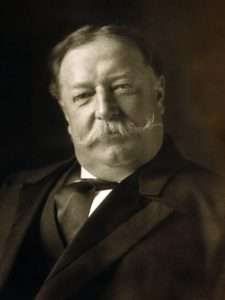
9/15/1857: Chief Justice William Howard Taft's birthday.
What’s on your mind?
Celebrate your independence with a subscription to Reason magazine, your most trusted source of honest, insightful news and analysis.




