The Volokh Conspiracy
Mostly law professors | Sometimes contrarian | Often libertarian | Always independent
Other Comments From Chief Justice Roberts
A wide-ranging interview between the Chief Justice and Judge Rosenthal at the Baker Institute.
I blogged earlier about what I thought was the highlight of Chief Justice Roberts's exchange with Judge Rosenthal at the Baker Institute. Here, I will flag a few of Roberts's comments of interest.
First, Roberts spoke about the difficult summer of 2005. In the span of a short span, he was nominated for Justice O'Connor's seat, Chief Justice Rehnquist died, and Roberts was then nominated for the Chief Justice seat.
Well, the beginning it was very emotionally draining, you're right. It was a level of tension. I mean, if I get nervous before arguing, you can imagine what it was like to get nervous before those hearings. And Chief Justice Rehnquist had been very much a mentor to me, and it was Saturday night, and I gone to bed. I was trying to get rested up. My wife called to tell me that the chief had passed away. And then the next morning, I got a call from the White House, and they wanted me to come in and had another interview with President Bush that afternoon, and then the next morning, they announced my nomination to be chief the day after that, I'm helping carry Chief Justice Rehnquist casket up to the lie in repose at the court, and the new hearings are starting the next week. There's just an awful lot going on, and I had to start learning a little bit more about Chief Justice's and their role, because that obviously hadn't been a been a focus. And I do remember thinking, you know, everything was looking pretty good with the first nomination.
Second, Roberts said he stumps law professors by asking them to name the portraits of Chief Justices in the East Conference Room.
And, you know, we have two conference rooms in the East one, they have on the walls the first eight Chief Justices, and the next one, they have the next eight chief justices. Just inside. I don't see where the room is for the, you know, 17. And I just sort of like, of like, you know, walk around, and you look up and there's, you know, John Jay, and I knew about him. And the next one, there's a picture of somebody I had no idea who it was. And this is the second Chief Justice. Turned out to be a fellow named John Rutledge who had a pretty he was there for five months. So I felt, well, that's not bad. And then the next one, and not, not really, you know, Oliver Ellsworth just rings a bell vaguely. And then John Marshall, you know, I could talk for hours about that. He's the most significant person in our political history who wasn't a president, and a lot more significant than many of the presidents. And then Chris Roger Taney, the unfortunate counterpart to Marshall. Okay, I know them. The next one I knew had worked with Lincoln, but I couldn't quite place the name Salman Chase there for a while. And then one, when I have professors in the conference room, and we're talking about something I will always ask, like, Who is that? And sometimes nobody knows.
Humblebrag. When I recently moved for the admission of South Texas alum to the Supreme Court bar, we had a breakfast reception in the East Conference room. I told our alums who all the Chiefs were. Who hasn't memorized all of the Chiefs? Jay, Rutledge, Ellsworth, Marshall, Taney, Chase, Waite, Fuller, White, Taft, Hughes, Stone, Vinson, Warren, Burger, Rehnquist, and Roberts. (I still would like to know where Roberts's bust will go, but that is a question for another time.)
Third, Roberts spoke at several juncture about judicial "courage." He said that Chief Justice Jay demonstrated an "incredible act of courage" by not answering questions posed in the "Correspondences of the Justices." Roberts also said that in this 250th year of independence, we should focus and celebrate "courage." He referenced the "extraordinary" bravery of those who signed the Declaration of Independence. They would not have been "given the privilege of being shot. They would be be hung, and all their families possessions would be gone." Roberts suggested that judges will need to exhibit a "great deal of courage," an "overlooked virtue of a judge," to disagree with what AI says. Judge Rosenthal also gave Chief Justice Roberts a biography of Chief Justice Chase, written by her father, Harold M. Hyman, who had been a longtime professor at Rice. Rosenthal said, and I agree, that Chase exemplified "courage." (I had the good occasion to cite one of Professor's Hyman's articles in a draft paper I wrote with Seth Barrett Tillman.) When I write about judicial "courage," people lose their collective minds. But this is a real concept. And, I've praised Roberts for having courage, to a limited extent.
Fourth, Judge Rosenthal asked how the Chief deals with criticism. The Chief responded, "I actually try not to read outside criticism too much. And it's, you know, just because you're you're on to something else, and you don't want to worry too much about you've done, you've done your best." I will not check how often Supreme Court IP addresses access the Volokh Conspiracy.
Fifth, Roberts quotes Justice Louis Brandeis who argued that the Court should not sit year round. One of my proposals for Court reform is for the Supreme Court to operate like all other courts, and not take a summer break. The Chief disagrees.
one big answer is that our schedule is set up. I resist the idea that it's time off, but we're not with each other in Washington in July and August. That makes it easy easier. Louis Brandeis, Louis, good friend of mine, Louis Brandeis, said he could do the 12 months worth of work on the court in 10 months, but he couldn't do it in 12 months. And I think there was a lot of wisdom in that. And, you know, sometimes people get together in the summer, do this and that whatnot. I am, I think I got the group right, a four seasons fan. And my approach is, see you in September, one of the best songs. But so that helps sort of recharge the batteries.
Sixth, Justice Rosenthal asked about Roberts's service as Chancellor of the Smithsonian Institution. The Chief said that "It is the best thing about being the Chief Justice, and it is an extraordinary thing." Roberts explains that he enjoys working with these experts, even though he lacks expertise:
And it is just it's an opportunity, as the chancellor, for me to participate in all of these amazing things, whether it's the oceanographic facility or the planetarium or the African American History Museum or the Air and Space Museum or the Portrait Gallery, all these things. And to be the sort of one person in the room that really doesn't know you know what's involved. And it's amazing how much respect these other people who are the top, top, top people in their fields, in philanthropy and all that they kind of like having sounding boards, not right, but somebody that they feel let me explain it to you, and I find it incredibly rewarding. The National Zoo was part of it, that's probably the most impressive thing, it's as the chancellor, you get to see the pandas before anybody else. And particularly when the kids were young, that was that was pretty.
In a draft paper, I propose that the Chief Justice should drop this role. Pandas are fun, but it is not really part of the Chief's job. Here is a preview of what I wrote:
As usual, the change should start from the top. The Chief Justice serves as Chancellor of the Smithsonian Institution. This role never made sense to me. The Chief Justice lacks a PhD or any formal training in research or museum management. Why would he hold this position? In fact, the first Chief Justice to serve as Chancellor was Roger B. Taney, who took over the position after Vice President Millard Fillmore became President. Moreover, in recent times, the Smithsonian is enmeshed in controversies with President Trump. There have been press leaks about Roberts's leadership of that entity. It would make sense for the Chief Justice to step out of this field and any related controversies. Indeed, Congress should modify the law that requires the Chief Justice to serve on the Board of Regents altogether.
Seventh, Judge Rosenthal turns to the Chief Justice's service as chairman of the judicial conference.
ROSENTHAL: Your role as head of the judicial United States, and this is the policy making and rule making body for the federal courts and the courts of appeals all over the country. I was privileged to serve on the conference, and I've seen you at work, and it's it was a pleasure to watch you made it look easy, but I know it's not. How do you do that?
ROBERTS: Well, that's another example of sort of me staying in my lane. The people involved in that are experts, trial judges like you know more about evidence and admission than I ever did or ever will. And so when you come up with particular provisions and rules, I understand that that reflects all your expertise. And throughout the budget, I mean, it's it's like everything else, we have to get a certain amount of money from Congress to support our actions, and Congress has been very good, and they are also responding to the particular serious threats that judges, particularly at the trial level, are facing now, and they're being very helpful and responsive in funding, but that's not something where I'm going to do much good. But the other judges are they serve on the wide variety of committees covering a wide variety of questions. It's a big commitment of their time, and I'm just very grateful for all
I previously offered these comments about the Chief's role as presiding officer:
If Chief Justice Roberts has adequately addressed the concerns of lower-court judges, I doubt those judges would feel compelled to talk to the press. I doubt the Chief is doing enough privately to assuage concerns. I have also heard from many judges over the years that the Chief runs the Judicial Conference with an iron fist. There is a discussion list, and any item not on the list cannot be discussed. There is no open-ended discussion. Indeed, the ill-fated judicial reassignment policy was not subject to any debate. We saw a glimpse of this parliamentary stranglehold in a piece about Roberts as chancellor of the Smithsonian. Perhaps in normal times, these Roberts Rules of Order make for an efficient process. But in times of crisis, the Judicial Conference must be a deliberative body that reflects the views of the entire judiciary, and not the agenda of the Chief Justice.
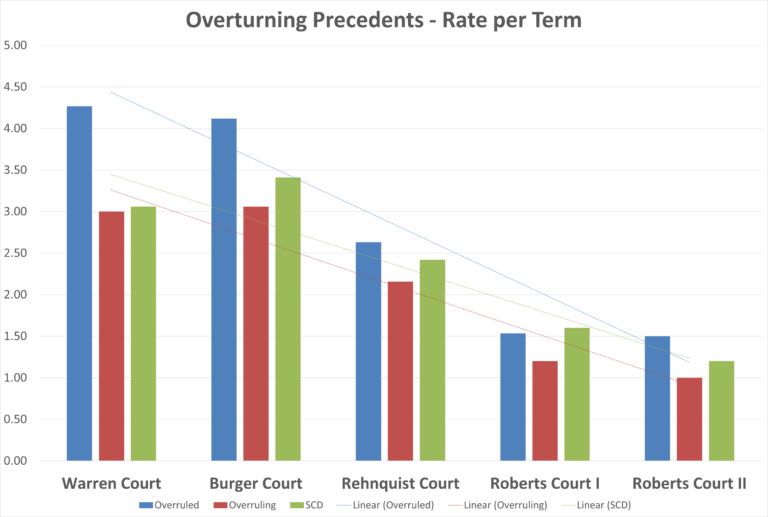
Eighth, Rosenthal asks about the biggest misconceptions about the Court. Roberts leads off by comparing the rate at which precedent was overruled on the Warren, Burger, Rehnquist, and "what they call the Roberts Court." The Chief knows these statistics to the decimal point:
For example, the idea that the court, since I've been there, has overruled a lot of cases. You look at the statistics, the Warren Court overruled something like 3.2% of the cases. The Burger Court, surprisingly, perhaps even more 3.4%. The Rehnquist Court, two point something percent, and what they call the Roberts Court fewer 1.19% or something like that.
It seems that Roberts has been reading co-blogger Jon Adler's posts from the Volokh Conspiracy.
Roberts also offers, unprompted, a reflection that he does not carry though George W. Bush's agenda. I think he is speaking directly to the charge that Justices appointed by President Trump should rule for President Trump's agenda.
And the other thing the notion that we carry forward the views of the people that appointed us is, is absurd. President George W Bush appointed me 20 years ago. The idea that I'm carrying out his agenda somehow is absurd. The issues here, now today, nobody would have thought those were going to be a big deal 20 years ago. And history is full of examples of presidents appointing people and being really surprised how they turned out, going both ways. Felix Frankfurter turned out to be to be a lot more conservative than his appointing judge Justice Brennan, a lot more liberal than his.
The Chief digressed to talking about the SUpreme Court police, and then returned to the theme of the appointing President:
Certainly, I'll always be grateful for President Bush for appointing me, and I'm sure all my colleagues are grateful there. But the idea that I'm carrying out, and they are carrying out some different agendas, I think really fallacious.
This exchange, and not the banal point about criticism, was the point the media should have focused on. For rightward drift, I'll spot you Frankfurter and maybe Jackson. For leftward drift, the list is far longer and deeper: Warren, Brennan, Blackmun, Stevens, O'Connor, Kennedy, Souter, Roberts…
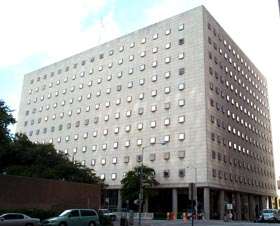
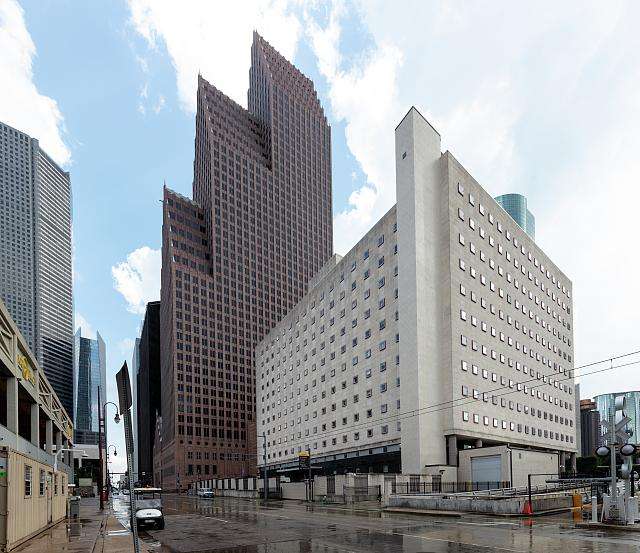
Finally, anyone who has ever been to the federal courthouse in Houston, would agree with Judge Rosenthal's observation: "And I'm very fortunate to have my job. I'm every day grateful, but that building in downtown Houston, which is the ugliest courthouse in the federal system." The Chief replied, "truly I'll get right on it." The Bob Casey Courthouse is a brutal cube of concrete. It looks like a cheese grater. Fortunately, the building is filled with some of the finest jurists in the judiciary.