

Post-9/11 Fear Grew the Surveillance State. 25 Years Later, It's Still Growing.
The U.S. government responded in ways that are so integrated into daily life that we no longer recognize them.
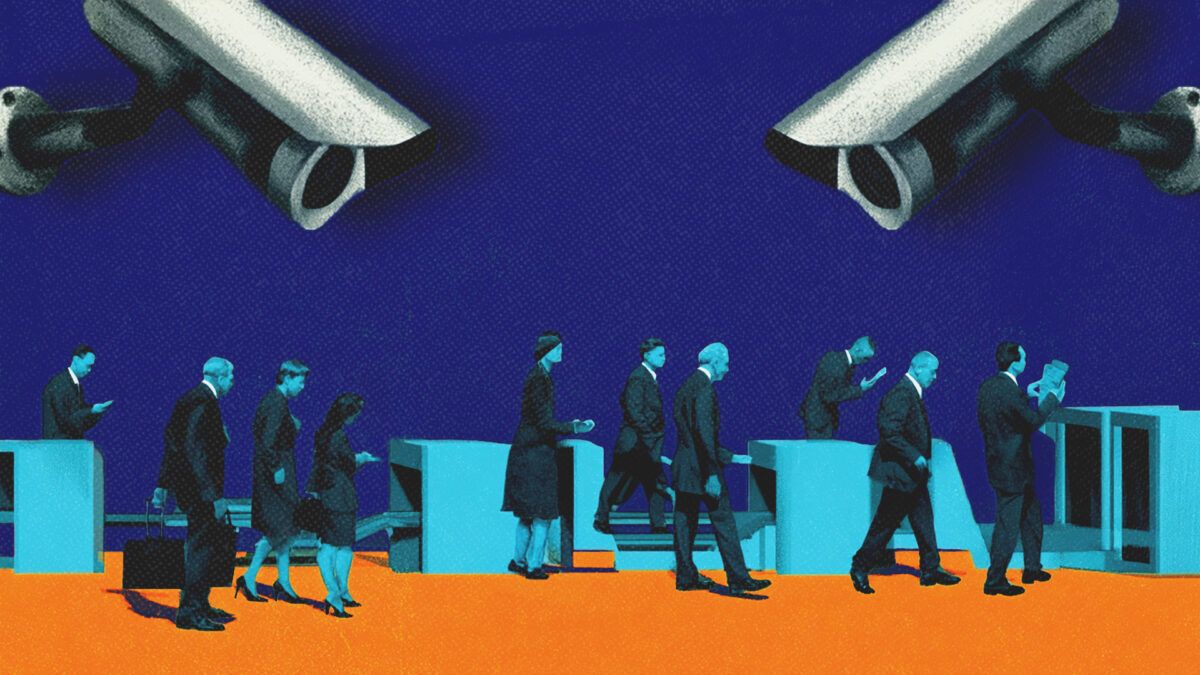
"Mom, why did he take your picture?" my preschooler asked. We were making our way through the Transportation Security Administration (TSA) checkpoint for a family trip.
"It's to compare my face with the picture in the computer," I said. "They want to make sure I am who I say I am."
As we put our bags on the conveyor belt to be X-rayed, I received another question. "Mom—what's that big machine?"
"A body scanner. It's supposed to find things under people's clothes."
"Can it see my privates?!"
"No," I hesitated. Contemporary scanners do not capture such details, but TSA agents may use them to inappropriately fondle people. Older backscatter X-ray machines could, and did, provide the TSA with images of naked bodies.
After passing through the metal detector, we waited for our bags. A man in front of us was pulled aside to have his hands swabbed for explosives. I received yet another inquiry.
"Mom—what is that thing?"
"What thing?"
"The thing they're rubbing on his hands."
"That—that is to see if there are things on his hands that shouldn't be."
To my preschooler, these surveillance measures will undoubtedly be routine. Scan your ID, pose for the biometric screening, step into the scanner, be "randomly selected" for additional screening. My children won't know that air travel wasn't always this way. Facial scans, physical searches of your person and property, and so on are not part of some organic evolution. They are a direct response to the terror attacks on September 11, 2001, and the subsequent war on terror. But my children won't have memories of that either.
Just as every baby boomer knows exactly where they were when John F. Kennedy was assassinated, people my age can tell you precisely what they were doing just after 9 a.m. on 9/11. I was in seventh grade music class. In other classrooms, my friends watched people jump out of buildings. My mom picked me up early from school, and I distinctly remember that every television channel had been overtaken by news coverage. I watched the twin towers collapse over and over again for what felt like days. President George W. Bush gave multiple primetime addresses, and soon American flags were all over the neighborhood and my school.
Some parts of 9/11's legacy are clear. Twenty-five years later, the United States government remains embroiled in a global war on terror. Members of the military bear both physical and mental wounds. The formal conflicts in Afghanistan and Iraq continue to inform the opinions of citizens and policymakers alike. Other reminders of the attack and subsequent responses abound—from the memorial at the World Trade Center site and annual memorial stair climbs to an absolute explosion of academic work related to terrorism and counterterrorism.
Other parts of 9/11's legacy are more difficult to observe, especially for Americans too young to remember life before the attacks. The U.S. government responded in many ways that either were largely kept secret from the public or are so integrated into daily life that we no longer recognize them as what they are: marked expansions of government that have weakened constraints on government and eroded our liberties.
Scale, Size, and Scope
In addition to launching the wars in Afghanistan and Iraq and other interventions abroad, the U.S. government underwent its largest restructuring since 1947. The Department of Homeland Security (DHS) began operations in 2003, uniting 22 different agencies under an integrated federal security apparatus. A cadre of new agencies appeared as well, including the TSA, Immigration and Customs Enforcement, U.S. Customs and Border Protection, U.S. Citizenship and Immigration Services, and the Office of the Director of National Intelligence. Other agencies saw significant structural changes, among them the Federal Emergency Management Agency, the U.S. Coast Guard, the Secret Service, the CIA, and the FBI.
Federal expenditures on "defense" increased rapidly, from $326 billion in 2001 to nearly $360 billion a year later. By 2010, the scale of federal military expenditures exceeded $652 billion. Estimates from 2020 suggest that the broader war on terror will cost U.S. taxpayers more than $8 trillion by 2050.
It wasn't just the raw scale or size of government that changed. If we truly want to understand how America has been transformed, we must also appreciate changes in the scope of government—the type and range of things the government does.
The fear generated by the 9/11 attacks drew citizens toward the government. This fear also generated a "disarming effect" where citizens came to accept, even welcome, measures that they would have previously regarded as gross violations of personal freedom.
The most obvious illustrations involve surveillance. Despite explicit constitutional protections against unlawful search, an overwhelming number of Americans supported increased government surveillance after 9/11, including wiretapping, collecting cellphone records, video surveillance, and reductions in restrictions on government spying.
This support, combined with the fear of another attack, led to the quick passage of the USA PATRIOT Act in October 2001. Among other expansions in the scale and scope of government, this law greatly expanded Washington's power to spy on people and reduced or eliminated constraints on surveillance. For example, the law made significant changes to the Foreign Intelligence Surveillance Act (FISA) of 1978, the federal law regulating surveillance and data collection of foreign intelligence on U.S. soil. The PATRIOT Act allowed for longer search and surveillance periods and permitted "roving" wiretaps, meaning that government agents could "follow" surveillance targets across different phones, email accounts, and locations, as opposed to requiring new authorizations. The law also made it easier for surveillance officials to acquire pen register, or "trap-and-trace," orders, meaning the government could collect more metadata in their investigations.
Other portions of the PATRIOT Act lowered the bar for officials seeking FISA approval. Still other sections relaxed the constraints on the U.S. government to share private information about U.S. citizens with foreign governments.
Moreover, the PATRIOT Act replaced more restrictive policies about data collection on businesses with a much broader provision allowing the government to obtain "any tangible thing" that may be "relevant" to an investigation, including business and library records, financial and travel records, and telephone metadata. The act allowed broader and more direct surveillance-related coordination and information sharing between officials across various arms of the government.
Americans largely welcomed these changes, with many expressing they'd have "no concern" if the government collected their personal phone records. Others stated their opinion that the government had not gonefar enough in restricting civil liberties to combat terrorism. It was not until Edward Snowden exposed some of the abuse of surveillance technologies by the National Security Agency that U.S. citizens clearly expressed disapproval of the expansion of federal spying. Even today, while many people express skepticism about some surveillance policies, support for surveillance in some capacity largely remains.
The Ratchet
September 11 opened the door for permanent alterations in the size of government and the types of activities our government undertakes. Economist Robert Higgs foreshadowed all this in his 1987 book, Crisis and Leviathan: Critical Episodes in the Growth of American Government. Higgs described a "ratchet effect" in which government often grows but rarely shrinks. During normal times, there is a baseline "supply and demand" dynamic, with bureaucrats offering an expanded role for themselves when citizens ask for goods and services. But a crisis and the fear it creates dramatically increase the demand for the government to "do something."
Government grows at a steady rate until a crisis occurs. A subsequent expansion, integration of new government activities, and retrenchment following the crisis's conclusion follow. The result is a higher level of government activity than what would have occurred absent the crisis—a "ratcheting" of growth.
We can see many examples of this dynamic from the last century. Before Washington entered World War II, scientists called on the U.S. government to develop a nuclear program over fear of a possible nuclear Third Reich. The ultimate result was the Manhattan Project. In the early Cold War, the fear of communism prompted calls for government action, resulting in loyalty oaths, domestic surveillance, and public hearings. More recently, calls for government to "fix" the COVID-19 pandemic resulted in restrictions on individual movement, dictates about masking, and support for government-issued "vaccine passports."
Eventually, the crisis that sparked the expansion of government—whether a pandemic, possible "nuclear Nazis," or terrorism—abates. Some policies implemented in the name of combating the crisis are eliminated or curtailed. For example, the restrictions placed by government officials during the COVID-19 pandemic related to masking, lockdowns, etc., were eventually eliminated.
But the expansion of government is not fully reversed. Policies and programs implemented in the context of crisis become integrated into the general operations of government. New bureaus become permanent, and policies developed to address an immediate crisis come to be the status quo within expanded government operations. The crisis permanently expanded the government.
Writing in 1987, Higgs did not have the 9/11 attacks in mind. But the framework helps us analyze how the terror attacks opened the door for bigger government—and helps us to appreciate both the monetary and nonpecuniary costs of government expansion.
Fear Is the Privacy-Killer
Immediately following the 9/11 attacks, a majority of Americans reported they felt afraid. This fear drove calls for officials to act—and fast. In late September 2001, nearly half of Americans worried that the Bush administration would not use military options fast enough to combat additional terrorism threats.
This passivity, if not outright support, among citizens was augmented by the incentives facing various groups of actors within government.
The Framers of the U.S. Constitution purposely designed a federalist system of checks and balances that diffused powers between different levels of government—federal, state, and local. Diffusing power among smaller units of government limits the power of the federal government. Further, these smaller units may provide other checks on federal overreach by suing the federal government, leveraging yet another intentional check (the courts) to determine if the actions of federal authorities are legal.
But during times of crisis, smaller units of government are drawn toward obeying the political center. Public calls for government action open the fiscal floodgates for those government entities—at all levels—that are supposed to address the crisis. As a result, actors in smaller units of government may find it beneficial to align their policies and activities with those of the federal government.
State and local police departments, as well as other peripheral units of government, quickly integrated surveillance protocols into their work in the name of fighting terror. Framed as "first preventers" of the next terror attack, police departments and local governments were quick to link their activities with the broader goal of combating terrorism.
Today, 90 percent of U.S. sheriff's offices with 500-plus deputies use automatic license plate readers, as does every police department serving more than 1 million residents. Over the course of the war on terror, local police departments and sheriff's offices readily accepted and deployed unmanned aerial vehicles. In 2012, dozens of police departments used drone surveillance. A little over a decade later, more than 1,400 such entities were deploying drones. The rationale for their use, then as now, is counterterrorism.
Other surveillance technologies, such as "cell site simulators" or "stingrays," have also been adopted by police departments across the country in the name of combating terrorism. These devices, usually about the size of a toaster oven, trick citizens' cellphones into transmitting location data and other information by simulating the signal from a real cell tower.
Over time, the immediate crisis of the 9/11 attacks and subsequent war on terror faded. Some crisis-related programs diminished or vanished completely. In 2004, for example, the DHS scrapped its Computer Assisted Passenger Prescreening System II—a system designed to assign a terrorism risk score to every commercial air passenger. The Multistate Anti-Terrorism Information Exchange, a data-mining and information sharing system, ceased operations in 2005.
True to the dynamics outlined in the ratchet effect, however, many expansions in government remain. Many provisions of the PATRIOT Act are still in effect, including those that allow expanded surveillance. Similarly, the use of biometric screening, AI, and other tools by federal and local entities are now practically expected.
Twenty-five years after the attacks, is it possible to undo these encroachments? Can we prevent new ones? In theory, formal constraints, whistleblowers, and the media can act as checks on government expansion. Unfortunately, these options might help but are likely woefully inadequate.
But consider Higgs' framework again. The earlier chapters of Crisis and Leviathan highlight the importance of citizen ideology. Higgs suggests the ideological acceptance of larger government is a necessary condition for the ratchet effect dynamics to manifest. In a similar way, ideology may prove the key for preventing future ratchets and possibly undoing previous ones.
With many intrusive policies implemented after 9/11, it was pushback from the citizenry that ultimately led to their cessation. Ultimately, it's up to us as individuals to defend liberty and reject the overbearing "protection" the government is offering.
This article originally appeared in print under the headline "9/11 and the Surveillance Ratchet."




