

Worst Nathan for You–Style Scheme Ever? A Polling Company Claimed Its Fake Polls Were a Social Experiment.
Information regulation is not the way to stop online hoaxes. But that doesn’t mean we should stop searching for the truth.
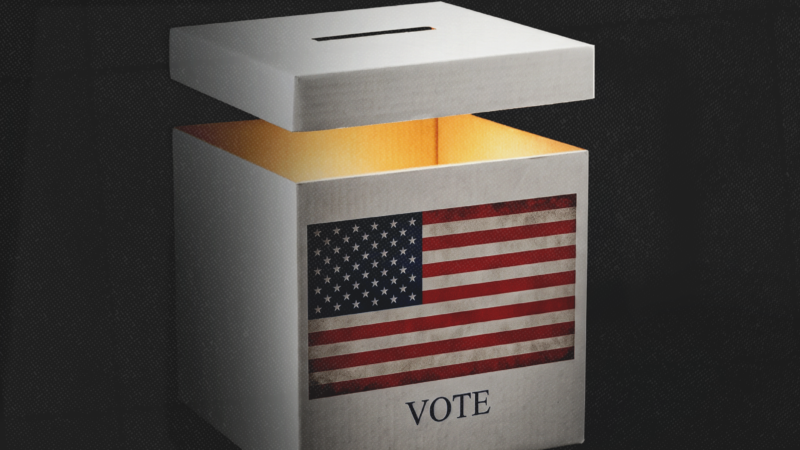
There has been much consternation this week about the use of fake polls in the media, with some government officials promising swift, and legally dubious, punishments for broadcasters that use them.
The use of these fake polls came to light on Wednesday, when The New York Times reported that "well-known polling aggregators," including the paper itself, had been citing fake surveys by Wedgewood Polls. The fake polling scheme was revealed when the outlet FivePlusOne contacted Wedgewood Tuesday for comment about an investigation into the pollster. That night, Wedgewood posted a now-deleted statement declaring that it was an "experimental project to demonstrate the vulnerabilities, lack of oversight, and overall barrier to entry in the modern polling industry." The fake pollster claimed it was "far too easy" to be taken seriously in media and public commentary.
A similar "social experiment" was revealed in August, when the Los Angeles Times reported that a poll by Median Strategies showing Mayor Karen Bass "leading ahead of Councilmember Nithya Raman by a wide margin" was "bogus." An earlier poll by Median Strategies showed Francesca Hong, who lost her race for Wisconsin governor, up by more than 20 percentage points. Median Strategies told the Times that the firm was "created as a short term social experiment to examine how purported polling information could enter and spread through the political information ecosystem without independent verification."
If Wedgewood's polling stunts were in fact social experiments (pollster Nate Silver is very skeptical of this explanation), then the experiment worked. Nobody is completely immune to deceit. And while savvy media consumers have become more attuned to detecting AI writing and video fakes, masses of people still fall for more than fake polls, as they have for a long time.
In 2018, when the word "slop" meant food for pigs and before anyone wrote posts using ChatGPT, the Intelligencer asked the question: "How much of the Internet is fake?" The answer, the outlet concluded, was "a lot."
At the time, Reason's Nick Gillespie noted that the article was a "sobering and obvious revelation that much of what we browse, engage, and interact with is in some fundamental way, total bullshit." Gillespie solemnly observed, "we're living not in the disintermediated, utopian world chronicled in the early days of Louis Rossetto and Jane Metcalfe's Wired, but something closer to the endlessly creative, weird, off-kilter, semi-insane world imagined by Philip K. Dick and, later, Neal Stephenson."
Eight years later, the "semi-insane" world is no less insane, and humans, as they always have, are falling prey to increasingly intricate schemes and hoaxes. In September, Semafor's Max Tani revealed that a large number of YouTube videos—several of which garnered hundreds of thousands of views—were made by "ghost creators." In these videos, presented as news reports, real actors were paid to read AI-written scripts "laced with misleading claims and outright falsehoods." According to Tani, these "accounts appear to be run not by political operatives trying to win, or foreign intelligence efforts seeking to destabilize the US, but by engagement junkies detached from the stakes of politics." While any semi-media-literate person in 2026 could tell you that not all YouTube videos should be taken as fact, the scale of the operation was staggering.
The deception crisis plagues the media as well. Recently, the platform Qwoted, which connects journalists with sources, had to remove a supposed art therapy expert from its website after her "details were found to be false," reported the Press Gazette. According to the Gazette, the fake therapist's insights had been cited in several outlets, including Psychology, Forbes, Glamour, and Vice. I have also raised concerns about news outlets and commentators citing polls published by EduBirdie, a Cyprus-based company that sells human-written academic papers to students for $8 a page (ethics aside, what a bold business model in the AI age).
So what is to be done? As Gillespie wrote in 2018, there are existing legal levers to root out fraud, but any top-down approach to squashing online lies "will be poorly applied, repressive, and ultimately arbitrary." Government-led crackdowns on COVID-19 "misinformation" have proven him right. Outsourcing the arbitration of truth would only diminish our access to information, and no one entity, particularly the government, should be trusted to determine what is true or false. Unfortunately, the Trump administration has not learned much from the pandemic era and has instead repeatedly tried to crack down on media coverage it doesn't like.
Ideally, media organizations would act as B.S. detectors, but clearly, they often fail to do so. So, consumers are left to wade through lies, AI hoaxes, and so-called "social experiments." This may be tedious work, but it is necessary for consumers to evolve as technologies change. This sleuthing for scams may even be enjoyable. Why pay to have your brain scrambled by Nathan Fielder's Elizabeth Holmes documentary when you can drive yourself insane by tracking down and scrutinizing widely cited statistics and polls?



