

He Won a City Council Seat by Openly Admitting How Little He Wants the Job
"I barely want to do this," Brady Rogers admitted. Voters apparently appreciated the honesty.
To many people, but especially libertarians, voting can feel dispiriting: By definition, every person on the ballot wants in some way to exert control over your life.
Perhaps that's why it's refreshing to see a candidate for office who truly seems not to want the job.
Brady Rogers worked as a robotics engineer for four years, but he quit in 2019 after deciding the corporate world wasn't for him.
"It was just a bit unfulfilling," Rogers tells Reason. "I wanted to do something a little more impactful with my skills….So I left to find something else that felt worthwhile."
He started The Rogerie, a retail store in his hometown of Kelowna, British Columbia, a city of about 170,000 people. Rogers and his wife collect shredded plastic waste and extrude it into filament for 3D printers, which they use to create new housewares to sell in the shop.
Then earlier this year, Rogers again got the feeling that he could be doing something beneficial with his talents. This time, it meant running for the Kelowna City Council.
But he had to stand out in a crowded field—he would be one of 37 candidates running, and only the top eight would win a seat.
So, he settled on a strategy: openly admit his lack of qualifications and how little he even wanted the job.
"I guess I'm running for Kelowna city council," read his campaign website. "I don't like meetings, I don't like having to be certain places at certain times, and I'm allergic to stuffy offices. But unfortunately, I happen to like Kelowna, and think I can help do some good."
"Do I enjoy politics? No," he adds. "Do I know what I'm doing? No. But am I qualified? Also no."
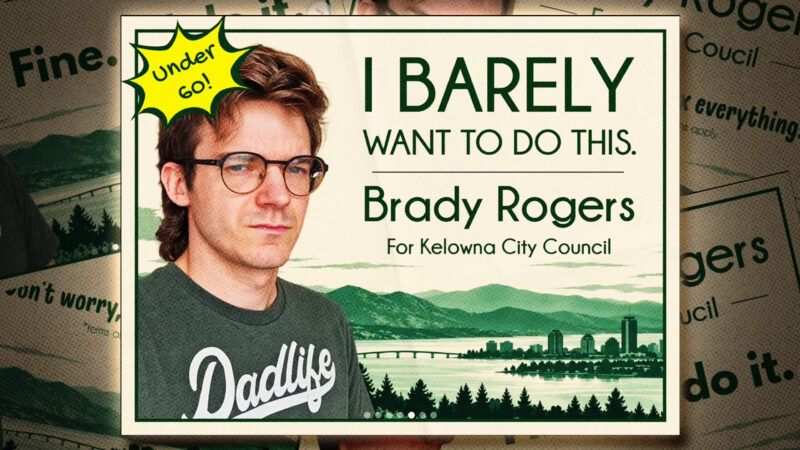
That lackadaisical attitude carried over into his campaign signage: Yard signs featured pictures of Rogers with sullen, shrugging expressions, alongside slogans like "I barely want to do this" and "Let's see what happens?" In a winking reference to political gerontocracy, one sign even bragged that he was "Under 60!"
The ploy worked, and the campaign went viral.
"I certainly thought it was clever. I thought it would work, but it was really just how I honestly felt when I started," Rogers admits. "I was pretty conflicted about committing to a four-year thing that I didn't even really fully understand the ins and outs of, but at the same time I saw the opportunity to have a bigger impact. So, I was conflicted, and I figured that's a good, honest place to start a campaign."
Ultimately, he won a seat: He placed fourth out of 37 total candidates and even beat three incumbents, one of whom lost her seat.
The irony of Rogers' outwardly indifferent attitude is that he actually does have a policy platform: On his website, he advocates finding solutions to homelessness not necessarily by spending more money but by making better use of the resources that the city and province already provide. He also notes that Kelowna taxes land and improvements at the same rate, which "means we tax someone for improving their property while relatively rewarding someone who sits on valuable, underused land." Writing this week at Reason, J.D. Tuccille made a similar point.
Of course, Rogers' underqualified and disinterested campaign persona is only partially true—he did, after all, want the job, or at least he saw it as a viable means of improving his city.
Still, it's refreshing for a candidate to treat public office as something less than a higher calling.
Ultimately, Rogers thinks that authenticity is why his campaign caught on and was ultimately successful with voters, when many campaigns struggle to create viral moments or capitalize on social media trends. Perhaps other people could even learn from him.
"I think why mine worked so profoundly is that it is a little bit of humor, but immediately behind it was a legitimate platform and me as a real person with the skills and a real desire to do something," Rogers says. "And I think that resonated. I think people [have] an appetite for a new kind of politics."




