

You Can Now Sue Federal Agents in California. Good Luck Getting Past Qualified Immunity.
Californians can now sue federal officers for civil rights violations, but cops can still claim qualified immunity as a bona fide defense for official misconduct.
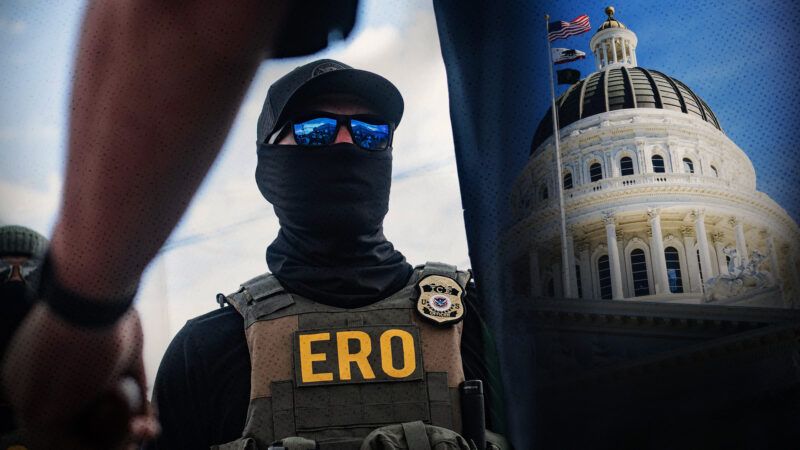
On Tuesday, California Democratic Gov. Gavin Newsom signed the No Kings Act (SB 747) into law, allowing Golden State residents to sue "every natural person who, under color of any law," violates their constitutional rights.
Under the law—sponsored by state Sen. Scott Wiener (D–San Francisco)—government actors accused of violating a California resident's constitutional rights can no longer avoid accountability simply because they are federal rather than state or local officials. The bill does not eliminate qualified immunity.
Qualified immunity—a judicial doctrine created by the Supreme Court—protects government officials from personal liability for civil damages if the act occurs while they are performing their duty. In Harlow v. Fitzgerald (1982), the Court established that government officials are entitled to qualified immunity when their conduct does not "violate clearly established constitutional rights of which a reasonable person would have known." Federal courts routinely use qualified immunity to shield abusive government officials from civil liability, even when their conduct is indefensible.
Through its ruling in Bivens v. Six Unknown Fed. Narcotics Agents (1971), the Court has largely narrowed civil liability claims against federal officers to violations of the Fourth, Fifth, and Eighth Amendments, provided the conduct is "in a new context," as Justice Anthony Kennedy wrote in Ziglar v. Abbasi (2017).
Under that precedent, any case brought against a federal official for a constitutional violation must fit the same narrow set of circumstances as cases in which the Court has already held a federal official liable for damages.
Instead of abolishing the doctrine, California's law creates a state-level cause of action that will allow anyone to bring a civil rights suit for monetary damages against any federal, state, or local official who violates their constitutional rights. The law limits the time to file a lawsuit to two years, counted from the date the violation occurred. It's retroactive, meaning that so long as the conduct happened on or after March 1, 2025, a lawsuit can be filed for nominal and compensatory damages. The law is "very much aligned with America's traditional values" and brings back the "original idea of accountability and enforcing constitutional rights," says Anya Bidwell, senior attorney at the Institute for Justice.
For people like Bidwell's client, George Retes Jr., the law provides an avenue to "amend his claim" that federal officers violated his Fourth and Fifth Amendment rights when they detained him for three days. Federal officials have long been hard to sue for constitutional violations. Section 1983 of the U.S. Code is the federal civil rights statute, but it only applies to state and local officials.
Federal courts have also failed to "definitively answer whether states have the power to provide a state court forum for suing a federal official for the violation of a federal constitutional right," says Clark Neily, senior vice president for legal studies at the Cato Institute. That has placed the burden on California and other states to create forums to adjudicate claims of civil rights violations by federal officials.
California's law applies equally to federal, state, and local officials, unlike a similar law passed by Illinois, which specifically targeted government officials carrying out immigration enforcement.
The "question of even-handed treatment will be central to analysis of the statute," says Northwestern University law professor James Pfander. "The state cannot single out federal officials for state regulation or lay a heavy regulatory hand on the federal government itself," Pfander adds, "but they can establish norms that are equally applicable to all, and the Court has been pretty clear that there's no federal supremacy preemption in circumstances where the regulatory energy of the state has been even-handedly applied to everyone."
In 2025, Illinois passed the Illinois Bivens Act, authorizing any person to "bring a civil action against any person who, while conducting civil immigration enforcement, knowingly engages in conduct that violates the Illinois Constitution or the United States Constitution." The Department of Justice swiftly filed a complaint in federal court against the Prairie State. Steven D. Weinhoeft, U.S. attorney for the Southern District of Illinois, accused Illinois of advancing "unconstitutional policies designed to undermine federal law."
It's unclear what, if any, challenge the department will muster against California's new law.
Still, the law's qualified immunity provision maintains the current status quo, accepting the judicial doctrine as a legitimate defense for misconduct.




