Reason.com - Free Minds and Free Markets
Reason logo Reason logo
  • Latest
  • Magazine
    • Current Issue
    • Archives
    • Subscribe
    • Crossword
  • Video
    • Reason TV
    • The Reason Roundtable
    • Free Media
    • The Reason Interview
  • Podcasts
    • All Shows
    • The Reason Roundtable
    • The Reason Interview With Nick Gillespie
    • Freed Up
    • The Soho Forum Debates
  • Volokh
  • Newsletters
  • Donate
    • Donate Online
    • Ways To Give To Reason Foundation
    • Torchbearer Society
    • Planned Giving
  • Subscribe
    • Reason Plus Subscription
    • Print Subscription
    • Gift Subscriptions
    • Subscriber Support

Log In

Create new account

Flock

Surveillance Camera Saboteurs Are Getting Government Officials' Attention

Sometimes direct action is the only way to get politicians to consider civil liberties.
J.D. Tuccille | 8.26.2026 7:00 AM

Share on FacebookShare on XShare on RedditShare by emailPrint friendly versionCopy page URL Add Reason to Google
Media Contact & Reprint Requests
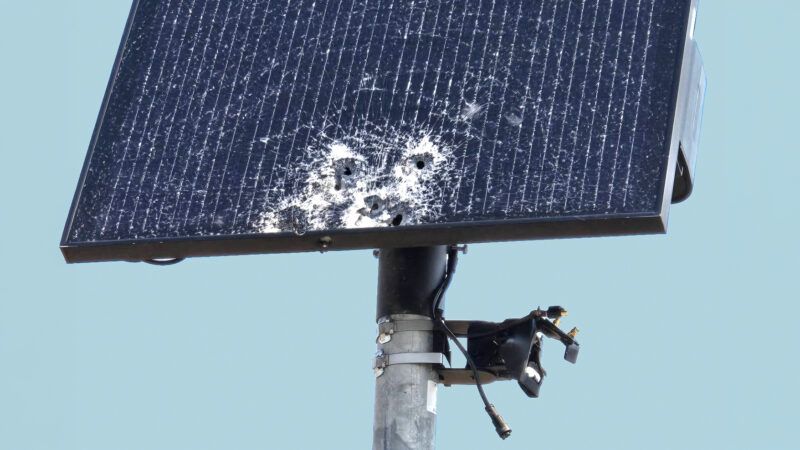
A damaged Flock Security automated license plate reader. | anarcho_mtnman/Instagram
(anarcho_mtnman/Instagram)

Government officials don't really have the same incentives and concerns as the people they exercise power over. Sometimes, to get officials' attention, you have to do something a little special involving signs, spray paint, hacksaws, or other innovative tools and approaches. At least, that's what's been happening to automated license plate readers (ALPRs)—often referred to as "Flock cameras" after the best-known company that provides them—across the country. Subject to escalating snooping, some people respond by sabotaging surveillance cameras' all-seeing eyes.

You are reading The Rattler from J.D. Tuccille and Reason. Get more of J.D.'s commentary on government overreach and threats to everyday liberty.

This field is for validation purposes and should be left unchanged.

The Growing Threat of Surveillance Cameras

ALPRs are cameras that scan traffic and automatically record and recognize license plates on passing vehicles. Without warrants, police can use them to identify who drove through an area where a crime was committed. They can also be used to track the movements of anybody who comes in view of the increasingly common cameras. ALPRs are often tied into shared databases; in the case of Flock Safety, the largest company in the field, it's a database that spans the country and is accessible by any subscribed law enforcement agency. With enough networked cameras in place, a person's travels to political meetings, religious services, shopping trips, recreational activities, and on-road expeditions can be automatically monitored and mapped for scrutiny by officials looking for "suspicious" activity.

That's if the ALPRs are used as intended. The Institute for Justice (I.J.) has documented "well over 100 incidents of ALPR abuse, including romantic stalking, wrongful stops and detentions, non-law enforcement use, and other types of misconduct." It continues to record abusive uses of the technology.

ALPRs also make mistakes. "In Española, New Mexico, a 12-year-old was handcuffed after an ALPR camera misread the last number of a license plate on a vehicle driven by her older sister as a '7' instead of the '2' it actually ended with," CBS News reported last year. A Vallejo, California, Police Department trial found that "35 percent of all hits were misreads for the mobile readers, with a similar number (37 percent) for the fixed readers," meaning license plates were misidentified with potentially serious implications for those wrongly implicated as suspects in crimes.

Privacy and accuracy concerns raise red flags with skeptical Americans, but government officials in many localities continue to cut deals with ALPR vendors and to install surveillance systems because they're a low-friction means of gathering data that might be useful in solving crimes—or of stalking ex-spouses and political opponents. That's driven part of the population to do-it-yourself efforts.


Cameras Targeted by Widespread Sabotage

In De Soto, Missouri, "a camera near the De Soto Athletic Complex was intentionally damaged. The camera pole was torn down, and the solar panel appeared to have been struck multiple times by projectiles," according to KMOV. Three ALPRs in Grand Junction, Colorado, were shot with a .22 rifle. Nine cameras were cut down in Summit County, Colorado. South Carolina's WIS reported that "at least two Flock safety cameras in Irmo have been spray-coated with foam sealant." Spray painting camera lenses was the tactic of choice in Florida's Atlantic Beach, Neptune Beach, and Jacksonville Beach.

"Flock cameras have been vandalized in at least 36 states," NPR's Meg Anderson reported last week. "They've been stolen, sawed down, crashed into, covered in paint and stickers, even shot at with guns."

FlockStats, which tracks anti-ALPR efforts, records a minimum of 194 cameras disabled across the country via sabotage, as of this writing.

The sabotage efforts come with risks, since they're illegal (though not necessarily morally wrong) acts of vandalism against public property. Several of those who've targeted ALPRs have been arrested for their troubles. Some agencies, such as the Oviedo Police Department in Florida, are now putting up decoy "bait" cameras which are themselves kept under surveillance to trap vandals.

Decoy schemes increase the risks of sabotaging ALPRs; Ovieda charged a man they arrested with three felony counts for cutting down a decoy. But they also demonstrate that sabotage has caught the attention of the officials who install the real ALPRs. And that attention seems to have had an impact.


Opposition Gets Officials' Attention

DeFlock, another anti-ALPR site, documents at least 135 communities "rejecting" ALPRs. Many of them canceled contracts with camera providers (usually Flock, but also Motorola and other firms). The reasons they cite often reflect the concerns raised by privacy activists who say that people's movements shouldn't be tracked by government officials without a warrant.

In Arizona, "Pinal County Sheriff Ross Teeple announced the cancellation of the Sheriff's Office contract with Flock Safety, citing 4th amendment concerns with the company's Automated License Plate Reader (ALPR) Cameras," the sheriff's office announced earlier this month.

When a county sheriff acknowledges that surveillance technology raises serious ramifications for civil liberties, you know vandals destroying cameras have tapped into a deep well of public opposition to widespread surveillance that extends beyond the ranks of the saboteurs.

People concerned about surveillance, but unwilling to risk felony charges, might consider countermeasures to ALPRs. Just as some clothing companies have introduced high-tech patterns intended to frustrate facial recognition, so entrepreneurs produce car add-ons that are supposed to confuse license-plate readers.

Without getting into the details of the products and their debatable effectiveness, some companies offer license plate covers marketed as obscuring plate characters (these are illegal in some states). Others sell infrared LED light frames that are supposed to wash out images.

A little more in-your-face is Bill Swearingen's noRecognition project, which has developed a car wrap that overwhelms cameras with busy imagery. According to a profile in TechCrunch, "Swearingen's computer-generated patterns do not block surveillance cameras from recording video footage. Instead, they scramble the camera's ability to identify objects, people, or faces so that the cameras do not trigger any detection alerts." He claims his patterns are effective with software including that used by Flock ALPRs.

A pattern busy enough to confuse surveillance cameras will certainly draw attention. The question is whether that attention will be as effective as that generated by ALPR saboteurs. For now, people willing to take legal risks to disable surveillance cameras are drawing public support and convincing at least some public officials to consider public concerns over civil liberties.


The Rattler is a weekly newsletter from J.D. Tuccille. If you care about government overreach and tangible threats to everyday liberty, this is for you.

This field is for validation purposes and should be left unchanged.

NEXT: Brickbat: Swing and a Miss

J.D. Tuccille is a contributing editor at Reason.

FlockCivil LibertiesLocal GovernmentState GovernmentsSurveillanceCamerasLicense Plate CamerasLaw enforcement
Share on FacebookShare on XShare on RedditShare by emailPrint friendly versionCopy page URL Add Reason to Google
Media Contact & Reprint Requests

Hide Comments (20)

Editor's Note: As of February 29, 2024, commenting privileges on reason.com posts are limited to Reason Plus subscribers. Past commenters are grandfathered in for a temporary period. Subscribe here to preserve your ability to comment. Your Reason Plus subscription also gives you an ad-free version of reason.com, along with full access to the digital edition and archives of Reason magazine. We request that comments be civil and on-topic. We do not moderate or assume any responsibility for comments, which are owned by the readers who post them. Comments do not represent the views of reason.com or Reason Foundation. We reserve the right to delete any comment and ban commenters for any reason at any time. Comments may only be edited within 5 minutes of posting. Report abuses.

  1. Spiritus Mundi   2 months ago

    Remember, it is a felony to destroy a flock camera. It is only a misdemeanor to use a flock camera to violate peoples' constitutional rights.

    1. drisco304   2 months ago

      Police have soverign immunity so it's not even a misdemeanor. It's just a mistake with the citizen left holding the bag.

  2. Stupid Government Tricks   2 months ago

    Wasn't there a case just a few days ago of a grand jury refusing to indict someone for vandalizing Flock cameras?

    I also wonder who the genius was who thought "Flock" wouldn't become a verb.

    1. Dillinger   2 months ago

      clearly not a Battlestar Galactica fan

  3. Spiritus Mundi   2 months ago

    Others sell infrared LED light frames that are supposed to wash out images.

    I wonder what would happen if those LEDs where really bright IR strobes? Maybe they are.

  4. Social Justice is neither   2 months ago

    So much for defending property rights if we're advocating for toddler tantrums. By this logic I get to burn down the offices and infrastructure of Reason if I disagree with them.

    1. Zeb   2 months ago

      Reason is spying on you and tracking your movements?

    2. windycityattorney   2 months ago

      Property rights of whom? The owners of the flock surveillance cameras? Property of the police depts? City/govt property that our own taxes paid for?

      If the residents pay for them but object, I could see an argument that we have the right to address the objection by stopping what we object to (mass warrantless surveillance) and if the only way to do that is to f with the ALPR readers then thems the breaks. Govt officials should be wiser stewards of their constituents money. Since LEO's are typically the ones wanting this...well guess whose taxes also pay all their budgets, salaries and equipment???

  5. BYODB   2 months ago

    It would be amusingly ironic if the people destroying flock cameras were caught due to their cell phones GPS position.

    1. MWAocdoc   2 months ago

      They would be heroes of Liberty.

  6. MWAocdoc   2 months ago

    Although I will not shed any tears over damaged cameras, the place to resolve this issue should be the Supreme Court. Previous jurists opened the door to his unwarranted violation of our rights by twisting the plain words and meaning of the Constitution out of all recognition; and ultimately only new rulings from the Supreme Court can restore those rights to us. No government agency has the authority to collect mass data on the public. The Fourth Amendment clearly states that investigations can only occur after a warrant has been issued based upon affidavits that a crime has been committed and that the subject of the investigation is likely to be the culprit. Until then, go for it!

    1. Stupid Government Tricks   2 months ago

      The Open Fields Doctrine is a classic example of the Supreme Court amending the Constitution by reinterpretation rather than leaving it to Article V, Congress, and the states. Because the Fourth Amendment only mentions "persons, houses, papers, and effects", the Supreme Court ruled in 1924 that the "open fields" around a house can be searched and trespassed without a warrant. Even worse, the decision was based on the out-and-out fraud of taking a quote out of context (https://reason.com/2025/12/31/if-you-give-a-bear-a-badge-will-it-respect-your-rights/) in a case where the state attached a camera to a bear to record what it saw, including the property owner's house.

      102 years later, and they have not seen fit to correct their mistake.

      1. James K. Polk   2 months ago

        Your commentary immediately conflicts with itself. You claim SCOTUS amended the Constitution, and then immediately note that 4th only mentions "persons, houses, papers, and effects". The open fields doctrine is not "based" on the alleged misquote from Blackstone, it's based directly on the text of the 4th amendment as well as the Founders original thoughts on the subject.

        1. Stupid Government Tricks   2 months ago

          Strange how it took 133 years after the 4th Amendment was ratified to discover that "open fields" was missing, along with innumerable other nouns.

          Not strange at all that you didn't follow the link.

          "The sole citation to support this historical assertion was to three pages of Blackstone's Commentaries," Institute for Justice attorneys Robert Frommer and Anthony Sanders noted in a 2017 Supreme Court brief. "The problem with Justice Holmes' citation is that in those pages, Blackstone was not talking about open fields, officers of the law, or even trespass. Instead, he was discussing the elements of burglary. Blackstone simply lays out the rule that to commit burglary, among other elements, the burglar must break into a home, and do it at night."

          Holmes "took this distinction between burglary and other crimes and gave it constitutional significance by applying it to an area—an open field—that Blackstone does not even address," Frommer and Sanders added. "By the same, ill-founded reasoning, Hester could have stated that the Fourth Amendment does not apply to the government entering homes during the day, or entering buildings such as barns and warehouses at all, all areas Blackstone contrasted to a break-in of the home at night."

          As for reading the 4th literally as you wish, apparently Justice Holmes felt the need to abuse his reference because he felt reading the 4th literally was not quite up to snuff and needed some buttressing.

          You statists are all alike. Bend the common language meaning to whatever suits your purpose.

          Fuck off, slaver.

  7. Ron   2 months ago

    I saw a Public protest where the announcer claimed in five years Atlanta went form 3000 cameras to 28000 cameras but less than 1% increase in solved crimes. i say their "benifits" are not worth the financial cost or the impact on privacy.
    Plus i do believe they will become a part of the overall social credit system. did you make two trips today when you should have made one, did you exceed your 15 mile radius of travel from home today or for the next plandemic. Or has it happened to people who were just traveling thru DC on Jan 6 they were all looked into wether they were on the Mall grounds or not.

    1. Eeyore   2 months ago

      That's not what the system is for. It's for cops to stalk ex-girlfriends. Measuring the 1000% increase in cops stalking ex-girlfriends it's a very effective system.

  8. Dillinger   2 months ago

    >>Sometimes direct action is the only way to get politicians to consider civil liberties.

    the time for direct action was like 1989

  9. car-keynes   2 months ago

    The Amendment IV reprise to this issue goes like thus:

    IFF a court has issued a valid warrant, THEN Flock footage might be used in construable legal fact in an ongoing investigation involving the suspect and including the plateholder linked to being the suspect.

  10. PatrickM   2 months ago

    "romantic stalking"

    Are we still doing phrasing?

  11. Rodger Cosgrove   2 months ago

    We have the right to video police. Police have the right to video monitor public spaces to thwart crimes, e.g., driving stolen cars or running red lights. Private video has busted criminals from porch pirates to murderers. Every police property or technology "can" be abused; that's not reasonable grounds to discard them.

    The paper Tucille cites showing a 35-37% error rate for ALPR is wildly at odds with my own experience in optical character recognition technology. IDK the circumstances to account for that measure, but it's certainly far out of the ordinary. In any case, the suggestion that it's not "morally wrong" to destroy or vandalize expensive public property because one irrationally believes in some unfounded "civil right" to be invisible in public spaces is outrageous.

Please log in to post comments

Mute this user?

  • Mute User
  • Cancel

Ban this user?

  • Ban User
  • Cancel

Un-ban this user?

  • Un-ban User
  • Cancel

Nuke this user?

  • Nuke User
  • Cancel

Un-nuke this user?

  • Un-nuke User
  • Cancel

Flag this comment?

  • Flag Comment
  • Cancel

Un-flag this comment?

  • Un-flag Comment
  • Cancel

Latest

Iowa Voters Don't Want Police or Flock Tracking Their Cars. Politicians Are Still Catching Up.

Davide Mamone | 10.24.2026 8:00 AM

Trump Wants To Force Data Centers To 'Make Their Own Electricity.' Deregulation Would Work Better.

Josh Pauzé | 10.23.2026 5:30 PM

The U.K.'s Online Safety Act Has Been a Failure. Regulators Want To Broaden It Anyway.

Meagan O'Rourke | 10.23.2026 5:05 PM

How Helping Someone Buy Drugs Can Send You to Prison for 20 Years

Jacob Sullum | 10.23.2026 4:50 PM

Under Proposed Treasury Rule, Corporate Homebuyers Who Don't Track Their Receipts Face $1 Million Fines

Christian Britschgi | 10.23.2026 3:50 PM

Recommended

  • About
  • Browse Topics
  • Events
  • Staff
  • Jobs
  • Donate
  • Advertise
  • Subscribe
  • Contact
  • Media
  • Amazon
Reason Facebook@reason on XReason InstagramReason TikTokReason YoutubeApple PodcastsReason on FlipboardReason RSS Add Reason to Google

© 2026 Reason Foundation | Accessibility | Privacy Policy | Terms Of Use

This site is protected by reCAPTCHA and the Google Privacy Policy and Terms of Service apply.

Reason

The All-Argentina Issue is Here

New from Reason: a look into what Javier Milei has accomplished and what it will take to make the most of Argentina’s window for real change. Out now for subscribers.

Subscribe & Start Reading Learn More
