Surveillance Camera Saboteurs Are Getting Government Officials' Attention
Sometimes direct action is the only way to get politicians to consider civil liberties.
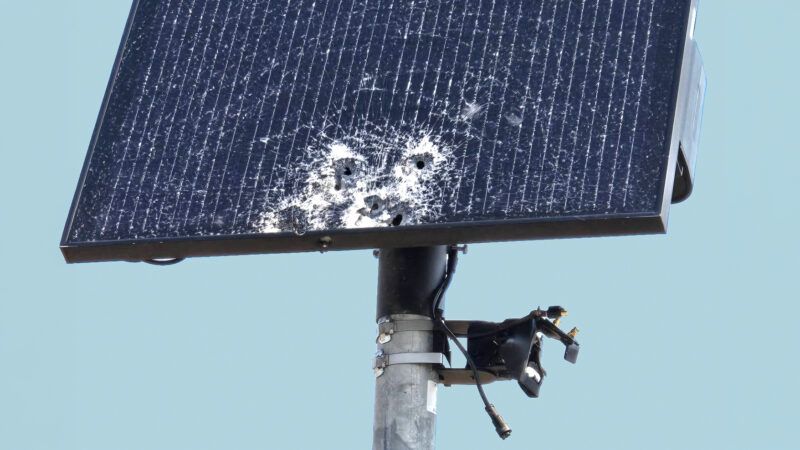
Government officials don't really have the same incentives and concerns as the people they exercise power over. Sometimes, to get officials' attention, you have to do something a little special involving signs, spray paint, hacksaws, or other innovative tools and approaches. At least, that's what's been happening to automated license plate readers (ALPRs)—often referred to as "Flock cameras" after the best-known company that provides them—across the country. Subject to escalating snooping, some people respond by sabotaging surveillance cameras' all-seeing eyes.
You are reading The Rattler from J.D. Tuccille and Reason. Get more of J.D.'s commentary on government overreach and threats to everyday liberty.
The Growing Threat of Surveillance Cameras
ALPRs are cameras that scan traffic and automatically record and recognize license plates on passing vehicles. Without warrants, police can use them to identify who drove through an area where a crime was committed. They can also be used to track the movements of anybody who comes in view of the increasingly common cameras. ALPRs are often tied into shared databases; in the case of Flock Safety, the largest company in the field, it's a database that spans the country and is accessible by any subscribed law enforcement agency. With enough networked cameras in place, a person's travels to political meetings, religious services, shopping trips, recreational activities, and on-road expeditions can be automatically monitored and mapped for scrutiny by officials looking for "suspicious" activity.
That's if the ALPRs are used as intended. The Institute for Justice (I.J.) has documented "well over 100 incidents of ALPR abuse, including romantic stalking, wrongful stops and detentions, non-law enforcement use, and other types of misconduct." It continues to record abusive uses of the technology.
ALPRs also make mistakes. "In Española, New Mexico, a 12-year-old was handcuffed after an ALPR camera misread the last number of a license plate on a vehicle driven by her older sister as a '7' instead of the '2' it actually ended with," CBS News reported last year. A Vallejo, California, Police Department trial found that "35 percent of all hits were misreads for the mobile readers, with a similar number (37 percent) for the fixed readers," meaning license plates were misidentified with potentially serious implications for those wrongly implicated as suspects in crimes.
Privacy and accuracy concerns raise red flags with skeptical Americans, but government officials in many localities continue to cut deals with ALPR vendors and to install surveillance systems because they're a low-friction means of gathering data that might be useful in solving crimes—or of stalking ex-spouses and political opponents. That's driven part of the population to do-it-yourself efforts.
Cameras Targeted by Widespread Sabotage
In De Soto, Missouri, "a camera near the De Soto Athletic Complex was intentionally damaged. The camera pole was torn down, and the solar panel appeared to have been struck multiple times by projectiles," according to KMOV. Three ALPRs in Grand Junction, Colorado, were shot with a .22 rifle. Nine cameras were cut down in Summit County, Colorado. South Carolina's WIS reported that "at least two Flock safety cameras in Irmo have been spray-coated with foam sealant." Spray painting camera lenses was the tactic of choice in Florida's Atlantic Beach, Neptune Beach, and Jacksonville Beach.
"Flock cameras have been vandalized in at least 36 states," NPR's Meg Anderson reported last week. "They've been stolen, sawed down, crashed into, covered in paint and stickers, even shot at with guns."
FlockStats, which tracks anti-ALPR efforts, records a minimum of 194 cameras disabled across the country via sabotage, as of this writing.
The sabotage efforts come with risks, since they're illegal (though not necessarily morally wrong) acts of vandalism against public property. Several of those who've targeted ALPRs have been arrested for their troubles. Some agencies, such as the Oviedo Police Department in Florida, are now putting up decoy "bait" cameras which are themselves kept under surveillance to trap vandals.
Decoy schemes increase the risks of sabotaging ALPRs; Ovieda charged a man they arrested with three felony counts for cutting down a decoy. But they also demonstrate that sabotage has caught the attention of the officials who install the real ALPRs. And that attention seems to have had an impact.
Opposition Gets Officials' Attention
DeFlock, another anti-ALPR site, documents at least 135 communities "rejecting" ALPRs. Many of them canceled contracts with camera providers (usually Flock, but also Motorola and other firms). The reasons they cite often reflect the concerns raised by privacy activists who say that people's movements shouldn't be tracked by government officials without a warrant.
In Arizona, "Pinal County Sheriff Ross Teeple announced the cancellation of the Sheriff's Office contract with Flock Safety, citing 4th amendment concerns with the company's Automated License Plate Reader (ALPR) Cameras," the sheriff's office announced earlier this month.
When a county sheriff acknowledges that surveillance technology raises serious ramifications for civil liberties, you know vandals destroying cameras have tapped into a deep well of public opposition to widespread surveillance that extends beyond the ranks of the saboteurs.
People concerned about surveillance, but unwilling to risk felony charges, might consider countermeasures to ALPRs. Just as some clothing companies have introduced high-tech patterns intended to frustrate facial recognition, so entrepreneurs produce car add-ons that are supposed to confuse license-plate readers.
Without getting into the details of the products and their debatable effectiveness, some companies offer license plate covers marketed as obscuring plate characters (these are illegal in some states). Others sell infrared LED light frames that are supposed to wash out images.
A little more in-your-face is Bill Swearingen's noRecognition project, which has developed a car wrap that overwhelms cameras with busy imagery. According to a profile in TechCrunch, "Swearingen's computer-generated patterns do not block surveillance cameras from recording video footage. Instead, they scramble the camera's ability to identify objects, people, or faces so that the cameras do not trigger any detection alerts." He claims his patterns are effective with software including that used by Flock ALPRs.
A pattern busy enough to confuse surveillance cameras will certainly draw attention. The question is whether that attention will be as effective as that generated by ALPR saboteurs. For now, people willing to take legal risks to disable surveillance cameras are drawing public support and convincing at least some public officials to consider public concerns over civil liberties.