

Reason.com - Free Minds and Free Markets
Reason logo Reason logo
  • Latest
  • Magazine
    • Current Issue
    • Archives
    • Subscribe
    • Crossword
  • Video
    • Reason TV
    • The Reason Roundtable
    • Free Media
    • The Reason Interview
  • Podcasts
    • All Shows
    • The Reason Roundtable
    • The Reason Interview With Nick Gillespie
    • Freed Up
    • The Soho Forum Debates
  • Volokh
  • Newsletters
  • Donate
    • Donate Online
    • Ways To Give To Reason Foundation
    • Torchbearer Society
    • Planned Giving
  • Subscribe
    • Reason Plus Subscription
    • Print Subscription
    • Gift Subscriptions
    • Subscriber Support

Log In

Create new account

Privacy

Roanoke Removes Gunshot Detectors Months After Approving Them

Limited evidence of effectiveness combined with privacy concerns raises questions about the sensors.
J.D. Tuccille | 8.5.2026 7:00 AM

Share on FacebookShare on XShare on RedditShare by emailPrint friendly versionCopy page URL Add Reason to Google
Media Contact & Reprint Requests
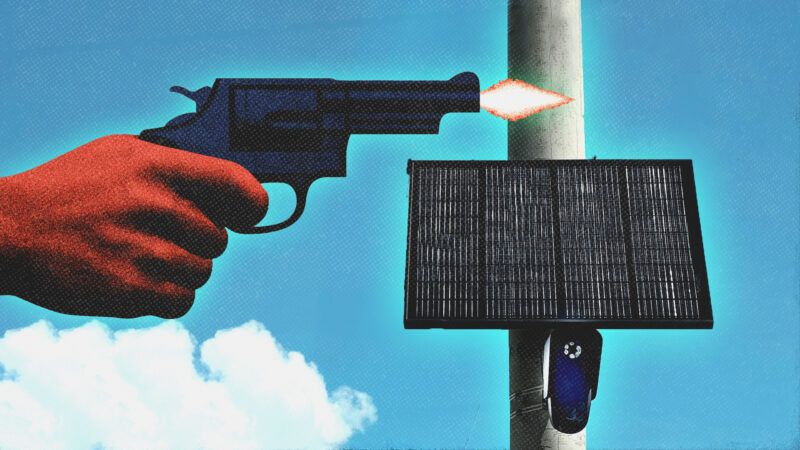
A person fires a gun near an acoustic gunshot detector. | Illustration: Midjourney Photo: Paul Weaver/Sipa USA/Newscom
(Illustration: Midjourney Photo: Paul Weaver/Sipa USA/Newscom)

Last week, the city of Roanoke, Virginia, ended its brief and fumbled experiment with Flock Safety's Raven acoustic gunshot detectors (AGD) after 41 of the 75 approved devices had been installed—30 of them in the wrong locations. Roanoke isn't alone. Numerous other cities have canceled contracts with Flock or with SoundThinking Inc, a competing provider of ShotSpotter, a similar technology, over cost, effectiveness, and privacy concerns related to scattering microphones across a city.

You are reading The Rattler from J.D. Tuccille and Reason. Get more of J.D.'s commentary on government overreach and threats to everyday liberty.

This field is for validation purposes and should be left unchanged.

Botched Installation Joins Privacy Concerns Over Microphones in Public Places

According to The Roanoke Star's Stephanie Harper, "an internal review traced the misplacements to data-entry errors: sensor addresses were mistyped, including 'Orange Ave.' rendered as 'Grange Ave.' more than once, and installation crews worked from a location list that council had never approved. The city first reported 16 misplaced sensors in late June, then corrected the figure to 30 a day later."

As a result of the botched installations, the Flock Safety AGD program, which was approved in April and paid for with $54,675 in federal grant money, ended just months later. The messy implementation was a major factor, but the program had been dogged with concerns about invasions of privacy that have swirled around AGD technology since its introduction.

"Some have raised the concern that ShotSpotter might be used as a voice surveillance tool—that is, that it could be used to listen to and record conversations occurring near ShotSpotter sensors," a 2019 privacy assessment of the AGD system by the New York University School of Law's Policing Project acknowledged. "This concern has been bolstered by a handful of occasions in the past that human voice has been captured by sensors and used in a criminal prosecution."

Ultimately, that report concluded that "the risk of voice surveillance is extremely low in practice."

In fact, though, Bloomberg reported in 2022 that New York City police may have been using ShotSpotter sensors to eavesdrop on public places, noting, "Its technology is always listening and can capture not only gunfire, but conversations held at a normal tone within 30 to 45 feet (14 meters) of a sensor."

Perhaps as important as eavesdropping abuse of AGD sensors is evidence that they don't work very well at their primary tasks.

80 Percent False-Positive Rates

"While vendors claim AGD offers high detection accuracy and meaningful results, independent research and city reports indicate otherwise," finds a new report by Jonathan Hofer of the Independent Institute. "The largest quasi-experimental study, analyzing sixty-eight metropolitan counties, found AGD had 'no significant impact on firearm-related homicides or arrest outcomes.'"

Among other problems, the report found, "false-positive rates for AGD systems consistently exceed 80 percent in major cities. In Chicago, over forty thousand unproductive deployments occurred in less than two years, consuming more than twenty thousand patrol hours and diverting officers from genuine emergencies."

Confirming that take, a 2021 City of Chicago Inspector General assessment concluded that "ShotSpotter alerts rarely produce evidence of a gun-related crime, rarely give rise to investigatory stops, and even less frequently lead to the recovery of gun crime-related evidence during an investigatory stop."

The Chicago assessment emphasized the steep costs associated with what its authors saw as a minimally beneficial technology. Hofer's report details those costs.

High Cost for Little Return

"Beyond the sticker price listed in city contracts, other costs, such as maintenance, add to the total outlays required to employ the technology. In 2022, the City of Oakland was paying nearly $800,000 per year for ongoing AGD services and maintenance," Hofer found. "Chicago was spending $9 million per year."

That might be a worthwhile investment if it produced results (and avoided invading people's privacy). But the data suggests that the industry's high claimed accuracy rate just doesn't correspond with reality when the sensors are installed along busy city streets where trucks rumble, dumpsters slam, firecrackers pop, and life and commerce generally produce noise.

"Sources that purport a 90-percent-or-more success metric are often counting false positives—if and when there is a documented investigation that demonstrates no gunfire occurred," adds Hofer. He points to research by the MacArthur Justice Center at Northwestern School of Law which found 89 percent of the alerts "turned up no gun-related crime and 86 percent led to no report of any crime at all."

Hofer adds that "in St. Louis, for every 100 alerts, police found evidence of a crime in less than one incident." By contrast, evidence of crime was found in 7.6 incidents for every 100 calls generated by members of the community.

A 2024 audit of AGD in New York City found "alerts only resulted in confirmed shootings between 8% and 20% of the time." The audit added: "During the month of June 2023, for example, out of the 940 ShotSpotter alerts that NYPD responded to 771 could not be confirmed as shootings upon arrival at the scene (82%), 47 were determined to be unfounded (5%), and 122 were confirmed as shootings (13%)."

Yes, some actual gunshots are detected. But that comes at high cost for purchasing and maintaining the AGD system as well as in terms of investigatory resources expended on wild goose chases.

Hold Off on Detectors in Favor of 'Proven Policing Strategies'

In recent years many cities, including Cambridge, Chicago, San Antonio, San Diego, Tacoma, and Roanoke have dropped AGD contracts. Politicians and members of the public called to pull the plug on the systems over cost, effectiveness, and privacy worries.

Hofer recommends that cities hold off on AGD "until independent validation demonstrates effectiveness." He also recommends transparency, so the public can assess the systems' failure and success rates. He calls for cost-benefit analyses and asks that municipalities "invest in proven policing strategies: adequate homicide detective staffing, modern case-management systems, and intelligence-led approaches that have more substantiated promise in crime reduction."

That is, terminating AGD contracts and emphasizing established techniques can both lower costs and improve effectiveness when it comes to fighting crime.

Although the gunshot detectors are gone, Roanoke citizens concerned about privacy can't rest quite yet. According to news reports, the city still has a fleet of license plate readers and surveillance cameras watching the streets.

The Rattler is a weekly newsletter from J.D. Tuccille. If you care about government overreach and tangible threats to everyday liberty, this is for you.

This field is for validation purposes and should be left unchanged.

NEXT: Brickbat: Banned T-Shirt

J.D. Tuccille is a contributing editor at Reason.

PrivacyGunsSecond AmendmentVirginiaTechnologyCivil LibertiesFlock
Share on FacebookShare on XShare on RedditShare by emailPrint friendly versionCopy page URL Add Reason to Google
Media Contact & Reprint Requests

Hide Comments (19)

Editor's Note: As of February 29, 2024, commenting privileges on reason.com posts are limited to Reason Plus subscribers. Past commenters are grandfathered in for a temporary period. Subscribe here to preserve your ability to comment. Your Reason Plus subscription also gives you an ad-free version of reason.com, along with full access to the digital edition and archives of Reason magazine. We request that comments be civil and on-topic. We do not moderate or assume any responsibility for comments, which are owned by the readers who post them. Comments do not represent the views of reason.com or Reason Foundation. We reserve the right to delete any comment and ban commenters for any reason at any time. Comments may only be edited within 5 minutes of posting. Report abuses.

  1. Vernon Depner   2 months ago

    Stop subsidizing the reproduction of indigent unmarried women. That's the long-term solution to armed violence.

    1. Liberty_Belle   2 months ago

      Castrating domestic violence and sex offenders would do the job better. Also it promotes better moods, improves prostate health, reduces roaming, fighting, and gives men a shinier coat.

      1. Agammamon   2 months ago

        There are far fewer 'sex offenders' that indigent women.

        1. Liberty_Belle   2 months ago

          Easier to round them up for a snip, then.

          1. Rick James   2 months ago

            Three generations of imbeciles is enough, put on your mask, take this vaccine and stop going outside.

      2. Vernon Depner   2 months ago

        Trap, neuter, and release.

  2. Heresolong   2 months ago

    It's far too easy to spend federal grant money, since you don't actually have to earn it or account to your local citizens for its use.

    1. Stupid Government Tricks   2 months ago

      That's what I saw too. "paid for with $54,675 in federal grant money" means the city had nothing to lose but somebody else's money.

      I bet banning feds from transferring any money to states, cities, etc would do wonders for both the federal budget and liberty.

      1. Eeyore   2 months ago

        That is the way. Government money just screws everything up.

  3. James K. Polk   2 months ago

    The "community" that would most benefit from ShotSpotter doesn't want it. It's just a snitch, after all. Stop wasting money.

  4. Eeyore   2 months ago

    Sick of answering 2am calls when someone explodes a firecracker or a car backfires or someone in the neighborhood slams a door really hard.

  5. KeninTX   2 months ago

    I have no problem with time-limited trials to see if gunshot detectors can be useful, esp when the cost is a fraction of a first-year patrol officer's salary & benefits. (That's a rounding error on the department's salary budget...)

    That Roanoke botched the deployment is a side-issue, and complicates the evaluation/decision process.

    I can almost agree with privacy concerns, but it would be a trivial issue to simply pass a law that forbids the use of gunshot detector audio *without* a warrant signed by a judge *before* the audio is captured. (If you are speaking loud enough that a microphone 45 feet away picks up your voice, you weren't even trying to keep your conversation secret, I mean, come on!)

    And finally, it's a gunshot DETECTOR, not a prevention tool - why would anyone think that by itself a gunshot detector will reduce the number of gunshot incidents or, even more absurdly, reduce crime in general? When a gun is fired, everyone in certain radius hears the shot - it's not a secret - the detector simply alerts the police of a possible gunshot event in a certain area.

    Gunshot detectors are a response to the reality that many lower-income neighborhoods under-report gunfire, and as such police never get a chance to investigate. Any neighborhood affluent enough to have an AWFL (Angry White Female Liberal) Karen already has a "volunteer gunshot detector", LOL.

    The purpose of the gunshot detector is to validly identify gunshots and locate the proximal area where it occurred. That's it. It's up to the shooters to fear the detector, and if the press keeps saying they are ineffective, why would criminals change their behavior?

    The real test would be for the detectors to be PROPERLY deployed, and there should be numerous active shooters deployed around the city, firing blanks at known locations and times over an extended period, and the results should be compared with the test firing data, THEN you can assess accuracy.

    Mis-installing the detectors and having impossible targets for them to meet ("reduce crime") is a recipe for failure.

    1. Stupid Government Tricks   2 months ago

      One of the more inept comments today.

      I can almost agree with privacy concerns, but it would be a trivial issue to simply pass a law that forbids the use of gunshot detector audio *without* a warrant signed by a judge *before* the audio is captured.

      First: you are beyond naive if you think passing a law would stop abuse. Gitcher head outa da sand and read some modern news.

      Second: any such law would recognize, officially, that these things can record people nearby, and that's the last thing anybody wants -- the business or the government.

      1. KeninTX   2 months ago

        First: you are beyond naive if you think passing a law would stop abuse. Gitcher head outa da sand and read some modern news.

        How would a prosecutor introduce illegal evidence in court? I've watched enough TV Lawyer shows to know the phrase "fruit of the poisoned tree"

        Second: any such law would recognize, officially, that these things can record people nearby, and that's the last thing anybody wants -- the business or the government.

        But, somehow, introducing recordings made by the devices in court wouldn't expose that fact? Really?

      2. KeninTX   2 months ago

        Also, I stand by this statement:

        (If you are speaking loud enough that a microphone 45 feet away picks up your voice, you weren't even trying to keep your conversation secret, I mean, come on!)

        Once installed, the location of these microphones becomes common knowledge (like flock cameras), and they are installed up high (think rooftops), not at street level. If your illicit activities are being discussed out in the open, within 45 feet of a known microphone, do you really have a presumption of privacy?

      3. Rick James   2 months ago

        First: you are beyond naive if you think passing a law would stop abuse. Gitcher head outa da sand and read some modern news.

        Damnit... and after I read Reason's article saying that license plate scanning for congestion pricing wouldn't be a problem... "if done right", I now have my doubts.

  6. Bobster0   2 months ago

    I am all for recording people in public, but only to punish those who say stupid things. Who decides what's a stupid thing to say? That's a stupid question. Prepare to be punished! 🙂

    1. Rick James   2 months ago

      I'm sure someone will find an authority to punish people for saying stupid things!

  7. Rick James   2 months ago

    They should combine them with license plate scanners for congestion pricing, make Reason's collective head explode.

Please log in to post comments

Mute this user?

  • Mute User
  • Cancel

Ban this user?

  • Ban User
  • Cancel

Un-ban this user?

  • Un-ban User
  • Cancel

Nuke this user?

  • Nuke User
  • Cancel

Un-nuke this user?

  • Un-nuke User
  • Cancel

Flag this comment?

  • Flag Comment
  • Cancel

Un-flag this comment?

  • Un-flag Comment
  • Cancel

Latest

Police Allegedly Destroyed $37,000 of Legal Hemp. Georgia's Supreme Court Just Upended 60 Years of Precedent.

Billy Binion | 10.4.2026 7:00 AM

The Millennial Internet Is Dead, and Politicians Killed It.

Elizabeth Nolan Brown | From the November 2026 issue

Mamdani Promised To Freeze the Rent. Now His Rent Freeze Is in Court.

C. Jarrett Dieterle | 10.3.2026 7:00 AM

Minneapolis Activists Used Encrypted Group Chats To Outmaneuver ICE. Now the Feds Want To Prosecute Them.

Eric Boehm | From the November 2026 issue

2 Lawsuits Cast Further Doubt on the Claim That ICE Agent Jonathan Ross Killed Renée Good in Self-Defense

Jacob Sullum | 10.2.2026 4:30 PM

Recommended

  • About
  • Browse Topics
  • Events
  • Staff
  • Jobs
  • Donate
  • Advertise
  • Subscribe
  • Contact
  • Media
  • Amazon
Reason Facebook@reason on XReason InstagramReason TikTokReason YoutubeApple PodcastsReason on FlipboardReason RSS Add Reason to Google

© 2026 Reason Foundation | Accessibility | Privacy Policy | Terms Of Use

This site is protected by reCAPTCHA and the Google Privacy Policy and Terms of Service apply.

Reason's July 4 Special!

For America's 250th, Get 2 Years of Reason for $17.76

Celebrate your independence with a subscription to Reason magazine, your most trusted source of honest, insightful news and analysis.

Subscribe to Reason


