Roanoke Removes Gunshot Detectors Months After Approving Them
Limited evidence of effectiveness combined with privacy concerns raises questions about the sensors.
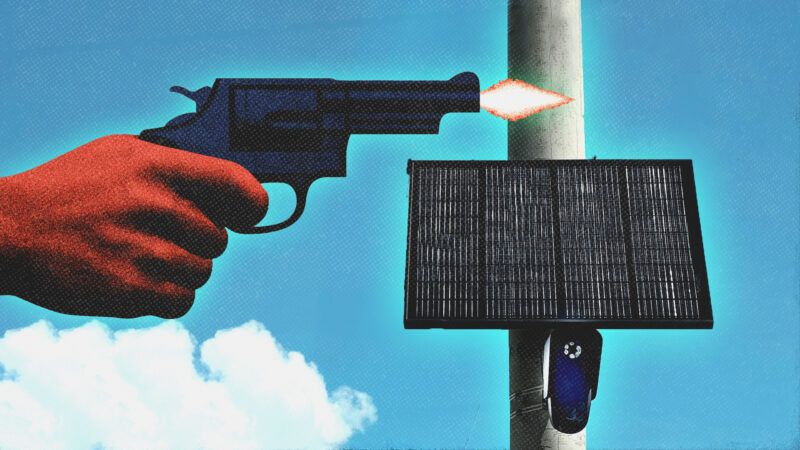
Last week, the city of Roanoke, Virginia, ended its brief and fumbled experiment with Flock Safety's Raven acoustic gunshot detectors (AGD) after 41 of the 75 approved devices had been installed—30 of them in the wrong locations. Roanoke isn't alone. Numerous other cities have canceled contracts with Flock or with SoundThinking Inc, a competing provider of ShotSpotter, a similar technology, over cost, effectiveness, and privacy concerns related to scattering microphones across a city.
You are reading The Rattler from J.D. Tuccille and Reason. Get more of J.D.'s commentary on government overreach and threats to everyday liberty.
Botched Installation Joins Privacy Concerns Over Microphones in Public Places
According to The Roanoke Star's Stephanie Harper, "an internal review traced the misplacements to data-entry errors: sensor addresses were mistyped, including 'Orange Ave.' rendered as 'Grange Ave.' more than once, and installation crews worked from a location list that council had never approved. The city first reported 16 misplaced sensors in late June, then corrected the figure to 30 a day later."
As a result of the botched installations, the Flock Safety AGD program, which was approved in April and paid for with $54,675 in federal grant money, ended just months later. The messy implementation was a major factor, but the program had been dogged with concerns about invasions of privacy that have swirled around AGD technology since its introduction.
"Some have raised the concern that ShotSpotter might be used as a voice surveillance tool—that is, that it could be used to listen to and record conversations occurring near ShotSpotter sensors," a 2019 privacy assessment of the AGD system by the New York University School of Law's Policing Project acknowledged. "This concern has been bolstered by a handful of occasions in the past that human voice has been captured by sensors and used in a criminal prosecution."
Ultimately, that report concluded that "the risk of voice surveillance is extremely low in practice."
In fact, though, Bloomberg reported in 2022 that New York City police may have been using ShotSpotter sensors to eavesdrop on public places, noting, "Its technology is always listening and can capture not only gunfire, but conversations held at a normal tone within 30 to 45 feet (14 meters) of a sensor."
Perhaps as important as eavesdropping abuse of AGD sensors is evidence that they don't work very well at their primary tasks.
80 Percent False-Positive Rates
"While vendors claim AGD offers high detection accuracy and meaningful results, independent research and city reports indicate otherwise," finds a new report by Jonathan Hofer of the Independent Institute. "The largest quasi-experimental study, analyzing sixty-eight metropolitan counties, found AGD had 'no significant impact on firearm-related homicides or arrest outcomes.'"
Among other problems, the report found, "false-positive rates for AGD systems consistently exceed 80 percent in major cities. In Chicago, over forty thousand unproductive deployments occurred in less than two years, consuming more than twenty thousand patrol hours and diverting officers from genuine emergencies."
Confirming that take, a 2021 City of Chicago Inspector General assessment concluded that "ShotSpotter alerts rarely produce evidence of a gun-related crime, rarely give rise to investigatory stops, and even less frequently lead to the recovery of gun crime-related evidence during an investigatory stop."
The Chicago assessment emphasized the steep costs associated with what its authors saw as a minimally beneficial technology. Hofer's report details those costs.
High Cost for Little Return
"Beyond the sticker price listed in city contracts, other costs, such as maintenance, add to the total outlays required to employ the technology. In 2022, the City of Oakland was paying nearly $800,000 per year for ongoing AGD services and maintenance," Hofer found. "Chicago was spending $9 million per year."
That might be a worthwhile investment if it produced results (and avoided invading people's privacy). But the data suggests that the industry's high claimed accuracy rate just doesn't correspond with reality when the sensors are installed along busy city streets where trucks rumble, dumpsters slam, firecrackers pop, and life and commerce generally produce noise.
"Sources that purport a 90-percent-or-more success metric are often counting false positives—if and when there is a documented investigation that demonstrates no gunfire occurred," adds Hofer. He points to research by the MacArthur Justice Center at Northwestern School of Law which found 89 percent of the alerts "turned up no gun-related crime and 86 percent led to no report of any crime at all."
Hofer adds that "in St. Louis, for every 100 alerts, police found evidence of a crime in less than one incident." By contrast, evidence of crime was found in 7.6 incidents for every 100 calls generated by members of the community.
A 2024 audit of AGD in New York City found "alerts only resulted in confirmed shootings between 8% and 20% of the time." The audit added: "During the month of June 2023, for example, out of the 940 ShotSpotter alerts that NYPD responded to 771 could not be confirmed as shootings upon arrival at the scene (82%), 47 were determined to be unfounded (5%), and 122 were confirmed as shootings (13%)."
Yes, some actual gunshots are detected. But that comes at high cost for purchasing and maintaining the AGD system as well as in terms of investigatory resources expended on wild goose chases.
Hold Off on Detectors in Favor of 'Proven Policing Strategies'
In recent years many cities, including Cambridge, Chicago, San Antonio, San Diego, Tacoma, and Roanoke have dropped AGD contracts. Politicians and members of the public called to pull the plug on the systems over cost, effectiveness, and privacy worries.
Hofer recommends that cities hold off on AGD "until independent validation demonstrates effectiveness." He also recommends transparency, so the public can assess the systems' failure and success rates. He calls for cost-benefit analyses and asks that municipalities "invest in proven policing strategies: adequate homicide detective staffing, modern case-management systems, and intelligence-led approaches that have more substantiated promise in crime reduction."
That is, terminating AGD contracts and emphasizing established techniques can both lower costs and improve effectiveness when it comes to fighting crime.
Although the gunshot detectors are gone, Roanoke citizens concerned about privacy can't rest quite yet. According to news reports, the city still has a fleet of license plate readers and surveillance cameras watching the streets.