European Commission Moves Us One Step Closer to the End of the Open Internet
It's coming faster than you might think.

On Monday, European Commission President Ursula von der Leyen signaled that a European Union–wide identity verification scheme for social media users may be coming soon. It would mark a massive advancement of the privacy-invading, speech-squelching, open-internet killing juggernaut that seems sadly unstoppable in the Western world.
As per usual, the scheme is being billed by authorities as a common-sense way to protect children. "Social media is not a toy," von der Leyen said in a July 12 statement. "While ultimately it is up to parents to decide when children get their first smartphones, what we already have is a consensus that there needs to be a start date for the age children can join social media."
"It is clear we need age-appropriate restrictions to platforms," von der Leyen continued, touting the European Commission's new age-verification app.
You are reading Sex & Tech, from Elizabeth Nolan Brown. Get more of Elizabeth's sex, tech, bodily autonomy, law, and online culture coverage.
In truly Orwellian fashion, von der Leyen claimed that "this is about putting power back into the hands of parents."
But of course, government-imposed bans on teens using social media do the exact opposite. They take decisions about age-appropriate internet usage out of the hands of parents and give it to regulators.
This is what Australia did last year, stipulating that no one under age 16 could have a social media account, regardless of whether their parents think it is OK. And despite report after report suggesting that Australia's ban is a flop—teens are easily getting around it—politicians in the U.S. and in the U.K. are rushing to emulate Australia. Now, it looks like the whole of the European Union could be next.
("In a few short years, the entire Western world might finally end the age of the open internet," notes Kelsey Piper at The Argument.)
"We need to set the age at which [minors] can legally access social media," said von der Leyen on Sunday. She promised to "present a proposal after the summer" that would focus on keeping minors off not just social media but all platforms that the government deems to have "age-inappropriate and addictive features"—a category she's calling "social media plus." (Shudders.)
As per usual, the rhetoric used to promote this scheme sounds so sweet and benign. Who could be against keeping kids off of "addictive" and "inappropriate" websites?
But the reality of implementing "social media plus" bans is that adults, teens, and children alike need to show ID or otherwise verify their real identities on every platform with which they interact.
From posting political commentary on X to asking potentially embarrassing health questions on Reddit, reviewing books on Goodreads, posting to a forum for LGBTQ young people, consuming TikTok content, subscribing to Substack newsletters, joining a community for people dealing with psychological issues, and so much more, your real identity will be tied to your online activity. Tech companies, regulators, and law enforcement may be able to connect you to activity across the internet. There would be no more online anonymity, at least not in any real sense.
Sure, some age-verification schemes do a better job protecting privacy and personal data than do others. (All things being equal, it's better to upload your ID to one app and then use that app to access various websites, rather than submitting your data to a bunch of sites individually.) But the whole business is still a privacy nightmare. Some companies that aren't supposed to store data surely will. Age-check apps themselves can be hacked. All of us become more vulnerable to snoops, identity thieves, and other malicious actors.
Meanwhile, the whole foundation of the open internet is upended. Instead of the free and open internet that has existed for decades, we get a "papers, please" internet. We normalize the idea that every online interaction should be traceable and every forum we visit should know who we are.
This is especially dangerous in countries without strong free speech protections. "In the U.K., where thousands of people have been arrested for online posts, it's hard not to interpret the sweeping age-verification laws for social media in terms of the secondary effect of requiring everyone to submit a bunch of identifying information to use social media," notes Piper. And even in the U.S., age-verification laws could open up more people to punitive government action based on their speech. After all, "the government has harassed and stalked people for anti-ICE speech," Piper points out.
All the while, teenagers either find ways around bans (as many in Australia are showing) or they're cut off from the online world—including the news, community, emotional support, abilities for self-expression, and other benefits it brings.
Politicians and the sort of pundits who have made a career out of tech fear mongering routinely suggest that the online world's harms to minors are catastrophic and proven. But the evidence is actually incredibly mixed, with many studies finding no link or even some positive correlations between social media or phone use and well-being, and neither the positive nor the negative studies are able to show a causal link. (Plus, there's just a lot of really bad or overhyped research out there.)
I'm not suggesting unfettered screen time is good for young children, that social media can't be bad for developing brains, or that parents should put no limits on what kinds of content and platforms their kids can access. And I realize that our current solutions for putting parents more in control are imperfect.
But that doesn't mean that putting the government in control is the right solution.
In the News
Sex work decriminalization in Thailand hits a snag. "A citizen-sponsored bill seeking protection of the rights of sex workers has hit a procedural hurdle after parliamentary leaders ruled that it qualifies as a money bill, meaning it cannot proceed without the prime minister's endorsement," Bangkok Post reports.
Called the Sex Worker Protection Bill, it will now need to be certified by Prime Minister Anutin Charnvirakul before lawmakers can even debate it. And since there's no set deadline for when Charnvirakul must make a move, that could leave the measure in indefinite limbo. More from the Post:
Deputy House Speaker Lertsak Pattanachaikul said parliamentary officials identified two provisions that might incur costs on the state.
The first concerns the creation of a Sex Worker Protection Centre, requiring additional personnel. The second recognises sex workers as employees, making them eligible for the social security system and requiring the government to increase its fund contributions.
Chalawan Muangchan of the Empower Foundation said the bill was developed with the Ministry of Social Development and Human Security to protect sex workers as labourers rather than treat them as criminals.
The move to classify the measure as a money bill has sparked some backlash. "Organisations backing the legislation…argued Parliament had applied inconsistent legal standards" and "questioned why similar legislation had previously escaped the financial bill classification," reports Thai Examiner, which has more details about the bill:
The proposed legislation would repeal the Prevention and Suppression of Prostitution Act B.E. 2539 (1996) and replace it with a protection-based legal framework. […] Under the draft law, adults aged 20 and over would be permitted to engage in sex work legally. Workers would gain access to labour protections, workplace health and safety standards and social security benefits available to other employees.
The legislation would also establish licensing arrangements for businesses while setting clearer standards governing employment conditions throughout the sector.
At the same time, the proposal preserves criminal penalties for serious offences. Human trafficking, child sexual exploitation, coercion and forced prostitution would remain criminal offences carrying severe penalties.
Supporters argue the distinction would allow law enforcement agencies to focus resources on organised crime and exploitation rather than consensual adult sex work. However, critics of the wider reform have argued that legal recognition could encourage further expansion of Thailand's commercial sex industry.
On Substack
AI as amplifying technology, not replacement technology: "The AI as Normal Technology framework is a correct and useful as a way to think about AI's impacts, unless and until there is some future discontinuity such as through recursive self-improvement," writes Arvind Narayanan. In a keynote address to the International Conference on Machine Learning last week, Narayanan suggested that rather than thinking of AI as a technology that will replace human work, he sees it as an amplifying technology.
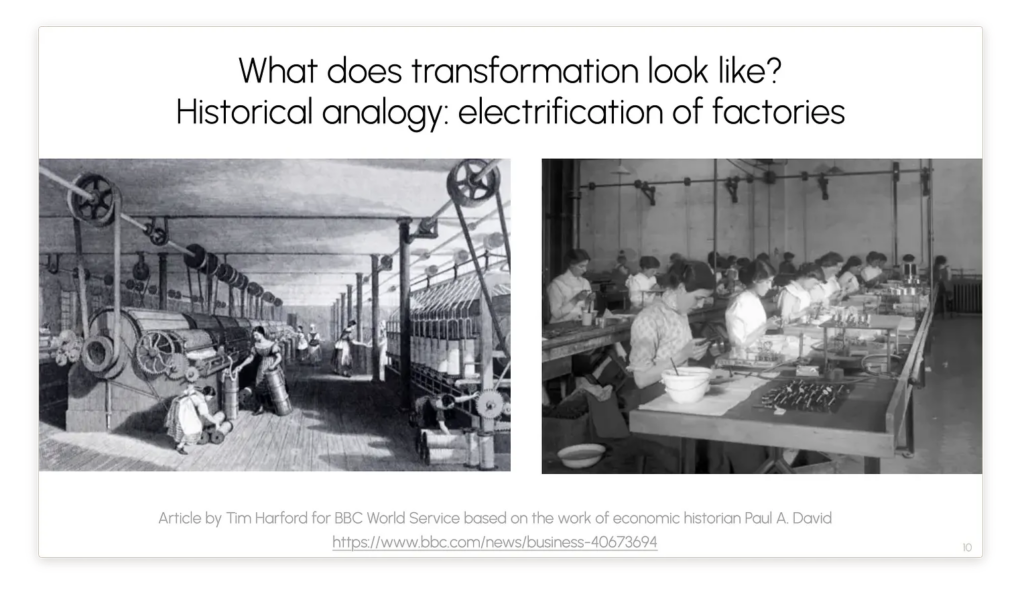
Before electricity, factories used to look like the picture on the left. A massive steam engine generated power and it was moved throughout the factory by mechanical gears and belts. So when electricity came along, factory owners tried to replace those steam boilers with electric generators. They thought it would be much more efficient. But this idea of a drop-in replacement did not work. We keep hearing that term in the context of AI agents today — that they will be drop-in replacements for human workers. That did not work in the case of electricity.
What actually worked, and what took 40 years to develop, is to recognize that electricity is a very different technology. It's portable, so you can move the power to wherever you need it. That lets you reorganize the entire layout of the factory around the logic of the assembly line. And that required changing the way that workers are trained, hired, and fired, new labor laws, and so forth. So that's the kind of organizational adaptation that it took in order to reap the benefits of electricity in factories.
Our claim is that this is the kind of process that we will go through for AI. A couple of decades from now, we will have fundamentally reorganized work. We don't know what that's going to look like, and that is the challenge in front of all of us. And that's not just a job for the AI companies to do, much like it wasn't the job of the electric utility to figure out how factories should be reorganized. In our view, this is the slowest of the four stages through which AI leads to economic impacts. Today, this process has not really gotten started.
More Sex & Tech News
Piccadilly Circus. The London Councils didn't like our campaign against the upcoming state spyware in the UK. So, first the word "government" was blacked out. Then the whole message was scrapped.
On the other side of the road, though: alive and kicking. pic.twitter.com/LmoCCIYX7E— Mullvad.net (@mullvadnet) July 10, 2026
• The AI industry needs "more energy than the entire country produces right now," President Donald Trump claimed at a NATO summit in Turkey last week. That's not true, notes Poynter. While "it's difficult to project future AI energy loads with certainty," Poynter found that current estimates from government and private sources come nowhere close to the figure Trump estimated. Rather, "these estimates of expected AI energy loads range from 6% to 25%."
• Prostitution arrests in Chicago are down significantly from 25 years ago, the Chicago Tribune reports. "Chicago police made 189 prostitution-related arrests in 2025 — down from 6,026 in 2001." But women still make up "the vast majority" of arrests, a Tribune investigation found. Prostitution customers "are arrested and charged, too, though far less frequently."
• New York just became the first state to ban AI data centers.
• Book publishers are suing Google, alleging that it broke copyright law while training its artificial intelligence system, Gemini, on their books.
• Scarlett Pavlovich, a former nanny employed by author Neil Gaiman, "sued Gaiman in the Western District of Wisconsin, after he moved there, alleging he repeatedly sexually assaulted her while living in New Zealand in violation of Wisconsin law and the federal Trafficking Victims Protection Act," notes the U.S. Court of Appeals for the 7th Circuit. But because the alleged assaults took place in New Zealand, she should sue in New Zealand, a federal district court ruled and the 7th Circuit just affirmed.