

DOJ Claim That Trump Could 'Bulldoze' Statue of Liberty Fits a Pattern
It's the latest example of Justice Department attorneys claiming broad and unreviewable powers for the president.
One shouldn't get into the habit of feeling sorry for high-ranking federal employees, who wield power over our lives and get a salary of our tax money for their trouble. Still, serving as a U.S. Department of Justice (DOJ) lawyer arguing on behalf of the government seems like an unenviable gig, as accomplished attorneys are reduced to backfilling legal defenses of their bosses' harebrained schemes.
When President Joe Biden decided to wipe out broad swathes of student loan debt, the DOJ argued that he could do so without Congress' approval using a law explicitly tailored to soldiers in active duty. The HEROES Act allowed the government to waive student loan repayment during "a war or other military operation or national emergency"; Biden's DOJ argued that the then-ongoing COVID-19 national emergency qualified to forgive billions of dollars in student loans for millions of borrowers. (By a 6–3 margin, the U.S. Supreme Court was unconvinced.)
But nowadays that example seems almost quaint. President Donald Trump's administration now rather routinely subjects its DOJ attorneys to the indignity of making facially indefensible claims about the president's power, simply because the executive demands it.
Last year, Trump demolished the East Wing of the White House with plans to build a gigantic ballroom in its place. His cited legal authority was a decades-old statute pertaining to general facility upkeep and maintenance.
In March, U.S. District Judge Richard J. Leon granted a motion enjoining construction on the ballroom. Congress did not authorize the project, Leon wrote, and "no statute comes close to giving the President the authority he claims to have."
Last week, DOJ attorney Yaakov Roth asked the U.S. Court of Appeals for the D.C. Circuit to overturn Leon's order and allow construction to continue.
Not only did Leon err in his decision, Roth argued, but courts have no authority to stop the project once it's begun—after all, the East Wing is already demolished, and construction on the ballroom is "well on its way." (On the other hand, when asked at what point the courts lost the ability to intervene, Roth said it would have been improper "even on day one.")
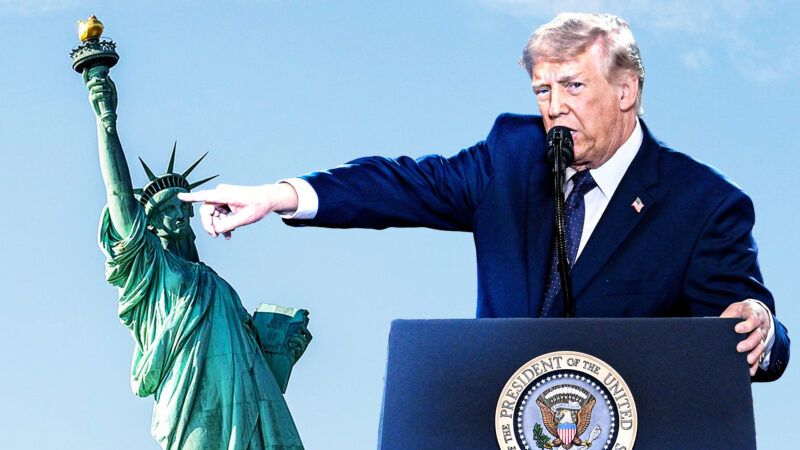
But when questioned, Roth went even further. "If the government decides, very quickly, to bulldoze the Statue of Liberty," asked Judge Patricia Millett, "[if] the government moved too fast…nothing can be done?"
"I think that's right, yes," Roth replied, which, according to ABC News, "sparked audible gasps in the courtroom."
Roth's position is not just laughable; it's offensive to the constitutional vestment of powers within three coequal branches of government.
But then again, what choice does he have? Trump claims he can demolish federal property and rebuild new ones in their place to his specifications, with no oversight or authorization. At that point, why would any federal structure be off-limits?
In fact, Roth's admission fits a pattern in which Trump's DOJ attorneys make increasingly maximalist arguments about presidential power in order to match their boss's policy goals.
Early in his second term, Trump imposed double-digit tariffs on nearly every nation on the planet. Like all taxes, the power to enact tariffs lies with Congress, not the president, but Trump argued that persistent trade deficits constituted an "emergency" that allowed him to act unilaterally.
As with Biden's student loan gambit, the Supreme Court was unimpressed with this line of logic. But during oral arguments, Justice Neil Gorsuch posed a hypothetical to Solicitor General D. John Sauer: If the president can impose any tariffs he deems fit to address an emergency of his own designation, could a future president then impose tariffs on gasoline-powered cars "to deal with the 'unusual and extraordinary' threat…of climate change?"
"It's very likely that could be done," Sauer replied.
Sauer was also on hand when Trump deployed National Guard troops to Chicago. A federal judge enjoined Trump's order, and the administration appealed.
"The President's determination to call up the National Guard," Sauer wrote in a brief to the Supreme Court, "is not judicially reviewable at all; at minimum, it is entitled to extremely deferential review, under which it should be upheld."
The government made a similar argument after Trump invoked the Alien Enemies Act of 1798 to bypass immigration procedures and deport hundreds of Venezuelan nationals to a prison in El Salvador. The U.S. Court of Appeals for the 5th Circuit pressed the administration to explain how the deportees met the statutory definition of alien enemies.
"The president's determination that the factual prerequisites of the [Alien Enemies Act] have been met is not subject to judicial review," Deputy Assistant Attorney General Drew Ensign replied. Instead, "it's subject to extremely deferential review."
Just last month, DOJ attorney Abhishek Kambli appeared before the D.C. Circuit Court of Appeals. At issue was Trump's executive orders targeting law firms that represented or employed Democrats, which included revoking their attorneys' security clearances. In response to the judges' questions, Kambli argued that a future Democratic president could punish Republican firms in exactly the same way.
Would it be legal, asked Judge Cornelia Pillard, "if an incoming president—let's say, a Democrat—says, 'I think that any lawyer who represents a Republican, by virtue of that representation…is a threat to national security?'"
Yes, Kambli responded, that would be allowed, and the courts would have no recourse. Kambli even concurred with Pillard's hypothetical that the president could deny security clearances to "law firms that represent Catholics," "African-Americans," or "Asian-Americans."
It's no surprise Trump believes his authority is unchecked—"I have absolute right to do what I want to do with the Justice Department," he told The New York Times in 2017. But in court, DOJ attorneys are echoing his position, arguing that presidents enjoy unlimited, unreviewable power.
We should all hope that argument never wins out—no matter what president is in office at the time.




