After 2 Decades of Raids and Prison Stints, Liverpool's 'Cannabis Martyr' Is Still 'Fighting for Freedom'
Gary Youds says his cannabis café is “what the future looks like the day after the drug war.”
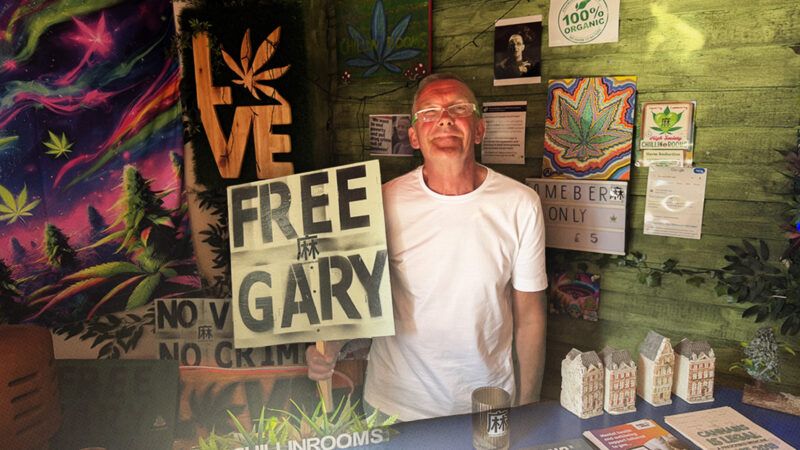
On the night of the World Cup final, televisions glow from almost every pub in Liverpool. But just six bus stops from the city's famous Anfield stadium, Gary Youds has opted not to show the match at his cannabis social club and harm reduction center.
Inside the Chillin' Rooms on Holt Road, about 30 members sit shoulder to shoulder on old church pews, drinking tea beneath a portrait of John Lennon and a sign declaring "ALCOHOL KILLS, CANNABIS CHILLS." Members are smoking spliffs, although a powerful ventilation system keeps the air surprisingly clear. At the far end of the room is a fully equipped stage where local musicians perform most nights. There is no television in sight.
The place could be heaving with soccer fans. But Youds says live sports would ruin the decidedly mellow vibe.
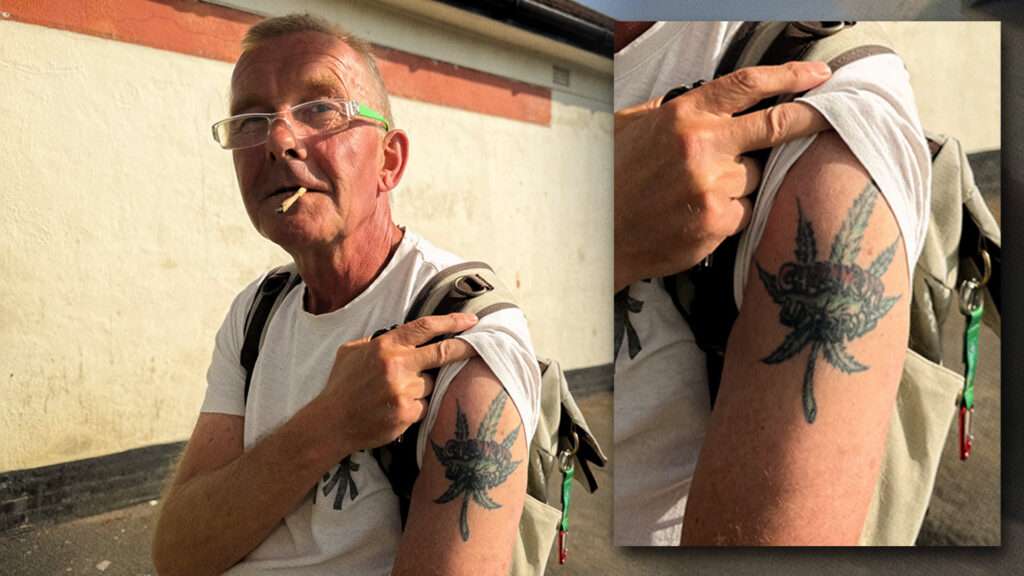
"I don't want no screens in here," says the 56-year-old Liverpudlian, dressed in his customary white T-shirt bearing the Chinese character for cannabis. That same symbol is unmissable outside, on the black metal gates that the police have sawed through more than once. The arms of Youds' glasses are neon green. A "Chillin' Rooms" tattoo peeks from beneath his left sleeve. He is wearing a pair of green Crocs dotted with cannabis-related symbols. He holds a mug of tea in one hand and a joint in the other. "I want people connecting and talking face to face," he adds. "No gimmicks."
It is an unusually strict rule for a man who has spent more than two decades defying the U.K.'s cannabis laws. The father of two, who uses cannabis to manage his spinal arthritis, has been arrested more than 30 times, been convicted 10 times, served four prison sentences, been repeatedly raided by ransacking police, and lost his home. The local newspaper anointed him "The Cannabis Martyr." He sleeps in his elderly mother's living room and claims to live on less than 100 pounds per week (about $135). Yet the club is thriving.
Youds believes the Chillin' Rooms model could be replicated nationally, turning dwindling pubs and vacant shops into alcohol-free cannabis cafés. "This would chill the country out if we had one in every town and city," he says. "It's going to create jobs and put the country back to work. This is a self-seeded community, and it's oven-ready for the whole of the U.K."
A third of Britons admit to having used cannabis, and consumers sustain an illegal market worth billions, none of which reaches the taxman. "We're taking cannabis off the streets, " Youds says. "That's why I'm holding my head up high. There's no empty building in this city that couldn't be repurposed for this industry."
Over four nights at the Chillin' Rooms in July, I meet members from Brazil, Sudan, India, and Australia; young men arriving alone; trans and gay regulars; entrepreneurs, students, scientists, and builders; and elderly patrons greeted by name. Many describe cannabis as medicine. Longtime neighbors tell me the only disturbances they have witnessed come when dozens of police officers descend on the building.
To the authorities, Youds is a persistent criminal. In the Chillin' Rooms, he is treated like an elder statesman. "The congregation is growing," he says. "Jailing me again would just elevate my profile more."
How the Cannabis Café Serves the Community
Until August 3, 2024, entry to the Chillin' Rooms required a referral. There was no Chinese character emblazoned on the gates, and new members generally arrived by word of mouth. That day, as anti-immigration protests spread across Merseyside, the county that contains Liverpool, Youds told his probation officer that "the city needs to chill out" and that his multicultural café could serve as a bastion of racial unity.
It was also his first night without an ankle tag enforcing an evening curfew. He returned to Holt Road, pulled open the gates, and stood outside.
Nobody came in that night. But Youds' doors have remained open from 11 a.m. to 11pm, seven days a week, ever since. The Chillin' Rooms receives hundreds of visitors per week. "Right now, it's the best I've ever seen it," says stuntman Eddie Sarsfield, who suffered serious burns on his arms working on Gladiator II and now has a medical cannabis prescription. He has visited the club since it reopened after the COVID-19 pandemic.
Recently, he says, two visitors from Portugal arrived after asking an AI chatbot where they could smoke cannabis in Liverpool.
"This is a ray of sunshine for the community," Sarsfield adds. "Gary has become a messianic figure. For so long, he's just consistently been a good guy. He's done nothing but say the exact same thing and fight the exact same cause for nearly 25 years. He deserves a break. Everyone knows that."
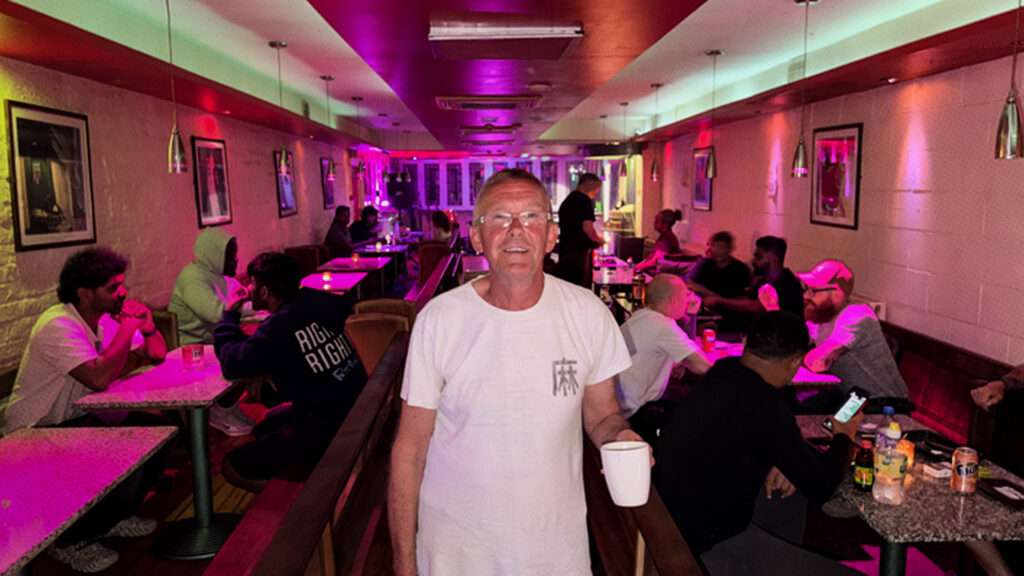
The contrast with the surrounding back streets can be stark. Holt Road sits in a deprived area where bike-riding dealers sell crack to fund their own addictions and women sell sex on nearby Shiel Road. Territorial feuds between Liverpool gangs are common. Yet rivals who might clash elsewhere have made peace inside the Chillin' Rooms. "People are coming here from all different parts of Liverpool," says Lee, who works at the club and does not want to use his real name due to the cannabis laws. "In any other place, you would not get this. I've worked in bars for years—there'd be some sort of fight."
A few months ago, Lee says, members of two rival gangs arrived on the same night and tension began to build. Youds persuaded them to sit down together. "They talked it out and squashed their beef," Lee says. "He's an absolute legend. He's out litter-picking every day. People come from the other end of the country to visit and have a joint with Gary."
Members describe the place as an urban oasis: part café, part community center, part informal clinic. People with epilepsy, Parkinson's disease, and chronic pain come through its gates. Some arrive carrying medical cannabis prescriptions; others remain locked out of that expensive system, which relies almost entirely on private clinics rather than the National Health Service. "They come in shaking," says Lisa, who also works at the Chillin' Rooms and did not want to give her surname. "But once they've had a smoke, they've stopped shaking."
Dave, a disabled member with complex regional pain syndrome, was among the first people in the country to obtain medicinal cannabis flower legally and has driven more than an hour with his wife from Cheshire to visit the Chillin' Rooms. "People would be at home consuming their medication alone, but here we can connect with each other," he says. Before he discovered that cannabis abates his pain, he recalls, he was a "morphine zombie."
"I was a drooling mess," Dave says. "I had to be maintained 100 percent of the time. I was on morphine and fentanyl and couldn't string a sentence together. But now I can contribute." He spends around 1,000 pounds a month (about $1,350) for enough cannabis to manage his condition, consuming the plant four times a day. But obtaining cannabis legally has not stopped patients nationwide from being harassed by police, arrested, and taken to court.
Dave's neighbors have reported him over the smell, and police have repeatedly visited his home, arriving in three cars on one occasion. "I was in the kitchen having my medication, and the copper put his foot in the door and tried to walk into our house," he says. "My son asked him, 'Do you think fentanyl and morphine's safe just because it's prescribed by your G.P.?' The copper did not know what to say."
Others say the club has helped them stop drinking. One member, a lifelong alcoholic in his early 70s, tells me he gradually lost the urge to visit the pub after he began spending time here. For him and many others, the Chillin' Rooms offers the familiarity and companionship of a local bar without the alcohol, aggression, or pressure to keep spending money. "This is my pub now," he says.
On busy evenings, the Chillin' Rooms becomes a neighborhood music venue with up to 100 people filling the pews. Youds says one of his greatest pleasures is watching musicians rehearse during the week and gradually perfect their performances, which often reference the café's caretaker. "He ain't a criminal or gangster / He's just a cannabis martyr / To be free, in what will be," sings one local artist.
"We hate the raids, but they just bring us closer together," Lisa tells me. She helped organize protests against Youds' imprisonment outside court, where musicians performed beneath "Free Gary" banners. "He's giving us community," she adds. "You can just come here and play. You never know what's going to happen." She compares it to The Cavern Club, the Liverpool nightclub made famous by the Beatles.
The party came to a screeching halt on February 18, when police raided the Chillin' Rooms on a packed night right as a band was preparing to play. Members were ordered to put their hands on the tables while officers searched the building. Youds was led away to prison, and the evening abruptly ended. "About 30 officers flooded into the place," Youds recalls. "I told them in the interview that [medical] cannabis is legal and I'm looking forward to getting in front of a jury." According to a police report, he told officers, "Cannabis isn't a drug; it's a flower."
After pleading guilty to permitting his premises to be used for smoking cannabis, Youds was released on April 28. He reopened the Chillin' Rooms yet again a month later.
The Story of U.K. Weed Legalization—and Youds' First Arrest
Back in 2004, when Youds first attempted to open the Chillin' Rooms legally, a police officer appeared at the licensing hearing to oppose his application. Youds had remortgaged his home to spend 60,000 pounds (almost $81,800) transforming a derelict former taxi office on Holt Road into a private members' club for weed smokers. Inspired after attending a 2002 cannabis conference in Liverpool called "Shaping a New Agenda," held months after the government had announced plans to downgrade cannabis from a Class B to a Class C drug, Youds fitted a ventilation system into the premises, kitted it out with fire alarms, and installed a kitchen and toilets.
Youds hoped the change in the law, which reduced penalties for cannabis possession, meant police would ease their enforcement approach. Around the same time, the U.K.'s first cannabis social clubs, including Quantum Leaf in Worthing and the Dutch Experience in Stockport, popped up elsewhere.
Youds applied to the local council for a license, hoping that Britain's then-softening approach to cannabis might afford him some room to maneuver. He passed a fire inspection, and his premises were deemed structurally sound, but officials rejected the application. His prospective members even petitioned the mayor, underlining Youds' desire to pay taxes, but their pleas fell on deaf ears.
In early March 2005, at 4:20 p.m., Youds opened his doors anyway. Within weeks, the club had amassed 400 members and won the approval of the local residents association. Not one neighbor submitted an official complaint, according to local news reports.
In late March, however, a police officer stumbled upon the establishment during his rounds. "It was just a bobby on the beat who walked in," says Youds. "He was so startled. He couldn't believe what was going on, like it was a coffeeshop."
A conditional discharge did not stop Youds from continuing to operate the Chillin' Rooms. That April, a police Land Rover allegedly ripped the metal gates off; scores of officers from the newly formed Matrix Unit, created to tackle gun crime, streamed into the café, shouting at members to freeze. Youds says everyone cooperated.
In a front-page Liverpool Echo story after that raid, Youds insisted: "We are doing nothing wrong. All we want is tolerance." Police said he was supplying cannabis, but Youds said his premises were used only for consuming the plant, adding that he had a zero-tolerance policy regarding alcohol and other drugs. "I just want to be left alone to open a business," he told the BBC. "And if the police don't put me in prison, I will come here and open up every day."
Merseyside police took that threat seriously. They distributed a 33-page operational guide to officers, offering advice on how to deal with cannabis cafés. "It is essential that a cannabis café is prevented from opening or is successfully policed, closed and prosecuted if one does open," it said. The guide recommended "disruption tactics," including visits by council and fire officials looking for health, hygiene, or safety violations.
A year later, in April 2006, Youds was sentenced to 12 months in prison, having pleaded guilty to two offenses of cultivating cannabis. As a result of that case, a café bank account with more than 13,000 pounds (over $17,500) was later frozen. "Either you wanted to martyr yourself in the cause of the pro-cannabis lobby or you wanted to set up a café, a deliberate and blatant challenge to the law," Judge Brian Lewis told Youds before consigning him to jail.
The judge had intended "martyr" as a rebuke. For Youds, it would be something closer to a calling.
Gary Youds Waits a Decade Before Reopening the Cafe
Youds served three uneventful months behind bars, partly at the notoriously ill-kept, Victorian-era Walton prison. Not being there for important family moments hurt the most. "I missed my oldest son's first day walking," he says. "I feel really guilty."
But when Youds emerged from prison in July 2006, he was not ready to immediately reopen the Chillin' Rooms. For nearly a decade, the cannabis martyr disappeared from public view. He worked a minimum-wage job maintaining a hotel, spending much of his time gardening, and focused on raising his young son.
During Youds' decade in the wilderness, Britain's brief liberal turn on cannabis went into reverse. In 2009, the government returned cannabis to Class B status against the advice of its chief drug adviser, David Nutt, whom it subsequently dismissed. Police raided the other cannabis cafés.
Yet elsewhere, legalization was moving from stoner fantasy to public policy. When Colorado and Washington state legalized recreational cannabis in 2012, Youds began contemplating a return. "I felt it was the right time," he says.
Youds got the place back up to scratch and reopened in early 2015. "I didn't make any fanfare about it," he says. "I invited a few friends, and before you know it, it's entirely functional and we're having the time of our life." Patrons could again "stay medicated and live the dream," as one poster advised. But in June 2015, the police came again.
"There were all these police cars sealing the roads," Youds says. "It was surreal." He was outside the gates when dozens of officers barged in. "About 30 officers dressed like Robocops jumped out the back of this van," he recalls. "It was 'Go, go, go.' They were running in with helmets and axes, smashing all my doors in. I was saying, 'There's no one even in there. Why are you smashing my doors in?'"
The police claimed to have discovered 11,000 pounds worth of cannabis (almost $15,000), plus grinders and bongs. In court in January 2017, Youds told the prosecuting barrister that the estimated value of what was found was vastly exaggerated: "I said it'd fit in a seven-inch-square margarine tub, so don't tell me about '11,000 pounds worth of weed.'" Despite his protests, Youds was sentenced to nine months in jail, away from his two children, then aged six and 12.
The Walton prison was worse when he returned. Routine drug testing had sharply reduced cannabis use in prison, but more-dangerous synthetic cannabinoids were widespread. "Spice" dealers came to Youds' door daily, and he saw inmates overdose across the wing. Because batches varied wildly in quality and concentration, dealers made vulnerable inmates test them to see whether they collapsed.
Conditions at Walton caused a national scandal during Youds' five-month stay. He plugged gaps in his windowless cell's brickwork with pieces of sponge, and his toilet regularly broke. "It was the worst time of my life," he says. "I feared for my life every day. I was scared to leave my cell. There was so much violence, and so many overdoses."
Gary Youds Gets Arrested Again—and Again and Again and Again and
Prison was supposed to put out Youds' campaign, but he emerged more convinced that his moral compass was pointing in the right direction. "The people here are my jury," he tells me at the café one night. "There's always at least 12, and not one is standing up and saying this isn't acceptable." And unlike in many pubs, "there's no one snorting white in the toilets."
After reopening in the second half of 2017, Youds sought support from U.K. Cannabis Social Clubs, an advocacy group that was calling out the treatment of cannabis growers. At one meeting in Leicester, he met James Tisdale, a terminal cancer patient and successful businessman, and his wife, Joanna Drinkwater.
Youds was soon ferrying cannabis oil to Tisdale in Birmingham. He made the train journey at least three times—and he refused any payment, Drinkwater later told a court. But the police were still targeting Youds. By his count, he was arrested nine times in 2019.
One of the raids has lived long in his clientele's memory. "We were sitting here and Gary said, 'This place, I'll never get raided again,'" says J.J., a musician who has been a member since 2015. "And then literally before he finished the word raided, two coppers came through the fire exit and put him straight in headlock and got him on the floor. They started to punch him and all sorts."
Youds steadfastly continued reopening and providing cannabis oil to Tisdale. "I'd provided it to him three or four times," Youds tells me as we stand outside Liverpool Lime Street station. "He was getting much better. He had his appetite back, and he was sleeping well."
On October 24, 2020, Youds entered Liverpool Lime Street carrying the oil, but a group of undercover police officers nabbed him before he could board the train. That led to a new set of charges.
After Youds reopened the Chillin' Rooms in 2021 after a pandemic pause, and still facing charges over the oil, he suffered the most violent raid yet: "They carried me out, smashed my glasses, scraped all my face on the floor, and pepper-sprayed me at the same time. It fucking terrified me, honest to God."
Upon inspecting Youds' home, officers found six "very large and well-maintained" cannabis plants up to six feet tall and three feet wide, describing them as "some of the largest plants [they] had ever seen." Youds said after his arrest that he was "growing the fruits of the earth for medicinal purposes" and was "saving the city by producing the fruits of the earth for the people."
Drinkwater testified at the trial that Youds' cannabis oil "is well known as one of the best in the U.K." and that he had "helped many people," adding: "There was no exchange of money or anything. Gary just wanted to help us, and we are eternally grateful for that help."
Even though Britain had legalized prescribed medical cannabis in November 2018, Youds was given a three-year prison sentence in February 2023. "I didn't even have a bag packed," he recalls. "I spent the first three weeks in prison in complete shock."
Will the U.K. Ever Legalize Weed?
Youds was released from his longest stint inside after a year, but prison still had not reformed him. "All revolutionaries go to jail," Youds told Vice upon his release. He reopened in 2024 on April 20, the most important day in the stoner calendar, a few months before he cast the gates open for all passersby during the riots. His incarceration "made me want to fight for the people inside," he says. "Hopefully I'm the one who can bring the change and put things right."
Youds was recently in court, defiantly demanding the return of 1,000 pounds in cash (about $1,350) that police had seized during the February raid, which he says had accumulated from the 5-pound entrance fees members pay ($6.75). He will be back in court on November 25. "The policeman was shocked that I'd turned up as I'd just come out of jail," Youds says. "I told him it was a real business."
Youds believes his criminal record cost him the home he bought on the other side of Anfield back in 2000. Unable to obtain a loan to repay his mortgage, he was forced to sell it in March. "No one lent me the money," he says outside his old home, where former neighbors greet him warmly near a towering palm tree that he planted in 2005. "I was on some kind of list. They mention your convictions. I went to court at least 10 times to get the repossession order canceled or stayed. I was devastated. I was going to live in that house for the rest of my life." Cannabis convictions, he says, "are holding so many people back."
When Youds got out of prison earlier this year, he moved in with his 80-year-old mother, Joan Youds, who had a stroke four years ago and now requires care. "He's just obsessed with that cannabis club," she tells me in her living room, opposite her son's single bed, as he prepares her lunch. "They'll bash it, knock it all to pieces—he'll start again."
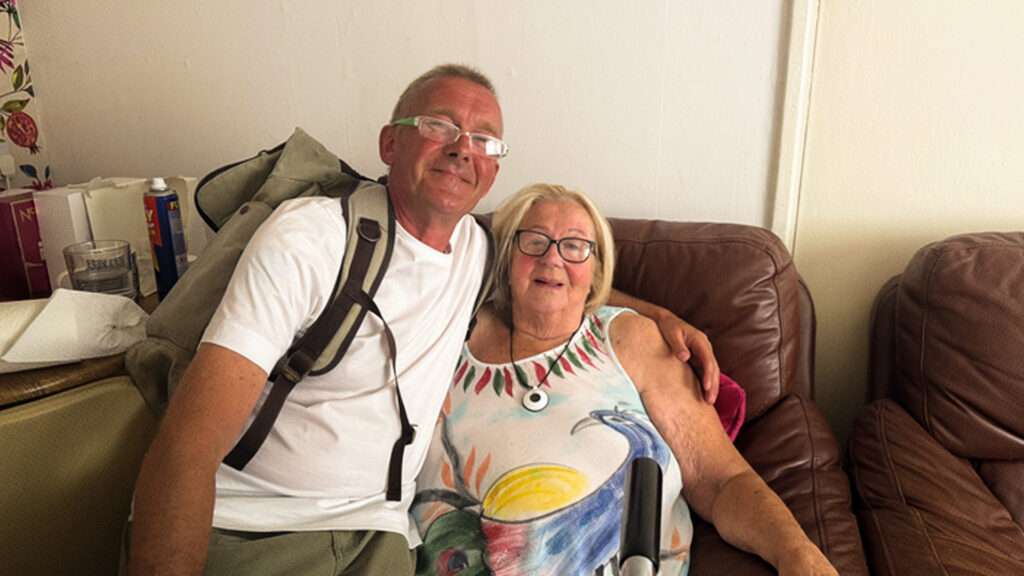
He is "a son in a million," she adds. "Potheads are just calm, peaceful. They just want to be left alone." Does she believe he will ever give it up? "He'll never stop," she replies.
Back in the club on my final afternoon, I hear a musician playing Bob Marley's "Redemption Song" while Youds tells me he sees his defiance as distinctly Liverpudlian. His family has lived for generations in a port city shaped by Irish migration, deindustrialization, and a distrust of distant authority. "We stand up to tyranny," he says. "If good men do nothing, tyranny prospers."
Youds hopes the new prime minister, the Labour Party's Andy Burnham, a fellow 56-year-old Merseysider, will be the man to liberate him once and for all, as figures like Virgin founder Richard Branson lobby for marijuana reform. "The community needs this right now," Youds says. "There's millions of us, and we want change. They should just let it be. The Chillin' Rooms is what the future looks like the day after the drug war. This is where the drug war ended. I think Andy is the man."
One Labour insider recently told me he is not optimistic that drug policy reform will be a priority for Burnham. But Youds has received support from the pro-legalization Green Party, which won more than 6 percent of the vote in the 2024 general election. "We have long supported the social club model championed by Gary Youds," a spokesperson for the Green Party's drug policy working group tells me, "and strongly believe this model will provide a necessary framework to engage all community stakeholders from the bottom up."
The cannabis social club model that Youds operates does not diverge from what is increasingly a norm in some parts of Europe, most notably Barcelona, says Kojo Koram, a professor of law and political economy at Loughborough University, and the author of The Next Fix: The Winners and Losers in the Future of Drugs. "Part of the value for lawmakers is that they see becoming a member of a social club creates a much more supportive environment if someone does find themselves struggling with their use of the plant, or other issues in life."
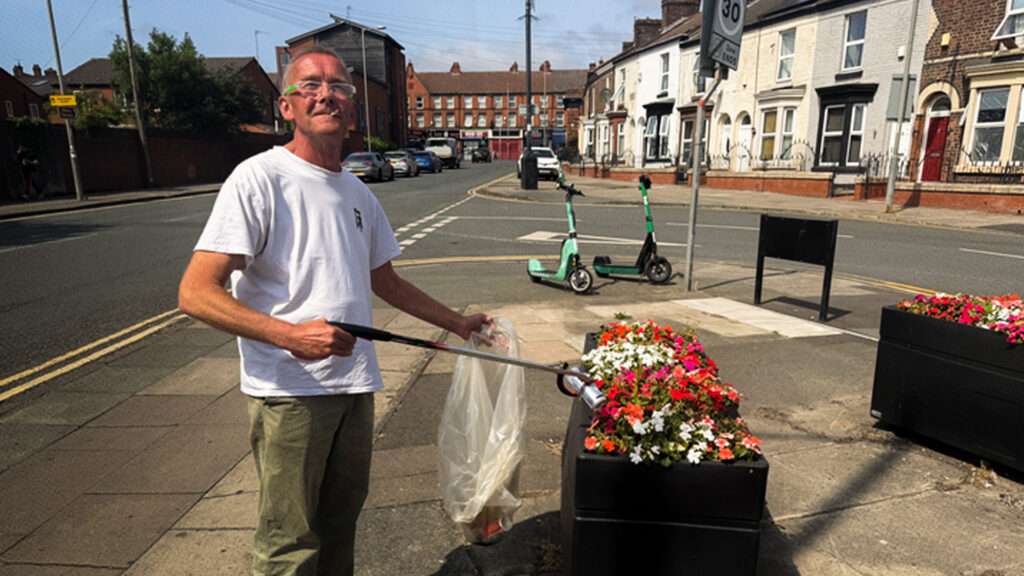
Youds takes me on his daily litter-picking round. "I'm not anti-establishment," he tells me as he fills a garbage sack. "I'm a model citizen. I pick my litter up. I get the bus. I don't do anything wrong. There are just laws that are wrong. I'm harmonizing with nature." He picks up an empty can of Red Bull from a flower bed. "The revolution will be cultivated," he says, dropping the can into the sack. "I'm sowing the seeds."
Does Youds worry about returning to prison and again leaving his ailing mother and his two sons, now 21 and 16? "I think the war is over," he says. "You can't be extinguished if you're working with nature."
With that, he dumps his second sack in a refuse bin and returns to the Chillin' Rooms, where he rolls a joint.