The Best Way To Keep Data Centers From Driving Up Electricity Costs
Don't impose a moratorium. Produce more energy.
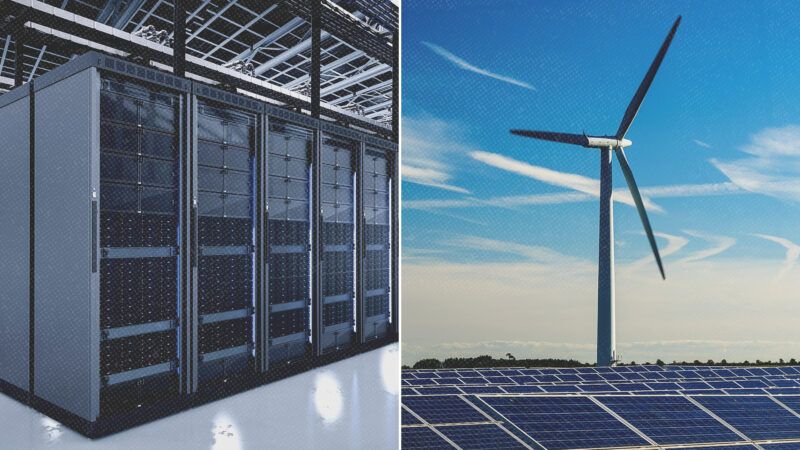
Public backlash to data centers is growing. About 70 percent of Americans would not want a new data center built near their homes, according to a new poll from Heatmap News. A majority, 55 percent, said they would "strongly oppose" it.
The same poll asked respondents why they thought electricity prices were rising, and 53 percent—up from 28 percent last August—blamed "the construction of new data centers." Fear over data centers' energy use, and to a lesser extent water use, is driving a broad backlash to their buildout.
While it's simply untrue that any big data center anywhere is consuming a dangerous amount of local drinking water (or that the total sum of AI infrastructure is consuming much at all), there is some legitimate debate as to whether these facilities are driving up utility bills. In a recent review of state-level data on electricity prices, the Institute for Energy Research found "a slightly positive but still statistically insignificant relationship between data centers and fast price increases." Often, new data centers are built at the same time as new power plants—so prices for nearby consumers can even fall. But in some cases, prices have gone up: PJM Interconnection, the country's largest grid operator, has put some of the blame for a 76 percent price hike in the first quarter of 2026 on "issues associated with data center load."
Whether the phenomenon is more widespread remains murky. Regardless, lawmakers across the country have seized on the public's fears and are proposing sweeping new restrictions on these facilities.
At the federal level, Sen. Bernie Sanders (I–Vt.) has sponsored a bill imposing a total "moratorium" on data center construction nationwide. Last week, New York lawmakers passed their own year-long moratorium. Other states are considering other ways to tighten restrictions—North Carolina, for example, which is advancing a bill that would impose new regulations and reviews on data center construction.
While elected officials say these measures are necessary to stop rising electricity costs, they're likely to result in less overall economic activity and fewer jobs. The costs associated with new data centers—which can bring thousands of jobs and millions of dollars in revenue to nearby communities—could be better kept under control simply by making it easier for power companies to meet demand.
That's the approach that lawmakers in Ohio and New Hampshire have taken. Each state has implemented a policy framework called "consumer-regulated energy" (CRE) to allow the owners of data centers (and other major industrial facilities) to buy their power from third-party providers instead of the centralized grid.
Not only does that keep any given facility's energy needs isolated from the rest of the grid—which, according to a Cato Institute report, means that big data centers can be built and powered at "zero cost to taxpayers and ratepayers"—it also speeds up their construction tremendously. When data centers can source their power from a third party, they bypass much of the decade's worth of infrastructure buildout that's necessary to connect to the grid.
A CRE-adjacent framework could soon be implemented nationwide. Earlier this year, Sen. Tom Cotton (R–Ark.) introduced the DATA Act, which would exempt off-grid data centers from federal regulations, making the entire process faster and cheaper.
If data center construction is increasing electricity bills, the best solution isn't a knee-jerk ban on the industry. It's common-sense reforms that make it possible for everyone, and every data center, to get the power they need.