
#Addiction
Plus: Meta and Google found liable, what the verdict means, an OnlyFans-style campaign website, and more...
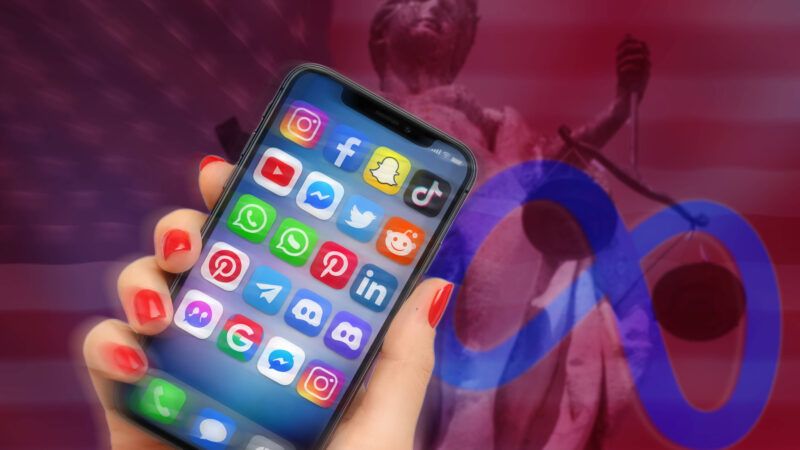
It begins: anyone who's ever spent too much time on social media—or simply suffered any setbacks while simultaneously having social media accounts—can claim "addiction" and reasonably expect a big payout. A landmark verdict in California has paved the way for that, and worse.
After nearly two months of trial, a jury on Wednesday decided that Meta and Google are liable—to the tune of $6 million—for the psychological troubles plaguing now 20-year-old Kaley G.M.
The Reason Roundup Newsletter by Liz Wolfe Liz and Reason help you make sense of the day's news every morning.
In a civil suit, Kaley claimed that addiction to YouTube and other online platforms when she was a minor led to depression, anxiety, and body dysmorphia. She originally sued four tech companies—Google, Meta, TikTok, and Snap—but the latter two settled before trial.
Her case is part of a consolidated case representing nearly 2,500 plaintiffs, and the first to come before a jury. "The trial's outcome could help spur a global settlement, though eight more bellwether trials are being prepared, with the next one scheduled to start this summer," notes Courthouse News Service.
Absolving parents (and ourselves) of blame: The implications of this verdict go way beyond Kaley, and even way beyond those thousands of current plaintiffs. This case—and one decided earlier this week in New Mexico—represent a legal and conceptual paradigm shift in how we consider social media.
Many people seem (or want) to believe that it's simply not possible to exercise restraint when it comes to smartphones and social media, or that parents bear any responsibility for controlling their kids' use and exposure. The shift showcases an embrace of powerlessness and corporate blame when it comes to tech habits, and a rejection of ideas like personal and parental responsibility. We've imbued these platforms with an almost magical status, while expecting their proprietors to perform superhuman feats of saving people from themselves.
In this case, Kaley testified to heavy use of social media from a young age. But she also suffered from school and home life problems and was exposed to domestic violence at a young age. To say that social media caused her problems is to rule out significant life stressors that can cause adolescents pain. It's to assume a causality that goes one way (heavy social media causes issues) when it could just as likely go the other way (girl turns to too much social media in the face of problems at home and school). It's to assign a massive and mystical power to smartphones and corporations, while utterly rejecting more mundane vectors or responsibility.
Her mother beat her, abused her, weighed her daily, called her fat, her sister tried to take her own life and her father abandoned her. Yet none of that apparently led to this poor girl's anxiety, depression and body dysmorphia, it was lip gloss review videos on youtube https://t.co/g8mBUwUym2
— Taylor Lorenz (@TaylorLorenz) March 25, 2026
Tort lawyers rejoice: This could be a gold rush for personal injury lawyers. Bad personal choices? Poor parenting? Material factors? Nah—must be the Reels!
"Cases like this will likely unleash a trial lawyer bonanza via a much broader wave of (mostly frivolous) lawsuits," predicts R Street Institute policy analyst Adam Thierer. "Every tort lawyer in America is probably thinking about ripping down their 'Been in a Crash?' billboards right now and replacing them with 'Addicted to the Internet?' signs."
The Wall Street Journal editorial board has a similar take. "Using a novel product liability theory to shake down companies won't help young people and isn't a good way to make law," it says.
Kaley's lawyers pushed their product liability theory, in part, by arguing that Meta and Google designed their products to be engaging and failed to design them in a way that would limit excessive use by teenagers. But using this as a standard for negligence is a very slippery slope. Social media companies are far from unique in trying to make products that people want to use or to showcase content that people want to consume. Nor are they unique in not actively working to prevent problematic consumption.
The addiction framework on display here could be used against food companies, streaming services, TV networks, game developers, porn producers, fitness programs, and a lot more.
Treating speech as "product": These cases may be good for tort lawyers, but they're a very bad omen for the open internet and free speech.
If social media platforms are legally liable for all the troubles of adolescence, it's not long before banning teens or severely limiting their use becomes the only sensible response. And that means checking IDs or requiring biometric identification for all users—the end of anonymity online.
If social media platforms are legally liable for any and all vague harms that someone could blame on their content, serious crackdowns on all sorts of material could become warranted. That means speech around controversial issues, diet and fitness, mental health topics, sexuality, and so much more will be suppressed.
And if social media platforms are a "product," rather than a venue for speech, we open the way for so much more government regulation of what can and cannot be said online.
"Many are cheering the [California and New Mexico] decisions, likening them to landmark lawsuits against Big Tobacco," notes Ari Cohn of the Foundation for Individual Rights and Expression (FIRE) on X. But "social media platforms and the information, ideas, and entertainment they connect people to aren't tangible items that inherently and invariably have physical impacts on the human body" and "the minute we start treating speech as if it were just another physical product is the minute we hand the government the power to decide what we can read, watch, and say."
As Will points out below, the president of the United States is in court RIGHT NOW trying to recast speech as a product in order to sidestep the strictures of the First Amendment and punish his perceived critics.
Beware this dangerous path! https://t.co/z53bJSDizs
— Nico Perrino (@NicoPerrino) March 25, 2026
Scenes from Cincinnati: An Ohio Congressional candidate has visually modeled her campaign website after OnlyFans, after her Republican primary opponent, Rep. Dave Joyce, reportedly criticized her for visiting a nude beach. Niki Frenchko's website features nude images discreetly covered in spots with campaign text, as well as the wacky mix of big government and limited government proposals that's come to characterize populist candidates—abolishing property taxes, protecting 2nd Amendment rights, and opposing AI data centers are all on the agenda. Frenchko told The Enquirer she was a "Thomas Massie-style Republican," and one of her campaign planks relates to releasing the Epstein files.
Quick Hits
- "Iran has bombed U.S. bases across the Middle East in retaliation for the U.S.-Israeli war, forcing many American troops to relocate to hotels and office spaces throughout the region," The New York Times reports. "So now much of the land-based military is, in essence, fighting the war while working remotely."
- Reason's Damon Root explains this week's Supreme Court decision in Cox Communications v. Sony Music Entertainment. Essentially, Sony argued that "if Cox Communications was aware of the fact that certain of its paying users were repeat offenders who routinely used the ISP to illegally download copyrighted materials, such as songs or movies, and Cox failed to cut off the internet access of those repeat offenders," then Cox was guilty of violating federal copyright law, Root explains. The Supreme Court (thankfully) rejected that argument.
- Trump plans to meet Chinese President Xi Jinping in Beijing in May.
- "Within 24 hours of being taken into custody by Immigration and Customs Enforcement (ICE), former Afghan Special Forces soldier Mohommad Nazeer Paktyawal was dead," writes Beth Bailey at Reason. "While ICE seeks to paint the father of six as a criminal, advocates working with Afghan refugees say his death was a preventable tragedy."
- Against the smartphone theory of everything: "Today, billions of people look at their phones and see the whole world. But some theorists look at the whole world and see only phones," writes Derek Thompson at The Argument.
